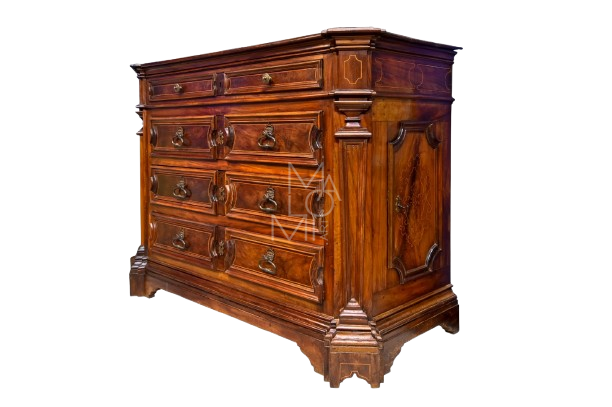
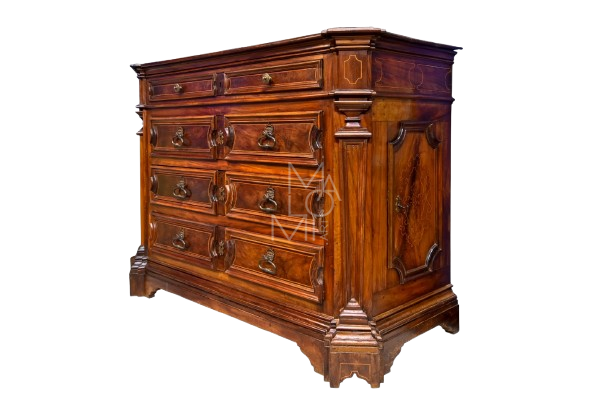
An Italian seventeenth-century walnut baroque canterano with concealed side-access doors
- Object Typology: Baroque canterano (monumental high-period chest of drawers) with integrated secret compartments.
- Date / Period: Late 17th century (Seicento).
- Geographical Origin: Central-Southern Italy (Calabrian manufacture under Umbrian and Roman stylistic influence).
- Primary and Secondary Woods: Solid domestic walnut (Juglans regia); secondary core timbers in poplar (Populus) and fir (Abies).
- Surface Techniques: Sawn blond walnut veneering (lastronatura), book-matched figured walnut burl reserves (radica), maple stringing (filettatura), and applied owl's-beak (becco di civetta) architectural moldings.
- Metalwork and Mounts: Lost-wax cast bronze drawer pulls executed as high-relief theatrical mascarons, cold-chased with a burin; foliate shield escutcheons; internal structural hardware in hand-forged wrought iron.
- Structural Engineering: 45-degree canted corner posts incorporating concealed, flush-fitting hinged doors opening to reveal shelved security repositories.
- Iconographic Themes: Dionysiac counts (Silenus with grape clusters), apotropaic gorgoneia with intertwined serpents (anti-envy guard mounts), winged sphinxes and chimeras (emblems of the riddle and the guarded secret).
- Condition Report: Excellent state of preservation overall; original high-period surface patina ("skin") intact; minor historic wear and shrinkage cracks consistent with age and material stability.
- Approximate Dimensions: 145 x 105 x 72 cm.
The baroque canterano in high-period interior furnishing: a typological, structural, and iconographic analysis of an exemplar with Side-access doors
introduction
Within the landscape of seventeenth-century Italian furniture, the transition from static, horizontally oriented storage vessels—namely the Renaissance cassone—to more complex, dynamic, and functional structures represents one of the most significant trajectories in the history of the decorative arts. Prominent among these emerging typologies is the canterano (or cantarano), a term historically rooted in Central and Northern Italy to designate the monumental chest of superimposed drawers.
The present essay aims to examine the formal, structural, and regional characteristics of a rare and monumental Baroque exemplar. This piece draws profoundly from Central-Southern Italian models, exhibiting marked affinities with Umbrian and Roman cabinetmaking workshops, even though archival research identifies its specific manufacture within the highly accomplished cabinetmaking traditions of late seventeenth-century Calabria. The work distinguishes itself not only through the architectural articulation of its facade but also by virtue of a peculiar and sophisticated functional solution: the presence of concealed hinged doors on its canted corners. These doors transform the case piece into a triple-access repository, achieving an admirable synthesis of Baroque ostentation and furniture engineering.
- Genesis of form and architectural syntax in the seventeenth century
The case piece under analysis abandons the rigid, box-like containment of the early Renaissance to embrace a fundamentally architectural and monumental conception. In the seventeenth century, furniture was no longer a mere utilitarian accessory; rather, it became a microcosm that dialogued directly with the proportions of patrician salons and Baroque interior architecture.
The morphology of the canterano develops vertically from a majestic overhanging top plank fashioned from precious timber—typically cut from a single, massive slab of walnut—which crowns a sub-top frieze band housing narrower drawers intended for writing materials. Beneath this register sits the primary block of large, superimposed central drawers. This volumetric composition is rhythmically punctuated along the sides by projecting molded pilasters and retractable lesenes. These elements are integrated into forty-five-degree canted corners that serve as a visual hinge transitioning to the short sides of the case piece. The entire structure finds its logical and physical resolution in a stately, molded plinth base that anchors the furniture to the floor of the patrician estate.
The facade is articulated through a rigorous, symmetrical partition. In the sub-top frieze, the drawers are framed by geometric line inlays and projecting moldings. Within the central block, the wooden surface is animated by the deep relief of applied moldings, which form geometric reserve panels designed to accentuate the play of chiaroscuro under natural light. The stanchions and corner pilasters are not merely simple right-angle joints but complex structural elements enriched with faux pillars, projecting lesenes, and stylized capitals. This volumetric treatment breaks up the massive bulk of the case piece, imparting vertical thrust and dynamism.
- The engineering of space: side doors within the canted corners
The element of paramount historical, artistic, and structural interest resides in the configuration of the flanks and corner posts. The piece features a forty-five-degree chamfer that unites the facade with the deep side panels. Far from being a purely aesthetic device implemented to soften the angularity of the carcase, this configuration conceals a highly sophisticated functional innovation: the lateral panels open on hinges to reveal spacious, secret internal compartments fitted with shelving.
The incorporation of doors on the flanks addresses a dual necessity. On one hand, it rationalizes the deep internal volume. In large-scale chests of drawers, which frequently exceed seventy centimeters in depth, the full extension of a heavily laden drawer exerted severe mechanical strain on the wooden runners of the period. The side-access configuration exploits the dead spaces adjacent to the central drawers without compromising the overall structural stability of the carcase. On the other hand, it aligns perfectly with the Baroque "culture of secrecy". Baroque furniture delights in astonishing, concealing, and revealing. The side doors, masterfully integrated into the decorative paneling and devoid of conspicuous pulls on the main facade, functioned as genuine security compartments for safeguarding confidential documents, valuables, or domestic silver. The door panels are adorned with elaborate, reserve-inlaid designs that effectively camouflage the junction line of the leaf within the broader ornamental schema.
- Material selection, cabinetmaking, and decorative techniques
The visual magnificence of the work is intimately bound to the quality of the raw materials employed and the mastery of finishing techniques practiced in seventeenth-century workshops. Domestic walnut (Juglans regia) is utilized in its solid form (massello) for both the structural framework and the drawer bottoms, as well as for the majestic top plank. The top is frequently harvested from a single, monumental log to showcase the natural flame of the grain to its best advantage.
The facade and lateral panels display a masterful application of thick, hand-sawn veneers (lastronatura) in blond walnut, contrasted chromatically with choice burl wood reserves (radica). The central panels of the drawers are bounded by moldings shaped in an owl's-beak (becco di civetta) or deep-frieze profile, which are highly representative of high-period Italian cabinetmaking. Delicate geometric stringing (filettatura) in contrasting timbers, such as maple or cherry, traces rectangular and rhomboidal outlines that embellish the sub-top frieze and outer contours, establishing a refined geometric grid that accentuates the underlying Baroque architectural discipline.
- Mounts and ironwork: function and symbol
In the study of high-period furniture, metalwork constitutes a fundamental diagnostic indicator for chronology and the sociological attribution of patronage. The mounts of this canterano testify to an exceptional level of craftsmanship. The pendant or bell-shaped pulls are cast in bronze or brass using the lost-wax method, depicting anthropomorphic or zoomorphic motifs in the form of Baroque mascarons. These elements heighten the plastic quality of the facade and serve as visual anchors across the drawer panels.
Similarly, the escutcheons and lock plates are shaped into escutcheon shields or foliate motifs, secured firmly with hand-riveted nails. They protect the timber from the friction of the key while celebrating the security of the case piece as a domestic vault. Finally, the internal ironwork and hinges—consisting of hot-forged wrought-iron straps concealed within the lateral doors—ensure the smooth rotation and support of the heavy side panels, sustaining substantial structural loads without warping.
The plastic-metallic apparatus applied to the facade of the canterano constitutes a vital semantic axis. An hermeneutic analysis of the bronzes reveals how seventeenth-century cabinetmakers and metalsmiths conceived these components not as mere utilitarian accessories, but as eloquent, speaking elements. They integrate the furniture into the complex web of symbols, allegories, and theatrical conceits that define the philosophical and artistic milieu of the Italian Baroque.
The selection of anthropomorphic and zoomorphic mascarons is rooted in the Renaissance revival of grottesche decoration. Over the course of the seventeenth century, however, this motif underwent a transformation toward volumetric and dramatic expression. The two-dimensional, graphic mascaron of the sixteenth century evolved into a projecting sculpture characterized by pronounced chiaroscuro naturalism. This iconographic evolution witnessed a shift from linear symmetry and planarity toward bold high-relief and full-round modeling. Here, torsion, asymmetry, and kinetic energy supplanted pure ornamentation in favor of a profound theatrical, apotropaic, and psychological potency.
The bronzes of the canterano engage in a direct dialogue with coeval monumental sculpture in Rome and Central Italy. They are profoundly informed by the dissemination of graphic pattern books produced by architects and designers, in which the human countenance is distorted to express extreme motions of the soul (moti dell'animo) or to evoke the realm of myth and Ovidian metamorphosis. Across the drawer panels and lock escutcheons, three primary iconographic registers alternate, each carrying a precise allegorical message.
The first register is occupied by Silenus and dionysiac deities, symbolizing the triumph of nature. Visually, these present as bearded male visages with coarse features, snub noses, and crowns of vine leaves, ivy, or grape clusters that merge into the hair. They are frequently depicted with mouths agape in an enigmatic laugh or a silent shout. They represent primordial instinct, the generative force of the earth, and abundance. The presence of vegetal elements intertwined with human features underscores the Baroque concept of perpetual metamorphosis, wherein the boundaries between the animal, vegetable, and mineral kingdoms (the bronze itself) become fluid and indeterminate.
The second register welcomes the apotropaic mascaron and the personification of Envy, charged with protecting the contents within. These display countenances contorted in scowling grimaces, featuring knit brows, deep-set orbits, and occasionally attributes recalling intertwined serpents or bifurcated tongues. These mascarons inherit the classical function of Roman gorgoneia. Placed across the drawers and near the locks, they operate as apotropaic devices. Their spiritual and psychological function was to ward off Envy, the evil eye, and, more practically, intruders. The case piece, as a repository of precious goods and private documents, displays bronze guardians that visually admonish anyone attempting to violate its secrecy.
The third register introduces the Sphinx and the Chimera, allegories of the enigma and the custody of secrets. These hybrid creatures fuse idealized feminine features with raptor wings or leonine bodies, often positioned at the corner posts or upon the escutcheons of the sub-top drawers. The sphinx is, par excellence, the emblem of the guarded secret and the riddle. Its introduction into the hardware is a sophisticated intellectual allusion, particularly fitting for a canterano equipped with secret compartments within its canted flanks. It exalts the cryptic nature of the furniture, celebrating the intellect of the owner, who alone is capable of unraveling the enigma to access the hidden chambers.
The executive excellence of these handles lies in their capacity to merge mechanical utility with figurative coherence. For instance, the agape mouths or lateral loops house the moving pivot of the drop pull, making the mechanical traction appear to emanate directly from the jaws of the creature, thereby emphasizing the physical prowess of the mythological figure. Likewise, the expansive, flowing hair and vegetal beards spread outward horizontally to conceal the structural nails or through-bolts. This gives the impression that the bronze is germinating directly from the organic surface of the walnut substrate. Finally, satin-finished surfaces alternate with polished highlights; the reliefs are burnished through handling over time, while the recesses accumulate a deep patina. This configuration maximizes the chiaroscuro effect, creating a sharp chromatic counterpoint to the warm undertones of the veneered walnut.
In the seventeenth century, the act of opening a drawer or approaching a ceremonial piece of furniture engaged a plurality of senses. The observer was captured visually by the perspective play of the moldings and intellectually by the decoding of the mascarons. Upon physical contact, the tactile coldness of the cast bronze contrasted with the warmth of the walnut timber. The mascarons of the hardware thus functioned as mediators between the user and the interior space of the furniture. Through their repertoire of theatrical expressions, they transformed the case piece into a domestic stage in miniature, reflecting the Baroque passion for artifice, illusion, and wonder.
- Seventeenth-century metallurgical techniques: lost-wax casting and the art of chasing
The fabrication of the bronze mounts for this canterano does not represent a simple instance of serial manufacture; rather, it constitutes a miniature application of the identical metallurgical techniques utilized for coeval monumental statuary. The plastic definition and vigor of the mascarons derive from a rigorous metallurgical process. This sequence develops linearly from the initial modeling in clay or wax, passes through plaster piece-molding and the subsequent refining of the wax clone, progresses to the pouring of the molten bronze, moves through blasting or cleaning, and concludes at the workbench with chasing and burnishing operations.
The micro-casting process initiated with the sculptor fashioning a prototype in wax or clay. In the case of repeated elements, a plaster matrix was taken to cast multiple hollow wax models. To these wax models, small wax cylinders—termed sprues or runners—were attached to form the channels for the entry of the molten metal and the escape of gases. Subsequently, the model was invested with a investment core or "tunic" of foundry loam (a mixture of clay, organic binders, and plaster) capable of withstanding extreme thermal shock. The assembly was then baked in a kiln; the wax melted and evacuated outward (hence the term "lost wax"), leaving a millimeter-thin cavity. Into this void was poured molten bronze—an alloy of copper and tin, occasionally enriched with zinc to enhance fluidity—at temperatures approaching 1000 °C.
Once the metal had cooled, the outer investment shell was broken away. This waste-mold technique rendered every piece unique in its finest details, as the raw casting emerged encrusted with flashing and oxidation scales. At this stage, the chaser (cesellatore) intervened, a figure whose intervention determined the ultimate artistic quality of the piece. Utilizing chisels and files, the artisan performed the deflashing to eliminate superfluous casting sprues. Through cold-chasing with a burin (bulino) and miniature steel chisels driven by a lightweight hammer, the craftsman refined the bronze surfaces. This work defined the strands of hair, the pupils of the mascarons, the detailing of the acanthus leaves, and the textured grounds, imparting crisp definition to features that the casting process had left indistinct. Finally, through burnishing and patination, the surfaces were smoothed with abrasive stones or scrapers. The bronze was then subjected to chemical patination or coated with dark lacquers to protect it from oxidation, establishing that profound tonal contrast against the blond warmth of the veneered walnut.
- The circulation of models: a comparative analysis with baroque graphic repertoires
Seventeenth-century metalsmiths and cabinetmakers did not work in isolation; instead, they constantly drew from graphic repertoires and ornament prints that disseminated the inventions of the foremost geniuses of Baroque architecture and sculpture. The mascarons on this canterano demonstrate precise formal consonances with the graphic and plastic corpora of Gian Lorenzo Bernini, Francesco Borromini, and Stefano della Bella.
The impact of Gian Lorenzo Bernini is discernible in the pronounced expressive warmth and psychological intensity of the dionysiac mascarons. Bernini had codified the study of extreme emotional states, as exemplified by his Anima dannata or the sculptural details of his Roman fountains. The metalsmiths appropriated his tendency to render mouths wide open, to deeply pierce the ocular orbits to exploit ambient light, and to model hair as organic, almost liquid masses in perpetual motion, appearing to flow across the wooden substrate.
While Bernini inspires the pathos of the countenances, the influence of Francesco Borromini is recognizable in the geometric-structural articulation of the lock escutcheons and pendant mounts. Borromini frequently integrated anthropomorphic and zoomorphic elements directly into architectural junctures, such as corner cherubim or scrolling cartouches within his capitals and architraves. In the handles of the canterano, this legacy manifests as a seamless fusion between the figurative element of the face and the geometric-functional component of the bracket or fixing plate, where the lines of force within the mascaron accommodate the torque and curvature of the ironwork itself.
The most direct reference for the micro-architecture of these furniture bronzes is found in the suites of etchings by Stefano della Bella, particularly his celebrated repertoires of Raccolte di vasi (Collection of Vases), Cartigli (Cartouches), and Grottesche (Grotesques). Della Bella elevated the taste for the Baroque capriccio to its zenith: his prints display metamorphic figures where human bodies dissolve into bat wings, vegetal tendrils, and marine scrolls. The apotropaic mascarons of the furniture, with their beards composed of crumpled acanthus foliage and hybrid zoomorphic profiles, derive directly from this graphic imagery, translated from paper to bronze through the technical virtuosity of foundry artisans.
Conclusion
The exemplar of the canterano analyzed herein represents a pinnacle of seventeenth-century Italian cabinetmaking. Far from being a simple utilitarian chest, the work synthesizes the ambitions of the aristocratic patronage of the era: scenographic monumentality, geometric rigor tempered by Baroque ingenuity, and a complex engineering of internal spaces.
The transition from Renaissance stasis to the articulation of space—magnificently expressed by the secret doors built into the flanks—demonstrates that the history of antique furniture is not merely a history of shifting decorative styles. Rather, it reflects an evolution in the culture of habitation, the pursuit of domestic privacy, and the safeguarding of material assets within the Baroque palace.
Bibliographical notes and documentary references
- A. González-Palacios, Il tempio del gusto: le arti decorative in Italia fra classicismo e barocco, Vol. I-II, Milan, Longanesi, 1986.
- G. Lotti, Il mobile barocco in Umbria: botteghe, maestranze e manufatti tra Sei e Settecento, Perugia, Electa Editori Umbri, 1994, pp. 84–112.
- E. Colle, Il Mobile Barocco in Italia: Arredi e decorazioni d'interni dal 1600 al 1738, Milan, Electa, 2000.
- C. Avery, La fusione a cera persa: tecniche e pratiche della piccola scultura in bronzo nel Seicento italiano, in «Rivista di Storia delle Arti Decorative», XII, no. 3, 2002, pp. 45–67.
- M. Catelli, Stefano della Bella e il Capriccio Ornamentale: Incisioni di cartigli, vasi e mascheroni per le arti applicate, Florence, Leo S. Olschki, 2011.
- R. Valeriani, I bronzi d'arredo nella Roma barocca: l'influenza berniniana e borrominiana nella maniglieria e nella ferramenta, in «Bollettino d'Arte», Serie VI, Vol. 88, 2005, pp. 101–124.
- J. Thornton, The Italian Renaissance Interior: 1400–1600, New York, Harry N. Abrams, 1991.