17th-Century Brescian Baroque Canterano: Antique Olive Wood and Ivory Inlaid Commode
Brescian Baroque canterano, antique inlaid commode, 17th-century ébénisterie, olive wood marquetry, antique ivory inlay.
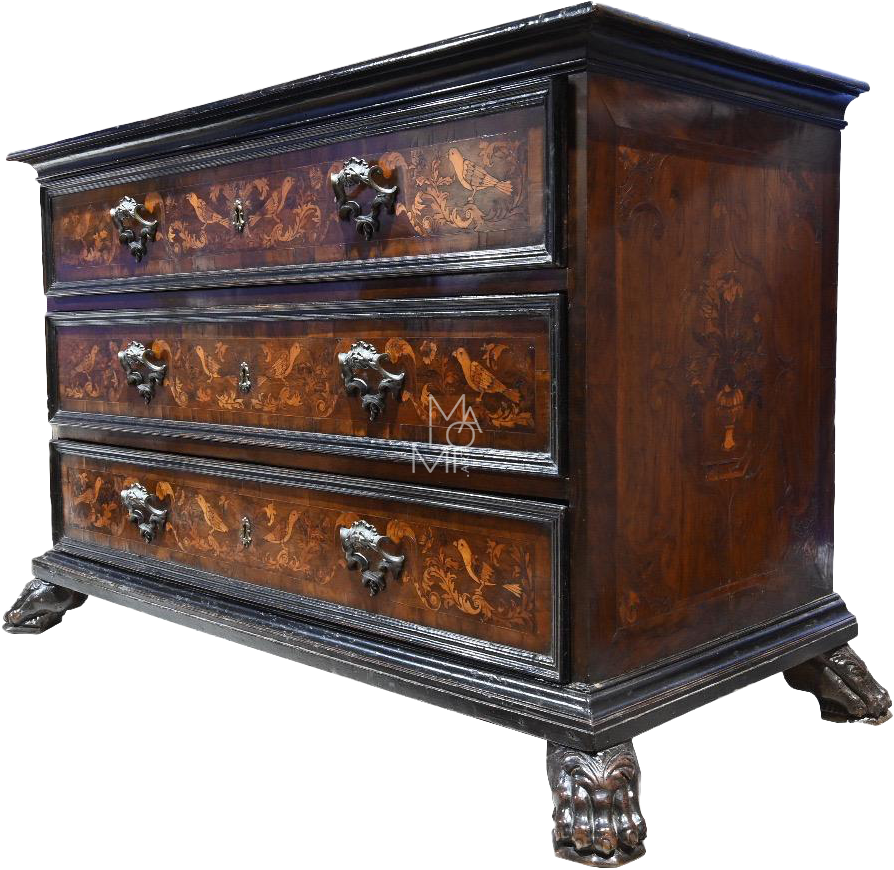
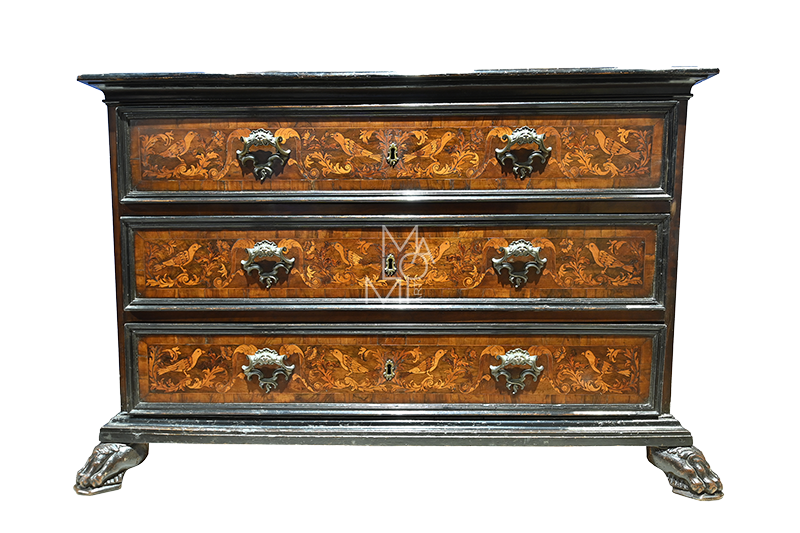
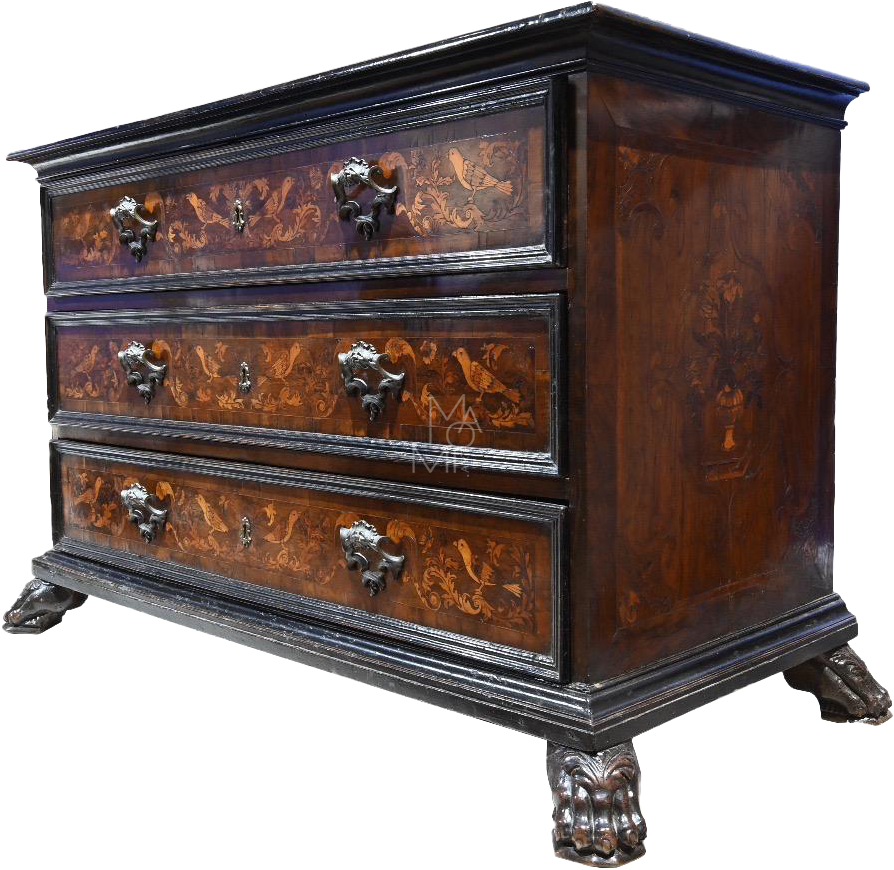
Exceptional 17th-century Brescian Baroque canterano commode. Antique chest of drawers intricately inlaid with olive wood, walnut, fruitwoods, and ivory tesseræ showcasing ornithological motifs and a pastoral scene. Original hardware and carved lion-paw feet.
- Typology: Baroque Canterano / Antique three-drawer commode (chest of drawers).
- Period and Origin: 17th Century (Seicento), fine cabinetmaking from the Brescian area (Lombardy, Italy).
- Dimensions: 145 x 70 x 98 H cm.
- Materials and Wood Species: Solid walnut and poplar core; thick figured olive wood veneers (lastroni); marquetried fruitwoods (pear, cherry, apple) and exquisite ivory inserts.
- Condition Report: Excellent state of preservation with authentic historical age patina.
- Hardware: Period-correct, original lost-wax cast bronze drop handles and forged iron escutcheons.
The Baroque Style in the Brescian Area: A Historical-Artistic and Technical-Scientific Analysis of a Seventeenth-Century Canterano
Introduction and Historical-Geographical Context of Seventeenth-Century Brescia
The canterano under analysis, with its imposing and monumental dimensions—measuring 145 centimeters in width, 70 centimeters in depth, and 98 centimeters in height—stands as an extraordinary and rare testament to the fine cabinetmaking art that flourished in the Brescian territory during the seventeenth century. To fully comprehend the genesis and stylistic complexity of this piece of furniture, it is essential to analyze the specific historical and geographical juncture of Brescia during the Seicento. At the time, the city and its vast territory functioned as a strategic borderland, placed under the firm political dominion of the Republic of Venice yet culturally permeable to the influences of the Duchy of Milan. This dual nature fostered the development of an autonomous figurative language, in which the structural rigor of the Lombard tradition blended with the chromatic richness, fluid lines, and ornamental drive characteristic of Venetian lagoon culture.
During the seventeenth century, the Brescian aristocracy and the rising mercantile bourgeoisie underwent a significant period of socio-economic redefinition. Furniture was no longer considered a merely functional object; rather, it became a fundamental instrument of self-representation and a visual manifesto of family prestige. The lavish salons of urban palaces and the sumptuous villa estates built in the hinterland demanded furnishings capable of dialoguing with large Baroque pictorial cycles and ornate wall stuccowork. The canterano, a monumental evolution of the Renaissance chest (cassone), emerged as the primary element of this domestic scenography. The specimen analyzed here perfectly reflects this cultural milieu, exhibiting exceptional executive skill and a decorative program deliberately designed to evoke the Baroque poetic of wonder and artifice (meraviglia).
Structural Analysis, Architectural Proportions, and Carved Supports
From a morphological and structural standpoint, the piece displays a solid, rigorously geometric volume, rhythmically divided on its front by three large superimposed drawers. The vertical progression of these volumes adheres to a precise architectural canon of Baroque derivation, aimed at imparting solemnity and visual stability through the use of recesses and projecting moldings. Each drawer is framed by dark walnut moldings that cast deep shadows—a solution clearly derived from architectural principles, serving to punctuate the horizontal space and visually discipline the exuberance of the inlaid ornamentation. This dialectic contrast between the severity of the structural framework and the richness of the surface decoration stands as one of the most distinctive and mature hallmarks of seventeenth-century furniture from the Po Valley.
The element of greatest plastic and sculptural impact is found in the lower section, where the entire body of the furniture rests on four monumental lion-paw feet (zampa ferina). Carved in the round from solid walnut wood, these feet do not merely serve a static load-bearing purpose; instead, they elevate the piece from the floor, dynamically projecting it into the surrounding space. The carving is distinguished by an extraordinary executive quality, evident in the profound chiaroscuro effect achieved by wrapping the paw in an exquisite acanthus leaf motif. The acanthus, an ornamental pattern borrowed from classical architecture and widely rediscovered and reinterpreted by Baroque culture, unfolds across the supports with sinuous lines and deep grooves that capture the ambient light. This interplay of voids and solids lightens the geometric severity of the base, imbuing the entire structure with a sense of aristocratic solidity combined with a refined plastic tension.
Material Selection and Cabinetmaking Techniques: The Commesso Ligneo
The selection of wood species used in the construction of the canterano reveals the master Brescian cabinetmaker's profound understanding of the mechanical, physical, and aesthetic properties of his materials. The internal carcass of the piece and the drawer linings are made of poplar wood—a soft, lightweight, and easily workable wood traditionally employed in Northern Italy as a structural backing. For the visible exterior surfaces, the craftsman orchestrated a refined chromatic and tactile contrast by combining several wood types. Solid walnut forms the core of the frames, moldings, and carved feet, selected for its extraordinary structural stability, tight grain, and characteristically deep brown hue, which serves as a perfect visual anchor for the entire composition.
The background of the large panels cladding the front, top, and sides consists of thick veneers (lastroni) of olive wood, chosen for its swirling grain, dense knots, and natural mottling, which lend an extraordinary luster and vibrant visual depth to the surface. Within this dynamic, figured background, the cabinetmaker inserted the delicate tesseræ that form the decorative design, utilizing fruitwoods such as pear, apple, and cherry. These species, characterized by an extremely fine, homogenous grain and warm hues ranging from golden blonde to rosy brown, allowed the craftsman to execute cuts of millimetric precision. The dominant executive technique is commesso ligneo (wood marquetry), in which various wood fragments are cut according to a preparatory drawing and fitted flush against one another on a single plane. By alternating light, dark, and occasionally dyed wood species, the artisan simulated perspective depth and volumetric form without relying on paint.
The Historical Value of Olive Wood and its Link to Brescian Dress and Identity
The analysis of the olive wood merits a dedicated discussion, as its presence in this canterano satisfies more than just aesthetic criteria; it is deeply rooted in the economic, agricultural, and cultural identity of Brescia and its province—specifically the Lake Garda region (historically known as the Magnifica Patria) and the morainic hills. From antiquity through the seventeenth century, olive cultivation represented a primary economic pillar for the Brescian territory. The lacustrine microclimate of Lake Garda, mild and shielded from cold Alpine currents, enabled the production of olive oil and timber of extraordinary quality, highly celebrated across the markets of the Venetian Republic. Olive wood was therefore not an exotic imported material, but a native species deeply tied to the land of origin—a symbol of territorial rootedness and agricultural wealth that patrons wished to ostentatiously display within their residences.
Furthermore, the use of olive wood in fine cabinetmaking connects intimately with the customs, traditions, and tastes of seventeenth-century Brescian society. The Brescian Seicento was an era marked by a striking contrast between the ostentation of aristocratic luxury—influenced by Spanish and Venetian fashions—and a profound attachment to the severe, pragmatic, and industrious traditions of the local land. This dualism was directly reflected in the attire of the local patriciate, who favored heavy fabrics, brocades, and velvets in warm, somber, earthy tones, enriched by precious details but devoid of the redundant excesses seen in Central and Southern Italian courts. Olive wood, with its golden figure and dark veins reminiscent of patterned textiles and iridescent silks of the period, perfectly embodied this aesthetic ideal: a sober, substantial luxury, intrinsically tied to the essence of the material and the mastery of manual labor. Choosing olive wood meant ennobling a product of one's own territory, transforming it through the art of marquetry into a precious surface that mirrored the austere elegance of contemporary Brescian dress.
Comparative Analysis with the Production of Contemporary Lombard and Venetian Workshops
Precisely positioning this Brescian canterano within its stylistic context requires a detailed examination of the cross-currents between the two primary manufacturing hubs of seventeenth-century Northern Italy: the Duchy of Milan and the Republic of Venice. Brescian cabinetmaking historically stood as a focal point of original synthesis between these two major schools, metabolizing the salient traits of each to produce objects endowed with a distinct personality. The Milanese influence manifests primarily in the architectural conception of the furniture and its rigid, monumental structural framework. Contemporary seventeenth-century Milanese workshops favored furnishings with severe lines, characterized by bold, dark moldings and a sharp geometric division of space. However, while contemporary ducal cabinetmakers tended toward a more abstract rigor or stark black-and-white contrasts through the use of ebony, ivory, and bone inspired by German models, Brescian craftsmanship tempered this severity by utilizing warm local woods and lively, naturalistic figurations, eschewing the cold geometric rigidity of Milanese precedents.
Conversely, the influence of the Serenissima is clearly perceptible in the choice of a warm chromatic palette and the distinctly pictorial quality of the marquetry. Venetian workshops were celebrated throughout Europe for their use of burls and precious woods with warm, vibrant tones, designed to create shimmering light effects that dialogued with the great lagoon tradition of painting. The Brescian canterano borrows its decorative fluidity from Venice: the plant volutes flowing across the front are not rigid, graphic symmetries, but supple, dynamic tendrils that unfold organically. Yet, compared to purely Venetian production—which during this period already displayed a marked inclination toward bombastic contours, exaggerated curves, and occasionally overloaded ornamentation—the Brescian specimen retains a formal composure typical of the mainland (terraferma). The front and sides remain strictly orthogonal and planar, demonstrating how the Brescian workshop successfully embraced Venetian ornamental richness and chromatic warmth without ever sacrificing the structural solidity and composure derived from the Lombard tradition.
The Iconographic Program of the Front and Sides: The Symbolic Meaning of Vegetal and Ornithological Motifs in the Baroque Era
In the seventeenth century, ornament was never a purely aesthetic or random choice; rather, it answered to a precise semantic and allegorical code shared between the cabinetmaker and the erudite patron. The decorative apparatus of the front and sides of this canterano reflects the complex Baroque vision of the cosmos, suspended between the celebration of Creation, Galileo-inspired scientific inquiry, and moral reflection on the transience of time. The three frontal drawers feature a dense decoration where the vegetal motif of volutes and scrolls creates a tight phytomorphic network hosting numerous ornithological figures. This dense intertwining symbolizes the Baroque concept of metamorphosis and perennial becoming: the plant volutes, growing out of one another without interruption, represent nature's generative force and its constant vital regeneration. This stylistic choice also addresses the aesthetic demand of horror vacui (the fear of empty space) typical of the Baroque, whereby the furniture's surface must be entirely saturated with ornament to generate wonder and captivate the viewer's gaze, disorienting it within a labyrinth of curved lines.
Within this vegetal labyrinth, the ornithological figures—captured in diverse naturalistic poses, both in flight and perched upon the tendrils—contain a dual layer of meaning. On one hand, they hold a spiritual and philosophical value rooted in Christian iconographic tradition, wherein the bird symbolizes the human soul rising above earthly baseness toward heaven; the juxtaposition of the soil-anchored vegetal element with the flying creature represents the Baroque tension between heavy matter and spiritual aspiration. On the other hand, the presence of these birds reflects the birth of modern naturalistic cataloging and the scientific collecting culture that enjoyed immense popularity within private cabinets of curiosities and Wunderkammern across Northern Italy during the Seicento. On the lateral portions of the furniture, the decoration becomes more synthesized yet equally monumental: a flower basket stands at the center of the paneled space. This compositional scheme celebrates the theme of the nature morte (still life), a pictorial genre in high vogue within seventeenth-century Lombardy, evoking concepts of material abundance and, concurrently, the transience of time through the ephemeral, fleeting beauty of cut flowers.
The Top Panel: The Bucolic Scene of the Peasant Girl and Connections to Arcadian Literature
The top panel of the canterano hosts the central narrative element of the entire piece, significantly elevating its artistic value: the wood marquetry of a reposing female figure with a basket by her side, identifiable as a peasant girl or a shepherdess. The inclusion of this specific iconography on a functional horizontal surface is not accidental; it reflects the cultural evolution of seventeenth-century Italy and the impending transition toward eighteenth-century sensibilities. Although the Academy of Arcadia (Accademia dell'Arcadia) was officially founded in Rome only in 1690, the entire second half of the seventeenth century was permeated by a vigorous pre-Arcadian and pastoral taste. This trend originated from the enduring success of Giovan Battista Guarini's Il Pastor Fido and the lyric poetry of Giambattista Marino. The figure of the reposing peasant girl embodies the idealization of rural life as a locus of peace, innocence, and spontaneity, standing in stark contrast to the rigid formalities, hypocrisies, and political tensions of urban court life.
The Brescian cabinetmaker does not depict manual labor in the fields in its raw, grueling daily reality; instead, he translates onto wood an idyllic, dreamy vision: the figure is relaxed, set within a stylized landscape context that evokes the myth of the Golden Age. The composition structures itself around two semantic fulcrums. The reposing peasant girl expresses, through her reclined posture, the concept of intellectual and contemplative otium, transforming into a personification of the Earth itself or a protective nymph of the fields. The basket at her side, overflowing with the fruits of the earth, serves as a clear allegorical attribute of fertility, abundance, and the benevolence of nature. It dialogues directly with the flower baskets inlaid on the sides of the furniture, closing a coherent iconographic circle that celebrates well-being and prosperity. For the Brescian aristocracy of the period, owning a piece of furniture that displayed such a scene on its top panel meant visually celebrating the economic wealth derived from their agricultural estates, filtered through the ennobling lens of classical myth and bucolic poetry.
The Radiance of Ivory in the Figure of the Peasant Girl and Brescia's Indissoluble Bond with Rural Culture
A close and microscopic examination of the central inlay on the top panel reveals a detail of exceptional technical and semantic value: the insertion of ivory tesseræ to render the visible anatomical parts of the peasant girl, specifically her arm, hands, and face. The introduction of an organic material of faunal origin and exotic import like ivory, juxtaposed with the warm local wood species of olive and fruitwoods, fulfills a dual objective, both aesthetic and symbolic.
From a strictly formal perspective, the ivory acts as a powerful luminous fulcrum within the composition. Its compact texture, devoid of conspicuous grain and characterized by an intrinsic ivory luster, creates a sharp chiaroscuro contrast against the dark, figured background of the olive wood. This technical expedient allowed the cabinetmaker to make the human figure pop from the surface of the furniture, granting it an almost sculptural tridimensionally and immediate legibility even under the dim ambient lighting conditions typical of seventeenth-century salons. Furthermore, the whiteness of the ivory accentuated the poetic idealization of the character: the skin of the peasant girl, historically weathered and darkened by the sun of field labor, is here transfigured into the noble, aristocratic blankness of ivory, assimilating the young woman to the nymphs of classical tradition and contemporary idyllic literature.
From a historical and sociological viewpoint, the centrality of this figure on the top of the canterano connects directly with the visceral and indissoluble bond of the Brescian territory with rural culture. In the seventeenth century, the economy of the province of Brescia was predominantly and solidly anchored to the soil. Although the city was an industrial and metallurgical center of primary importance for firearms production, the true wealth and stability of great patrician families (such as the Martinengo, Fenaroli, or Avogadro families) derived from the scientific, intensive management of their extensive landholdings in the Low Brescian Plain (Bassa Bresciana), Franciacorta, and the valleys. The local nobility, unlike that of other more courtly and detached Italian centers, maintained a relationship of pragmatic and daily proximity to the agrarian reality. The large agricultural estates and fortified homesteads (corti coloniche) were the economic engine of the fief, and the peasant, though subjected to the rigid social hierarchies of the era, was recognized as the backbone of the state's prosperity.
The inclusion of the peasant girl on the furniture was therefore not a mere exotic ornamental whim, but a genuine celebration of Brescian identity. Exalting rural life through the luxury of marquetry and ivory meant, for the patron, proudly displaying the primary source of his wealth. The overflowing basket next to the young woman thus became the symbol of the plain's harvests, hill viticulture, and lakeside fruit cultivation. In this manner, the Brescian cabinetmaker succeeded in executing a cultural operation of extraordinary modernity for the seventeenth century: he took an element of daily, popular reality—rural culture with its industrious rhythms and its concreteness—and ennobled it through the use of the most precious material at his disposal, ivory, transforming a domestic piece of furniture into a celebratory monument to the land and civilization of Brescia.
Preservation and Authenticity: The Contemporary Hardware
A factor of fundamental importance for the correct historical-artistic and commercial valuation of this canterano is the presence of its contemporary (coeva) hardware. The large drop handles, keyhole escutcheons, and internal lock mechanisms in forged iron and lost-wax cast bronze are original to the seventeenth century and have undergone no replacements or alterations over the centuries. Such preservation is extremely rare in furniture of this era, which was frequently stripped of its original handles to conform to the fashions of subsequent centuries or for metal reclamation.
The bronzes present an authentic and inimitable age patina, characterized by microscopic signs of wear, natural deposits, and a deep oxidation that only the slow passage of time can confer. The fluid, sinuous shapes of the pendants, occasionally enriched with small anthropomorphic or zoomorphic motifs, integrate organically with the surrounding inlaid design, proving that the hardware was conceived from the outset as an integral part of the furniture's decorative scheme. The perfect correspondence between the mounting holes and the wooden substrate confirms the integrity of the artifact, ruling out remounting interventions and guaranteeing that the entire piece originates from a single, original workshop of haute ébénisterie.
Theoretical Chemical-Physical Analysis of the Aging of the Utilized Wood Species
From the standpoint of materials science applied to cultural heritage conservation, the current state of the canterano is the culmination of over three centuries of complex chemical-physical and biological phenomena. The different wood species employed have reacted distinctively to environmental factors due to their specific cellular structures, densities, and internal chemical extractives. The chromatic shifting of the inlaid panels is primarily driven by ultraviolet (UV) radiation from light and atmospheric oxygen, which trigger the photochemical degradation of lignin and natural wood extractives. Olive wood possesses a high concentration of oily substances and polymerized phenolic compounds; over the centuries, exposure to light has caused the photo-oxidation of these components, leading to a lightening of the yellowish background and a progressive loss of contrast against the dark veins—which, being rich in stable plant melanins, tend to remain pronounced. Fruitwoods (pear, cherry), being diffuse-porous and homogenous woods, are highly susceptible to yellowing and shifting toward brown or grayish hues due to the decomposition of internal tannins, blending the originally rosy or orange tones into the characteristic "antique patina" that visually certifies the furniture's authenticity.
Alongside photochemical phenomena, hygroscopic behavior and wood anisotropy play a crucial role in the structural preservation of marquetry. Wood is a living material that constantly exchanges moisture with the surrounding environment, altering its dimensions differently depending on the grain direction (axial, radial, tangential). On the top panel of the canterano, tesseræ of olive and fruitwoods with differing grain orientations lie in close contact, glued onto a stable wood substrate. Olive wood has a high volumetric shrinkage coefficient and is a "nervous" wood that tends to contract significantly in low humidity conditions; fruitwoods, while exhibiting more moderate shrinkage, respond with different hysteresis times. These non-homogenous dimensional responses generate severe shear stresses along the boundary lines of the marquetry. Over centuries, the natural failure and crystallization of historical organic glues (hide or fish glue) cause microscopic lifting of the tesseræ, known as delamination phenomena, or shrinkage gaps palpable to the touch. The substantial stability and excellent current state of preservation of the furniture demonstrate not only proper environmental conservation over time but, above all, the exceptional mastery of the seventeenth-century cabinetmaker in anticipating and preventatively compensating for these internal physical stresses.
Conclusions and Reference Bibliography
In conclusion, this seventeenth-century Brescian canterano represents a supreme synthesis of luxury cabinetmaking art from the Baroque of the Po Valley. Through the judicious use of noble woods and fruitwoods, exceptional plastic skill in the deep carving of the lion-paw feet, and a complex iconographic stratification ranging from the scientific naturalism of ornithological motifs to the bucolic idealization of the genre scene on the top panel—ennobled by ivory radiance—the furniture stands as a historical, social, and material document of primary interest. The absolute integrity of its materials, the coherence of the decorative program, and the vital presence of contemporary hardware seal its immense historical-artistic and museum-grade value, offering a sophisticated and privileged insight into the refinement of taste, technique, and cultural identity of the Brescian land in the seventeenth century.
Specialist Bibliographical References
- Alberici, Clelia, Il mobile lombardo, Milan, Görlich Editore, 1969.
- Alberici, Clelia, Il mobile veneto, Milan, Electa, 1980.
- Colle, Enrico, Il mobile barocco in Italia. Arredi e decorazioni d'interni dal 1600 al 1738, Milan, Electa, 2000.
- Anelli, Luciano, La pittura di genere a Brescia nel Seicento, Brescia, Grafo Edizioni, 1983.
- Bacchi, Andrea; De Marinis, Fabrizio (eds.), I legni storici: essenze, tecniche e stili dell'ebanisteria italiana, Florence, Centro Di, 1997.