Explore a masterpiece of 15th-century Lombard wooden sculpture: art-historical analysis of the Brescian master carvers' polyptych figures.
The breath in wood: evolution, iconography, and workshops of lombard wooden sculpture (14th-16th Century)
Introduction
Wooden sculpture in Lombardy represents one of the densest and most complex chapters in the history of Po Valley plastic art. Often wrongly considered an artistically "minor" production compared to marble or bronze statuary, wood carving has actually expressed peaks of intense expressionism and sophisticated technical skill. The Lombard territory, historically a crossroads of transalpine currents, Venetian influences, and rigorous courtly styles, found in wood the material of choice to give form to popular devotion and the commissions of large religious workshops. This essay aims to analyze the stylistic evolution, technical peculiarities, and workshop dynamics that characterized this specific production between the Twilight of the Middle Ages and the Mature Renaissance.
- Geography of the material and workshop techniques
The flowering of wooden sculpture in Lombardy is closely linked to the availability of specific forest resources and the codification of rigorous workshop practices. Lombard sculptors preferred stable and workable local woods, among which linden (lime wood) stood out, appreciated for its softness and the absence of excessively hard grains—features that made it ideal for extremely fine plastic detail and sharp drapery of northern derivation. Walnut, dense and compact, was instead chosen mainly for large structural complexes such as Renaissance choir stalls and coffered ceilings, while poplar and willow were used for lighter devotional sculptures or those intended to be carried in processions.
The preparation of the support required years of seasoning to prevent cracks caused by the hygrometric movements of the wood. Often, the blocks were hollowed out internally from the back to lighten the weight of the statue and prevent splitting due to internal fiber tension. In the contemporary perception, a wooden sculpture was never considered finished without the intervention of the painter (pictor), a figure who often enjoyed a contractual status equal to or higher than that of the carver (intaliator). The process first involved canvas-lining (impannatura), applying strips of fine linen cloth over the wood joints to absorb material movements, followed by priming (ammanitura) with successive layers of gesso and animal glue, then meticulously smoothed. Water gilding involved applying gold leaf over a base of Armenian bole, burnished with an agate stone to obtain reflective surfaces, and finally punching (punzonatura) for the geometric relief decoration of haloes and garment borders.
- International gothic and the transalpine transition
During the 14th and the first decades of the 15th century, Lombardy experienced a cultural season dominated by the workshop of Milan Cathedral and Visconti commissions. This climate favored an extraordinary circulation of foreign craftsmen, particularly Bohemian, Rhenish, and Burgundian. Contacts with the Germanic world imported into Lombardy the taste for the so-called Schöne Madonnen (Beautiful Madonnas), characterized by sinuous rhythms, sickle-shaped drapery, and cascades of folds that hid the real anatomy of the body. Lombard workshops absorbed this fluid and aristocratic line, blending it with Lombard naturalism, which was always attentive to the psychological rendering of faces and the details of daily life.
Alongside Marian figures, late Gothic production distinguished itself by Crucifixes of strong dramatic impact. In these works, the influence of the northern Geiselmünd (wounded Christ) translated into a raw realism: veins were created by applying hemp cords beneath the gesso layer, blood was rendered in material relief, and wounds exhibited an expressionistic drama intended to move the faithful to profound compassio (shared suffering).
- The fifteenth century: master carvers and the advent of the renaissance
With the transition from Visconti to Sforza rule, Lombard wooden sculpture underwent a profound structural and spatial mutation, welcoming the rules of Renaissance perspective and symmetry without renouncing its vocation for the expressive rendering of reality. Active in Milan, Lodi, and throughout the duchy, Giovanni Pietro and Giovanni Ambrogio De Donati embody the transition toward the Renaissance. Their wooden altarpieces (ancone)—monumental multi-tiered polyptychs protected by architectural frames—show a geometric spatiality updated on the innovations of Donatellian art (filtered through Padua) and Vincenzo Foppa. The De Donati family knew how to combine the monumentality of the figures with minute attention to decorative detail, defining a qualitative standard that dominated the Lombard market for decades. The structure of these works generally featured a lower predella with scenes of the Passion or childhood, a central register with lateral saints and the main scene, and an upper lunette dominated by God the Father or the Crucifixion.
The Lombard Renaissance also found a supreme expression in the choir stalls of major basilicas, such as San Lorenzo in Voghera or Santa Maria Maggiore in Bergamo. In these complexes, perspective intarsia—the juxtaposition of woods of different species and shades to create the illusion of depth—became an instrument of intellectual and geometric speculation, transforming choir stalls into true manifestos of mathematical humanism.
- Wood as a theological medium: liturgy, devotion, and compassio
In the Lombard context between the 14th and 16th centuries, wooden sculpture did not merely respond to aesthetic criteria, but was intrinsically linked to liturgical practices, visual theology, and the need to guide the emotional experience of the faithful. The choice of wood as a plastic support was itself charged with deep symbolic and pastoral values. Late medieval and 15th-century spirituality, heavily influenced by Franciscan and Dominican preaching, focused on meditating upon the human suffering of Christ and the Virgin. Wooden sculpture, because of its intrinsic material closeness to flesh and human warmth, became the instrument of choice to stimulate compassio. The hyper-realism of the wounds, the use of mixed-media inserts like cords for veins or parchment for lacerated skin, and vivid polychromy responded to the precise theological need to make the mystery of the Incarnation visible and tangible.
A peculiar aspect of Lombard wooden sculpture was its dynamic function within the celebrations of the liturgical year, as many works were true mobile ceremonial devices. One can think of the Crucifixes with articulated arms used during Good Friday services, whose arms could be folded along the sides to simulate the deposition and burial. Similarly, lightweight processional statues in hollowed-out poplar were carried on shoulders through city streets during plagues to sacralize the urban space. Life-sized Lamentation complexes (Compianti), arranged around the recumbent body of Christ, physically forced the worshiper to step inside the sculptural group, transforming them from a passive spectator into an actor in the sacred drama. From the perspective of ecclesiastical patronage, large polyptychs acted as visual theological encyclopedias for the illiterate laity, where the spatial articulation strictly mirrored the cosmic order, starting from the earthly scenes of the predella, through the intercession of saints in the central register, up to the heavenly dimension of the finial.
4.bis. An archetype of the transition: the case of the sculptural group by the brescian ebanisti
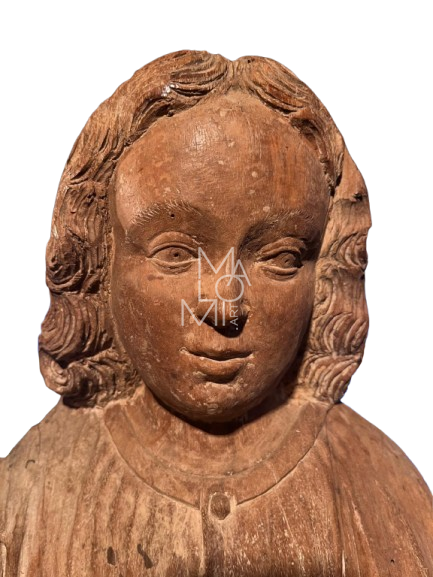
To understand the effective scope of the stylistic transition between Late Gothic and early Lombard Renaissance, a close examination of the Sculptural Group by the Brescian Ebanisti of the 15th Century is highly emblematic, a work studied in depth within the official art-historical entry available at malomi.art. This work, consisting of four standalone figures originally arranged back-to-back, offers a perfect material synthesis of the workshop dynamics and theological demands previously discussed.
The Brescian sculptural group constitutes, first and foremost, an exceptional document for the archaeology of color and matter. Although the surfaces appear almost completely stripped down to the purity of bare wood due to drastic historical cleanings, the most protected undercuts still preserve intact the technical stratigraphy theorized in historical carving treatises. Within the folds of the belt and the recesses of the lower capital, the whitish residues of the gesso and animal-glue priming are visible, topped by the reddish traces of Armenian bole. This latter element confirms that the work was originally embellished with brilliant water gilding, while surviving ochre shades on the ankles bear witness to an ancient painterly incarnation intended to bestow anatomical verisimilitude upon the sacred figures [4].
Morphologically, the four Brescian figures exhibit that co-existence of idioms characteristic of the frontier fifteenth century. In the garments, two distinct plastic spirits live together: if on one hand deep, broken "V"-shaped folds and concavities of irreducible late Gothic flavor can be observed, on the other the central figure adopts a relaxed, heavily longitudinal drapery. The breaking element from the medieval past lies in the underlying anatomical awareness of the craftsman. Despite the heaviness of the geometric drapery, the protrusion of the knee and the subtle flexion of the hip are clearly perceptible beneath the cloth, denoting an early adherence to the laws of gravity and Renaissance volumetrics.
The group connects directly to the theological-liturgical function of the wooden medium through the representation of musica ficta. The inclination of the torsos, the postures, and the partial amputation of the hands indicate that the characters originally held musical instruments or membranous choral books now lost. The acoustic and choral dimension is made explicit by the refined physiognomic rendering of the faces: the slightly parted mouths and disengaged lips mimic the physical act of liturgical chanting, transforming the statues into plastic extensions of the celestial harmony meant to echo through the navy. Finally, the elevated architectural destination of the work—plausibly the finial of a polyptych, the crowning of a choir balcony, or a monumental organ casing—is revealed by the structure of the base. The bare feet rest on a hexagonal platform that connects to an inverted capital decorated with deeply carved, openwork acanthus leaves. The profound hollowing out of this decorative element proves that the carver millimetrically calculated a perspective view from below (di sotto in su), offering the faithful gathered below a slender, monumental perception of the angelic assembly.
4.ter. Material fragmentation and iconographic shifts
The conservation destiny of the Brescian group introduces a central historiographical problem in the study of wooden sculpture: the alteration of iconographic perception caused by the loss of mobile attributes and painterly layers. Over the centuries, the hygrometric movements of wood, wood-boring insect infestations, and, above all, changes in aesthetic taste triggered drastic stripping interventions that reduced originally hyper-realistic and polychrome artifacts to simulacra of bare wood. This process of material denudation, while aligning with a modern purist taste that appreciates the graphic sign of the chisel, strips the work of its original aesthetic finish, which coordinated light reactions within the sacred space.
Even deeper is the semantic shift caused by the loss of accessory elements in wood or metal, such as lutes, psalteries, or membranous missals that the figures originally held. Deprived of their specific object-referent, these plastic assemblies undergo a process of iconographic abstraction. Sculptural groups conceived as precise allegories of liturgical chant and musica ficta are frequently reinterpreted by later critics as generic angelic cohorts or figures in mute visual dialogue. The subtraction of the mobile attribute breaks the immediate narrative link that bound the work to contemporary ritual practice, transforming a dynamic liturgical device into an object of pure formal and museum contemplation.
- The economy of faith: lay confraternities as driving forces of patronage
While grand marble statuary found its hub in cathedral workshops controlled by ducal or episcopal authorities, Lombard wooden sculpture was primarily supported, funded, and directed by the connective tissue of lay confraternities, often termed scuole or consorzi. These free associations of citizens or trade guilds represented true economic powers capable of influencing the Po Valley art market through a virtuous cycle fueled by bequests and membership fees. Between the 15th and 16th centuries, a proliferation of confraternities dedicated to the Body of Christ (Corpus Domini) and the Virgin of the Rosary occurred; these entities commissioned monumental Eucharistic tabernacles or complex sculptural cycles centered around the Mysteries, prompting workshops to standardize high-relief narrative modules easily legible during communal prayers.
Lombard archival documents reveal how confraternity priors exerted strict control over carvers' operations via the contract of allocation (allogazione). The confraternity often supplied the raw material to guarantee its quality, dictated the iconographic program drafted by theologians or notaries, and meticulously selected the painter for the polychromy. Control over gilding and colors was extremely rigid, specifying the exclusive use of pure gold leaf and azurite (azzurro d'Almagna) to reflect the social prestige of the consortium. This investment met a dual need: on one hand, an eschatological motivation tied to suffrage masses for the souls of deceased members; on the other, a strong dynamic of inter-confraternal social competition, wherein different consortia rivaled for the possession of the most sumptuous chapel within the same church.
- Giovanni Pietro Rinonapoli and the master of Santa Maria di Castello
The landscape of the second half of the 15th century is populated by anonymous masters of the highest stylistic profile, whose works have been progressively brought to light by 20th-century and contemporary criticism. The Master of Santa Maria di Castello, named after the monumental polyptych preserved in the homonymous church in Alessandria—at the time orbiting within the cultural sphere of the Duchy of Milan—displays a stylistic signature of extraordinary power. His style is distinguished by crumpled, geometric, and almost metallic drapery, heavily reminiscent of the Ferrarese painting of Cosmè Tura and the influences of transalpine sculpture, charging the figures with a nervous tension that breaks the balance of classical Renaissance composure.
Wooden sculpture found a widespread distribution in the mountainous and lakeside territories of Lombardy, such as Como, Sondrio, Varese, and the Bergamasque and Brescian valleys. Far from the strict control of the Milanese court, local workshops developed hybrid languages of great charm, where Renaissance demands were translated into more archaic, geometric, and violently expressive forms, intended for a public that demanded immediate and emotionally impactful sacred images.
- The early Sixteenth century: between Gaudenzio Ferrari's expressionism and mannerism
The advent of the 16th century marked the moment of maximum cohesion among wooden sculpture, painting, and scenographic architecture, finding its ideal synthesis in the grandiose undertaking of the Sacri Monti (Sacred Mountains). Gaudenzio Ferrari dismantled the boundaries between disciplines, integrating the architectural space of the sacred chapel with a perspective mural painting background and with plastic actors in wood or polychrome terracotta that visually engaged without continuity. Gaudenzian figures thus became actors in a moving sacred drama, where hair was sometimes made of real wigs, eyes were made of glass paste, and expressions oscillated between the purest lyricism and grotesque caricature.
The Del Maino family dominated the Milanese and Pavese scene between the late 15th and the first decades of the 16th century. Their style, initially bound to Bramantesque perspective rigor and the decorative richness of Amadeo, progressively leaned toward softer, more monumental forms, influenced by Leonardo da Vinci's Milanese sojourn. Their compositions show a mature understanding of Leonardesque pathetismo and prelude, in structural severity and iconographic decorum, the rigid regulations that would be imposed a few decades later by the Council of Trent and the directives of Carlo Borromeo.
- The hispanic duchy and the counter-reformation: the orthodoxy of carving
The transition of the Duchy of Milan under direct control of the Spanish Crown and the simultaneous implementation of the decrees of the Council of Trent radically transformed the intellectual status and iconography of Lombard wooden sculpture. Under the rigorous episcopate of Carlo Borromeo and his cousin Federico, Milan became the bulwark of faith against Protestant heresies, leading to the application of strict rules on sacred art, as established in the famous Instructiones fabricae et suppellectilis ecclesiasticae of 1577. The archbishop imposed the dismantling of old wooden polyptychs in favor of isolating the single devotional statue—monumental and visible from a great distance—while shifting the focus of carving onto the design of colossal architectural tabernacles in the shape of small temples placed at the center of the main altar.
The strong presence of governors and religious orders from the Iberian Peninsula introduced dramatic devotional types into Lombardy typical of Spanish Baroque, such as the cult of the Madonna della Soledad (Solitude), represented with garments of real black fabric over wooden cores, and grand portable sculptural groups for Holy Week processions. The iconography of saints underwent rigorous standardization based on historical and biblical truth, banning apocryphal legends and imposing a meticulous anatomical rigor in the representation of martyrdom, where glossy varnishes mimicked fresh blood perfectly, matching the somber and heroic Habsburg spirituality of the era.
- Plastic atlas of the territory: peculiarities and strengths of lombard provinces
Lombard wooden sculpture is configured as a variegated mosaic of distinct territorial identities. In the western macro-area, Milan and Pavia distinguished themselves by a courtly classicism closely tied to the models of Bramante and Leonardo [1], characterized by a monumental rigor evident in major ducal workshops, while Varese imposed itself within the workshop of its own Sacro Monte. In the central macro-area, Lodi became the land of excellence for the architectural perfection of the De Donati altarpieces, while Cremona developed a fruitful naturalistic dialogue with the painting schools of the Po Valley and Emilia.
Moving toward the eastern macro-area, Bergamo and Brescia felt the political proximity of the Serenissima Republic of Venice. Bergamo excelled in the art of monumental perspective intarsia and in a harsh, spiky valley expressionism. Brescia, for its part, emerged as a crossroads of exceptional liveliness, where political submission to Venice did not flatten local production but favored the grafting of lagoon sensitivity onto the robust plastic tradition of the Po Valley. Brescian workshops distinguished themselves by a characteristic "plucked" and sharp carving, capable of generating deep chiaroscuro contrasts through broken "V"-shaped folds that recall Northern graphic design and the expressiveness of Flemish masters.
Within this context fits the production of excellence of 15th-century Brescian cabinetmakers and carvers, skilled in declining the solid, slender volumetrics of the Lombard Renaissance within round-sculpture structures intended for elevated, perspective usage. Masterpieces like the mentioned group of liturgical chanters testify to how the Brescian school could blend Venetian linear harmony with an extremely accurate psychological naturalism, visible in the refinement of youth faces and the plastic rendering of hairstyles with geometric curls.
In the alpine and lakeside territories of Como, Lecco, and Sondrio, plastic art bound itself indissolubily to transalpine transits; notably, Valtellina became famous for producing winged altarpieces (Flügelaltäre) of Germanic inspiration carved in stone pine [5]. Finally, Mantova declined carving according to a solid, aristocratic composure derived from the archaeological classicism of Andrea Mantegna, while the Monza and Brianza area specialized in devotional sculpture for conventual use with sober forms, early aligned with the rigor and purity of lines imposed by the Borromean Counter-Reformation.
Conclusions
Lombard wooden sculpture reveals itself as an autonomous and extraordinarily vital artistic phenomenon, capable of metabolizing heterogeneous cultural stimuli and translating them into a unique plastic language. From the elegant line of International Gothic to the perspective experimentations of the 15th century, up to the theatrical realism of the early 16th century, Lombard carvers knew how to exploit the flexibility and living warmth of wood to establish a direct, fleshly dialogue with the viewer. This production, far from being a stylistic periphery, represented the true connective tissue of the figurative and devotional consciousness of historical Lombardy.
Footnotes
- Cf. G. Romano, Rinascimento in Lombardia: Foppa, Zenale, Bramantino, Milan, 1997, pp. 45-62, for an analysis of the transition from late Visconti Gothic to Sforza perspective spatiality.
- On the activity of the De Donati and the codification of the Renaissance wooden altarpiece, see M. Casciaro, La scultura lignea lombarda del Rinascimento, Milan, 2000, pp. 112-135.
- Cf. S. Carlo Borromeo, Instructiones fabricae et suppellectilis ecclesiasticae (1577), ed. by M. Marinelli, Vatican City, 1952, ch. XVII.
- Regarding the Brescian school and the sculptural group of the 15th-century cabinetmakers, see the formal and conservation study in Gruppo Scultoreo degli Ebanisti Bresciani XV Secolo, Malomi S.r.l. Art Gallery.
- For transalpine influences and Flügelaltäre in Valtellina, reference is made to A. R. Peroni, L'influenza della cultura renana nella plastica lombarda del Quattrocento, in «Arte Lombarda», n. 42, 1975, pp. 18-29.
Reasoned academic bibliography
- Borromeo, Carlo (San), Instructiones fabricae et suppellectilis ecclesiasticae, Milan, 1577 (reprint edited by L. Grassi, Milan, 1977).
- Casciaro, Raffaele, La scultura lignea lombarda del Rinascimento, Milan, Skira, 2000.
- Malomi S.r.l., Gruppo Scultoreo degli Ebanisti Bresciani XV Secolo - Scheda Storico-Artistica, Art Gallery, 2026.
- Romano, Giovanni (ed.), Maestri del legno d'Oltralpe in Lombardia (1350-1550), Exhibition catalogue, Milan, Electa, 1998.
- Romanini, Angiola Maria, L'arte gotica in Lombardia, Milan, Ceschina, 1964.