The Samson cycle in Antwerp baroque tapestry
wedding feast of Samson, blinding of Samson, Forchoudt firm Italy, Durini collection tapestries, antique tapestry restoration, Antwerp manufacturing 17th century.
The Samson cycle in the Antwerp tapestry of the baroque: an art-historical essay on a pair of tapestries from the Wauters workshop
Introduction to the study of Flemish textile heritage
In the multifaceted and fascinating panorama of the applied arts of seventeenth-century Europe, the textile manufacture of Flanders represents an economic and cultural hub of extraordinary importance. Within this context, the city of Antwerp was able to conquer a position of absolute prestige, developing a figurative language strongly indebted to the monumental inventions of Peter Paul Rubens. The pair of tapestries under examination, having monumental dimensions equal to three hundred and seventy-six centimeters by five hundred and eighty each, bears witness to the peak of this happy marriage between baroque painting and artisan wisdom. The two panels, respectively depicting the wedding feast of Samson and the blinding of Samson, originally formed part of a more extensive series dedicated to the deeds of the biblical hero, whose vicissitudes are handed down in the Book of Judges. Through the study conducted by the art expert Arabella Cifoni, it is possible to penetrate the secrets of these artifacts, placing them in the cultural climate of around sixteen seventy-five, an era characterized by intense commercial exchanges and complex workshop dynamics.
Chapter one: the manufacture of Antwerp and the enigma of attribution
The role of the Wauters brothers in late-seventeenth-century production
The attribution of the two monumental panels leads directly to the workshop of the brothers Michael and Phillip Wauters, active in Antwerp in the second half of the seventeenth century. Heirs to the profession of their father Jacob, who passed away in sixteen sixty, the two brothers were able to expand the family business by equipping it with a modern and branched commercial structure throughout Europe. One of the most interesting curiosities of this corporate management lies in their absolute operational independence: each of the two brothers in fact owned his own autonomous workshop, although they used to exchange the preparatory cartoons and drawings inherited from their father in a completely interchangeable manner. This custom has often made the work of art historians complex in distinguishing the individual hands, making the stylistic signature or the inventory documents the only certain foothold for a philological assignment. Upon the death of Michael, which occurred in sixteen seventy-nine, an extraordinary figure of an ante litteram businesswoman emerged: the eldest daughter Maria Anna Wauters-Thijsius, who assumed the leadership of the company making use of the collaboration of her brothers-in-law Cornelis de Wael and Jeremias Cockx, demonstrating how women could manage complex commercial empires in the baroque Flanders.
The attribution to Phillip Wauters and the links with the Jason series
While Michael was a family man with numerous children who continued the business, Philip Wauters maintained a condition of celibacy throughout his life, concentrating his energies on the development of foreign markets. Historical data converge in believing that the series of the stories of Samson is to be specifically attributed to the workshop of Phillip. A highly relevant archival anecdote dates back to sixteen eighty-five, when in the documents of the heirs of the company it is mentioned that a series dedicated to Jason and Medea presented borders identical to the history of Samson. Since the Jason series had been entirely developed in Phillip's laboratory, historians were able to deduce with certainty the authorship of the latter also for the Samson cycle, confirming the workshop's habit of reusing the expensive cartoons of the architectural friezes for totally different iconographic subjects.
The geometric style and historical falsehoods about the Tuscan manufacture
The critical investigation into the place of weaving has revealed fascinating stylistic details that in the past had deceived critics. The characteristics of the human figures, marked by whimsical movements, theatrical poses, and elongated but not slender proportions, combined with clothes arranged in large folds modeled in a schematic way, had led some scholars to hypothesize an origin linked to the workshops of Oudenaarde. However, the style of that Flemish center found no comparison in the type of architectural border, which instead unequivocally points to the Antwerp environment. A historiographical curiosity of no small account reveals that, in past eras, Tuscan origins had been erroneously supposed for these very tapestries, a critical blunder probably due to the warm chromatic range and the solemnity of the figures, later definitively disproved by the discovery of the marks and accounting documents from beyond the Alps.
Chapter two: the reuse of the rubensian genius and the variants of the feast
The metamorphosis of the feast of Herod
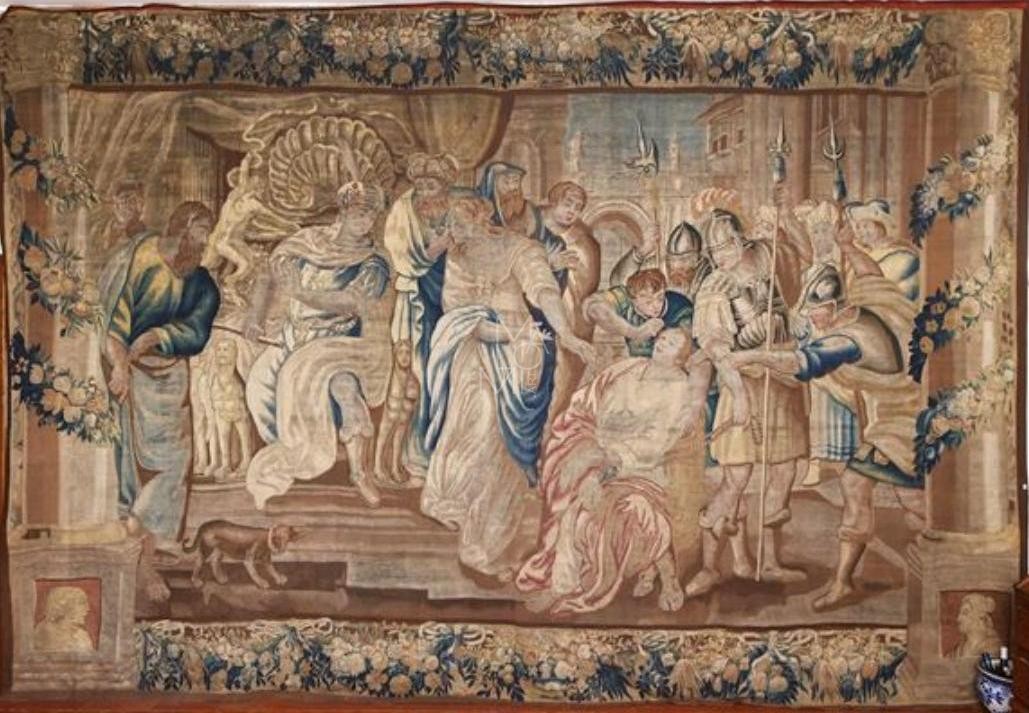
The first tapestry of the pair shows an iconographically very rare episode, namely the wedding feast of Samson at Timnah. The compositional genesis of this panel reveals an artistic background typical of the era: the author of the cartoon did not directly use an original painting by Rubens, but rather resorted to a translation engraving executed by Schelte Adamsz Bolswert, taken from the famous rubensian painting of the feast in the house of Herod and published in Antwerp by Gillis Hendricx after sixteen forty-five. To save on design costs and exploit a spatial layout of assured success, the cartoonist performed an operation of thematic substitution disarming in its simplicity: he eliminated the figure of Salome presenting the head of the Baptist and inserted in her place the standing figure of Samson, transforming an evangelical tragedy into a biblical wedding celebration of the Old Testament.
The variants of the cartoonist and the detail of the intruder
Despite the overwhelming influence of Rubens' personality, the designer of the cartoons, identified as the painter Abraham van Diepenbeeck, introduced numerous significant variants. Among these, the most enigmatic curiosity is represented by the figure of a man placed on the right, immediately behind the bride's father, who emerges warily from behind a curtain. This character, completely absent both in the original painting by Rubens and in the engraving by Bolswert, inserts an element of suspicion and espionage into the scene, perhaps alluding to the plots of the Philistines who sought to capture the hero's secret. The theatricality is accentuated by the internal division of the panel: on the left Samson's wife with her parents and at their feet a small dog, while on the right a core of guests celebrates around a table laden with lobsters and peacocks, with the monumental figure of Samson standing out in the center.
The artistic partnership with Abraham van Diepenbeeck
The identification of the cartoonist as Abraham van Diepenbeeck finds confirmation in his constant collaboration with the Wauters brothers, for whom he had already designed the successful series on the life of Marcus Aurelius. A student of Rubens starting from sixteen twenty-three, Van Diepenbeeck had participated in the execution of the cartoons for the glorification of the Eucharist commissioned by the infanta Isabella. An anecdote linked to his biography, narrated by the contemporary Arnold Houbraken, reveals that at the beginning of his career the painter had gone to Italy to learn the art of glassmaking. The experience was however so negative and bankrupt as to push him to definitively abandon that trade to dedicate himself to monumental painting and the design of tapestries, a fortunate choice that allowed him to develop that simplified chromatic range, dominated by light blue, blue, brown, and yellow hues with touches of red, which we find perfectly expressed in the panels of the Samson cycle.
Chapter three: the violence of light in the blinding of the hero
The dramaturgy of the capture and the link with Delilah
The second panel illustrates the tragic epilogue of Samson's love for Delilah, narrating the moment in which the hero is deprived of his extraordinary strength through the cutting of his hair, violating the vow of Nazariteship. The scene is characterized by a dynamic excitement that contrasts sharply with the convivial setting of the first tapestry. Van Diepenbeeck organizes the space around the downed and immobilized body of the giant, onto whom the Philistine soldiers rush. Delilah appears aside, an ambiguous figure embodying the paid betrayal, while the soldiers in armor break in brandishing spears and instruments of torture. The action focuses on the brutal act of blinding, which will condemn Samson to turn the millstone in the prison of Gaza.
The proscenium layout and the theatrical frame
One of the most relevant stylistic peculiarities of this pair of tapestries lies in the treatment of the border, conceived as a real independent theatrical architecture. The figured scenes do not occupy the entire space of the cloth, but are set in the background, ideally placed behind a proscenium with twisted columns enriched by floral garlands and festoons of flowers that converge towards a central cameo. This scenographic expedient had been borrowed directly from the rubensian series of the history of Achilles and the triumph of the Eucharist. The resulting visual effect is one of extraordinary spatial depth, although in the mass production of the Wauters this heavy border sometimes risked overwhelming the restricted space of the figurative group, to the detriment of the overall plastic effect. In the specific case of the pair under examination, the quality of the figures and friezes is kept exceptionally high, a clear sign of a replica executed with the utmost care and intended for a high-ranking patronage.
Chapter four: the commercial plots of the Forchoudt firm and the diaspora of the cloths
The account of the tribulations in Cadiz
The collecting history and the diffusion of the Samson cycle are indissolublessly linked to the affairs of the Forchoudt commercial firm of Antwerp. The archive documents bear a fascinating curiosity dated sixteen seventy-six, concerning a correspondence from which we learn of the notable problems encountered by the company representative in Cadiz in attempting to sell a series of eight pieces of the history of Samson. The Flemish merchants had to deal with customs duties, port disputes, and the economic fluctuations of the local Spanish nobility. This commercial impasse often forced the Forchoudts to fragment the series or to divert the naval cargoes towards the Italian ports of Liguria and Tuscany, fueling a diaspora that explains the presence of identical specimens in various European collections.
The diffusion of the cloths in Italy between Milan and Portofino
The network of agents of the Forchoudt firm allowed the Wauters tapestries to enjoy extraordinary popularity throughout Europe. In Italy, a very important core of this same series, characterized by the same floral twisted columns, was historically preserved in the collections of Palazzo Durini in Milan, later to flow into the collections of the Musei del Castello Sforzesco. Another core is still found in Liguria, at the Cervara, namely the Abbazia di San Girolamo al Monte di Portofino, bearing witness to how the Genoese patricians loved to decorate their residences with the monumental anversese biblical stories. Passages on the antiquarian market, such as the wedding feast formerly in Villa La Tana at Bagno a Ripoli sold by Semenzato in nineteen ninety-four, or the similar cloth that appeared in the Pandolfini auction in April twenty twenty-five, confirm the wide penetration of these artifacts on Italian territory.
International comparisons: Vienna and Malbork
The complete series of the history of Samson originally provided for eight episodes ranging from the sacrifice of the parents to the final collapse of the temple of Dagon. The most complete edition that has reached us belongs to the Kunsthistorisches Museum in Vienna, a monumental cycle which however has never been precisely studied and of which only ancient historical photographs exist. Another edition is found in the Polish castle of Malbork, but close comparison reveals that it was executed with much less care and with a drastic removal of the background, proving how the Wauters workshops varied enormously the artistic and technical level of the individual textiles depending on the agreed price, oscillating from masterpieces intended for royal courts down to very coarse series intended for the English mass market.
Chapter five: conservation, material, and restoration of flemish cloths
The pathologies of baroque textile matter
The conservation of tapestries produced in Antwerp in the seventeenth century poses notable methodological challenges due to the intrinsic nature of the materials employed. The adoption of the simplified chromatic range based on sheared wools and imported silk yarns suffers today from differential degradation phenomena. The silk, used to render the passages of light on the armor of the Philistines or the transparency of the glasses on the wedding table, tends to crystallize and pulverize much faster than the wool. This generates the so-called fenestrations, gaps in which the weft disappears leaving exposed the bare warp threads. Furthermore, the historical use of mordants based on iron salts to obtain the dark tones of the draperies has triggered acid hydrolysis processes over time, which literally gnaw away the contours of the human figures designed by Van Diepenbeeck.
Methodological guidelines for conservative restoration
A correct restoration intervention for this pair of tapestries must rigorously follow the principles of minimal intervention and reversibility. The protocol provides for a first phase of controlled micro-aspiration to remove the incoherent particulate deposits accumulated over the centuries. Subsequently, one proceeds to an aqueous washing by capillarity on an inclined plane using demineralized water and neutral surfactants, a fundamental operation to restore elasticity to the hardened wool fibers and to eliminate harmful acidic substances. The consolidation proper is executed by means of localized supports in linen or cotton cloth dyed in matching tones, fixed on the reverse by means of needle-and-thread sewing with couching stitch, avoiding arbitrary mimetic reconstructions. Finally, to prevent deformations due to the static weight of the five meters of length of the cloth, the application of a continuous support lining and of a continuous hook-and-loop Velcro suspension system is recommended, capable of uniformly distributing structural tensions on the exhibition wall.