Pair of baroque poplar wood ceroferary Angels - 17th-century lombard wooden sculpture, Como school
High-quality pair of 122 cm 17th-century Lombard Baroque candle-bearing angels in poplar wood. Como school / Intelvi Valley origin with original gilding.
Academic descriptive summary
Artwork gverview
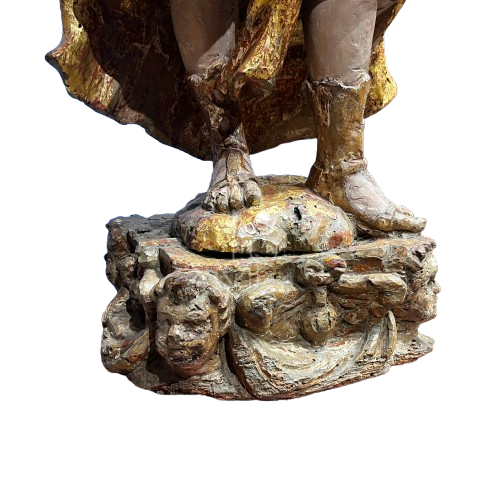
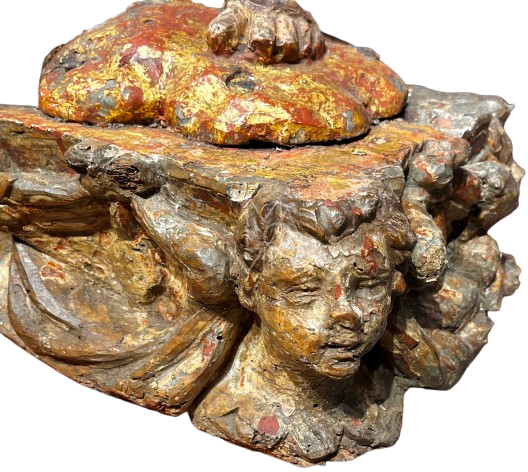
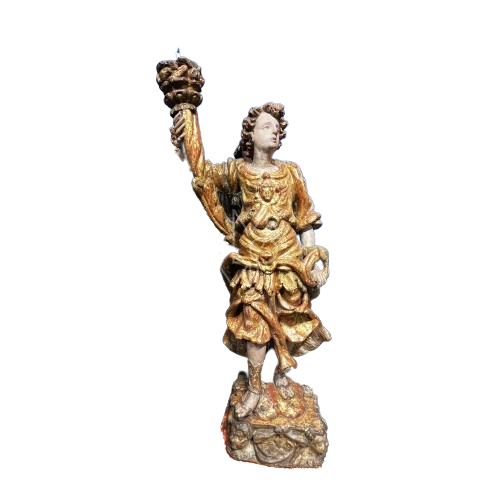
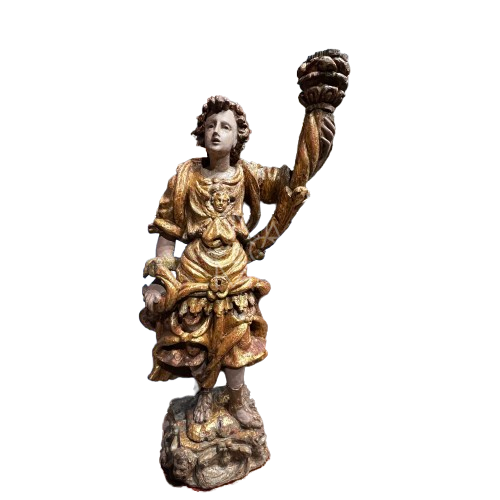
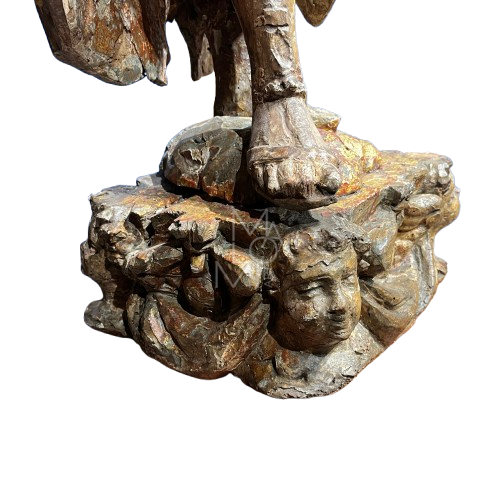
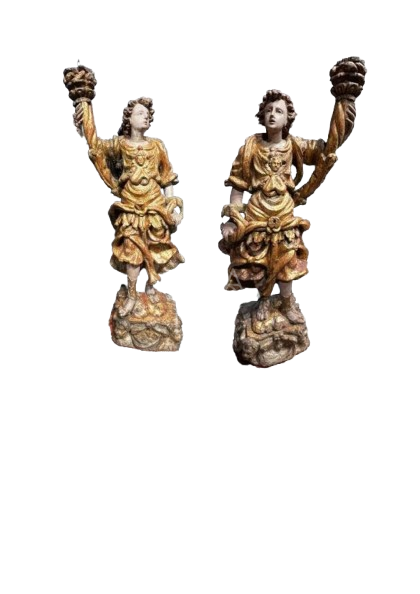
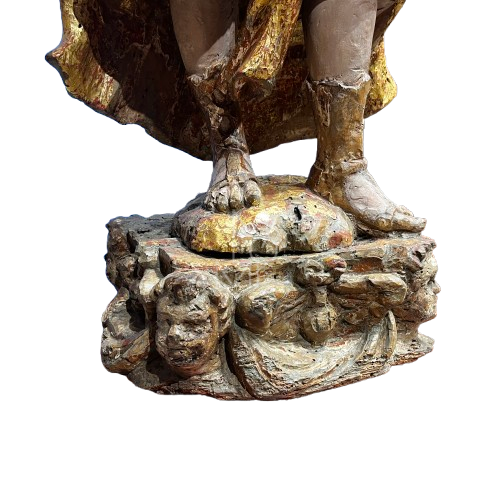
An extraordinary and rare pair of full-length, polychrome, and gilded wooden sculptures depicting ceroferary (candle-bearing) angels. This pendant pair stands as a definitive masterpiece of 17th-century Lombard Baroque woodcarving (c. 1660-1690), originated within the Como artistic milieu under the direct stylistic influence of the renowned Silva dynasty from the Intelvi Valley. Carved in the round (a tuttotondo), the figures exhibit an imposing monumentality and a theatrical all'eroica (heroic) stance, with their countenances cast ecstatically skyward. Each angel cradles a winding cornucopia acting as a candle socket, designed in a mirrored, chiastic composition to serve as fixed wings framing a monumental altar tabernacle. The figures are clad in long tunics characterized by deep, fragmented drapery (luce franta), exposing the legs up to the knee and revealing detailed Roman sandals (cothurni). The sculptures are supported by their original wooden bases carved in the form of a gray theophanic cloud, embellished at the four corners with finely detailed cherub faces.
Technical and diagnostic specifications
- Object Typology: Pair of altar sculptures / Ceroferary angels
- Chronology: High/Mature Baroque (c. 1660-1690)
- Geographical Origin: Lombardy, Como school / Intelvese workshops (Silva circle)
- Medium / Material: Ancient poplar wood (Populus spp.)
- Surface Finish: Original polychromy and gold leaf gilding over bole ground
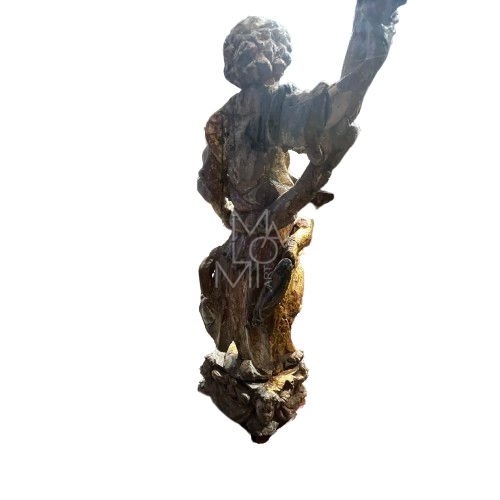
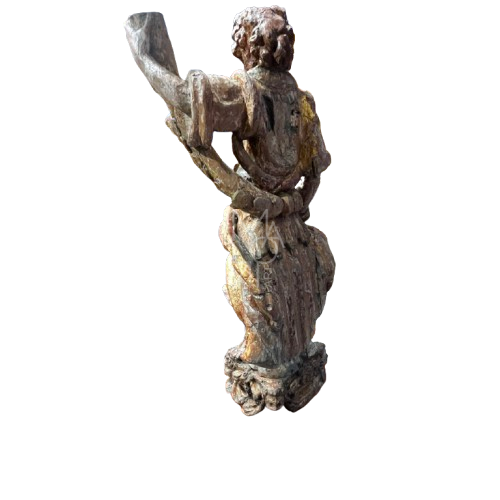
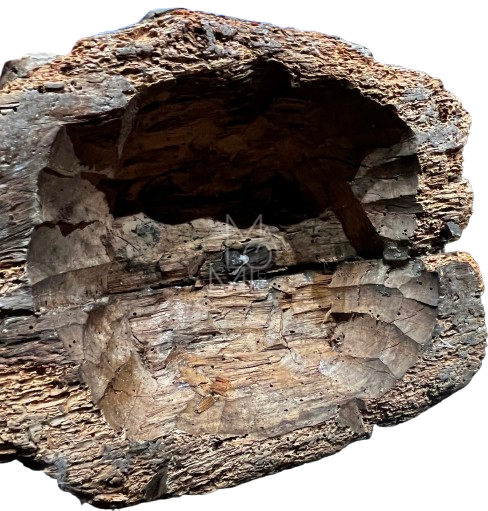
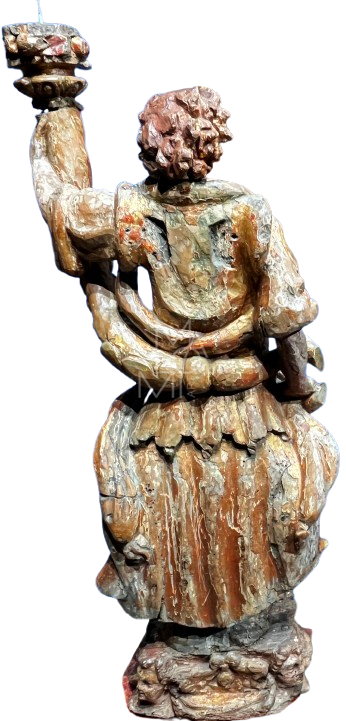
- Structural Features: Flat load-bearing reverse with integrated geometric slots for detachable wings. Structural bell-shaped inner core hollowing (svuotamento a campana) executed from the base up to relief wood tension.
- Dimensions: 122 x 30 x 40 cm (each)
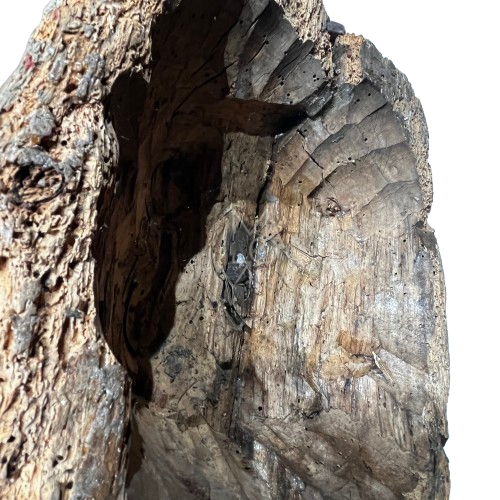
- Conservation Status: Good. The facade shows paint losses exposing the white gesso ground. Heavy beetle tunneling degradation (Anobium punctatum) is visible along the outer sapwood perimeter of the lower base. Original hand-forged wrought iron anchoring pins remain intact with a deep matte oxidation patina and characteristic iron gall staining absorbed by the wood fibers.
The ceroferary Angel in the lombard baroque: A historical-critical, formal, and material analysis of a pair of polychrome wooden sculptures from the Como area
- Historical-artistic introduction and cultural context
Wooden sculptural production represented one of the most vibrant, pervasive, and qualitatively sublime expressions of the Catholic Counter-Reformation, finding a pivotal and driving center within the Duchy of Milan and the broader Lombard territory. Following the decrees of the Council of Trent and the pastoral impetus of Archbishops Carlo and Federico Borromeo, liturgical furnishings underwent a radical reorganization. Ceroferary—or candle-bearing—angels ceased to be mere secondary decorative elements and became an integral component of the Baroque altar apparatus. They were specifically designed to channel the focus of the faithful toward the tabernacle while amplifying the theatricality and devotional intensity of liturgical functions. The pair of sculptures under analysis, with their imposing dimensions of 122x30x40 cm, fits seamlessly into this rich material and iconographic tradition of the high 17th century.
- The socio-political and cultural context of the Como area and the intelvese workshops
During the high 17th century, the Como region constituted a complex geopolitical and cultural borderland. While it was closely bound to the fortunes of the Spanish-ruled Duchy of Milan, it was simultaneously projected toward the transalpine world. The Diocese of Como oversaw a vast territory extending from the shores of the lake to the Swiss bailiwicks, serving as a strategic outpost for Catholicism. From a socio-political perspective, the second half of the 17th century was marked by a complex economic recovery following the devastating plague epidemic of 1630.
Artisanal workshops and woodcarving masters—many of whom were based in the cluster of villages within the Intelvi Valley (Val d'Intelvi), the Canton of Ticino, and the lake basin—reorganized their guild statutes. Extraordinarily prominent dynasties of artisans, most notably the celebrated dinastia dei Silva of Morbio Superiore (featuring leading figures such as Agostino, Francesco, and Giovan Francesco Silva), alongside the Barberini and Taurino families, established a tight monopoly over the production of plastic decorative programs in both stucco and wood. Art was not a purely aesthetic pursuit; rather, it served as a vehicle of political prestige for local oligarchies and civic bodies, who financed the modernization of parish churches to reaffirm their loyalty to the Spanish Crown and the government in Milan.
- The catholic reformation and local religious fabric
The deep religiosity of the local Como fabric was governed by the rigorous enforcement of Tridentine decrees, inherited from Borromean magisterium and staunchly defended by the bishops of the Diocese of Como, such as Feliciano Ninguarda and Lazzaro Carafino. The daily life of the lakeside and valley communities was entirely punctuated by the activities of lay confraternities, particularly the Confraternities of the Blessed Sacrament (Santissimo Sacramento) and of the Rosary (del Rosario). These devotional associations became the primary patrons of wooden statuary.
Local devotion focused intensely on exalting the Eucharistic dogma, which was constantly threatened by the geographical proximity to the reformed Swiss territories (Calvinist and Zwinglian). The pair of candle-bearing angels under examination responds precisely to this doctrinal urgency: the light from their tapers was meant to gloriously illuminate the Altar of the Blessed Sacrament. The local Church harnessed Baroque dramatic intensity to educate and emotionally move the faithful. The all'eroica (heroic) pose of these angels, their ecstatic countenances directed skyward, and the dynamic movement of their garments translated the theological concept of proximity between the earthly and celestial realms into a powerful visual reality, transforming these angelic creatures into guardians of orthodoxy.
- Workshop chronicles, anecdotes, and artisanal rivalries in the Intelvi Valley
Behind the solemnity of these artifacts lies the vibrant, hyper-competitive microcosm of the Intelvese Magistri—a network of family-run workshops regulated by a strict hereditary transmission of technical secrets. Parish archival records from the Como and Lugano regions of the era are replete with legal disputes, correspondences, and "price wars" that reflect the vivid human reality behind sacred woodcarving.
A frequent anecdote found in 17th-century chronicles involves the rigorous evaluations to which parish building committees (fabbricerie) subjected sculptures before final payment. Sculptors from rival parishes were often appointed to judge the quality of a piece. It was not uncommon for a competing evaluator to accuse his rival of using "green" (unseasoned) timber, or of concealing structural defects in the poplar wood beneath excessive layers of gesso, sparking lengthy litigation.
Furthermore, a deeply rooted tradition of "industrial espionage" existed among woodcarving families. Workshop apprentices were occasionally dispatched to neighboring churches to covertly copy the hair designs or drapery compositions of highly sought-after masters like the Silva. This explains the fascinating migration of graphic models and the stylistic homogeneity found across the pre-Alpine region, where a successful invention—such as the fractured drapery revealing the knee—was quickly absorbed into a shared visual lexicon, reproduced by local communities eager to match the grandeur of neighboring parishes.
- Iconographic analysis: The Angel, the cornucopia, and the allegorical apparatus
The work is conceived in the round (a tuttotondo) as a full-length figure, a solution that ensured perfect volumetric legibility from multiple viewpoints within the sacred ecclesiastical space. The figurative composition brilliantly synthesizes biblical motifs with classicizing references. Instead of holding a traditional floral candlestick, the angel cradles a long cornucopia. This attribute, typically tied to pagan iconography associated with abundance (the mythological horn of the goat Amalthea), is here fully Christianized. Within the context of Baroque liturgy, the overflowing cornucopia serving as a socket for the taper does not symbolize worldly wealth, but rather the superabundance of Divine Grace, the infinity of Christ’s light, and the spiritual nourishment of the Eucharist. The twisting, serpentine movement of the horn—which sinuously wraps around the figure, passing behind the back from the left hand to be triumphantly raised by the right—acts as the primary compositional engine, accentuating the verticality and Baroque dynamism of the whole.
- Historical curiosities of the liturgical cornucopia and the "Miracles of Wax"
The substitution of a traditional wooden or metallic candlestick shaft with a cornucopia represents a refined intellectual whim of the high Baroque, but it also conceals practical facets tied to historical devotional practices. In the 17th and 18th centuries, the management of altar candles was not merely a practical chore, but a critical center of financial expenditure and ritual symbolism, overseen closely by confraternities. Pure beeswax, mandatory for liturgical tapers under Borromean regulations, was an absolute luxury commodity, frequently targeting theft and smuggling.
An intriguing curiosity regarding this specific sculptural typology relates to the cornucopia shafts themselves: the curvature of the wood wrapping around the angel’s back required millimetric precision to ensure that the heat of the flame and the dripping of hot wax did not damage the precious gold leaf gilding on the garments below. To resolve this issue, a concealed metallic insert (known as a bocciolo or padella) was placed inside the upper mouth of the cornucopia to catch the molten runoff.
In the popular folklore of the Como countryside, the blessed wax residues extracted from these angelic candle-holders during Easter or Corpus Christi festivities were considered thaumaturgical. Faithful parishioners competed to obtain small fragments, melting them down into domestic talismans to protect their crops from the devastating lake storms and hail.
- Formal structure, drapery, and corporeal dynamism
From a formal and stylistic standpoint, the sculpture projects a fierce, solemn, and monumental stance. The body’s weight is distributed according to a calculated counterpoised (contrapposto) scheme that shatters the static nature of the wooden block. The garment consists of a long, finely carved tunic characterized by deep drapery, tormented by projecting and sharp folds that capture and refract light. This generates the effect of fractured light (luce franta), which is highly characteristic of the carving solutions favored by Intelvese masters. The bold cut of the skirt, exposing the legs on the front up to the knee, and the detailed Roman sandals (cothurni) cladding the feet directly evoke the fashion of dressing all'eroica or all'antica (in the heroic or ancient style). A prominent cherub head decoration stands out in relief on the chest, gathering the fabric of the tunic—a refined detail that functions both as a decorative element and as a theological seal confirming the celestial nature of the creature. The angel's face, framed by a thick mane of forcefully carved wavy hair, is turned skyward with expressive pathos, dramatically linking the sculptural space of the statue to the metaphysical light descending from heaven or the church’s architectural heights.
- The compositional chiasmus and the balance of the pendant pair
The second sculpture of the pair manifests the Baroque principle of mirroring correspondence with absolute clarity, a fundamental requirement for the design of 17th-century Lombard altar complexes. While the dynamic thrust in the first specimen relies on the elevation of the right arm, the action is inverted in a strictly symmetrical fashion in the second work: the angel raises the long cornucopia with the left hand, which wraps behind the back and converges toward the opposite right hand.
This configuration establishes a perfect chiastic scheme when the two sculptures are placed on either side of the tabernacolo or the altar ancona. The two angels are not conceived as isolated entities, but as a unified, theatrical scenic machine. The gaze of this second angel is likewise cast upward with deep pathos, yet with a slight inclination that, when contrasted with the first figure, centers the viewer’s attention onto the focal point of the sacred space, enhancing the visual and spiritual convergence of the Baroque architecture.
- Material analysis and structural engineering: the solid-block sculpture and the hollowed-out base
Direct examination of the reverse side and the lower support section reveals a specific construction technique, highly characteristic of pre-Alpine Baroque timber engineering for large-scale figures. The sculptor carved the poplar (Populus spp.) trunk while maintaining the angel's body as a completely solid block, entirely without interior hollowing. The upper scapular dorsal region displays a synthetic treatment executed via wide gouge strokes, featuring two distinct rectangular mortise slots meticulously chiseled to accommodate the insertion of detachable wings (now lost).
Analysis of the underside reveals that the bell-shaped hollowing is exclusively confined to the interior of the cloud-shaped base. This peripheral cavity was designed to lighten the pedestal and relieve the hygrometric tensions of the timber at its thickest point. The structural body of the sculpture above—which remained solid to ensure maximum mechanical resistance against the leverage of the heavy cornucopia—is firmly anchored and secured to the underlying base by means of large, hand-forged historical wrought iron nails and pins. These metallic joints, visible within the lower cavity, display a deep oxidation patina that has chemically mineralized the surrounding poplar fibers, permanently sealing the coeval assembly of the two components.
- Detailed analysis of the basements and micro-sculpture
The quadrangular pedestal is conceived as an integral part of the sacred narrative, modeled in the form of a gray cloud acting as a volumetric expression of the theophanic sky. Emerging from the four corners of the plinth are cherub faces carved in high relief, revealing remarkable execution quality. The somatic features display heavy eyelids, pronounced cheeks, and lips parted in a vibrant, naturalistic rendering, flanked by a drapery festoon modeled as a garland across the front of the block. The plastic and vigorously roughed-out curls indicate the full reception of the rhetorical and emotional idiom of the mature Baroque of the late 17th century (c. 1660-1690). From a strictly sculptural perspective, the atmospheric softness of the cloud contrasts sharply with the brilliance of the garments above, exalting by volumetric antithesis the aerial lightness of the celestial creature suspended over the vaporous mass of its own wooden base.
- Conservation state and pictorial stratigraphy
Close inspection reveals a rich stratigraphy of chromatic layers and documents the complex conservation history of these pieces. On the surface of the cloud and the faces, traces of the original gold leaf gilding laid on bole emerge, partially obscured or integrated by subsequent historical patinas in shades of ochre, gray, and brown. Within the holes on the reverse and beneath the base, remnants of wrought iron pins exhibit a deep oxidation patina, characterized by a dark, matte, and stratified brown-reddish hue (magnetite and goethite). Around the insertion points of these pins, the fibers of the poplar wood display a dark, chemical-chromatic transition halo (iron gall staining), caused by the centuries-long reaction between the iron oxide and moisture.
The wooden surface exhibits the physiological signs of aging, with widespread paint losses and micro-flaking that reveal the underlying ammannitura (the white gesso preparation layer). A heavy accumulation of coherent dust and historical patinas has settled within the cavities and gouge marks of the reverse. Moreover, a severe wood-boring beetle infestation (Anobium punctatum) is evident, particularly concentrated along the outer perimeter of the base (the softer sapwood layer). This infestation, now stabilized, reduced the wood to a characteristic channeled tunneling texture, providing undeniable material evidence of the artwork's age.
- Hypothesis on the definitive original placement
By cross-referencing the monumental height (122 cm), the lighting function of the cornucopia, the structural engineering of the load-bearing solid reverse fitted with wing slots, and the hollowed-out base, any hypothesis suggesting a placement on a free-standing 360-degree presbyterial balustrade is categorically excluded. The artwork was imperatively engineered for a frontal or slightly angled view. The statues were originally mounted against the walls of a large, monumental altar machine within the Como area. They were nestled within lateral niches or positioned atop side pedestals and broken cornices bordering the central tabernacle. In this configuration, they acted as fixed theatrical wings to frame the operational liturgical space while visually enhancing the perspective transition toward the Eucharistic repository.
- Critical conclusions
In conclusion, the pair of candle-bearing angels under examination stands as an excellent and cohesive testament to 17th-century Lombard Baroque manufacture from the Como region, heavily influenced by the plastic models of the Intelvese workshops. The ability to maintain extraordinary proportional consistency while symmetrically mirroring the posture and movement of the cornucopia demonstrates that the workshop operated using rigorous design templates. The robustness of the anatomical structure, the vigor of the woodcarving, and the moving pathos of the faces distinguish this work from coeval Roman Baroque developments or the more decorative solutions of the Neapolitan school. The artwork constitutes a visual document of the highest significance, capable of seamlessly synthesizing the rigor of Counter-Reformation devotion with the spectacular formal theatricality that defines the golden age of Northern Italian art.
Reference Bibliography
- AA.VV., Scultura lignea barocca in Lombardia, edited by Daniele Pescarmona, Milan, Cariplo, 1992.
- Arslan, Edoardo, Le pitture e le sculture di Brescia, Brescia, 1962.
- Banzato, Davide; Spiazzi, Anna Maria (eds.), Angeli. Volti dell'Invisibile, exhibition catalogue, Milan, Skira, 1999.
- Borromeo, Carlo, Instructiones fabricae et supellectilis ecclesiasticae (Milan, 1577), translation and notes edited by Massimo Marinelli, Vatican City, Libreria Editrice Vaticana, 2000.
- Casciaro, Raffaele, La scultura a Milano nel Seicento: dinamiche di bottega e modelli romani, in "Nuovi Studi", V, 8, 2000, pp. 115-132.
- Casciaro, Raffaele, Le corna della discordia: l'iconografia della cornucopia nell'arredo liturgico d'età barocca, in "Arte Cristiana", LXXXVIII, 2000, pp. 245-256.
- Frangi, Francesco; Morandotti, Alessandro (eds.), Il Seicento lombardo, exhibition catalogue, Milan, Skira, 2004.
- Mazzini, Franco, I Fantoni: quattro secoli di bottega di scultura in Europa, introduction by Giovanni Testori, Bergamo, Provincia di Bergamo, 1978.
- Pescarmona, Daniele (ed.), I Silva: una dinastia di scultori tra barocco lombardo e classicismo romano, Como, NodoLibri, 1998.
- Terraroli, Giovanni, Scultura in legno nel Bresciano: dal Rinascimento al Barocco, Brescia, Grafo, 1986.