Candelabra angels with removable wings: a scholarly catalog and structural analysis of a pair of seventeenth-century wooden sculptures
Scholarly catalog entries and diagnostic profiling of a pair of carved and water-gilded wooden church angels. Early 17th-century Po Valley craftsmanship (h. 62 cm) featuring a rare demountable sliding wing mechanism.
- Typology: Pair of specular, liturgical d'apparat candelabra sculptures (ceroferari angels).
- Dating: First three decades of the 17th century (circa 1600-1630).
- Cultural sphere: Northern Italian workshop, regional Lombard-Venetian borderland (Brescia, Bergamo, or Mantua).
- Material and technique: Carved softwood (Swiss stone pine or poplar), water gilding with pure gold leaf over a brownish-red Armenian bole, polychrome flesh tones rendered in fine oil mediums.
- Dimensions: Height 62 cm, width 35 cm, depth 20 cm each.
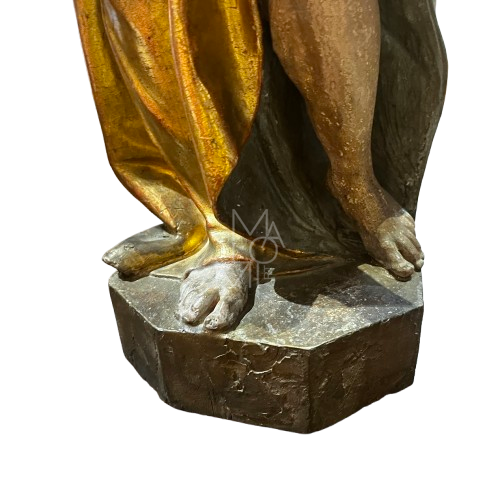
- Basement: Integrated molded octagonal base finished in a dark, faux-stone mineral polychromy.
- Structural peculiarity: Mechanical bayonet attachment system with removable and sliding wings utilizing hand-forged iron hooks and cross-locking safety pins, engineered for the transport requirements of post-Tridentine demountable festive altars.
- Conservation status: Stable primary structural core; radial shrinkage cracks (occipital and front drapery zones); widespread surface craquelure with lifting scales and losses of gold leaf; oxidation of ferrous hardware elements; abraded flesh tones showing historical overpaintings.
Historical-Artistic, Structural, and Diagnostic Study on a Pair of Candelabra Angels in Carved, Gilded, and Polychrome Wood from the First Half of the Seventeenth Century
Chapter I: Introduction and Typological Contextualization within the Counter-Reformation Liturgical Framework
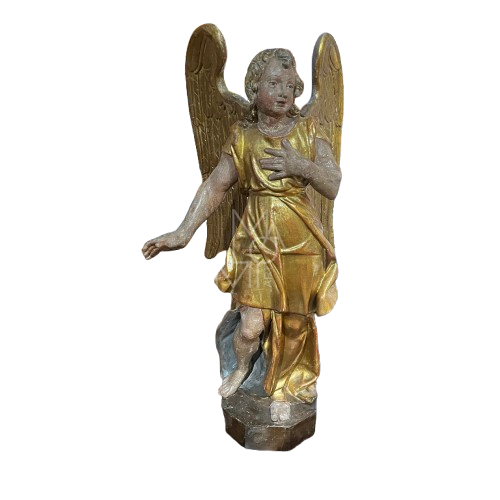
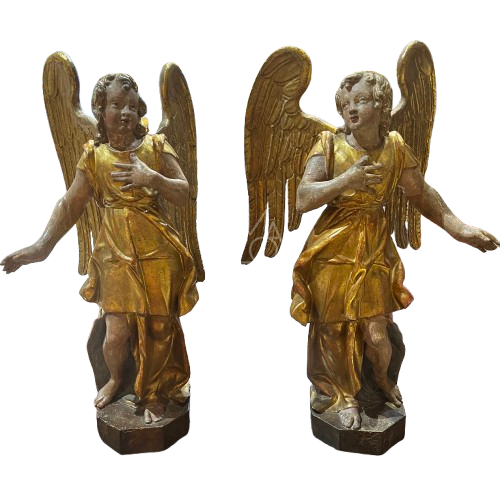
The pair of sculptures under examination, depicting two splendid standing angels, symmetrical and specular, presents itself to the scholar as an excellently preserved example of that sacred wooden plastic art which flourished in Northern Italy between the late sixteenth and the first decades of the seventeenth century. With a height of sixty-two centimeters, a maximum width of thirty-five, and a depth of twenty, these figures belong to the successful category of minor statuary for devotion and liturgical furnishing, originally conceived as an integral part of a complex and monumental altarpiece mechanism. Both figures rest on rigorous molded octagonal bases, a geometric device typical of the Late Renaissance and Baroque tradition that guarantees structural stability and perspectival rigor. In the complex sacred numerology that reaches the modern era intact from medieval speculations, the number seven exhausts the creation of human time (linked to the seven days of Creation), while eight represents the emblem of the Resurrection, marking the overcoming of the worldly dimension and the entrance into eternity, symbolized precisely by the eighth day of theological reckoning.
The specular arrangement of the bodies clearly indicates that the two artifacts were destined to flank a central element of utmost importance, such as a tabernacle, a crucifix, or the altar canopy itself, channeling the gaze of both the faithful and the celebrant toward the focal point of the Eucharistic mystery. This reorganization of sacred space responded strictly to the decrees emerging from the Council of Trent, sealed in fifteen sixty-three, which had strongly reaffirmed the pedagogical, emotional, and devotional value of sacred images under the rigid formula of the decree De invocatione, veneratione et reliquiis sanctorum, et sacris imaginibus. In the climate of the Counter-Reformation, the angel ceased to be a purely decorative or abstract figure and reclaimed its ancient role as a minister of the heavenly court, actively participating in earthly ritual. The light that these sculptures originally supported, through torches or metal candles inserted into the metal supports or wooden cornucopias originally fitted into their outstretched arms, did not merely serve a practical necessity of illumination, but embodied the Lux Christi, the living and radiant presence of the deity on the tabernacle, transforming the altar into a true stage of faith where wonder was meant to move the soul to devotion.
A historical curiosity linked to this typology of artifacts resides in the fact that candelabra angels were often adorned with real fabrics or garlands of fresh flowers during the main festivities of the liturgical year. The accounting ledgers of seventeenth-century parishes frequently report small expenses destined for the purchase of silk ribbons or metal wires used by sacristans to secure ephemeral elements to the outstretched arms of the sculptures, demonstrating how these objects were not considered cold, motionless simulacra, but dynamic actors constantly re-signified within Baroque theatricality.
Chapter II: Formal, Stylistic, and Iconographic Analysis between Mannerism and Baroque
From the standpoint of stylistic rendering, the sculptures exhibit a refined balance between the formal legacies of Late Mannerism and the first, vigorous accents of the Po Valley Baroque. The bodies of the angels are animated by a slight but perceptible contrapposto, in which the weight is distributed asymmetrically across the legs to generate a sinuous, almost serpentine movement that rises along the torso and concludes in the proud torsion of the neck. This disruption of rigid medieval frontality still reflects the sophisticated lessons of the second half of the sixteenth century, yet opens up to a completely new fluidity designed to conquer the surrounding space by breaking the boundaries of the wooden block.
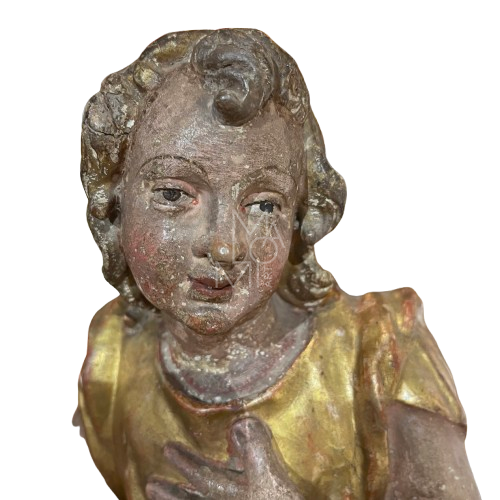
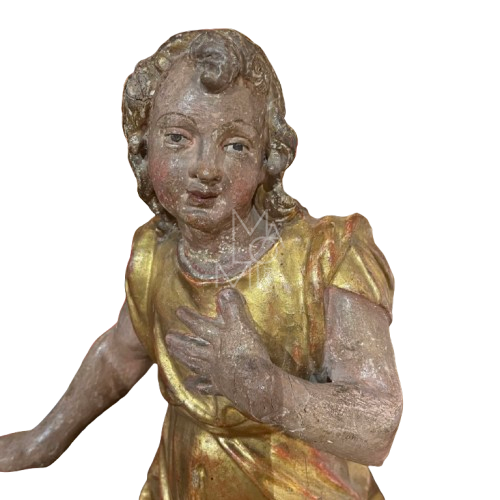
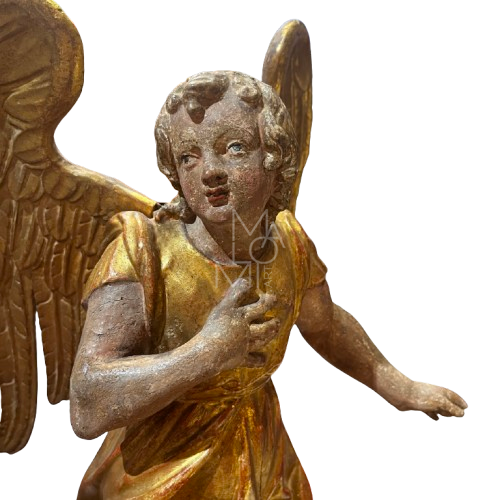
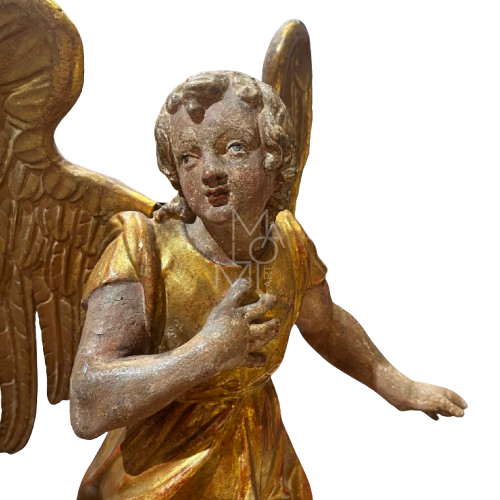
The faces present idealized features but are charged with a deep pathetic expressiveness. In the first angel, the head is rotated three-quarters and tilted upward, with full lips visibly parted in the act of hinting at a silent prayer or a sacred chant, a visual device that Baroque literature defined as the rendering of mystical ecstasy. The second angel, while sharing the same proportional matrix, offers a more frontal and focused gaze, studied to converge downward, ideally toward the officiating priest. The rendering of the hair constitutes one of the qualitative peaks of the pair, where the carver hollowed out the wooden mass with deep gouges to isolate compact, serpentine curls, among which a virtuosic snail-like curl stands out on the forehead of the second angel. The deep grooves did not have a merely descriptive function, but served to create artificial shadows capable of highlighting by contrast the brilliance of the gilded crests, ensuring a vibrant legibility of the faces even in the dim light of altar candles.
The drapery of the tunics does not merely cover the anatomy, but follows its dynamism through deep, geometric, and sharp folds that intersect in the front section, forming a characteristic diamond or X-shaped pattern. The fabric tightens at the waist by means of a high belt, then bulges above the knee of the free leg and falls in heavy vertical folds down to the octagonal base. This broken movement generates a syncopated visual rhythm that intentionally contrasts with the realistic softness of the bare flesh tones, emphasizing the supernatural and glorious nature of the heavenly garments. Finally, the large outspread wings dominate the composition, extending upward. Their plumage is extremely detailed on the front, defined through a graphic and parallel carving that accentuates the verticality of the figures and lightens their massive wooden bulk.
An interesting anecdote concerns the gestural expression of these heavenly figures: in the conduct manuals for preachers and theatrical actors of the early seventeenth century, the hand brought to the chest with slightly splayed fingers, exactly as observed in this pair, was codified as the visual sign of intimate persuasion and submissive acceptance of the divine will. The artisan who carved these angels did nothing more than translate into wood a gestural code perfectly comprehensible to the public of the time, who attended both religious functions and profane theatrical stages.
Chapter III: Material Aspects, Execution Technique, and the Specific Po Valley Mobile Joinery with Removable Wings
A profound understanding of the materiality of these sculptures requires an examination focused on cabinetry techniques and the singular constructive intelligence that governs their assembly. The carver worked on a primary log of soft, compact-grained wood, presumably Swiss stone pine or poplar, species of choice for Po Valley plastic art due to their homogeneity and the absence of hard knots, qualities that allowed for the execution of very bold undertrims while minimizing the risk of sudden splitting. While the body of the angel and the octagonal base are carved from this main vertical-grained block, the wings constitute independent elements, carved separately to follow the natural direction of the plumage grain and avoid wasting raw vegetable material.
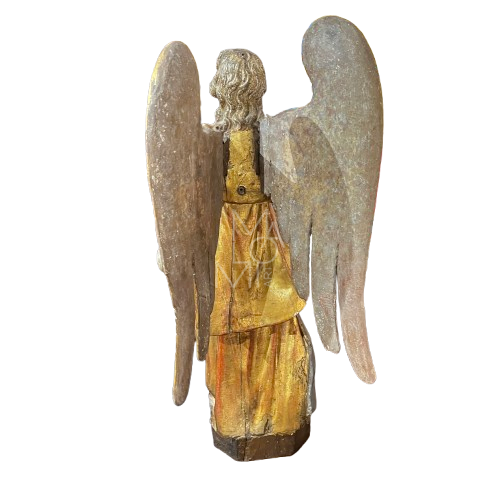
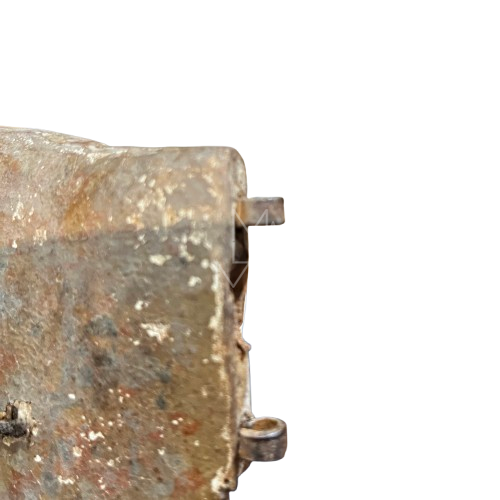
The element of maximum engineering and technological interest resides in the overcoming of blind and permanent anchoring systems, typically sealed with strong glues or irreversible pass-through riveting. The workshop here applied a sophisticated solution of flexible mobile joinery, based on the principle of removable or sliding wings with a bayonet fitting. The inner joint profile of the wing houses two protruding metal appendages in hand-forged iron, acting as true hinges or alignment guides. The upper appendage presents a robust solid square section, designed to slide from top to bottom inside an open-ended mortise or slotted track cut into the back of the wooden fusto. The lower appendage exhibits instead an ring or eyelet morphology. When the wing completes its downward path along the upper guide, this eyelet fits precisely into a corresponding slot made on the angel's torso.
This refined structural kinematics was completed by a subsidiary safety device acting as a true mechanical keystone. Through a pass-through circular hole in the back of the statue, in perfect alignment with the housing of the metal eyelet, a wooden pin (wedge) or a cross-metal pin was inserted from the outside. This pin intercepted the iron ring of the wing, locking it solidly to the body, canceling any torsional or shuddering play resulting from the protruding center of gravity and supporting the lateral thrust of the stretched wings. At the same time, removing the pin allowed for the immediate sliding of the entire wing apparatus upward in a few seconds. Such flexibility preserved the fragile feathered ends from accidental impacts during handling and responded to precise logistical needs linked to coeval liturgical furnishing.
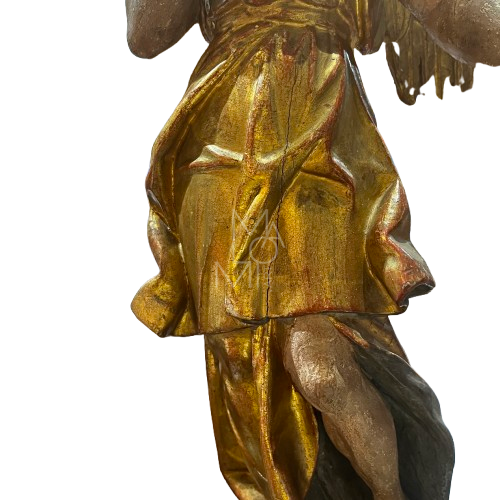
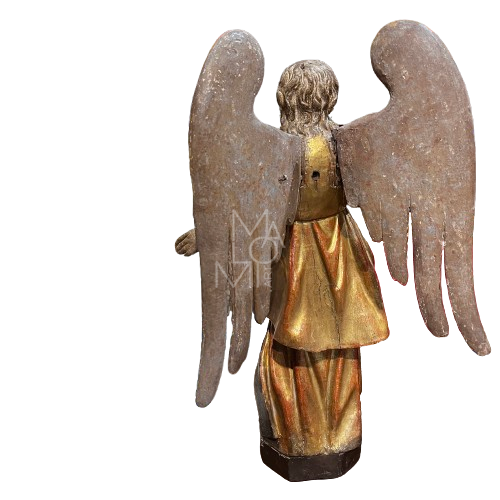
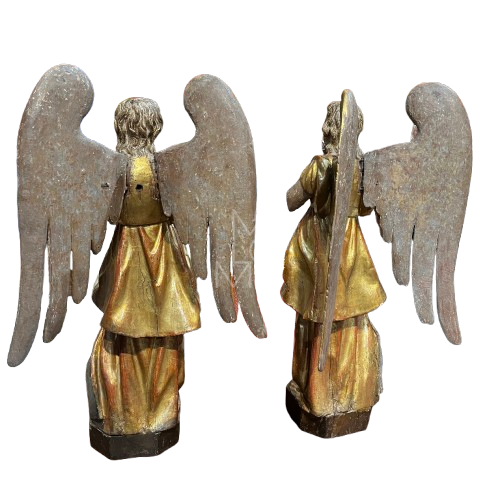
The characteristic logic linked to the workshop economy of the period is also revealed on the back of the sculptures. While the front shines with the dazzling technique of water gilding—executed by applying pure gold leaf over a bed of brownish-red Armenian bole laid on glassy preparations of gesso and rabbit-skin glue, and subsequently burnished to a mirror finish with an agate stone—the back of the bodies shows a synthetic carving in relief-shalt (schizzato), intended to remain hidden from the sight of the faithful. The same drastic material contrast governs the posterior section of the wings: completely devoid of gilding, they are coated with a poor, matte polychromy based on natural earths and lampblack, quickly applied with large brushstrokes to simulate plumage with gray-blue tones. In seventeenth-century workshops, the youngest apprentice was usually tasked precisely with roughing out the back portions and applying matte finishes. It is not uncommon to discover, beneath these poor patinas, small graphic marks or initials traced in charcoal by assistants to identify the pieces during assembly—precious invisible signatures destined to remain secret.
Chapter IV: Historical Deepening: The Logistics of Demountable Altars and the Structural Role of Seventeenth-Century Pastoral Visits
The adoption of a system with removable and sliding wings on this pair of candelabra angels should not be interpreted as an isolated technical virtuosity, but finds a precise historical explanation in the strict logistical, devotional, and legal requirements that regulated the management of sacred furnishings in post-Tridentine Italy. The seventeenth century was the era of great pastoral visits, a legal-administrative institution relaunched with force by the Council of Trent to reaffirm episcopal authority over the territory and granularly verify the decorum, orthodoxy, and conservation status of every single church in the diocese, from city cathedrals to the most remote rural oratories.
During these inspections, bishops' decrees—inspired by the famous Instructiones Fabricae et Supellectilis Ecclesiasticae introduced in Milan by Saint Charles Borromeo in 1577—often imposed radical modifications on existing altars, ordering the replacement of furnishings considered obsolete, indecent, or non-compliant with the rigid Counter-Reformation aesthetic. Many minor altars and family chapels did not possess stable structures in marble or masonry, but were equipped with transitional wooden decorative apparatuses, known in documents as "mobile altars," "apparatus machines," or "sacred theaters." These complexes were set up on the occasion of specific solemnities, patronal feasts, or Forty Hours devotions, and were then dismantled and stored in warehouses or sacristies to preserve them from winter dust and humidity.
In this context, the ability to rapidly disassemble the most fragile and cumbersome elements of a sculpture acquired vital importance. Candelabra angels, positioned on altar steps or at the sides of the tabernacle, were constantly exposed to the risk of damage during the frantic phases of assembling and dismantling festive scaffolding. The wings, with their protruding, thin, and jagged profile, constituted the point of maximum mechanical vulnerability. A system of removable wings allowed sacristans and parish carpenters to store the angel bodies and wings in separate crates, optimizing warehouse space and reducing to zero the probability of breaking the feathered carving during transport.
Furthermore, there was a frequent circulation of sacred apparatus furnishings among different churches within the same pieve or diocese. It was not uncommon for wealthier parishes to rent or lend their wooden machines and gilded statues to neighboring communities lacking means, enabling them to worthily celebrate major religious anniversaries. The artifacts therefore had to travel on animal-drawn carts along the rough local roads of the Po Valley or the valleys, exposed to constant vibrations, jolts, and inclement weather. An angel conceived with fixed, integrated wings would have required huge transport crates and would have faced almost certain breakage at the joint points due to the dynamic stresses of travel. The ingenious system with an iron ring and a removable cross-pin brilliantly solved this problem: the wings were packed flat, adhering to the sides of the bodies or in dedicated compartments, absorbing impacts without transmitting destructive tensions to the torso of the sculpture. The carving technique thus bent with extraordinary foresight to the harsh logistical necessities and bureaucratic practices of the seventeenth-century Church.
Chapter V: Diagnostics of the State of Preservation and Material History
A close analysis of the matter and the internal sections of the sliding joints analytically documents the complex conservation history of the two artifacts, marked by localized mechanical stresses and past interventions of devotional maintenance. The wooden support shows the physiological signs of time, in particular some radial cracks and longitudinal splits that run vertically through the front draperies and the nape of the figures. This damage is caused by the hygrometric movements of the wood which, expanding and contracting over the centuries to accommodate changes in humidity within churches, exerted strong internal tensions until causing the fibers to split, especially in the primary logs that retain the core of the trunk. Since the preparatory layer of gesso and glue is by nature rigid and devoid of elasticity, it was unable to follow these movements of the wood, resulting in superficial micro-cracking (craquelure) and dangerous flaking of the gilded and painted film, especially along the edges of the garments and on the shoulders.
This dorsal portion, precisely due to its mobile nature and the continuous historical friction linked to the seasonal assembly and disassembly of the wings, shows signs of severe mechanical and material degradation. The wood profile along the wing's contact line is completely devoid of any preparatory layer of gesso or gilding, exposing bare, frayed, and blackened wood fibers due to coherent deposits. Longitudinal micro-cracks from mechanical stress are found concentrated around the insertion points of the iron hinges. The hand-forged ironwork shows widespread and deep surface oxidation, with the formation of porous rust scales. This chemical phenomenon has caused a partial swelling of the metal, exerting dangerous internal pressure on the walls of the housing holes, which threatens the cohesion of the wooden support and hinders the original fluidity of the wing sliding. In the immediate vicinity of the joint, on the visible front of the wing, the preparatory layer shows flaking and sudden losses of gold leaf, caused by vibrations and micro-percussions produced by the metal appendages whenever the wing was repositioned in its housing.
In the areas of the flesh tones, particularly on the feet, hands, and cheeks, the original oil polychromy appears heavily depleted due to historical rubbing and improper cleaning, exposing the underlying grigiastra preparation and some subsequent repaintings, identifiable in the reddish traces applied in ancient times to revive the faded color of the faces. On the summit of the heads and along the edges of the octagonal bases, numerous circular exit holes are also found, attributable to biological attack by wood-boring insects. Although the woodworm infestation appears inactive today, internal galleries may have reduced the density of the wood at specific points. Finally, the overall surface is covered with an uneven, stratified patina composed of historical dust, coherent deposits, and residues of maintenance waxes or fossil wax dripped from sacred candles, which over the centuries infiltrated the crack of the preparation, creating small waterproof areas that darkened the tone of the surface protective varnishes.
Chapter VI: Archaeometric analysis of the octagonal base undersurface and identification of the wooden substrate
The close examination of the molded base undersurface provides analytical data of exceptional scientific value for the dating of the manufacturing process, revealing the traces of historic carpentry tools and the morphology of structural degradations accumulated over the centuries. The unlevelled surface displays clear marks of rough-hewing executed through workshop adzes and flat chisels, leaving the raw texture of the wood fiber fully exposed.
From the standpoint of material and botanical identification, the grain conformation, the diffuse yet fine porosity, and the natural light-brown coloration emerging beneath the patina of historical grime allow for the attribution of the wooden substrate to the genus of poplar (Populus nigra or Populus alba). This softwood was widely prevalent and employed in Po Valley liturgical statuary between the sixteenth and seventeenth centuries due to its high workability under the blade.
The conservation diagnostics applied to this section document phenomena linked to the macroscopic shrinkage of the wood mass. A deep radial drying crack cuts longitudinally through the octagonal block, originating from the outer perimeter and converging toward the geometric core of the original tree-trunk pith. This fracture is partially filled with incoherent debris and traces of ancient patinas.
Furthermore, the left quadrant of the base highlights damage caused by a severe, past infestation of wood-boring insects: the fiber appears deeply hollowed and porous due to a dense network of collapsed internal galleries, which have compromised the superficial structural cohesion of the perimeter edge. The absence of fresh frass indicates that the biological attack is currently inactive, although the area requires an urgent structural consolidation via the infiltration of fluid resins to restore the mechanical density of the sculpture's supporting foot.
Critical-Conservation Appendix I: In-Depth Analysis of the Back and Structural Framework of the First Specimen
The autoptic investigation conducted on the posterior portion of the first specimen offers fundamental data integrating the purely aesthetic examination of the front, providing clear answers about the original joinery. The back view constitutes the technological archive of the work, where the artisan left execution traces unmasked by the gold finish.
- The differentiated carving: The back of the body shows a simplified and synthetic volumetric finish compared to the front. The draperies maintain the direction of the vertical folds but lose the deep tridimensional chiaroscuro modulation of the front. This relief-shalt (schizzato) treatment definitively confirms that the works were placed against a fixed structure and not visible from all sides by the congregation.
- Wing attachment: In the center of the angel's back, the joint line where the tenone of the left wing inserts into the mortasa is clearly visible. This joint appears partially sealed by historical fillings based on gesso and animal glue, applied in ancient times to hide the discontinuity of the contact line prior to the application of the paint film, and reinforced by hand-forged vertical metal pins.
- Structural holes: A pass-through circular hole is noted in the upper-middle part of the back of the left angel. This technical housing originally accommodated a pin or a metal hook (anchoring bracket), used to secure the statue to the marble or wooden wall of the altar, preventing it from tipping over due to the forward imbalance of the outstretched arms.
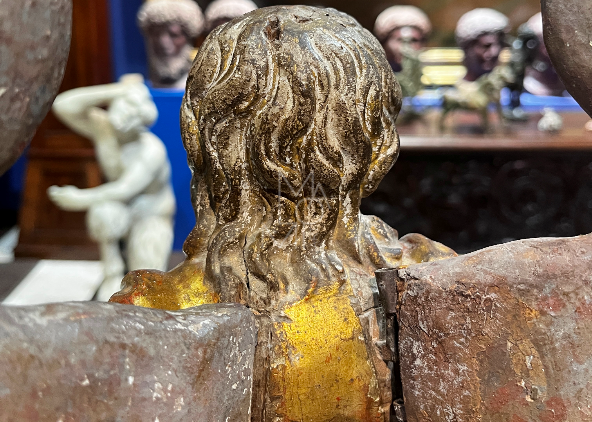
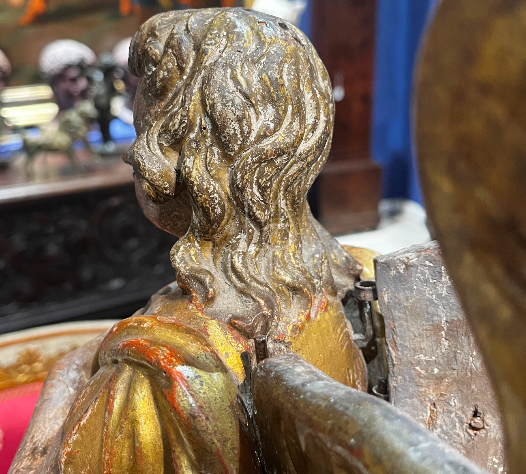
Critical-Conservation Appendix II: Focus on the Head, Hair, and the Second Face
The macro detail of the heads and the upper portion of the torso provides the opportunity to closely analyze the carver's execution skill and the degradation phenomena affecting the apical zone of the sculptures, comparing the physiognomic correspondences of the manufacture.
- The plastic analysis of the hair: The hair is carved in sinuous, moving, and wavy curls falling onto the nape, framing the face. The deep gouge carving develops an organic flow that generates strong chiaroscuro contrasts. The surface shows a complex chemical-material stratification: above the gesso preparation, traces of the original water gilding are observed, integrated by a dark polychrome finish applied in the hollows of the curls to define shading. Centuries of wear have removed the surface gold layers on the raised areas, revealing the underlying whitish preparation.
- Comparative analysis of physiognomies: The first angel shows a head rotated three-quarters and tilted upward, with full lips parted in the act of hinting at a silent prayer or a sacred chant, infondendo the figure with a strong dramatic and ecstatic tension. The second face, while sharing the same proportional matrix, presents a more frontal and focused gaze, studied to converge downward. On the forehead of the latter, a very prominent central snail-like curl stands out, acting as the geometric hub of the hairstyle. The definition of the eyebrows and the cut of the eyes reveal with absolute certainty the hand of the same master carver.
- Alterations of the apical zone: A dense and widespread network of micro-cracks affecting the entire painted and gilded film of the head is recorded, due to wood contractions. A clear biological attack by wood-boring insects is found, evidenced by exit holes concentrated on the summit of the head. The gap between the wing and the shoulder shows signs of natural historical structural adjustments: the original filling that was originally meant to mask the joint point has been almost entirely lost.
Critical-Conservation Appendix III: Axial Back Focus of the Second Angel and Structural Conclusions
The axial posterior view of the second angel allows for the completion of the specular examination of the pair's wooden joinery, confirming the methodological constants of the carving workshop and offering a definitive summary of the structural health of the two artifacts.
- The joinery of the second specimen: In the center of the back, along the axis of the gilded tunic, the square housing hole provided with the pass-through pin or the wooden locking wedge is visible. This device, homologous to the one found in the first angel, ensures the coincidence of altar fixing practices. In this specimen too, the vertical folds of the tunic on the back are resolved with broad and sliding planes, devoid of undertrims.
- Morphology of the wing svasatura: The left wing (right for the observer) shows a clean and geometric cut in the upper inner part, near the shoulder. This svasatura derives from a millimetric adaptation performed in ancient times to make the sculpture adhere perfectly to the molding of the hosting altar, confirming how removable wings were trimmed and adapted directly at the installation site.
- Overall structural conclusions: The combined investigation of the two angels allows for the determination that the pair retains good nuclear stability, guaranteed by the solidity of the single-block wood logs. However, the attachment points of the mobile wings and the large radial cracks from hygrometric shrinkage (particularly on the nape and front draperies) represent the vectors of greatest mechanical fragility. The internal tensions of the wood are still sensitive to thermohygrometric variations, making it mandatory to control the exhibition microclimate (maintaining a stable relative humidity between 50% and 55%) to prevent the widening of cracks and the consequent detachment of the raised preparatory scales.
Appendix: Specialized Bibliography on Polychrome Wooden Sculpture between the Sixteenth and Seventeenth Centuries
- Bacchi, Andrea, ed., Scultura del Seicento a Roma, Milan, Longanesi, 1996.
- Banzato, Davide and Anna Maria Spiazzi, eds., Scultura lignea policroma nel Veneto. Dall'alto Medioevo al primo Seicento, Milan, Skira, 2004.
- Baxandall, Michael, The Limewood Sculptors of Renaissance Germany, New Haven-London, Yale University Press, 1980.
- Bologna, Ferdinando, Il soffitto della Sala Magna dello Steri di Palermo e la cultura figurativa del Trecento e Quattrocento, in Studi di Storia dell'Arte, volume one, 1990.
- Casciaro, Raffaele, La scultura lignea del Rinascimento in Puglia, Rome, Gangemi, 2001.
- Castelnuovo, Enrico, ed., Scultura lignea: Lucca 1200-1425, Milan, Electa, 1995.
- Cavalieri, Federico, Osservazioni sulla scultura lignea lombarda tra Manierismo e Barocco: le botteghe dei Taurino e dei d'Alberto, in Prospettiva, numbers 83 and 84, 1996, pages 112-129.
- Gentilini, Giancarlo, I Taurino e l'intaglio ligneo in Piemonte tra Cinque e Seicento, Turin, Centro Studi Piemontesi, 1999.
- Giusti, Paola, ed., Scultura lignea sacra nel Regno di Napoli, Naples, Electa Napoli, 1992.
- Masi, Giorgio, Tecniche della doratura storica: dal guazzo alla mecca nel contesto degli arredi sacri seicenteschi, Florence, Nardini Editore, 2012.
- Passeri, Giovanni Battista, Vite de' pittori, scultori ed architetti che hanno lavorato in Roma, morti dal 1641 fino al 1673, Rome, anastatic reprint, 1934.
- Santi, Francesco, La scultura lignea in Umbria dal XII al XVI secolo, Rome, Istituto Poligrafico dello Stato, 1776.
- Spiazzi, Anna Maria, Gli angeli candelofori nella liturgia veneta post-tridentina: forme, funzioni e botteghe d'intaglio, in Arte Veneta, volume 52, 1998, pages 45-61.
- Terraroli, Giovanni, ed., La scultura lignea in Lombardia, Milan, Cariplo, 1997.
- Veca, Giovanni, La bottega e il sacro: l'intaglio ligneo nell'Italia settentrionale tra Manierismo e Barocco, Cinisello Balsamo, Silvana Editoriale, 2008.