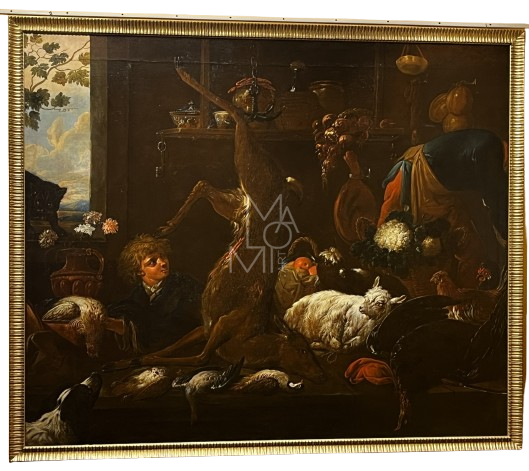
The pantry with characters and animals by Felice Boselli: a Baroque masterpiece between Po valley naturalism and Flemish painting
xplore the pantry with characters and animals by Felice Boselli (186x226 cm). An academic analysis of Baroque still life, Flemish influences, and Farnese patronage.
- Artist: Felice Boselli (Piacenza 1650 - Parma 1732)
- Title of the work: Pantry with characters and animals
- Period: Late 17th century - early 18th century (c. 1685-1710)
- Medium and support: Oil on canvas
- Dimensions: 186 x 226 cm
- State of preservation: Excellent; typical chromatic alterations are present due to the historical use of bitumen in the shadow areas, contrasting with a well-preserved impasto density of the lead white highlights.
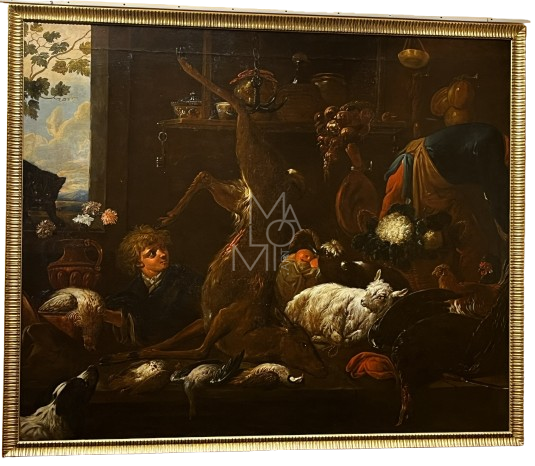
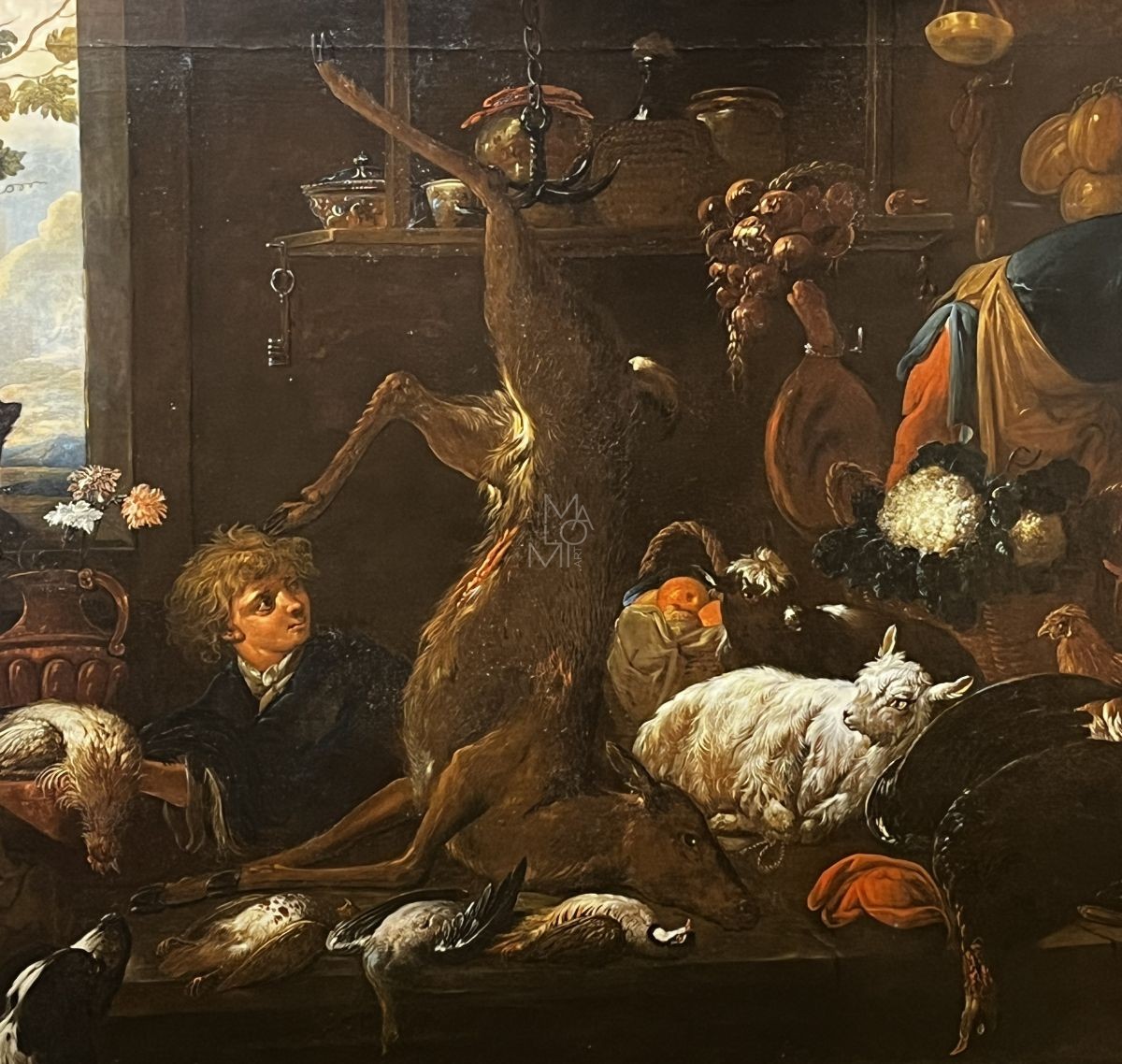
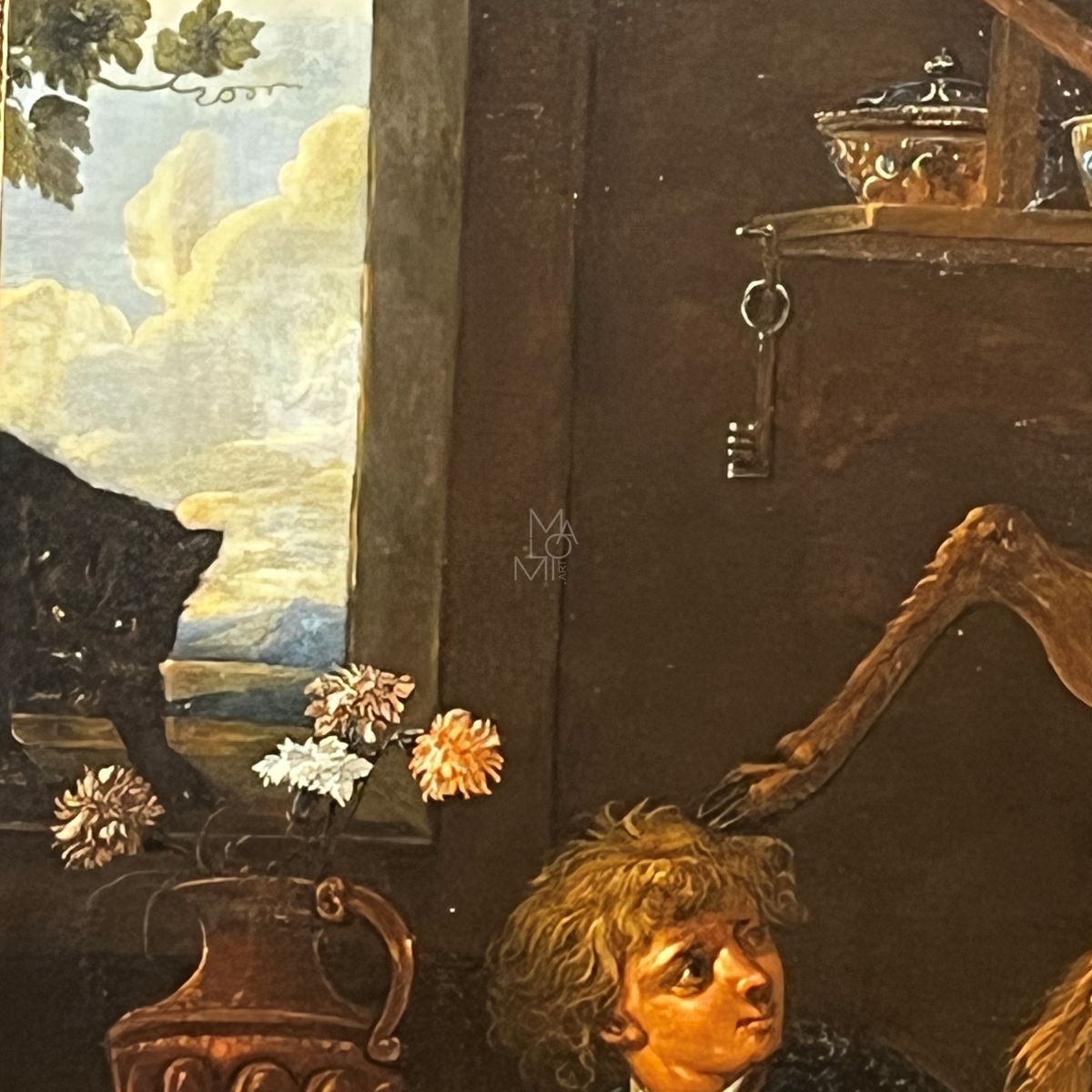
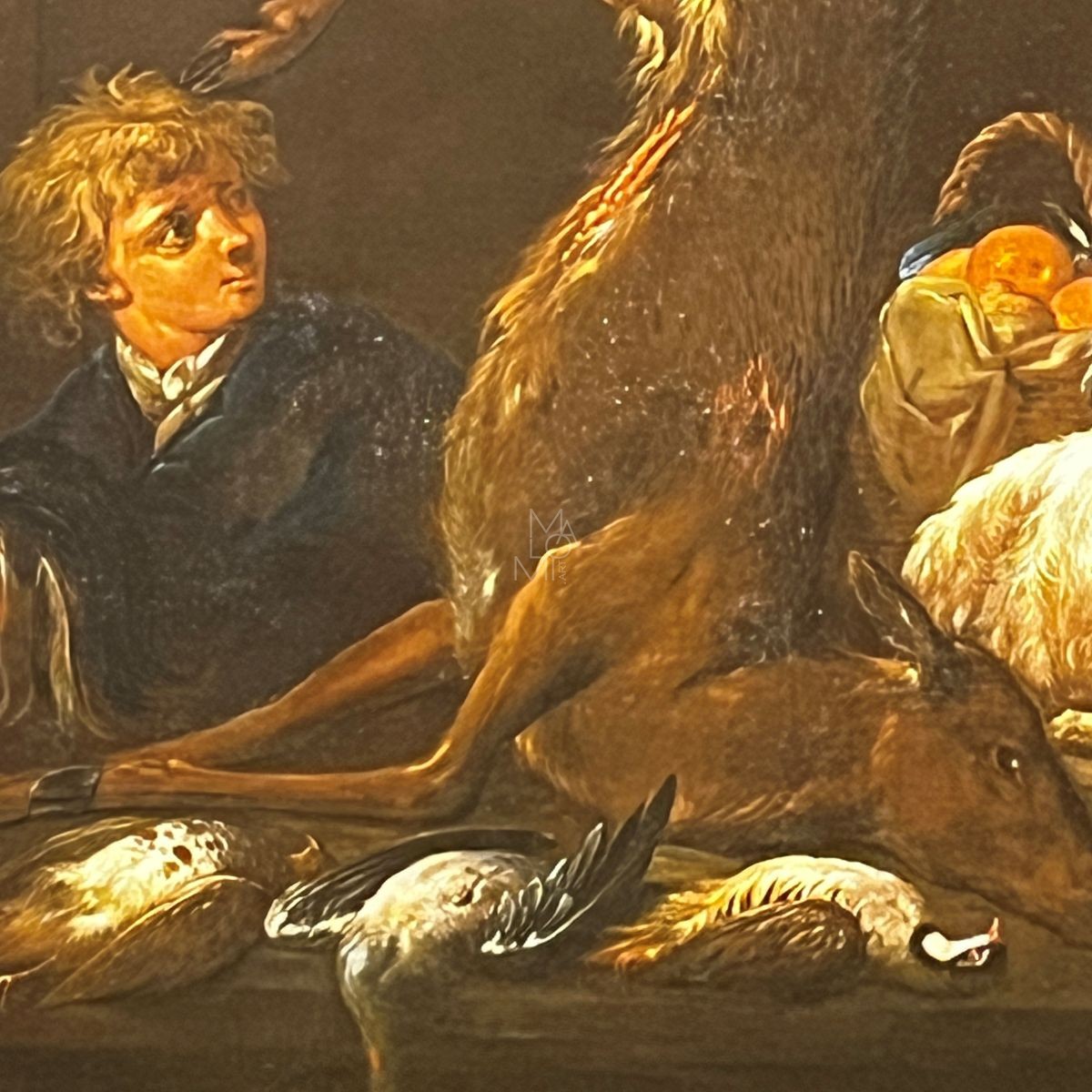
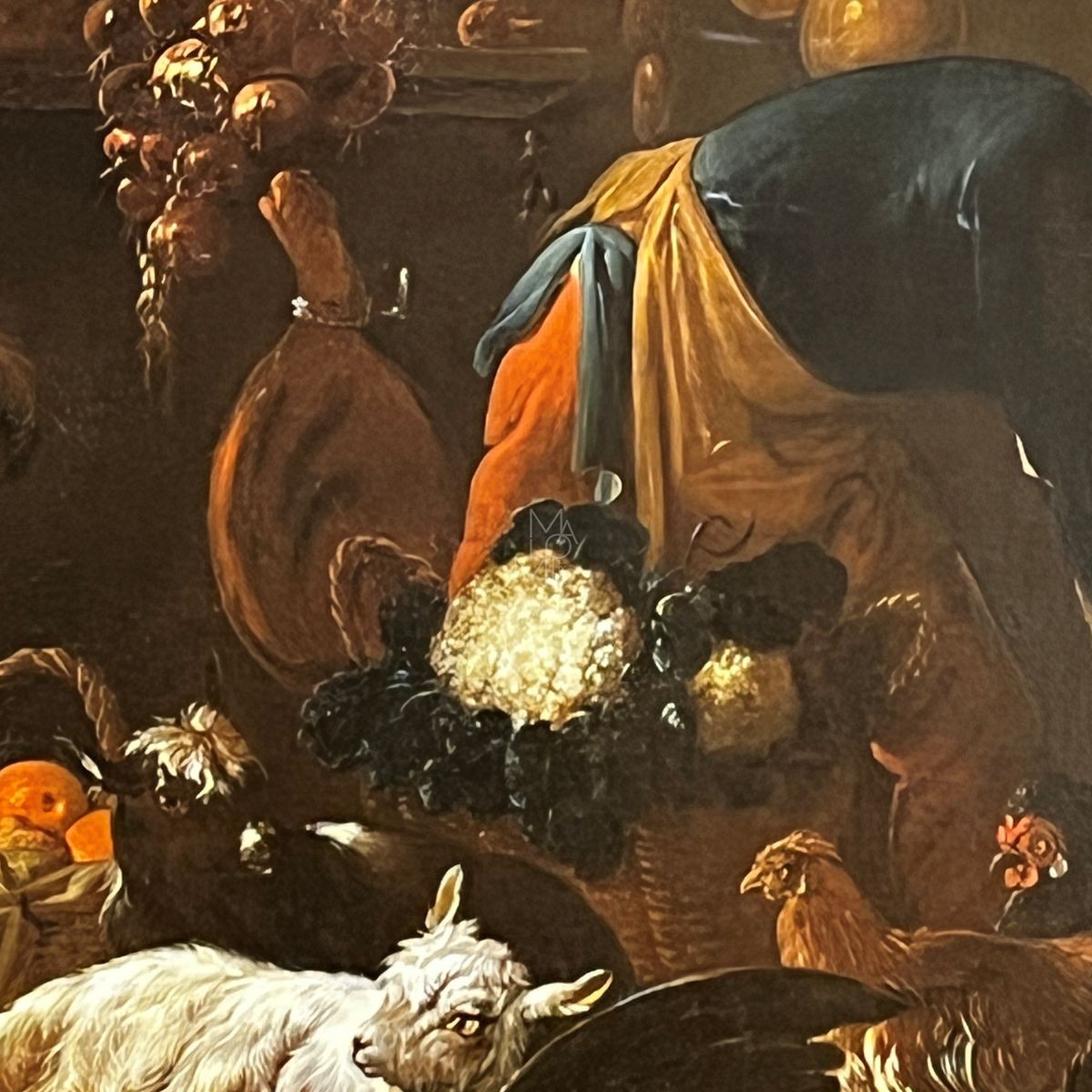
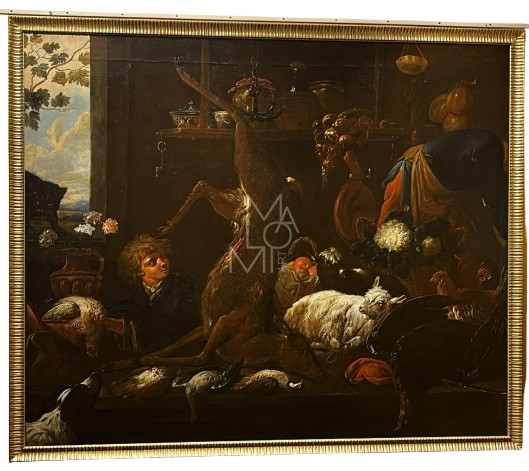
- Descriptive summary: This monumental canvas stands as one of the summits of Felice Boselli's display painting, specifically designed for the formal dining halls of the Sanvitale and Meli Lupi families. Departing from the standardized workshop templates, the composition features noble iconographic variants such as a hunted roe deer and a live kid goat in the foreground, replacing the more pedestrian sides of beef or pork. The depiction of the young kitchen assistant, rendered with an elegant, sharp profile devoid of grotesque caricature, illustrates a rare transition toward a refined physiognomic classicism that mirrors the famous Girl knitting (formerly in the Peccorini Maggi collection). Boselli’s technical virtuosity achieves a masterly tactile differentiation between animal fur, coarse popular garments, and metallic refractions on copper vessels, all governed by a diagonal, high-contrast Caravaggesque light. Furthermore, the implicit presence of the cat, rooted in the Latin pun on the word felis, serves as the author's sophisticated cryptographic signature.
The pantry with characters and animals by Felice Boselli (cm 186 x 226)
A monumental masterpiece between Po valley naturalism and transalpine suggestions
Chapter I: Introduction to the figure of Felice Boselli and the work
The historiographical primacy of the Piacenza master
In the vast and varied landscape of genre painting in northern Italy between the seventeenth and eighteenth centuries, the figure of Felice Boselli occupies a position of singular critical importance. Born in Piacenza in 1650 and passing away in Parma in 1732, the Farnese painter boasts an absolute historiographical primacy, having been the first Italian artist specialized in the still life genre to benefit from the systematic and scientific study of a dedicated monograph. This critical rediscovery and the entire reconstruction of his biographical trajectory are due to the wise and tireless research activity of the Piacenza art historian Ferdinando Arisi. His work succeeded in rescuing Boselli from centuries of unjust academic devaluation, which tended to consider the painting of inanimate things and popular scenes as a merely artisanal or decorative exercise, devoid of the intellectual dignity reserved for the great painting of history or sacred devotion.
The monumentality of the canvas under examination
Within the substantial production of the master, the canvas depicting the pantry with characters and animals immediately configures itself as a pivotal and monumental work, both for the intrinsic complexity of its compositional layout and for its exceptional physical dimensions, which measure 186 centimeters in height by 226 centimeters in width. A painting of such spatial breadth cannot be considered a simple easel exercise or a casual studio caprice. On the contrary, it represents a conscious demonstration of pictorial strength, a display work conceived to dialogue with the vast architectural quadratures of the patrician residences of the Emilian aristocracy. The canvas stands as a fascinating point of intersection where the rigid and vigorous realism of the Po valley tradition blends admirably with the sophisticated and opulent suggestions of northern painting, creating a hybrid language with an authentically European breath.
Chapter II: Chronological coordinates and transalpine suggestions
The stay in upper Lombardy and the Sopransi portrait
To fully understand the stylistic genesis and the cultural ambition that underlie the creation of the pantry with characters and animals, it is necessary to connect the work to a few rare but highly certain chronological reference points in Boselli's production. Among these, a fundamental role is played by the famous portrait of lieutenant don Giovanni Sopransi with a hunting trophy. This canvas bears a precious autograph inscription on the back of the original, which states that the Parma painter Bosellus created and painted the effigy in Varese in the twelfth month of the year 1685. This inscription constitutes an archival document of inestimable historical value, as it unequivocally attests to the presence of the thirty-five-year-old painter in upper Lombardy at a very specific date. The stay in Varese directly exposed the artist to the cultural ferments and art collections of a territory heavily permeated by commercial contacts and figurative exchanges with transalpine countries.
The assimilation of Flemish models
Twentieth-century criticism has amply demonstrated how the portrait of lieutenant Sopransi, despite belonging to a different pictorial genre, is closely linked to our large pantry by the same formal root, founded on the assimilation of northern models. During his stay in Lombardy, Boselli had the opportunity to closely study the Flemish and Dutch engravings and paintings that circulated abundantly in Milanese and pre-Alpine collections. A studio anecdote handed down by local sources tells how the painter used to spend entire days copying the graphic details of prints by Frans Snyders and Pieter Aertsen, fascinated by the ability of these masters to confer an almost heroic dignity upon markets and kitchens. This deep and pondered transalpine reception is reflected in the pantry with characters and animals, where the harsh and sincere course of Emilian painting is enriched by an analytical and Flemish-style sensitivity in the meticulous description of the still life, which translates into a magniloquent, dramatic, and highly theatrical scenic rendering.
Chapter III: Iconographic analysis and compositional variants compared to the Bosellian canon
The break with traditional schemes
The pantry with characters and animals commands the attention of scholars due to the presence of several iconographic variants of extraordinary critical interest, which testify to a deliberate and learned deviation from the most frequent and economically profitable compositional modules of the Bosellian repertoire. In the vast majority of his kitchen scenes stored in the workshop, the painter tended to repeat tested formulas easily legible by the local public. The central element of these standardized compositions was almost always represented by the classic side of beef or pork, quartered and displayed in all its raw and sanguine anatomical evidence. It was a powerful visual signature, yet linked to a peasant and domestic dimension, a direct expression of the rural economy of the Piacenza and Parma countryside.
The introduction of noble game and the kid goat
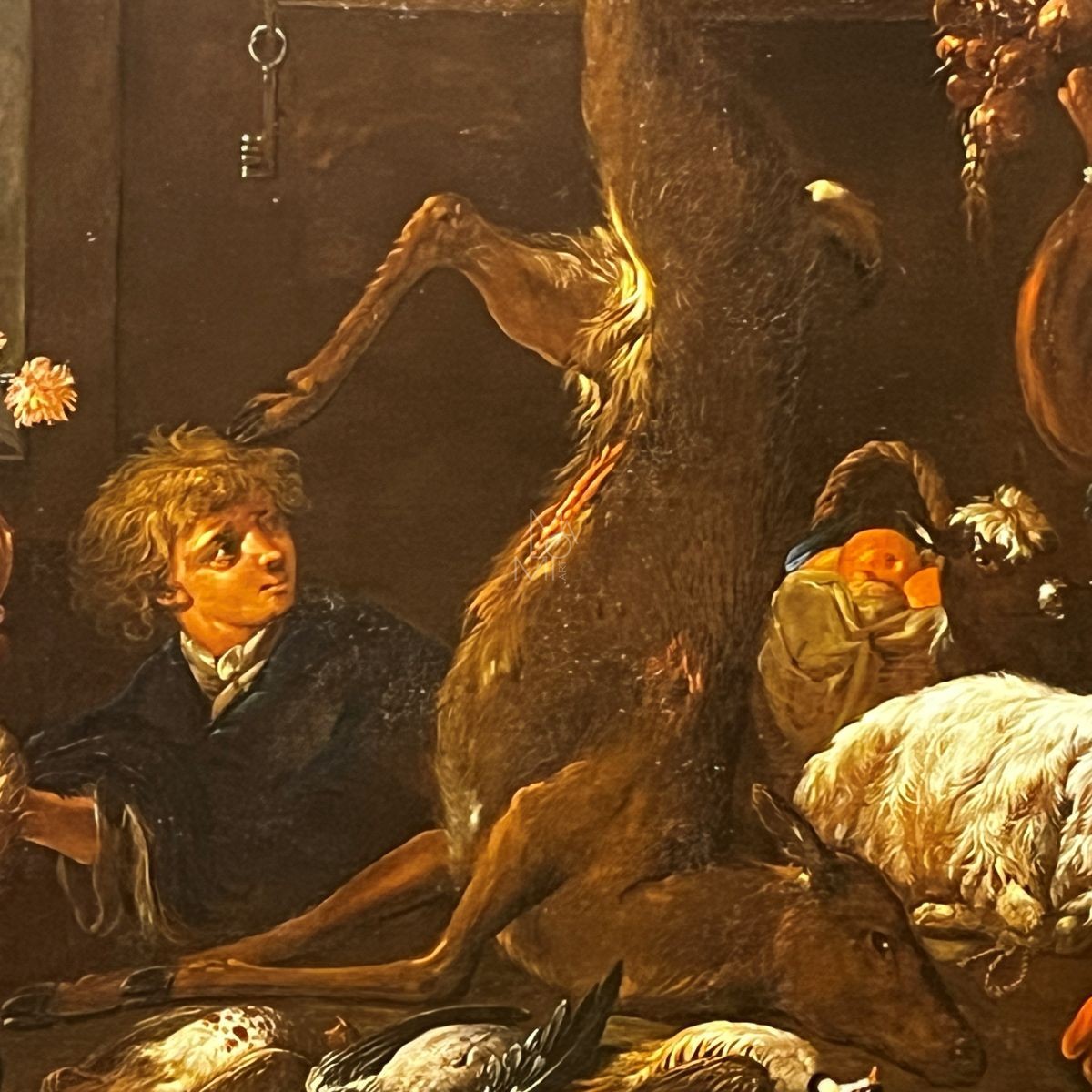
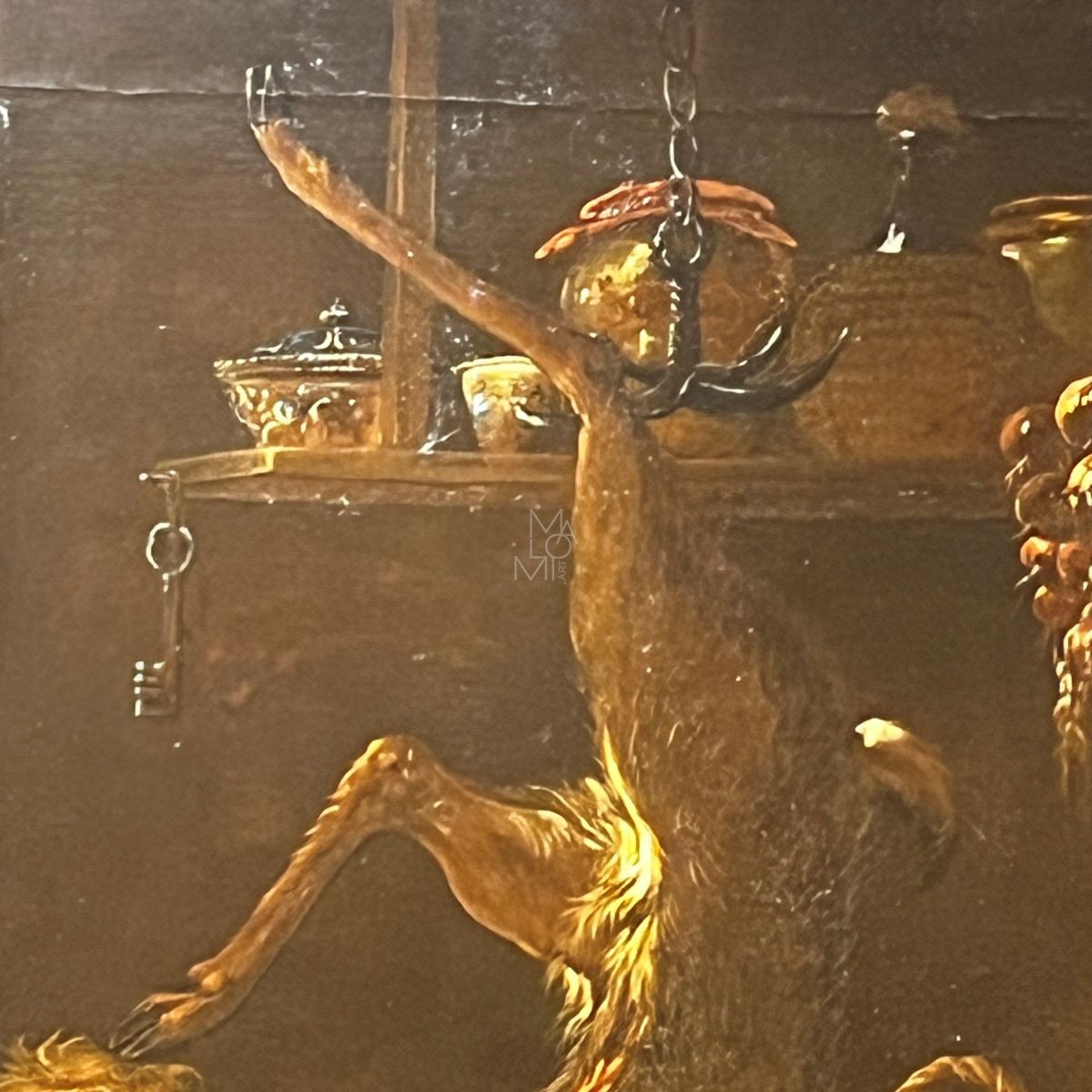
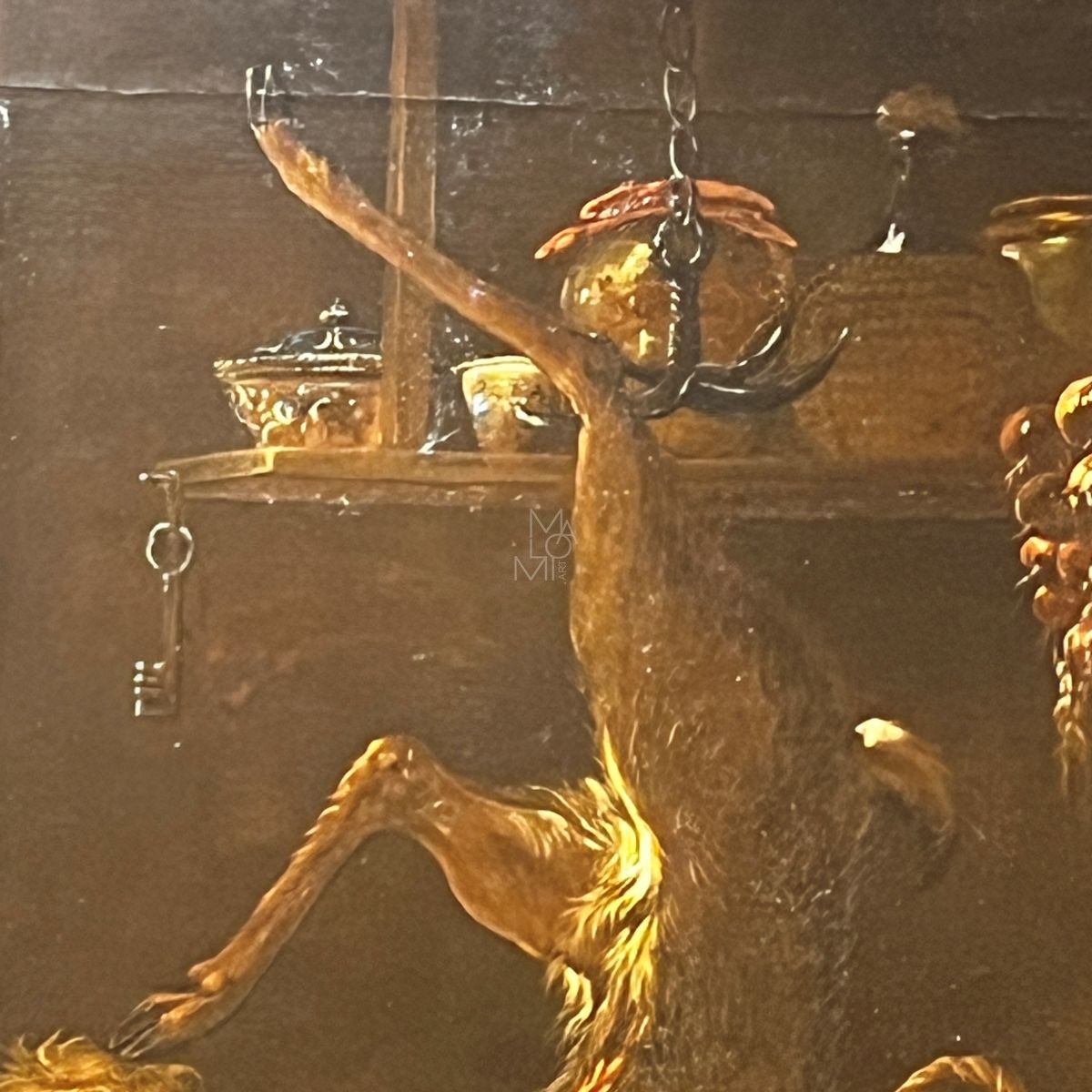
In the large canvas under examination, on the contrary, we witness a true aristocratic elevation of the subject through the display in the foreground of a roe deer hung from a metal hook. The choice of the roe deer, a noble and elusive animal linked to the great hunt reserved for the dominant classes, dismantles the prosaic nature of the plebeian kitchen and projects the scene into a dimension of lordly prestige. This significant variation is echoed by the equally unusual illustration of a live kid goat instead of the typical and recurring lamb. In the studio tradition of Felice Boselli, the lamb represented a sort of visual signature, to the point that a famous curiosity of the time reported that the artist was able to paint its white fleece from memory, without the need for a natural model, in less than a day of work. The insertion of the kid goat, with its sharper shapes and lively temperament, therefore represents a conscious executive challenge and a search for different expressive means, clearly oriented towards emulating the variety and eccentricity of northern faunal painting.
Chapter IV: The representation of the human element: from the popular to the sophisticated
The overcoming of plebeian caricature
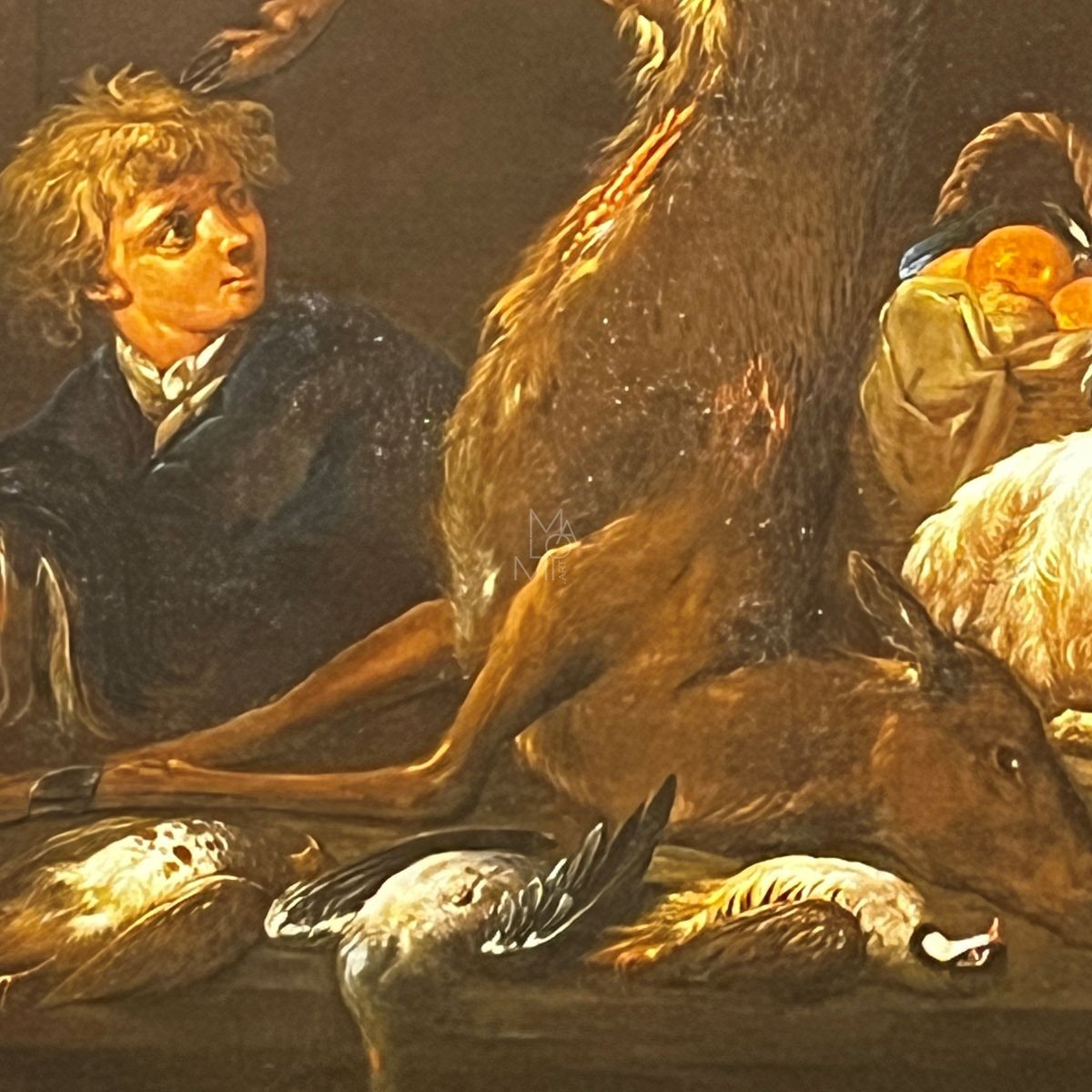
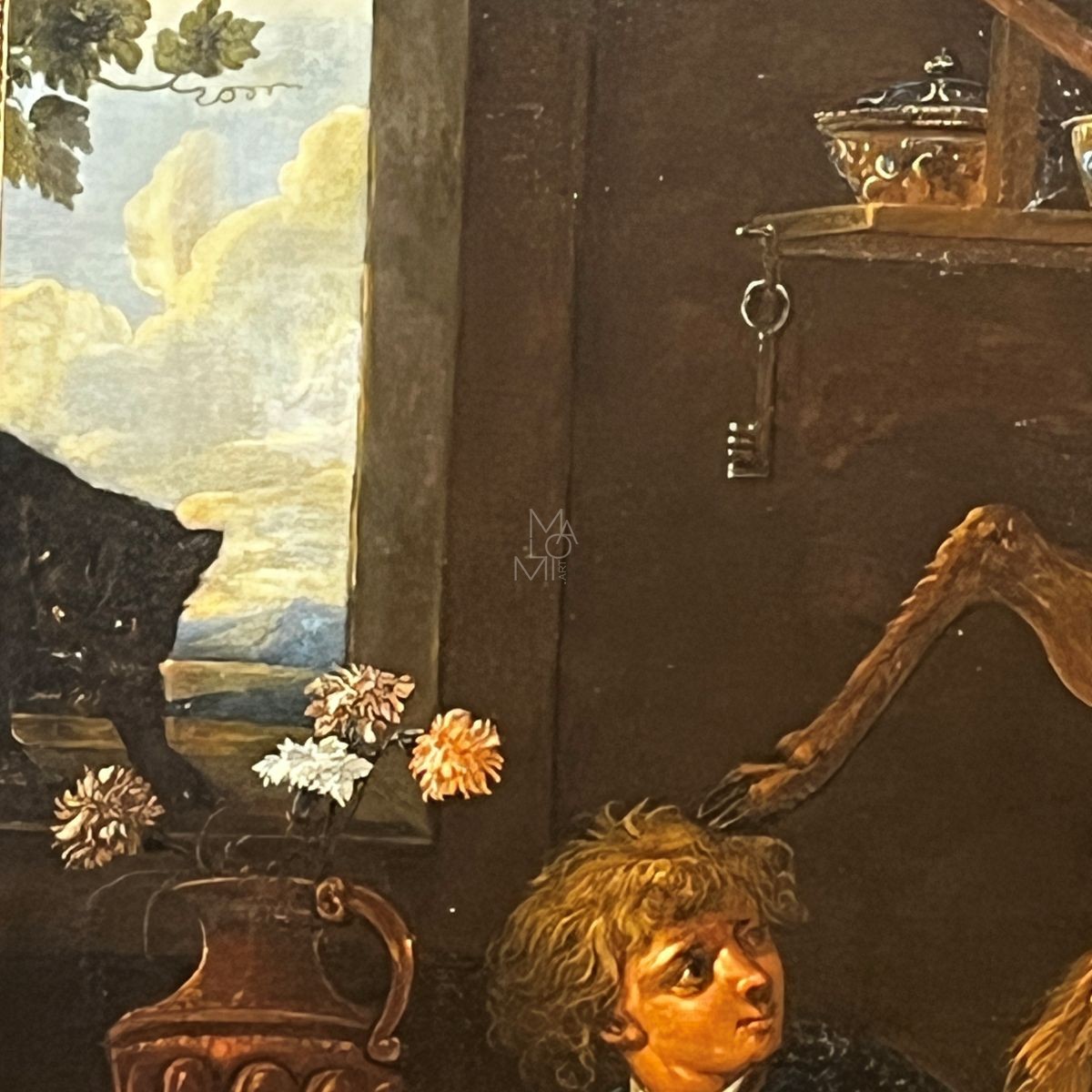
A similar and significant interpretative shift is recorded in the analysis of the human figures that animate and justify the complex layout of the pantry. In Boselli's usual repertoire, the human element is often confined to a burlesque or rigidly popular dimension, populated by Emilian children with rosy cheeks and chubby bodies, or by old merchants with markedly caricatured features, direct heirs to the tradition of grotesque heads of Leonardesque matrix and the ways of the commedia dell'arte. In the large canvas examined, however, the artist decides to ennoble the universe of servants and frequenters of kitchens and taverns. The human fulcrum of the scene consists of a lively kitchen assistant whose face shows a lean physiognomy, characterized by a sharp and thin nose that stands out sharply from the conventional and grotesque potato noses that crowd the rest of Boselli's production.
The physiognomic analogies with the girl knitting
This refined physiognomic research denotes the will to infuse greater psychological introspection and an unprecedented formal grace into genre characters. This stylistic path would find one of its most sophisticated and mature expressions in the famous girl knitting, a painting once preserved in the prestigious Peccorini Maggi collection in Mottaziana di Borgonovo Val Tidone. The close comparison between the face of the assistant in our pantry and that of the girl intent on domestic work reveals a surprising executive affinity. In both works, Boselli mitigates the roughness of Po valley realism through a softer and more blended modeling, arriving at conferring almost sweet and feminine features upon the kitchen assistant, which redeem his social condition to elevate him to the protagonist of an elegant interior narrative.
Chapter V: Morphological analysis and luministic syntax
The baroque spatial orchestration
From the point of view of pure morphological syntax, the pantry with characters and animals presents itself as a masterpiece of Baroque spatial orchestration. The immense surface of the canvas is organized according to a predominantly horizontal compositional grid, designed to restore the illusion of a complex and deep environmental depth. Boselli renounces the simple two-dimensional juxtaposition of objects on the plane and builds a complex theatrical scenography articulated on multiple levels of reading. Light assumes an absolute structural role in this context, acting as the main formal separator of the pictorial matter. It is a dense, warm, and highly directional light, of clear Caravaggesque derivation, which enters the room from an external and lateral source ideally located on the left, cutting diagonally through the dense and enveloping darkness of the environment.
The three volumetric planes of light
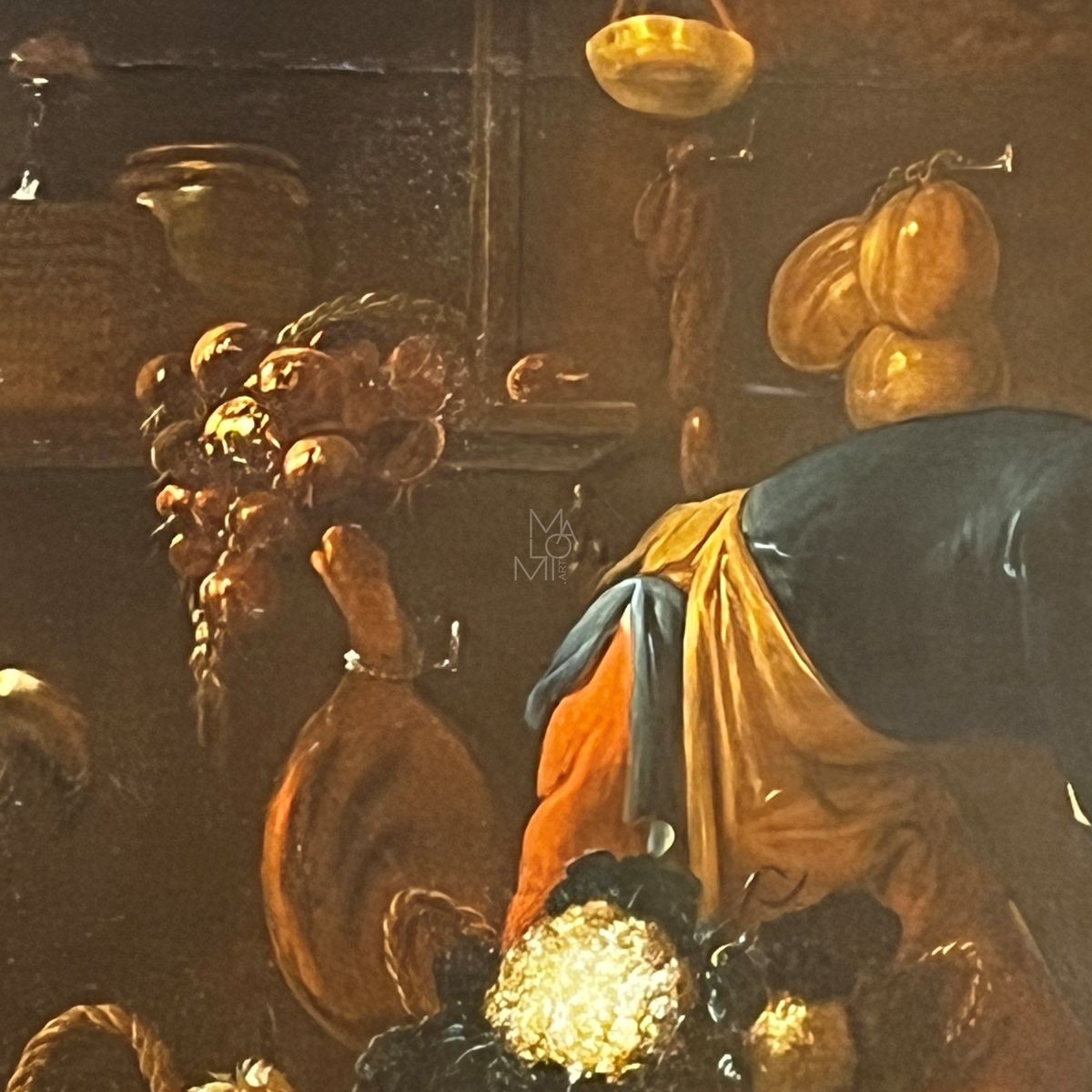
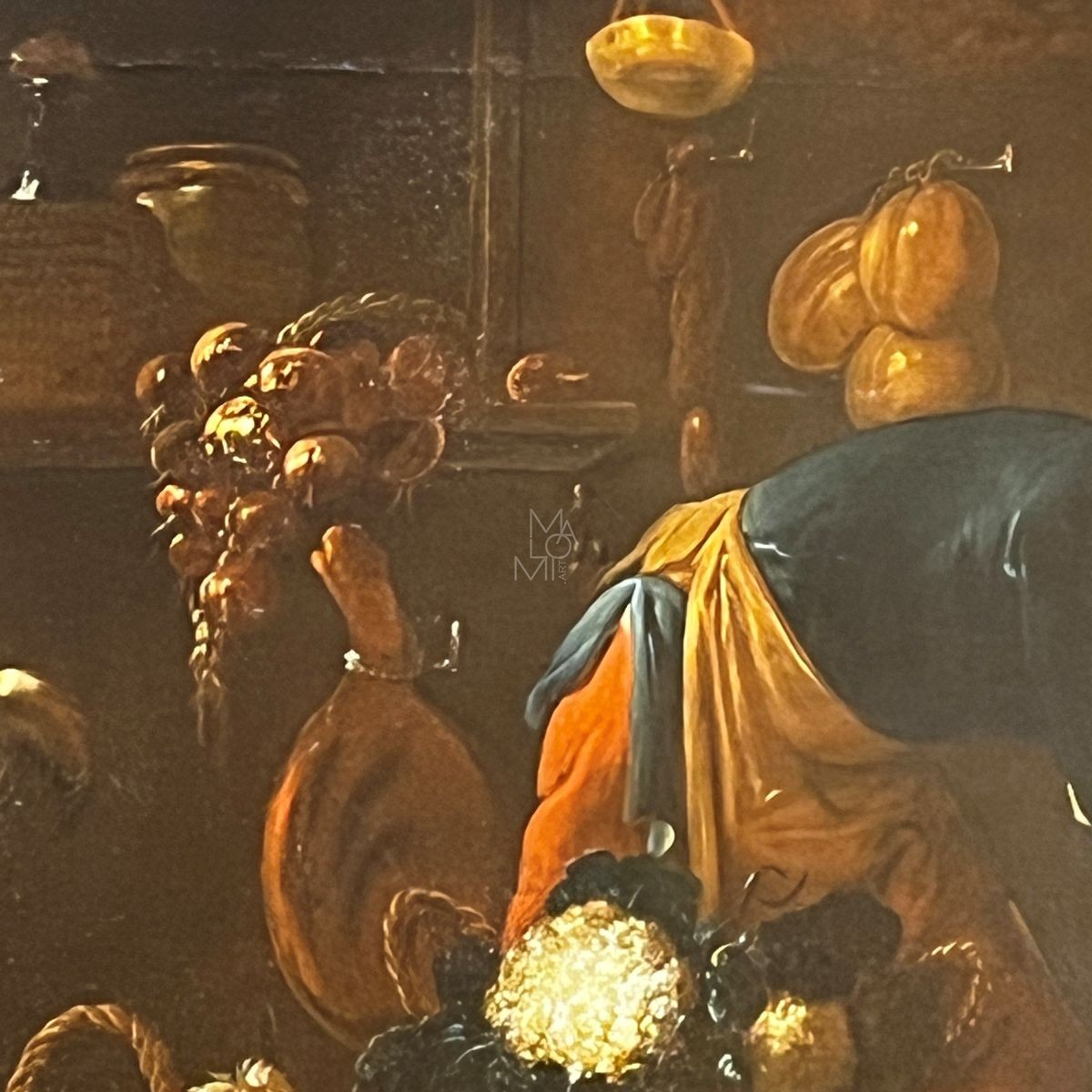
This luministic direction allows the artist to isolate volumes with sculptural precision and to distribute the narrative across three distinct volumetric planes. The foreground is invested by a zenithal and merciless light, which beats down on the bodies of the animals, enhancing their tragic immobility and volumetric concreteness. In the middle ground, the light becomes softer and more diffused, caressing the faces and clothes of the kitchen assistant and the patrons, creating warm chiaroscuro passages that soften the contours of the human figures. Finally, the background coincides with the deep space of the pantry, where the light fades almost completely into a mysterious and suggestive twilight. In this deep shadow, the shapes of shelving, copper pots, and tableware are barely perceived, elements that dilate the perception of the architectural space without distracting the observer from the dramatic fulcrum of the composition.
Chapter VI: Technical skill in material rendering
The tactile differentiation of surfaces
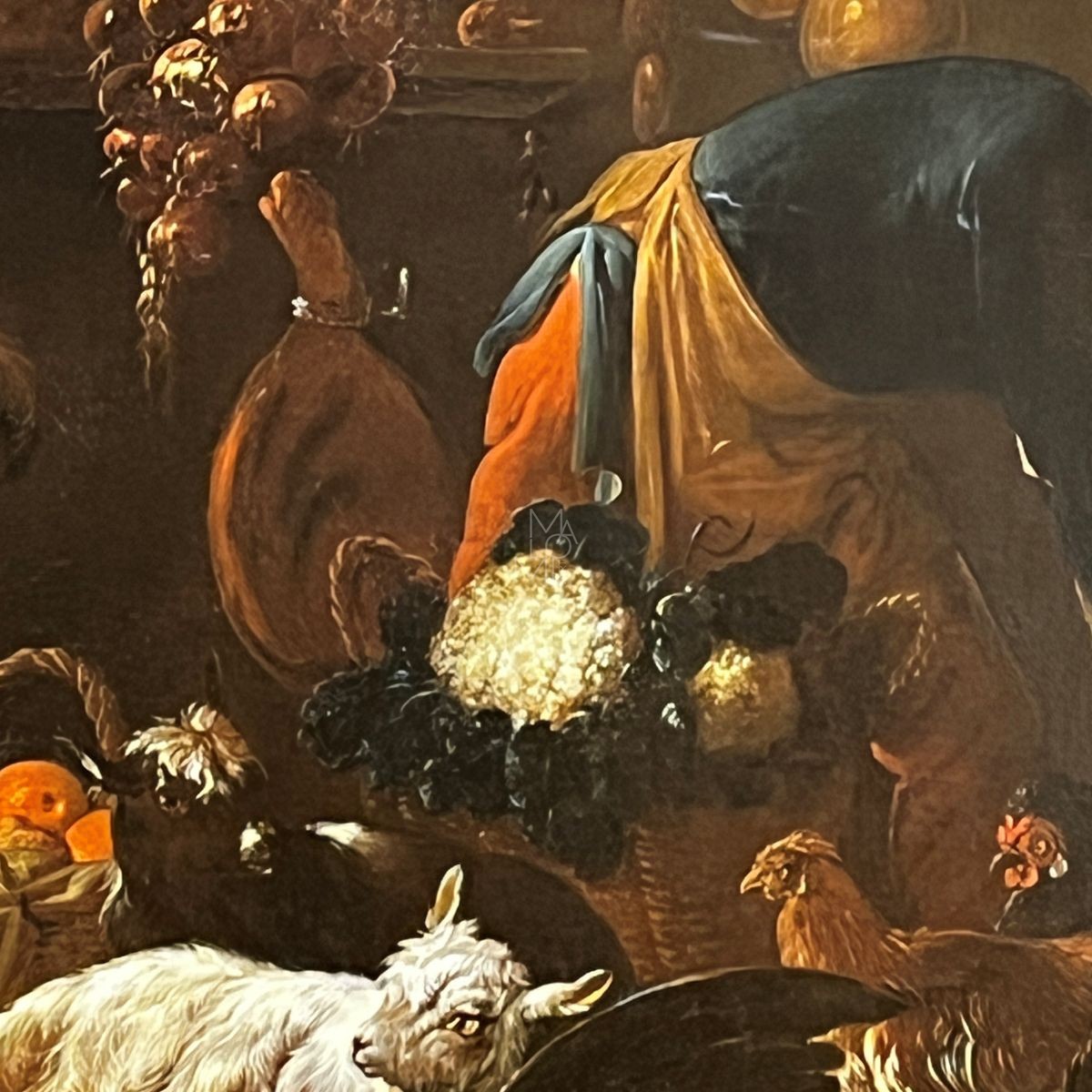
The extraordinary collecting fortune that Felice Boselli enjoyed in life was largely based on his unparalleled technical skill in the mimetic rendering of reality and the tactile differentiation of surfaces. Within the pantry, this ability reaches heights of absolute virtuosity, as the artist constantly varies the density of the pictorial mixture and the direction of the brushstroke depending on the intrinsic nature of the matter he intends to evoke. The hairy coat of the hanging roe deer and the ruffled fleece of the living kid goat are restored through an extremely fragmented and pasty pictorial conduct, where small touches of pure color are superimposed to simulate the soft texture of the fur and the effect of sunlight infiltrating between the hairs. On the contrary, the light and iridescent plumage of the birds laid out in the foreground is resolved with a fluid, liquid spreading rich in superimposed glazes, capable of restoring the impalpable consistency of feathers.
The contrast between fabrics and metallic reflections
This exceptional material sensitivity is also found in the description of the costumes of the popular characters. Boselli does not seek the elaborate and shiny finish of silks or velvets typical of court portraitists, but celebrates the rough and honest consistency of coarse wool clothes and the raw linen of shirts. The draperies are wide, deep, and sculpted by dense shadows, interrupted by sharp touches of light that define the weight of the fabric. To this organic and warm world of fabrics and animal meats is opposed the cold and mineral universe of tableware and copper basins that populate the kitchen. With decisive, rapid brushstrokes loaded with lead white and warm earths, Boselli captures the luminous refraction on the convex metallic surfaces, creating sudden flashes that restore the exact visual consistency of embossed metal.
Chapter VII: Hermeneutics of symbols and micro-narratives
The baroque memento mori
Beneath the apparently immediate surface of a chaotic and opulent genre scene, the pantry with characters and animals guards a complex network of symbolic and moral references, perfectly aligned with the taste and mentality of the Baroque age. The large display of butchered meat and game should not be interpreted only as a celebration of food abundance, but embodies within itself the deep warning of the memento mori, that is, the reflection on the transience of earthly life and the corruptibility of all organic matter. The roe deer hung upside down, with its torn chest offered to the viewer's gaze, becomes a visual metaphor for the vulnerability of bodies and the inevitable end of all carnal beauty, a theme that religious preachers of the time constantly utilized in their sermons and that painters translated into images of powerful visual impact.
The Allegory of Taste and the sociological dimension
In contrast to this sacred and melancholic dimension, the figure of the young assistant lifting a flask introduces into the composition the profane allegory of Taste and the celebration of sensory pleasures. The boy acts as a mediator between the inanimate world of the pantry and the universe of the viewer, inviting the latter to enjoy the fruits of the earth before time takes its destructive course. In the background, the presence of popular characters consuming wine and food introduces a true sociological micro-narrative. The Baroque kitchen is thus transformed into an autonomous theatrical microcosm, a social space antithetical to the official salons of the nobility but governed by extremely rigorous aesthetic rules, where the daily struggle for survival and the celebration of material life find a solemn artistic legitimacy.
Chapter VIII: Comparison with pure still lifes
The centrifugal accumulation of workshop works
To fully appreciate the structural complexity of our pantry, it is fundamentally useful to establish a formal comparison with the production of pure still lifes by Felice Boselli, that is, with those compositions in which the human figure is totally excluded from the scene. In pure still lifes, many of which are preserved today in the halls of the Galleria Nazionale della Pilotta in Parma or in the Musei Civici of Palazzo Farnese in Piacenza, the compositional layout responds to a logic of predominantly horizontal and centrifugal accumulation. Vegetables, fish, fruit baskets, and feathered game are piled directly onto rough stone counters or wooden fences, saturating the pictorial space in a highly dense and almost claustrophobic manner. In these works, the viewer's eye is forced to wander incessantly from one detail to another, jumping from the rough texture of a turnip to the slimy surface of a fish, without managing to find a center of visual gravity detached from the rest.
The human figure as a syntactic organizer
In the large pantry with characters and animals, the insertion of human figures radically modifies this perceptive dynamic, introducing a central narrative axis and a clear syntactic organizer. The kitchen assistant introduces an element of strong verticality within the compositional grid, breaking the monotony of the horizontal lines of the food hoard. The human figures create a visual and emotional hierarchy that guides the viewer's gaze through the painted space. The still life loses its nature as an isolated object catalog and is integrated within a living action, where animals and tableware are no longer simple fragments of displayed reality, but become co-stars and scenic backdrops of a complex Baroque theatrical performance.
Chapter IX: The Bosellian palette in the light of coeval restorations
The stability of warm earths
Modern restoration interventions and diagnostic investigations conducted on important complexes of works by Felice Boselli have shed new light on the chemical composition of his pigments and the secrets of his executive practice, offering precious elements of comparison applicable also to our large canvas. Laboratory analyses have confirmed the painter's absolute predilection for a warm, earthy palette closely linked to the Po valley naturalistic tradition. Boselli built the chromatic architecture of his paintings starting from dense layers of raw umber, burnt Sienna, and ochres. These mineral pigments applied with brushstrokes loaded with oil binder have demonstrated extraordinary chemical stability over time, maintaining their original deep and warm luminous intonation unaltered.
The insidious nature of bitumen and the structural use of lead white
Conversely, restorations have highlighted the artist's extensive and sometimes unscrupulous use of dark preparations based on bitumen or carbon blacks for the execution of backgrounds and the deepest shadow areas. Bitumen, an unstable organic substance that tends to liquefy and darken under the action of heat and light, has undergone an unstoppable process of chemical alteration over the centuries. This phenomenon explains why the backgrounds of Bosellian pantries sometimes appear today flat and devoid of those subtle original atmospheric variations that the artist had originally studied. To counteract this dark drift intervenes the structural use of lead white, which Boselli used with exceptional ease. Applied in thick and full-bodied mixtures, almost in plastic relief, lead white allowed the capture of the real light of the environment on the points of maximum volumetric emphasis, such as the white fleece of the kid goat or the highlights on the tableware, creating those chiaroscuro contrasts that constitute the authentic visual strength of Emilian Baroque painting.
Chapter X: The cat as a cryptographic signature and Baroque rebus
The phonetic assonance of the term felis
Among the most fascinating and famous curiosities that stud the study of Felice Boselli's production, a place of honor belongs without doubt to the recurring presence of the cat within his kitchen compositions. In the learned and witty Baroque civilization, deeply fascinated by wordplay, emblems, and visual rebuses, the cat ceases to be a simple domestic animal inserted for reasons of environmental verisimilitude and assumes the role of a true cryptographic signature of the artist. The intellectual mechanism is based on a precise linguistic assonance linked to the Latin language, in which the cat is called felis. By transliteration and immediate phonetic assonance, the term evoked to the ear of the cultured public of the time the Christian name of the painter, that is, Felice.
The semantic postures of the feline in the studio
Boselli, who sometimes loved to sign his most demanding masterpieces by extending his name into the Latin form of Felix, utilized the feline as an ironic and shrewd visual alter ego inserted directly into the scene. In large display canvases like our pantry, the cat assumes different semantic postures full of wit. It is often portrayed crouched under the kitchen tables, partially hidden by the foliage of cabbages, intent on monitoring the butchered meats with flashing eyes, ready to take advantage of the servants' distraction to commit a food theft. This expedient not only introduces a note of lively anecdotal realism, but constitutes a refined and proud claim of artistic authorship, a way to affix one's ideal signature through a figurative rebus perfectly integrated into the daily life of the representation.
Chapter XI: The Farnese aristocratic patronage
The function of kitchens in salons of representation
To understand the intended use and origin of a canvas of exceptional dimensions such as the pantry with characters and animals, it is necessary to overcome the modern conception that tends to consider still life painting as an intimate and domestic genre. In the age of the Farnese, the commissioning of these monumental kitchen scenes was the exclusive prerogative of the most powerful and influential families of the landed and feudal aristocracy of the duchy of Parma and Piacenza, among which the Sanvitale counts of Fontanellato and the Meli Lupi marquises of Soragna stood out. The representative salons of these houses did not host only dynastic portraits or solemn mythological cycles, but were adorned with huge genre canvases that covered entire walls, conceived to impress illustrious guests and diplomatic delegations during sumptuous official banquets.
The cultural rivalry between the Sanvitale and the Meli Lupi
The choice to commission works of such format from Felice Boselli responded to precise and calculated needs of political self-representation and dynastic prestige. Between the Sanvitale and the Meli Lupi existed an underground but very sharp cultural rivalry, which was also expressed through the splendor of their respective art collections. Displaying a monumental pantry overflowing with noble game like the roe deer, rare birds, and first fruits of the earth meant visually celebrating the immense fertility, wealth, and generosity of the fiefs controlled by the family. Boselli's painting, capable of ennobling culinary matter through a solemn and European luminous direction, offered these aristocratic houses the perfect visual tool to manifest their economic power and courtly magnificence, rivaling in splendor with the Farnese ducal court itself.
Chapter XII: Archival documents and the inventory accounting of the Sanvitale
The patrimonial progression in the records of Fontanellato
The historical reconstruction of the massive presence of monumental works by Boselli in patrician collections finds extraordinary scientific confirmation in the analysis of archival documents and inventory records of House Sanvitale. The examination of these ancient accounting papers has allowed art historians to precisely trace the expansion of the family's artistic heritage. In the inventory drawn up in the year 1702 for the possessions of the Rocca Sanvitale in Fontanellato, no fewer than thirty-seven paintings attributed to the hand of the Piacenza master are cataloged. But the most impressive data emerges from the subsequent inventory of 1715, where the number of Boselli's canvases recorded exceeds the quota of seventy elements. This progression testifies to a continuous and almost symbiotic patronage relationship between the painter and the noble family.
The destination of large formats and the donation of 1838
In the eighteenth-century inventory descriptions, paintings presenting dimensions similar to our large pantry are identified with specific formulas such as large kitchen pictures with game and servants. These documents specify how such colossal formats were expressly conceived as fixed furnishings for dining rooms, often ordered in symmetrical pairs to balance the architecture of the walls. The history of this immense collection experienced a decisive turning point in the year 1838, when count Stefano Sanvitale decided to make a conspicuous and generous donation of a large part of the family's artistic assets in favor of the Pinacoteca of the city of Parma. This donation allowed many of Boselli's large kitchens to flow into today's Complesso Monumentale della Pilotta, safeguarding for future centuries the historical memory of that happy marriage between the creative inspiration of the Piacenza painter and the ambitious patronage of the Farnese nobility.
Chapter XIII: Twentieth-century critical fortune and the philological reconstruction of Ferdinando Arisi
The rediscovery of the catalogue raisonné
The path that led to the full aesthetic recognition of Felice Boselli as one of the absolute summits of Baroque still life in Italy found its climax in the philological research conducted by Ferdinando Arisi starting from the nineteen-seventies. Before this fundamental historiographical intervention, the painter's catalog appeared as a fragmented and confused corpus, seriously compromised by the presence of countless late copies, workshop imitations, and generic attributions to northern masters or the Lombard school. Arisi undertook a monumental work of critical cleansing, applying rigorous criteria based on stylistic comparison and the study of documentary sources.
The qualitative criteria of pure autography
One of the most lasting contributions of Arisian research was the isolation of the practice of autograph replications with variants by the master. Faced with a compositional grid of exceptional commercial success, Boselli did not allow the workshop to execute a mechanical copy, but intervened personally by modifying individual iconographic details or inserting physiognomic variants to satisfy the needs of new elite patrons. To distinguish the master's hand from that of his son Giacinto Boselli or studio collaborators, twentieth-century criticism fixed rigorous qualitative parameters based on space dynamics and light vibration. It is precisely the excellent executive quality found in the spreading of lead white on the fur of the animals and the noble characterization of the face of the kitchen assistant that guarantees the absolute autography of this pantry, confirming the historical judgment that sees in this work one of the highest and happiest moments of the entire production of the Farnese master.
Appendix: Index of fundamental bibliographical references
- ARISI, Ferdinando, Felice Boselli, Roma, Cassa di Risparmio di Piacenza, Edizioni d'Arte d'Agostini, 1973.
- ARISI, Ferdinando, Natura morta farnesiana: Felice Boselli (1650-1732), Piacenza, Tipografia Le.Co., 1995.
- BOCCHI, Gianluca; BOCCHI, Ulisse, Naturalia: pittori di natura morta a Parma e Piacenza in età farnesiana, Viadana, Arti Grafiche Castello, 1992.
- FORNARI SCHIANCHI, Lucia, edited by, Galleria Nazionale di Parma. Catalogo delle opere: Il Seicento, Milano, Franco Maria Ricci, 1999.
- FORNARI SCHIANCHI, Lucia, edited by, I Sanvitale: arte e mecenatismo tra Parma e Fontanellato, Milano, Silvana Editoriale, 2003.
- CIRILLO, Giuseppe; GODI, Giovanni, Le nature morte della Galleria Nazionale di Parma, Parma, Step, 1982.
- SALERNO, Luigi, La natura morta italiana 1560-1805, Roma, Bozzi, 1984.
- GREGORI, Mina, edited by, La Natura Morta in Italia, Milano, Electa, 1989.
- BOTTERI, Silvia, edited by, Fasto e pittura di genere: le nature morte dei Meli Lupi di Soragna, Colorno, Grafiche Step, 2004.