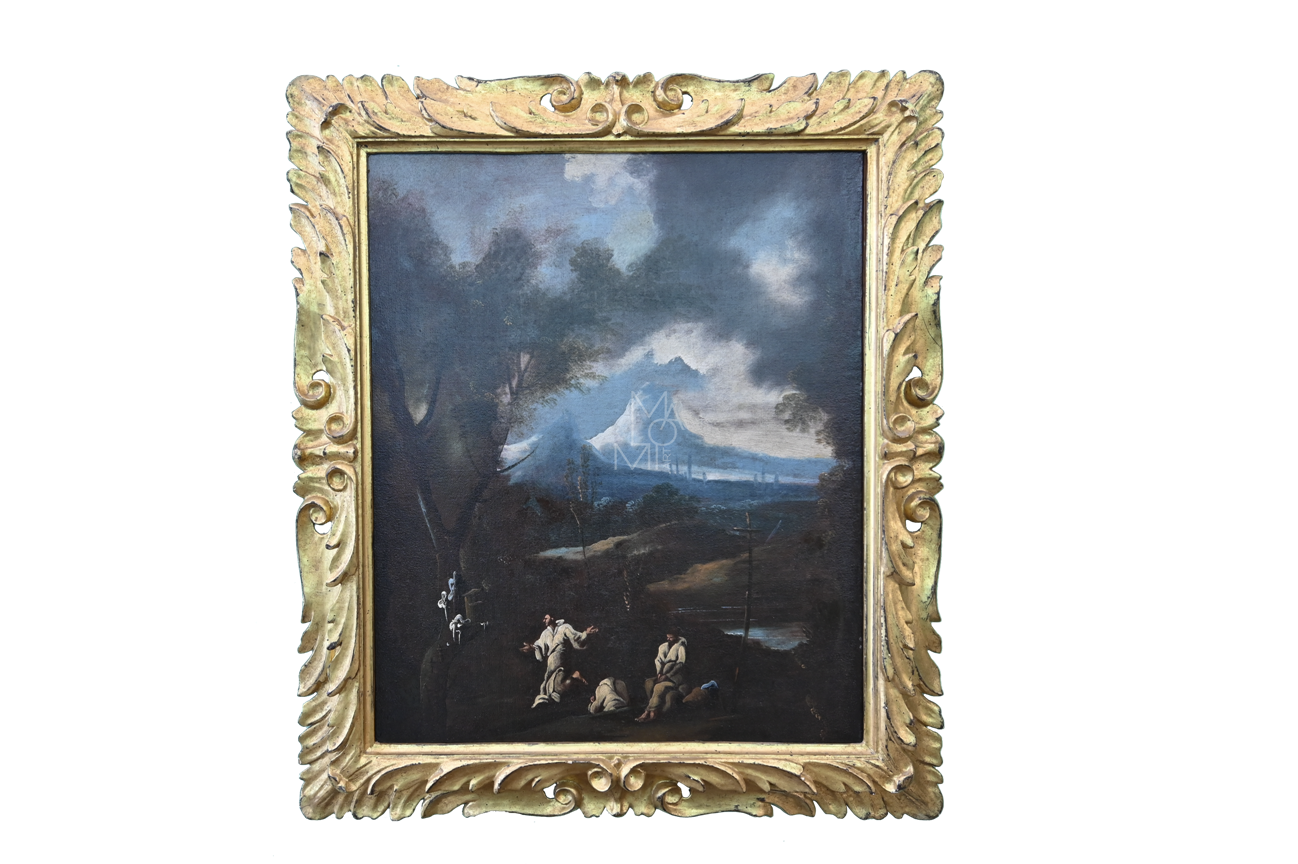
The Miracle of Saint Romuald (Camaldolese Friars in Prayer)
- Subject: The Miracle of Saint Romuald (Camaldolese Friars in Prayer)
- Attribution: Circle of Alessandro Magnasco, known as Il Lissandrino (1667–1749), and Antonio Francesco Peruzzini (1643–1724)
- Period: Mid-Eighteenth Century (coeval, c. 1700–1750)
- Medium: Oil on canvas (pittura di tocco / brush-touch technique)
- Canvas Dimensions: 84 x 68 cm
- Framed Dimensions: 104 x 90 cm
- Frame: Original 18th-century Barocchetto frame in finely carved and leaf-gilded wood, featuring asymmetrical acanthus scrolls and dynamic organic motifs.
- Condition Report: Excellent antique state, preserved in its first patina with a widespread, stable, and chemically consistent craquelure.
- Provenance: Malomi S.r.l. Art & Antiques Gallery.
- Critical Commentary: This sophisticated eighteenth-century canvas represents a significant example of the anti-classical and proto-Expressionistic trends within the Ligure-Lombard school. The work masterfully balances a rugged, storm-laden woodland landscape—expressive of Peruzzini's stylistic orbit—with the elongated, phantasmic human figures (macchiette) characteristic of Magnasco's circle. Saint Romuald and his fellow monks are rendered in a state of spiritual rapture (fuga mundi), their white habits sculpted by rapid, pastose highlights of lead white (biacca) that clash dramatically with the dark, bituminous background. A silvery shaft of divine illumination pierces the leaden sky, sanctifying the jagged peak of the holy mountain that references the Hermitage of Camaldoli. The canvas scale, tailored for an elite private domestic gallery (quadro da stanza), coupled with the deep visual funneling effect of the integrated Barocchetto frame, transforms the artifact into a cohesive gesamtkunstwerk of the late Baroque period, presenting exceptional value for international institutional curators and discerning collectors of Old Masters.
Introduction and state of research
The present study offers a monographic and philological analysis of an oil on canvas painting depicting the Miracle of Saint Romuald, an early work attributed to the circle of the Genoese master Alessandro Magnasco. The piece belongs to the distinctive genre of monastic-eremitic painting, a thematic tradition that enjoyed extraordinary success among collectors during the eighteenth century across the Ligurian, Lombard, and Tuscan areas of influence. The canvas demands scholarly attention due to its successful synthesis of rugged landscape elements and the vibrant spiritual tension of the figures. These features accurately reflect the formal models of the Lissandrino and the complex workshop dynamics typical of coeval studios specializing in this genre.
Historico-artistic analysis and cultural context
To fully understand the executive genesis of the canvas, it is necessary to contextualize it within the operational practices of Alessandro Magnasco's workshop and his frequent collaborations, most notably with the landscape painter Antonio Francesco Peruzzini from Ancona. In the late-Baroque and proto-Eighteenth-century artistic environment, the execution of large landscapes with figures was frequently divided among specialists. The landscape painter was tasked with constructing the geological and botanical framework: intricate woodlands, storm-laden skies, craggy mountains, and reflective bodies of water were conceived not as passive backgrounds, but as emotional extensions of the sacred narrative.
Magnasco and the painters within his inner circle would intervene subsequently, inserting the characteristic slender, dynamic figures historically referred to as macchiette. The canvas under examination documents this executive dichotomy, exhibiting a flawless osmosis between the rugged, steep natural space—marked by northern tonal qualities—and the devotional human core.
Scenes of cenobitic and eremitic life, particularly focusing on Camaldolese and Franciscan friars, constitute one of the defining hallmarks of Magnasco’s production. Far from representing purely conventional devotional painting in the Counter-Reformation sense, these canvases catered to the tastes of an aristocratic Milanese and Genoese clientele fascinated by the rigorous, penitential austerity of monastic orders, the inherent theatricality of eremitic isolation, and an internalized spirituality. This aesthetic was occasionally tinged with a pre-Enlightenment or esoteric restlessness, mirroring the religious and philosophical tensions of the early eighteenth century.
Iconographic and iconological reading
The iconography of the painting is traditionally linked to the Miracle of Saint Romuald, founder of the Camaldolese Order (a reformed branch of the Benedictine congregation). The scene illustrates the theological core of Camaldolese eremitic life: the detachment from the earthly world to achieve mystical union with the divine. On the left side of the composition, the standing figure of Saint Romualdo, or an eminent monk of the order, serves as the emotional locus. The gesture of his wide-open arms recalls the ancient posture of the orant, here heightened with theatrical emphasis. The tocco di macchia technique enhances the visual impact of his white habit struck by a raking light, symbolizing the purity of the monastic rule.
At the saint's feet, his companions are captured in attitudes of profound submission and rapture: one friar is entirely prostrated on the ground, while a second is crouched in prayer. The fragmentation of their bodies emphasizes the annihilation of the ego in the presence of the theophany. The topographical element of the jagged mountain in the background is not merely geographical data, but a precise iconological attribute. It evokes the Tuscan-Romagnolo Apennines where the Hermitage of Camaldoli stands, but primarily functions as an axis mundi connecting earth and heaven. The silvery light investing the peak as it breaks through the dense cloud cover is the explicit manifestation of the divine—the miracle—visually legitimizing the eremitic life chosen by the monks in the foreground.
From a strictly formal perspective, the work exhibits the salient characteristics of what is defined as pittura di tocco (touch painting). The painterly draftsmanship rejects academic design and Renaissance smoothness in favor of flickering, constructive brushstrokes. Forms, faces, and fabric folds are generated directly by the color through short, pastose, and rapid filiform strokes. The whites of the friars' garments are not homogeneous fields, but juxtapositions of pure lead-white highlights that refract the light, imparting an almost ectoplasmic and vibrant appearance to the figures. The proportions of the bodies are deliberately altered and elongated according to expressionistic modules that amplify the pathetic and emotional effect of the sacred narrative.
The palette is rigorously restricted and dominated by earth tones, bituminous browns, and the deep greens of the wild vegetation. This austere chromatic structure serves to emphasize, by contrast, the two luminous poles of the painting: the blinding white of the eremitic robes and the silvery blue of the cloudy sky at the center. The heightened chiaroscuro generates an atmosphere charged with pathos and mystery, typical of the mature Baroque and the anti-classical currents of eighteenth-century Italian art.
The painting, executed in oil on canvas, preserves the material characteristics typical of the eighteenth century. A close examination of the surface reveals a widespread and homogeneous craquelure (the network of micro-fissures in the paint film), completely consistent with the natural aging of oil binders on a textile support. The canvas presents itself in its first patina, preserving the original vibration of the brushstrokes, which an overly aggressive cleaning would risk flattening.
An element of exceptional critical value is the presence of the original eighteenth-century frame in carved and gilded wood. The carving style, characterized by broad foliate acanthus scrolls, asymmetrical motifs, and dynamic lines, places the object firmly within the taste of the Italian Barocchetto. The frame functions not merely as a protective border but expands the dynamism of the painting spatially, engaging in a dialogue with the tormented forms of the interior landscape.
Dimensional analysis and proportional ratios of the artifact
A nodal aspect for an objective assessment of the work lies in the study of its metrics and the spatial relationship between the canvas and its containment structure. The painting measures eighty-four centimeters in height by sixty-eight centimeters in width regarding the stretcher size, while the total dimensions including the frame amount to one hundred and four centimeters in height by ninety centimeters in width. This proportional module offers valuable avenues of inquiry, both regarding the workshop conventions of the eighteenth-century ligure-lombard school and the original destination within historical collections.
The dimensions of the canvas alone (84x68 cm) configure a vertical rectangular format that departs from the scale of public altarpieces, aligning the artifact with the dimensions of a quadro da stanza intended for a private domestic gallery. In the historical taxonomy of art formats, this specific extension corresponded to a canvas of "four palmi" or "five palmi" depending on the local unit of measurement adopted—such as the Genoese palmo or the Milanese braccio—and represented the standard of excellence for paintings destined for the intellectual salons and spiritual reflection chambers of the patrician nobility. This scale guaranteed a perfect balance between the need to describe an expansive, rugged landscape and the requirement to maintain a close, almost intimate observation of the tormented anatomical details of the praying friars.
The metric analysis becomes even more compelling when examining the thickness and impact of the coeval Barocchetto frame, whose inclusion determines an increase of twenty centimeters on the vertical axis and twenty-two centimeters on the horizontal axis. This pronounced volumetric presence reveals that the wooden carving was not conceived as an accessory or a later addition, but as a sculptural and perspective extension of the pictorial narrative. The ten-centimeter width on each side of the carved band, featuring acanthus leaves and asymmetrical scrolls, creates a strong splay and theatrical embrasure effect. This geometric beveling functions as a visual funnel: it drives the viewer's eye into the depth of the sacred composition while simultaneously projecting outward the golden light of the metal leaf, amplifying by contrast the dark, bituminous tones of the internal woodland. The proportional relationship between the pictorial void and the sculptural solid confirms the unified nature of the artifact, establishing it as a coherent example of integrated historical decoration.
Methodological considerations and research protocol
The critical analysis, historical contextualization, and subsequent attributional proposal of a painting traceable to the circle of Alessandro Magnasco require the application of a multilinear and highly integrated methodological model. The complex organization of eighteenth-century Ligurian and Lombard workshops—structured around the practices of replication, serial production of monastic subjects, and collaboration with landscape specialists—renders a purely subjective aesthetic judgment or the mere intuition of the connoisseur insufficient. To arrive at a critical assignment that is philologically sustainable and scientifically verifiable, the research protocol of this study articulates three interconnected levels of inquiry: philological-documentary research, comparative formal criticism, and the contribution of scientific diagnostics applied to cultural heritage.
The first phase of the protocol aims to reconstruct the material history of the artifact, investigating its provenance within historical collections and its transits through the art market. This segment of the research is based on tracking the lot through the systematic examination of archival documentation and recent ownership records provided by the Malomi S.r.l. gallery, with the objective of linking the work to the flows of contemporary collecting and international Old Master auctions. Parallel to this, the investigation extends to archival inventory research, specifically scanning the descriptive ledgers of major patrician art galleries between the eighteenth and nineteenth centuries, concentrated primarily in Milan, Genoa, and Florence. In old inventories, canvases by Magnasco and his circle were frequently recorded under generic or purely descriptive definitions, such as "landscapes with friars," "scenes of hermits," or "touch paintings," elements that require patient and cross-referenced decoding. This documentary research is complemented by the exegesis of coeval historical sources, with particular reference to Carlo Giuseppe Ratti's Vite de' pittori, scultori, ed architetti genovesi published in 1769, a text that represents the primary source for mapping the dense network of assistants, copyists, and continuators of the Lissandrino's style.
The second methodological pillar consists of stylistic-comparative analysis, conducted according to the principles of formal criticism established by the twentieth-century Italian school, with specific reference to the methodologies of Giovanni Morelli and Roberto Longhi. To distinguish the hand of an regional master or his immediate circle from later imitations, this methodology applies a detailed morphological analysis to the macchiette. The investigation focuses on involuntary anatomical execution details, such as the shape of the feet, the articulation of the fingers, and the eye sockets reduced to simple, dramatic hollows of shadow. These minor stylistic features allow for a direct comparison with secure works by Magnasco, such as the Camaldolesi Friars in Prayer preserved in the Musei di Strada Nuova in Genoa. Another cornerstone of this structured connoisseurship lies in isolating the distinct hands within the paint film, aiming to verify the classic operational pairing between Magnasco and Antonio Francesco Peruzzini. Through microscopic observation of the points where the human figures interface with the natural background, it is possible to determine whether the paint layers of the monks were superimposed onto a botanical or rocky cluster that was already partially dry, thereby confirming the practice of a dual-specialist workshop and distinguishing the work from a single-hand execution or a servile copy.
Finally, the stylistic and documentary findings are validated and secured through a protocol of non-destructive physical and chemical diagnostic investigations, designed to confirm the material compatibility of the work with the stated period (the mid-eighteenth century). Ultraviolet fluorescence photography, conducted using a Wood’s lamp, proves fundamental for assessing the state of preservation of the paint surface: the old, original varnish, oxidized over time, reacts by emitting a homogeneous amber fluorescence, while later restorations or apocryphal overpaintings emerge as dark, opaque spots due to their different radiation absorption coefficient. To penetrate the superficial paint layers and investigate the compositional stages of the painting, scanning infrared reflectography is employed. This technique reveals the presence of the latent underdrawing and any pentimenti (authorial changes); a rapid, nervous underdrawing executed directly with a brush and lacking the rigidity typical of mechanical tracing or copying constitutes crucial evidence of a genuine eighteenth-century creative process. The diagnostic protocol concludes with X-ray fluorescence spectrometry (XRF), an in situ elemental chemical analysis technique used to map the pigments of the palette. The investigation verifies the exclusive presence of materials consistent with the mid-eighteenth century, such as lead white, natural umber, and Mars browns, confirming the complete absence of industrial synthetic pigments introduced only from the nineteenth or twentieth centuries onward, such as zinc white or titanium white. The coherent intersection of these three investigative vectors forms the scientific backbone of the essay, offering an objective foundation for critical contextualization within the Magnaschian school.
The critical fortune of Alessandro Magnasco and his circle
The historiographical trajectory of Alessandro Magnasco, known as the Lissandrino, and his circle represents one of the most singular, complex, and fluctuating cases in the history of Italian art. The reception of his pittura di tocco has experienced an extreme parabola, oscillating from fervent appreciation by coeval patrician collectors to radical critical neglect during the neoclassical and academic hegemony, before undergoing a spectacular and total rediscovery during the twentieth century. The analysis of his critical fortune is not merely an exercise in historiography, but an indispensable methodological tool for understanding how the work under examination—once dismissed as a eccentricity or a minor genre painting—is today considered a crucial testament to the anti-classical and pre-Romantic currents of the European eighteenth century.
During the artist's lifetime, the success of his production was closely tied to a refined, cultured, and unconventional aristocratic patronage. Although the official historiography of large altarpieces found it difficult to assimilate compositions so distant from the canons of Roman classicism or triumphal Baroque, the financial and noble oligarchies of Genoa, Milan, and Florence immediately grasped the innovative scope of his visual language. Figures of the caliber of the Governor of Milan, Count Girolamo Colloredo, or the Grand Prince Ferdinando de' Medici in Florence, competed to acquire his dark landscapes populated by friars and hermits. Coeval historiography culminated in the aforementioned Vite by Carlo Giuseppe Ratti (1769), who, despite occasionally displaying a certain formal bewilderment at such a fragmented mode of painting, praised its bizarre spirit, humorous invention, and the "singular touch" that rendered his figures alive and vibrant with very few brushstrokes.
However, with the advent of Neoclassicism between the late eighteenth and early nineteenth centuries, the axis of theoretical taste shifted drastically toward order, rational design, linearity, and the chromatic clarity advocated by Winckelmann and Mengs. In this altered cultural climate, the painting of Magnasco and his followers was systematically downgraded and stigmatized. Academic theorists of the nineteenth century viewed his frayed brushwork and violent chiaroscuro as symptoms of a moral and formal decline, a sort of aberration or painterly "delirium" far removed from the sublime composure of ideal art. For over a century, works from the Magnaschian circle suffered a drastic commercial and critical devaluation, frequently ending up in museum storage or receiving erroneous, generic attributions in auction catalogues, where they were listed simply as works of the "Ligurian school" or genre eccentricities.
The true critical rebirth of the Lissandrino occurred in the opening decades of the twentieth century, parallel to the birth of the historical avant-gardes and the theorization of Expressionism. Art historians from Central Europe, free from the constraints of classicism of Italian matrix, identified Magnasco as a brilliant, visionary precursor of modernity. The turning point was marked by Benno Geiger’s monumental monograph published in Vienna in 1914, followed by landmark exhibitions promoted by the Cassirer Gallery in Berlin. German and Austrian critics and collectors were transfixed by that constructive brushwork and psychic tension that created tormented, mystical figures, reading into them an eighteenth-century anticipation of the modern existential drama.
In Italy, the definitive consecration and insertion of the artist into the canon of great masters was due to the tireless critical activity of Roberto Longhi and, subsequently, the fundamental studies of Fausta Franchini Guelfi. Longhi, with his extraordinary sensitivity to formal and luministic values, placed Magnasco within that "anti-classical and realist" lineage that runs through Italian art from Caravaggio to the Crespi family, highlighting the purely painterly quality of his touch. In the post-WWII period, criticism progressively abandoned the idea of Magnasco as an isolated or merely eccentric painter, integrating him fully into the philosophical and religious debate of his time. It became clear that his scenes of Camaldolese or Franciscan asceticism, far from being simple caricatures or genre scenes, were in close dialogue with Quietist currents, Jansenism, and the impulses of spiritual renewal coursing through early eighteenth-century Europe, in open contrast to the rhetoric of the triumphant Roman Church.
Today, the critical fortune of the Magnaschian circle is solidly established on an international level. The most recent research focuses precisely on the complex dialectic of workshops and collaborations with landscape specialists like Peruzzini or Tavella, recognizing a highly specialized executive proficiency in these collective works. The rediscovery of the autonomous value of the coeval Barocchetto frame, understood as an integral part of the work's visual design, testifies to a modern, holistic critical approach. Within this complex historiographical parabola, the painting under examination is configured no longer as an isolated antique object, but as a significant fragment of that glorious "painting of the spirit" that redefined the expressive boundaries of the European eighteenth century.
Catalogue raisonné of institutional comparisons
The philological integration of the painting under examination within the production of the Magnaschian circle requires a rigorous comparative analysis with the touchstones of the master's autographic production, currently preserved in major public museum collections. Indeed, the genre of monastic and eremitic scenes presents morphological and compositional constants that allow for precise executive and iconographic parallels to be drawn.
The first and most natural term of comparison is the canvas depicting Camaldolesi Friars in Prayer, preserved in the Musei di Strada Nuova at Palazzo Bianco in Genoa. In this institutional work, the management of space and the insertion of the monks' figures respond to the identical constructive criteria found in the painting under study. The white habits of the Camaldolese religious are treated with the same luministic sifting: the lead white is not applied in flat fields, but laid down in thick, filiform highlights that catch the raking light, standing out dramatically against the dark, bituminous tones of the ground. Furthermore, the positioning of the bodies, partially prostrated or caught in an almost febrile postural instability, shows a profound affinity with the expressionistic modules of the canvas under examination.
A second fundamental nucleus of comparison can be traced in the eremitic-themed paintings preserved in the Pinacoteca del Castello Sforzesco in Milan and the Pinacoteca di Brera. In these Milanese compositions, executed during the artist's extended stay in Lombardy, the practice of collaborating with Antonio Francesco Peruzzini emerges with clarity. The treatment of the vegetation in these canvases features trees with twisted, sinuous, almost anthropomorphic trunks, whose foliage is resolved with rapid dabs of dark color superimposed onto overcast, stormy skies. The ray of silvery light that pierces the clouds and strikes the mountain in the background of our painting faithfully replicates the luministic devices of the Milanese works, where the sharp chiaroscuro serves not only a plastic function but acts to dramatize the sacred event.
Finally, the comparison with the Landscape with Friars in Prayer in the Galleria degli Uffizi in Florence, linked to the patronage of Grand Prince Ferdinando de' Medici, warrants mention. In this canvas, the ruggedness of wild nature and the severity of monastic isolation are pushed to their extreme consequences. The parallel with our work extends to the dimensions and the overall visual impact, confirming how the Miracle of Saint Romuald analyzed here responds fully to the qualitative and compositional standards required by high-ranking patronage of the early eighteenth century, which was fascinated by this specific expression of Ligure-Lombard landscape painting.
Theological-iconographic analysis of the Camaldolese order in eighteenth-century painting
The choice to portray members of the Camaldolese Order with such frequency, and specifically the figure of the founder Saint Romuald, cannot be reduced to a mere picturesque pretext or a genre eccentricity. Painting within the circle of Alessandro Magnasco engages in a tight, profound dialogue with the theological currents, spiritual anxieties, and religious debates that traversed Europe and Northern Italy between the late seventeenth and the first half of the eighteenth century.
From a strictly visual standpoint, the white habit of the Camaldolese represents an element of profound symbolic value. Within the composition, the blinding luminosity of the tunic stands in stark opposition to the darkness of the woods and rocky mountains. This visual dialectic translates into pictorial terms the core of eremitic theology: the fuga mundi, the total detachment from the vanities and corruptions of earthly life to withdraw into the desert of the soul, where a mystical encounter with God becomes possible. The choice of a solitary life in the hermitage, symbolized by the jagged mountain evoking the sacred topography of Camaldoli, is read as a path of asceticism and radical purification.
Furthermore, the emphasis placed on the dramatic gestural expression and the tormented bodies of the friars reflects the influence of rigorous, internalized spiritual currents, such as Quietism and Jansenism, which were finding fertile ground during those years precisely within the Lombard and Ligurian dioceses. In contrast to the theatricality and triumphal brightness of the Roman Counter-Reformation—expressed by large altarpieces populated by saints in glory amidst angels and golden clouds—Magnaschian painting proposes a severe, penitential, and almost terrifying religiosity. The miracle is not a public, festive event, but an interior, striking illumination that pierces the darkness of existence, leaving man prostrated, annihilated, and trembling before the divine majesty.
Saint Romuald, the reformer of the Benedictine rule, thus becomes the emblem of a return to the original purity of early Christian communities. The figure of the praying saint with outspread arms, struck by the shaft of divine light, visually legitimizes the choice of monastic isolation in the face of the early stirrings of secularization and the rising Enlightenment. The canvas under examination is therefore configured as a true visual theological manifesto, capable of intercepting that need for a profound, dramatic, and uncompromising spirituality that characterized the intellectual aristocracy of the early eighteenth century in Italy.
General conclusion
The monographic examination conducted on the painting depicting the Miracle of Saint Romuald has allowed for the restoration of this work from the Magnaschian circle to its proper historico-critical, philological, and material dimension. Far from being a mere serial reproduction or a decorative genre painting, the canvas has revealed itself as a dense palinsest where the finest insights of Ligure-Lombard pittura di tocco, the operational dynamics of eighteenth-century workshops, and the complex theological and philosophical demands of the early Italian eighteenth century intersect. The stylistic osmosis observed between the tormented rendering of the landscape and the flickering expressionism of the monastic figures testifies to a direct, conscious reception of the formal models developed by the artistic partnership of Alessandro Magnasco and Antonio Francesco Peruzzini.
On the level of the contemporary art market and historico-artistic valuation, the presence of the precious coeval frame in carved and gilded wood shifts the axis of evaluation from a purely documentary dimension to that of a total work of art. In an era when original frames were frequently replaced or destroyed to accommodate changing tastes, the survival of this Barocchetto ensemble constitutes an added value of absolute rarity and critical importance. The perfect correspondence between the dynamic profiles of the carving and the asymmetrical flow of the internal botanical elements demonstrates that the frame was conceived from the outset as a spatial and emotional extension of the painting itself.
In conclusion, this study confirms that works produced within the circle of the Lissandrino do not represent an isolated eccentricity or a dead end in art history, but rather a powerful anti-classical and pre-Romantic current. Capable of anticipating modern sensibility through the sifting of light and the pathetic distortion of physiognomies, the analyzed painting stands as a fundamental piece for understanding the extraordinary visual richness of the European eighteenth century. Today, it commands the attention of scholars and connoisseurs alike, not merely as a high-period antique object from the Malomi S.r.l. catalogue, but as a living testament to that "painting of the spirit" that redefined the expressive boundaries of sacred representation.
Bibliographical and documentary appendix
This appendix compiles the bibliographical references, scientific texts, and international documentary sources indispensable for the methodological study, historico-critical contextualization, and attributional verification of works from the Magnaschian circle.
Coeval historical sources
- RATTI, Carlo Giuseppe, Vite de' pittori, scultori, ed architetti genovesi, Stamperia di G. Gravier, Genova, 1769.
- SOPRANI, Raffaele - RATTI, Carlo Giuseppe, Vite de' pittori, scultori ed architetti genovesi... in questa seconda edizione rivedute, accresciute ed arricchite di note, Genova, 1768-1769.
Monographs and general catalogues raisonnés
- FRANCHINI GUELFI, Fausta, Alessandro Magnasco, Sagep Editrice, Genova, 1977.
- FRANCHINI GUELFI, Fausta, Magnasco, Electa, Milano, 1991.
- GEIGER, Benno, Alessandro Magnasco, Paul Cassirer Verlag, Vienna, 1914.
- GEIGER, Benno, I dipinti di Alessandro Magnasco. Catalogo ragionato, Istituto Italiano d'Arti Grafiche, Bergamo, 1949.
- MRETH, Mary Newcome, Alessandro Magnasco (1667-1749), Palazzo Reale di Milano, Exhibition Catalogue, Electa, Milano, 1996.
Studies on landscaping and workshop collaborations
- BONA CASTELLOTTI, Marco, La pittura di tocco e di macchia nel Settecento italiano, Mondadori, Milano, 1986.
- FRANCHINI GUELFI, Fausta, Antonio Francesco Peruzzini e Alessandro Magnasco: il sodalizio tra paesaggio e figura, in «Arte Documento», n. 12, 1998, pp. 134-143.
- PALLUCCHINI, Rodolfo, La pittura veneziana del Settecento, Istituto per la Collaborazione Culturale, Venezia-Roma, 1960.
Critical contributions and essays on collecting
- LONGHI, Roberto, Momenti della pittura bolognese, in «Paragone», n. 225, 1968, pp. 3-24 (reprinted in Opere complete di Roberto Longhi, Sansoni, Firenze).
- MARCENARO, Caterina, I dipinti di Magnasco nelle collezioni civiche genovesi, Sagep, Genova, 1965.
- TAGLIAFERRO, Laura, La magnificenza privata: il consumo d'arte a Genova nel Settecento, Marietti, Genova, 1991.