The Baptism of Christ by Paolo Fiammingo | Old Master Painting
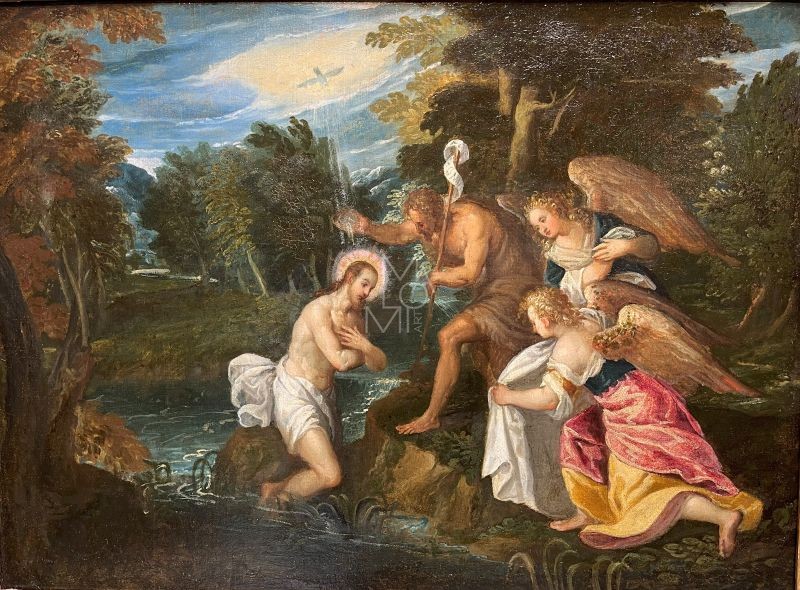
Late 16th-century Old Master oil painting "Baptism of Christ" attributed to Paolo Fiammingo (1540-1596). Exquisite Veneto-Flemish art with coeval frame.
- Artist: Pauwels Franck, called Paolo Fiammingo (Antwerp, c. 1540 – Venice, 1596) – Attributed
- Subject: The Baptism of Christ in the Jordan River
- Period: Late Sixteenth Century (c. 1580–1590)
- Medium: Oil on canvas
- Canvas Dimensions: 65 x 88 cm
- Dimensions with Frame: 116 x 98 cm
- Frame: Coeval to the painting, carved wood with genuine gold leaf gilding (Sansovinesque style)
- Provenance: Private Collection, Germany
- Expertise: Art-historical and critical study by Prof. Mauro Lucco
International Mannerism between Flanders and Venice: The Baptism of Christ by Paolo Fiammingo
A critical and historical-artistic study of a late sixteenth-century Veneto-Flemish painting
- Historical-critical framework and artist profile
The present contribution examines an oil-on-canvas painting depicting the Baptism of Christ (canvas: 65x88 cm; including coeval frame: 116x98 cm), recently emerged from a prestigious German private collection. The work is confidently restored to the autograph catalogue of Pauwels Franck, universally known in Italian art-historical chronicles as Paolo Fiammingo (Antwerp, c. 1540 – Venice, 1596). The attribution of the painting is supported by an expert study by the art historian Mauro Lucco, who confirmed its authenticity and its chronological placement within the artist's full maturity.
Pauwels Franck received his initial training in Antwerp, where he was registered as a master in the Guild of Saint Luke in 1561. Attracted by the chromatic and monumental revolution of the Italian Renaissance, he journeyed south, joining the influx of transalpine masters who redefined the canons of European landscape painting. Following a documented commission for the banker Hans Fugger in Augsburg, Franck settled permanently in Venice around 1578–1580, almost immediately entering the fertile circle of Jacopo Tintoretto.
Within the workshop of Robusti, Fiammingo specialized primarily in executing landscape backdrops for the large-scale monumental canvases destined for the Doge's Palace and major Venetian religious institutions. Once he established his own independent workshop, he successfully codified a hybrid visual language of extraordinary commercial acclaim, characterized by pastoral, mythological, and sacred scenes embedded within dense sylvan settings. The work under consideration belongs fully to this mature phase, wherein Northern graphic reminiscences are dissolved into the atmospheric density and luminism characteristic of the Venetian lagoon school.
- Iconographic analysis: an evangelical synthesis
The subject reproduces the episode of the baptism of Jesus in the Jordan River, a pivotal theophanic event concordantly described in all four Synoptic and Johannine Gospels (Matthew 3:13-17; Mark 1:9-11; Luke 3:21-22; John 1:29-34). Paolo Fiammingo opts for a synthetic and simplified composition, excising the crowd of neophytes that customarily populates more monumental treatments of the same theme, in order to focus on the dogmatic and emotional core of the narrative.
The narrative unfolds through a rigorous yet fluid concatenation between the figures and the surrounding space, orchestrated along a vertical theophanic axis that unites heaven and earth. In the upper portion, a luminous breach opens amidst dense clouds, revealing the dove of the Holy Spirit, which radiates an argenteous light directly onto the Savior's head, thereby manifesting the divine filial investiture. Beneath this heavenly light stands Christ, kneeling in the waters of the river in a posture of humble submission. His body displays a vibrant chiaroscuro that models his anatomy, deeply indebted to Mannerist statuary and the twisting, dynamic bodies studied under the tutelage of Tintoretto.
Upon the rocky bank on the right, the figure of Saint John the Baptist dominates, clad in his traditional camel skin, as he holds the staff cross with its scroll and performs the ritual gesture of pouring the baptismal water. Assisting the Baptist are two angelic figures—a number deliberately reduced in comparison to the complex celestial choirs of coeval painting—a choice that heightens the intimacy of the moment. The angel in the foreground carefully holds Christ's white robe, a topical iconographic detail intended to underscore the intrinsic sacrality and purity of the sacrament being celebrated.
- Formal structure, space, and landscape
The true underlying protagonist of the composition is the sylvan landscape, an identifying hallmark of Paolo Fiammingo's stylistic vernacular. The scene does not unfold within an open, desert expanse, as rigorous geographical philology of the Jordan would dictate, but is instead nestled within a dense clearing carrying a distinct pre-Alpine or Northern flavor.
The composition is framed by lateral arboreal screens that enclose the figures, directing the viewer’s gaze toward the background, where nature recedes according to the principles of Venetian aerial perspective. The foliage of the trees is rendered with a free, feathered, and light-infused brushstroke, typical of the technique acquired from Tintoretto yet still tethered to the meticulous Flemish analysis of natural detail. The contrast between the darkness of the woods and the sudden celestial radiance creates a characteristically late-Mannerist luministic dramaturgy, accentuating the sacred intimacy of the event.
- The socio-political and religious context of late sixteenth-century Venice
To fully comprehend the genesis and reception of a work such as Paolo Fiammingo's Baptism of Christ, it is indispensable to contextualize the canvas within the specific socio-political and spiritual fabric of Venice during the final decades of the sixteenth century. The period spanning from 1575 to 1596 (the year of the artist's death) was marked by profound geopolitical transitions and the definitive assimilation of the decrees of the Council of Trent (concluded in 1563), which radically redefined the role of sacred images and devotion in daily life.
In the closing decades of the sixteenth century, the Republic of Venice was navigating a complex phase of political consolidation. On one hand, the devastating plague of 1575–1577 had decimated nearly a third of the lagoon's population, undermining the labor force and the humanist optimism that had characterized the first half of the century. On the other hand, the progressive loss of centrality in Atlantic trade routes prompted the Venetian patriziate to invest heavily in land ownership on the Terraferma, transforming the mercantile aristocracy into a class of cultured and refined landowners.
From a politico-religious standpoint, the Serenissima consistently maintained a fierce jurisdictional autonomy relative to the Papacy. Although the Venetian state proclaimed itself steadfastly Catholic, its nature as a cosmopolitan emporium dictated a pragmatic tolerance toward foreign communities (such as Lutheran German merchants, Orthodox Greeks, and Jews) who were indispensable to the Republic's economy. This partial independence from Rome fostered a unique cultural climate in Italy, wherein the local Inquisition (monitored and moderated by Venetian lay magistrates, the Savi all'Eresia) seldom resorted to bloody excesses, preferring social control and public order over systematic ideological persecution.
Art was required to conform to three precise Counter-Reformation requisites theorized by Cardinal Gabriele Paleotti in his Discorso intorno alle immagini sacre e profane (1582): dogmatic clarity, verisimilitude, and the capacity to stimulate devotion (docere, movere, delectare). The iconographic choice of the painting under analysis fits perfectly within this precise ideological horizon. Baptism was one of the sacraments most staunchly defended by the Council of Trent against the tenets of the Protestant Reformation. Representing the institution of the sacrament by Christ Himself served to visually reaffirm Catholic orthodoxy, while the reduced format of the canvas suggests it was intended for private domestic prayer and meditation.
- Transalpine patrons in Venice and references to period inventories
Paolo Fiammingo’s artistic trajectory in Venice was sustained by a dense network of commercial and financial relations linking the lagoon city to the great metropolises of the Holy Roman Empire, specifically Augsburg and Antwerp. Within this landscape, the extraordinary economic and political power of the Fuggers stands out—the celebrated dynasty of German bankers and merchants who selected Venice as their strategic Mediterranean hub, establishing their headquarters in the monumental Fondaco dei Tedeschi at Rialto. Even before permanently embedding himself within the Venetian art scene, Pauwels Franck established contact with this transalpine elite. His primary patron was Hans Fugger (1531–1598), who engaged him to execute extensive pictorial cycles dedicated to mythological and allegorical themes for the Castle of Kirchheim in Swabia.
Upon relocating to Venice, Paolo Fiammingo became the natural point of reference for wealthy German and Flemish merchants residing in or passing through the lagoon. The analysis of accounting documents and contemporary inventories confirms the pervasiveness of these works within transalpine collections. In the inventories of the Fugger family (specifically within the liquidation and estate records of Hans Fugger and his descendants in Augsburg), one encounters frequent mentions of paintings described as "Landschaften with Historien" (landscapes with sacred or mythological stories) attributed to "Paulus Frank" or "Paolo Fiammingo".
Similarly, Venetian notarial records associated with the merchants of the Fondaco dei Tedeschi—such as the Flemish De Vos family or the German Hechel family—record at the close of the sixteenth century the presence of "quadri de paesi con figure con sue cornici" (paintings of landscapes with figures and their frames) destined for export to Northern Europe. The Baptism of Christ examined here, originating from a historical German collection, aligns perfectly with this channel of artistic exportation. For Northern collectors, a medium-format "cabinet painting" (65x88 cm) represented an ideal status symbol, capable of blending Venetian colorism with the analytical tradition of Flemish art.
- Paolo Fiammingo’s devotional style and inquisitorial rigor: a comparison with Paolo Veronese
Paolo Fiammingo's Venetian sojourn coincided with a period of heightened tension between the expressive freedom of artists and the doctrinal scrutiny exercised by the Tribunal of the Holy Office. The watershed event of this season was the celebrated trial of Paolo Veronese on July 18, 1573, sparked by his inclusion of dwarfs, buffoons, and drunken German soldiers in the monumental Last Supper painted for the refectory of Santi Giovanni e Paolo (subsequently renamed The Feast in the House of Levi to circumvent condemnation).
The conciliar decrees enacted at Trent in 1563 had imposed strict oversight upon sacred artistic expressions, delegating the vigilance over the doctrinal purity of images to inquisitorial tribunals. When the Holy Office initiated criminal proceedings against Veronese in 1573, challenging the profane licenses and irony introduced into the evangelical text, the entire Venetian artistic community realized that the boundaries of tolerance had shifted. The formal condemnation and the mandate for emendation imposed upon the Veronese master compelled Venetian workshops toward a path of extreme iconographic prudence.
While Jacopo Tintoretto responded to this climate of disciplining by accentuating the dramatic, visionary, and intensely emotional mysticism of his compositions for the Scuola Grande di San Rocco, Paolo Fiammingo devised an original and equally effective solution to evade censorial complications. His strategy relied upon a synthetic narrative arrangement of the sacred protagonists, enclosed and insulated within the landscape—a device that allowed him to fulfill devotional requirements without incurring doctrinal risks.
An analysis of the work under consideration in light of this coercive environment reveals how the artist consciously eliminated any potential element of disruption or profane digression. Unlike the monumental interpretations of the era, the scene here is reduced to its dogmatic core:
- There are no bystanders or secondary figures extraneous to the biblical text.
- The theophanic axis (Celestial Light - Dove - Christ) is distinct and unequivocal.
- The angels perform strictly liturgical functions as assistants to the sacrament, devoid of any concession to Mannerist sensuality or caprice.
Paolo Fiammingo’s devotional style thus proves perfectly aligned with post-Tridentine dictates: the work instructs the faithful on the value of baptism without distraction, while the dense sylvan clearing isolates the sacred event from the secular world, transforming the landscape into a locus of quiet and orthodox Catholic contemplation.
- The coeval frame and its historical-artistic value
The notation regarding the presence of a coeval frame (which expands the overall dimensions of the artifact to 116x98 cm compared to the 65x88 cm of the canvas alone) constitutes an element of exceptional historical-critical and conservative value. The endurance of the original pairing between painting and frame provides significant evidence regarding the provenance and intended function of the work.
The frame conforms to the stylistic parameters of the mature and late Venetian Renaissance, standing as a fine example of master cabinet-making, carved and gilded with genuine gold leaf in the final quarter of the sixteenth century. The substantial width of the moulding (exceeding 20 centimeters per side) reflects a desire to elevate the domestic cabinet piece into a monumental wall object, capable of interacting with the opulent coffered ceilings and wooden paneling of Venetian patrician palaces or the residences of refined international patrons.
The ornamentation features rich relief decoration that alternates geometric patterns with phytomorphic and floral motifs, punctuated by raised rosettes or bosses at the corners and midpoints—elements characteristic of the "Sansovinesque" style. Furthermore, the inner moulding features a delicate bead-and-reel or dentil profile that eases the viewer's eye into the perspectival depth of the painting.
The coeval nature of the frame yields three fundamental interpretive criteria:
- Integrity of the support: It drastically reduces the likelihood that the canvas underwent cropping or reduction in format during subsequent centuries, confirming the measurements of 65x88 cm as the original dimensions intended by the artist.
- Corroboration of private destination: This category of elaborately rendered "cassetta" frames was specifically designed for paintings intended for the porteghi (main grand halls) or reception salons of private collections.
- Uniqueness of the artifact: The rarity of a sixteenth-century painting preserved alongside its original frame significantly enhances the historical, documentary, and collectible value of the entire ensemble, visually encapsulating the aesthetic of International Mannerism within a single monumental unit.
Conclusion
The Baptism of Christ analyzed herein stands as a stellar exemplar of cross-cultural artistic transition. Paolo Fiammingo does not disavow his Flemish roots—evident in his conception of the landscape as a pulsating microcosm—but instead filters them through the lens of light and color acquired in the lagoons. Mauro Lucco's study restores to art history a canvas that lucidly documents that fruitful European dialogue which transformed late sixteenth-century Venice into an artistic laboratory without borders, protected by a magnificent period frame that preserves its pristine splendor and structural integrity.
- References
- Aikema, B., De schilder Pauwels Franck, alias Paolo Fiammingo, in "Mededelingen van het Nederlands Instituut te Rome", XLIII, 1981, pp. 137–166.
- Aikema, B., Paolo Fiammingo tra Venezia e l'Europa, in Arte delle Fiandre e pittura veneziana tra Rinascimento e Barocco, edited by B. Aikema and D. Meijers, Busto Arsizio, 1985, pp. 95–112.
- Bushart, B., Die Fuggerkapellen bei St. Anna in Augsburg, München, 1994.
- Lucco, M., La pittura a Venezia nel tardo Cinquecento, in Storia di Venezia. L'Età Rinascimentale, edited by A. Tenenti and U. Tucci, Roma, Istituto della Enciclopedia Italiana, 1996.
- Mason Rinaldi, S., Palma il Giovane. L'opera completa, Milano, 1984.
- Pallucchini, R., La pittura veneziana del Seicento, Milano, 1981.
- Prodi, P., Il Cardinale Gabriele Paleotti e la Riforma cattolica delle immagini, in "Rivista di storia della Chiesa in Italia", IX, 1955, pp. 161–212.
- Ridolfi, C., Le Maraviglie dell'arte, ovvero le vite degli illustri pittori veneti e dello Stato (1648), edited by D. von Hadeln, Berlin, 1914-1924 (vols. I-II).