The ancient fair of Bergamo and Città alta: a nineteenth-century view from the meadow of sant'Alessandro
porta orientale fair bergamo, lombard genre painting restoration period, 19th century view of bergamo alta, grand tour collectors lombardy, marouflage paper to wood restoration, biedermeier fashion and carriages 1840s
(Bergamo, 1803 – 1878)
With influences from Luigi Deleidi, known as il Nebbia
Circa 1845 – 1850
cm 87 x 145
The horizon of the veduta: historical-critical and material analysis of a nineteenth-century urban landscape
The Prato di Sant'Alessandro and the monumental layout of the fair
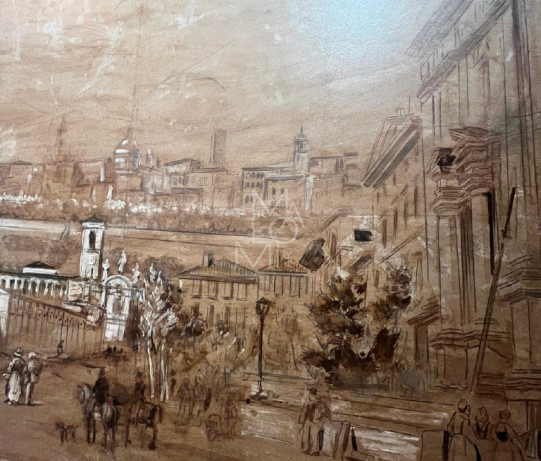
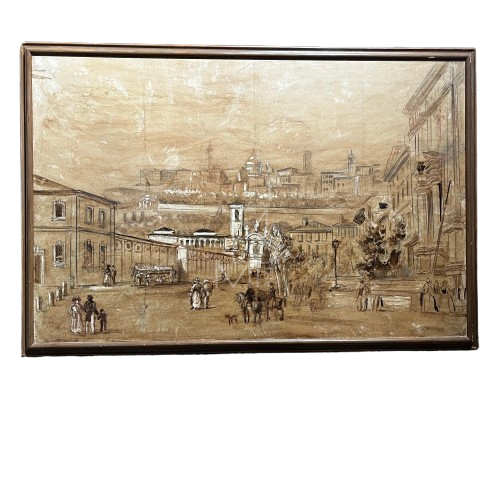
The work under examination inserts itself authoritatively within the glorious tradition of European vedutismo, a genre that since the eighteenth century has codified the scientific and poetic representation of urban space. Between the late eighteenth century and the first half of the nineteenth century, the veduta underwent a fundamental evolution in which the perspective and almost topographical objectivity of Enlightenment matrix merged with Romantic sensibility and the aesthetics of the Grand Tour. The painting in question documents a crucial stylistic transition, wherein architectural rigor meets a vibrant atmospheric rendering. The scene restores a cross-section of urban life during the Habsburg era, where the ancient monumental layout harmoniously coexists with daily anecdotal scenes.
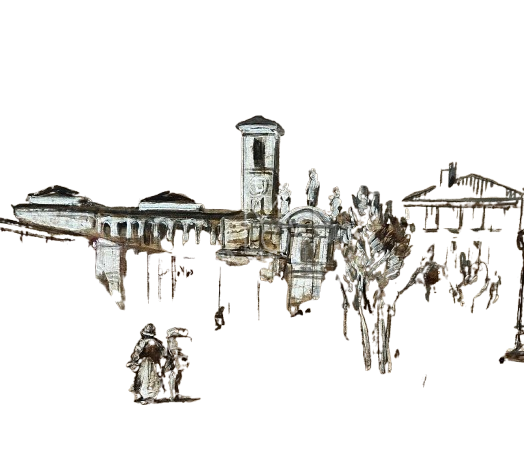
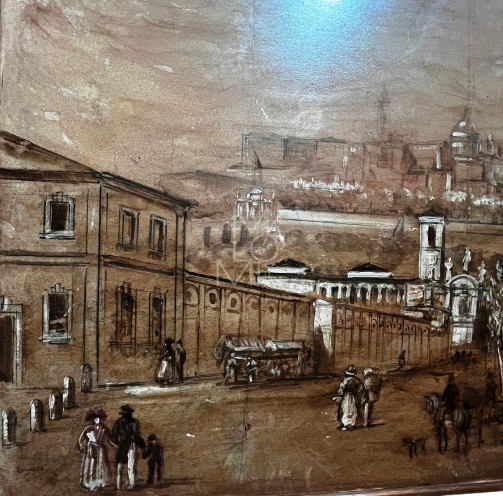
This imposing composition configures itself as an essay in visual urban archaeology, as it immortals the outer perimeter of the ancient stone Fair of Bergamo, permanently erected in masonry between 1734 and 1740 upon the design of Giovan Battista Caniana. This immense commercial quadriporticus, originally composed of no fewer than five hundred and forty shops arranged around a central tree-lined square, constituted the economic engine of nineteenth-century Bergamo during the celebrations of the patron saint Alexander. In the painting, the long building curtains punctuated by arcades and monumental entrances faithfully describe the structural morphology of the fair complex prior to the progressive demolitions initiated in 1906 to make room for the modern Piacentinian Center.
A curiosity linked to this location concerns the very organization of the shops, which were assigned to merchants through a rigid system of drawing lots to avoid favoritism, thereby concentrating cloth vendors, silk merchants, and leather workers from all over Europe into specific sectors. Another fascinating anecdote narrates that the fair was considered a legal sanctuary or free-trade zone: during the weeks of the market, insolvent debtors could circulate freely within the perimeter without fear of being arrested, an economic expedient aimed at maximizing financial flows and attracting buyers from every corner of the peninsula.
Perspective geometries and the visual axis toward the hill
The composition adopts a vantage point highly studied in academic settings, echoing the layout of coeval engravings and vedute. The foreground describes the space in front of the fair, historically known as the Prato, an area that during the weeks of the market transformed into a sumptuous open-air theater. Alongside the negotiations of precious commodities, the Prato hosted temporary structures for puppet theaters, acrobats, sellers of miraculous elisir, and storytellers who entertained the crowds of visitors, turning the economic event into a true popular festival. The buildings that laterally flank the scene recall the old Ospedale Maggiore di San Marco and the architectural bodies annexed to neighboring monasteries, before the urban clearances that would reshape the face of the lower city.
It is said that precisely on this meadow, during the bustling days of the fair, the first eccentric experiments of nineteenth-century science made their appearance, such as magic lanterns and cosmoramas, which allowed ordinary citizens to observe illusory and three-dimensional images of distant capitals like Paris or London, anticipating that fascination with the exotic which is also breathed in the collecting choice of this large veduta.
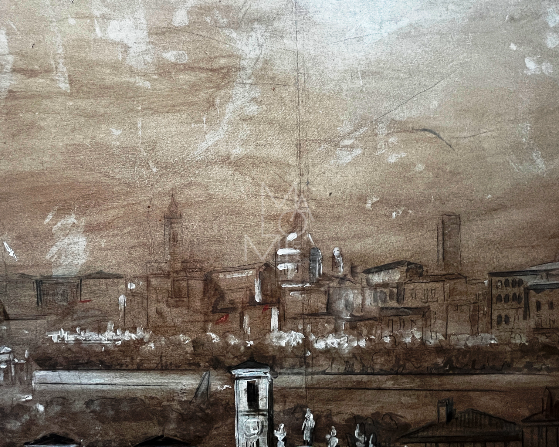
The majestic hilly backdrop elevates the topography to an indispensable identity symbol. The monumental architectures of Bergamo Alta serve as the geometric and ideal fulcrum of the entire composition, with the soaring profiles of the Campanone, or the Civic Tower, and the mass of the cathedral of Sant'Alessandro emerging beyond the customs and military line of the Venetian Walls. This juxtaposition between the commercial vivacity of the plain and the aristocratic solemnity of the hill perfectly reflects the historic Bergamasque duality, where the mercantile activity of the flatland constantly interlocked with the center of political and religious power perched upon the rock.
The identification of the Porta Orientale and monumental details
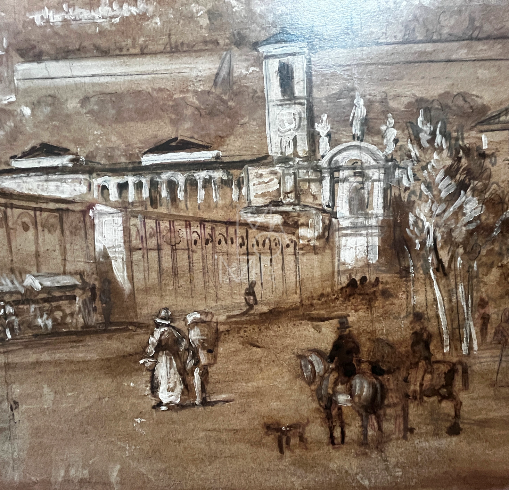
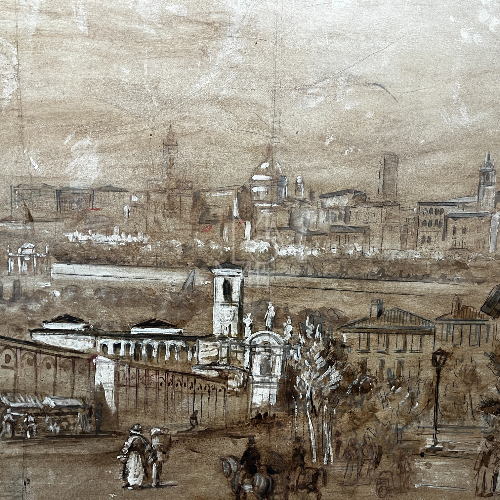
An examination of the monumental details located in the center-left portion of the middle ground resolves a fundamental topographical nod, allowing the identification of the access structure as the lost Porta Orientale of the fair, also known as the entrance toward the Sentierone and Borgo Pignolo. Caniana had designed the entrances of the stone fair as true baroque scenic outposts, enriched by plastic elements that the author of the painting describes with exceptional visual acumen. Above the entablature of the central portal, one can clearly distinguish the profiles of monumental statues and acroteria arranged symmetrically, which in historical sources appear dedicated to civic virtues and the protectors of commerce.
Immediately adjacent to the portal emerges a corner turret, a partially set-back structure that did not merely possess structural and customs functions, but served as a visual pivot to connect the long arcaded wings of the shops. An archival anecdote reveals that precisely within these turrets resided the custodians of the fair and the representatives of the mercantile tribunal, appointed to resolve on the spot disputes regarding weights, measures, and the authenticity of the gold and silver coins circulating during the market days. It is furthermore passed down that in one of these narrow spaces lay the public weighing room, where every single bale of raw silk had to be taxed before crossing the gates, generating fundamental revenue for the city treasury and sparking not infrequent attempts at nocturnal smuggling through the artificial canals surrounding the area. To the left of the portal stretch the building sleeves punctuated by regular arches, rendered in the painting with dense bistre washes that evoke the depth of the open bays where historically the exhibition stalls were placed.
Visual comparison with the engraving tradition of Rosa and Berlendis
The painting establishes a tight formal dialogue with the graphic repertoires of the Romantic era that codified the mythical image of Bergamo. A systematic comparison with the drawings and etchings of Costantino Rosa and the vedutista and architect Giuseppe Berlendis brings to light consonances and variants of great critical interest. While the graphics of Berlendis and Rosa often develop from zenithal or wide-angle viewpoints aimed at emphasizing the geometric plan of Caniana or the optical thrust of the Sentierone, the painting under examination predilects a lowered, eye-level viewpoint that flattens the visual axis on the meadow and amplifies the monumentality of the Città Alta in the background.
A curious detail regarding the renowned prints of Berlendis was their extremely high scientific precision, so much so that they were utilized by early road engineers and foreign travelers as true visual travel guides, purchasable in the art shops of Milan and Venice. The rendering of the hill also highlights a sharp methodological departure from editorial precision. Where the engraving repertoires show a crisp, almost cartographic line attentive to the individual windows of Palazzo Rezzonico or the stone blocks of the walls, the author of this veduta chooses an atmospheric and soft rendering, where the domes and the Campanone are evoked through washes and blurred glazes.
This pictorial conduct clearly feels the influence of nebbiatismo, that particular stylistic signature introduced by Luigi Deleidi, known as il Nebbia, famous for his hazy landscapes. The management of the genre figures confirms this expressive autonomy, since the isolated human figures of the editorial prints are replaced here by a strong narrative dynamism, with groups of characters creating small nuclei of genre painting. The graphic line in pen, joined with the fluid application of bistre, demonstrates that the author did not merely translate a coeval print, but reinterpreted the graphic model to give life to an autonomous piece of pictorial virtuosity intended for the private collecting of the Lombard Grand Tour.
Habsburg-era fashion and the comparison with Francesco Coghetti
A detailed analysis of the costume elements and the means of transportation present in the painting provides highly precise historical parameters for dating the scene, anchoring it to the social dynamics of Lombardy under Austrian rule. The human figures, though synthetically depicted, maintain legible silhouettes and volumes of the garments typical of Romantic fashion and Biedermeier taste. The aristocracy and upper bourgeoisie of Bergamo during that period found their greatest interpreter in the Bergamasque painter Francesco Coghetti. A comparison between the silhouettes of the figures in the painting and the rigorous canvases of Coghetti preserved at the Accademia Carrara highlights an unequivocal identity of costume.
The gentlemen strolling on the meadow of the fair wear the ubiquitous top hat, a symbol of bourgeois social status, combined with a tailcoat or a redingote. The jackets show a slim line on the torso and slightly sloping shoulders, which faithfully mirror the male portraits executed by Coghetti for the Orobian nobility. An eccentric curiosity linked to the top hats of the era concerned their height and internal lining, which was often utilized by the merchants of the fair to hide confidential bills of exchange or high-value commercial contracts during their movements between the boroughs and the fortress, in order to avoid the frequent pickpockets who loitered in the crowds of the market.
The female element proposes the same chronological coherence, as the women show wide gowns with a smooth bell shape, which temporally precedes the introduction of the metal crinoline cage patented in the mid-1850s. The ladies sport shawls or short capes in cloth or cashmere and bonnet hats that tightly frame the face, complying with the modest elegance of the Restoration. In the center of the piazza move light two- or four-wheeled vehicles with partially reclining hoods, traceable to the typology of the gig or cabriolet, the vehicles of choice for moving easily through the streets that connected the historic boroughs of the plain with the slopes of Città Alta.
Technological archaeology and the introduction of gas in Bergamo
A monumental detail of a technological nature allows the dating of the work to be narrowed with surprising chronological precision. On the right side of the expanse of the meadow emerges an isolated vertical element that clearly identifies itself as a public street lamp for urban illumination. The history of Bergamasque civic services provides incontrovertible historical milestones in this regard. Until the first half of the 1840s, the meadow of the fair and the Sentierone were poorly lit by oil lanterns placed on temporary wooden poles or wall hooks, the lighting of which was limited almost exclusively to the weeks of the August fair.
The technological turning point occurred in 1845, the year in which the municipal congregation of Bergamo approved the project for the introduction of innovative public lighting utilizing gas distilled from fossil coal. The first pipelines and modern permanent cast-iron candelabra, characterized by a hexagonal-section lantern, officially entered into function between 1845 and 1846, starting precisely from the perimeter of the Sentierone and the fair area to facilitate evening trades and ensure public safety. A historical anecdote reports that the first lamplighters tasked with the evening lighting were received by the populace with wonder and suspicion, and that the advent of gas radically changed the nightlife of the lower city, extending the opening hours of shops past sunset and allowing the development of historic cafes.
The pole reproduced by the artist displays the typical silhouette of these early nineteenth-century candelabra. The presence of this street furniture fixes an initial execution term at 1845, while the total absence of the gigantic crinoline skirts fixes a final term at 1855, placing the genesis of the work in the narrow five-year span between 1845 and 1850, when the stone fair experienced its last splendors of the Habsburg era.
Material aspects and conservation of paper on plywood
The material binomial constituted by paper glued onto plywood represents a critical node of exceptional interest for the history of artistic techniques and the conservation of cultural heritage. The monumental format of eighty-seven by one hundred and forty-five centimeters indicates that the work was originally born by combining multiple large sheets of watermarked paper to cover the entire extension of the veduta. The choice of paper as the primary support for a work of this scale suggests that the painting was born as a monumental exhibition drawing or as a highly refined preparatory cartoon intended for an atelier studio, where the paper surface allowed a fluid application of the graphic line in ink and the immediate absorption of aqueous washes.
The mounting onto a plywood panel constitutes a subsequent conservative intervention, executed through the technique of marouflage presumably during the twentieth century. Originally conceived as a work on loose or flexibly stretched paper, the composition suffered greatly from the natural hygroscopic movements of the cellulosic support, which tended to produce wrinkling, tears, and deformations due to variations in environmental humidity. The adhesion of the paper to the rigid wooden panel allowed the permanent stabilization of the surface planarity and halted the mechanical degradation of the sheet. This historicized restoration has preserved a Bergamasque urban palimpsest by now erased from history, freezing the freshness of the mark and the vastness of the perspective gaze to deliver an intact image of the beating heart of nineteenth-century Bergamo.
The late twentieth-century frame and the structural layout of the support
The frame enclosing the large veduta qualifies as an artifact from the second half of the twentieth century, characterized by a linear and molded profile that responds to the museographical criteria of sober elegance widespread in the post-World War II period. This structure does not merely possess an aesthetic function and a role of visual transition between the work and the exhibition environment, but plays a fundamental static role in containing the backing panel. The wooden frame tightens and protects the margins of the plywood onto which the paper was adhered, preventing the natural twists of the wood caused by the thermo-hygrometric variations of the room from affecting the fragile paper film.
The lining and framing intervention, executed concurrently with the creation of the late twentieth-century frame, reflects the conservative practice of the period, aimed at privileging the maximum structural stability of historic supports over the original flexibility of loose sheets. This operation locked the internal tensions of the joined sheets of paper, preserving the work from perimetric tears and guaranteeing the readability of the complex perspective weave over the long term.
Graphic analogies and drafting styles with the masters of vedutismo
Under a strictly formal profile, the drawing unveils a profound knowledge of the graphic codes codified by the masters who frequented and portrayed the Orobian territory in the first half of the nineteenth century. The conduction of the line in pen, joined with the washes of bistre and sepia, shows a tight analogy with the autographed sheets of Luigi Deleidi, known as il Nebbia, from whom the author borrows the sensitivity in describing vegetation. The foliage of the trees on the right of the square, resolved with small jagged touches and clusters of brown ink to evoke shaded zones, faithfully retrace the graphic solutions adopted by Deleidi in his landscape studies and theatrical set designs preserved at the civic museums.
A second nucleus of formal affinities is found with the production of Costantino Rosa, particularly in the definition of the genre figures and the architectural layout of the Porta Orientale. The author of the painting adopts the same descriptive acumen as Rosa in tracing the profiles of passersby and the structure of the gigs with very few essential marks, yet loaded with dynamic expressiveness. However, while Rosa often maintains a descriptive clarity of Enlightenment matrix, the creator of this veduta prefers a more atmospheric and Romantic approach, drawing closer to the pictorial and volumetric solutions of the circle of Marco Gozzi and Giovanni Migliara. The ability to modulate the raking light on the facades of the fair shops and to blur the contours of the domes of Città Alta to simulate atmospheric dust elevates the work from a simple topographical reproduction to an autonomous result of great pictorial quality, fully inserted into the artistic debate of the Lombard School of the Restoration.
Proposed specific attribution and historical-critical justifications
On the basis of the topographical, technological, and stylistic evidence emerged from the close analysis of the artifact, the assignment of the work is proposed to the direct circle or tight sphere of Costantino Rosa, with a strong and conscious reception of the coeval scenographic and landscape culture introduced to the Orobian territory by Luigi Deleidi. This attribution is founded upon a dense series of academic reasons that invest the philology of the drawing, the structure of the composition, and the sociology of nineteenth-century collecting taste in Restoration Lombardy.
The first element in support of this thesis lies in the specific execution of the pen stroke defining the human figures and the means of transport on the meadow of the fair. Costantino Rosa, a fine draftsman and lithographer trained within the climate of the painting chair at the Accademia Carrara, codified a repertoire of urban genre figures characterized by extreme formal synthesis yet rigorous volumetric precision. In the painting under examination, the male figures with top hats and the ladies with shawls and smooth bell-shaped skirts exactly reflect Rosa’s graphism: the bodies are constructed through rapid and decisive perimeter lines, subsequently filled with saturated monochrome washes to yield the effect of silhouettes in backlight. The same morphological expertise is found in the description of the Porta Orientale of the fair. Rosa was a profound connoisseur of Caniana’s architectures, which he portrayed on multiple occasions in his lithographic series of the 1850s. The author of the painting does not limit himself to a generic reproduction, but demonstrates an analytical sensitivity of academic matrix in rendering the crests, the statues, and the corner turret, treating the architectural data with the same graphic rigor found in the master’s autographed sheets.
If the perspective layout and the precision of the street furniture look directly to the models of Costantino Rosa and the rigorous axonometries of Giuseppe Berlendis, the pictorial rendering of the hilly background introduces a second indispensable pole of influence: that of Luigi Deleidi. The way in which the profile of Città Alta and the surrounding vegetation have been resolved — renouncing a crisp outline in favor of a soft, fluid, and aqueous application of bistre — evokes the stylistic signature known in the Lombard critical landscape as nebbiatismo. The author of the work demonstrates having assimilated Deleidi’s lesson in the management of atmospheric dust, where the Campanone and the dome of the Cathedral seem to emerge from a light luminous haze, typical of Po Valley afternoons and Orobian hills. The tree branches on the right, pecked with varying densities of brown ink to simulate the passage of light through the leaves, detach from the rigidity of editorial prints to embrace an exquisitely pre-Romantic sensitivity. This happy fusion between the drawing rigor of Rosa and the chiaroscuro softness of Nebbia suggests a paternity to be sought among the finest pupils or collaborators operating in the studios of the Accademia Carrara between 1845 and 1850.
A final academic justification lies in the exceptional nature of the format of eighty-seven by one hundred and forty-five centimeters. A monochrome drawing on paper of these dimensions was not conceived as a simple sketchbook entry, but as a "veduta da parato" or a finished exhibition work destined to ennoble the walls of a patrician mansion in the lower city. The choice of the Fair of Sant'Alessandro as the main subject, combined with the celebratory view of Città Alta, responded to the demand of a high-ranking collecting circle desirous of possessing a piece of technical virtuosity that exalted the monumental and economic identity of Bergamo.
Bibliographical references
- Berlendis, Giuseppe. Raccolta delle principali vedute della città di Bergamo e suoi contorni, disegnate dal vero ed incise. Bergamo: Stamperia Natali, 1841.
- Bottani, Tarcisio and Wanda Taufer. I mercanti della seta e l'antica Fiera di Sant'Alessandro a Bergamo. Corponove: Bergamo, 2000.
- Lorandi, Marco, Fernando Rea and Chiara Tellini Perina, eds. La pittura di paesaggio in Lombardia: l'Ottocento. Milano: Electa, 1993.
- Nova, Giorgio. L'illuminazione pubblica in Lombardia tra restaurazione e unità. Milano: Franco Angeli, 1982.
- Mazzocca, Fernando, ed. Francesco Coghetti e il suo tempo: pittura della Restaurazione tra Roma e la Lombardia. Cinisello Balsamo: Silvana Editoriale, 2002.
- Pelandi, Luigi. Attraverso le vie di Bergamo scomparsa: la Fiera e il Sentierone. Bergamo: Bolis, 1963.
- Rosa, Costantino. Vedute di Bergamo e suoi contorni tratte dal vero e litografate. Bergamo: Litografia Cattaneo, 1852.
- Rea, Fernando, ed. Luigi Deleidi detto il Nebbia (1784-1853): un pittore bergamasco tra classicismo e romanticismo. Bergamo: Accademia Carrara, 1884.