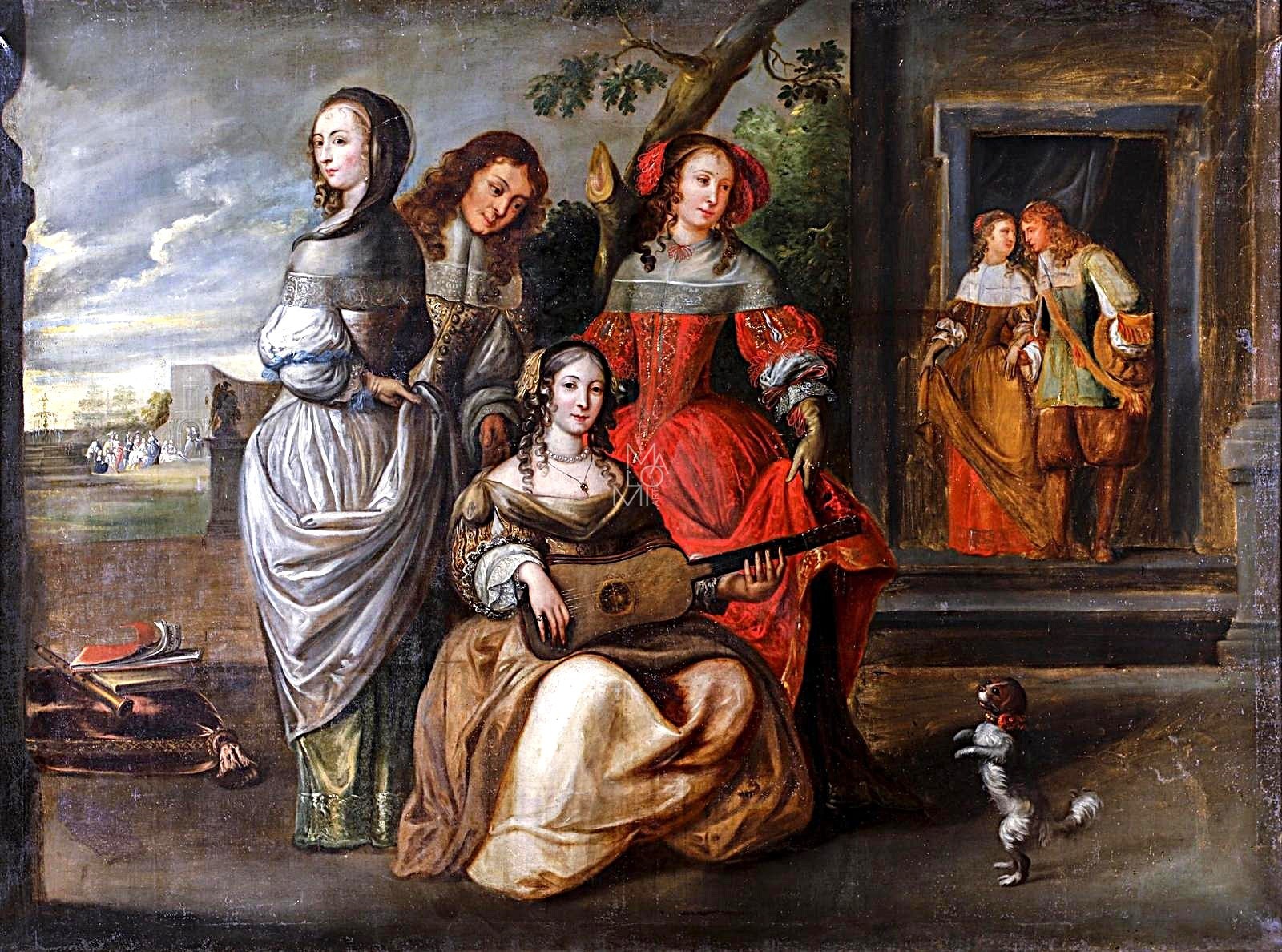
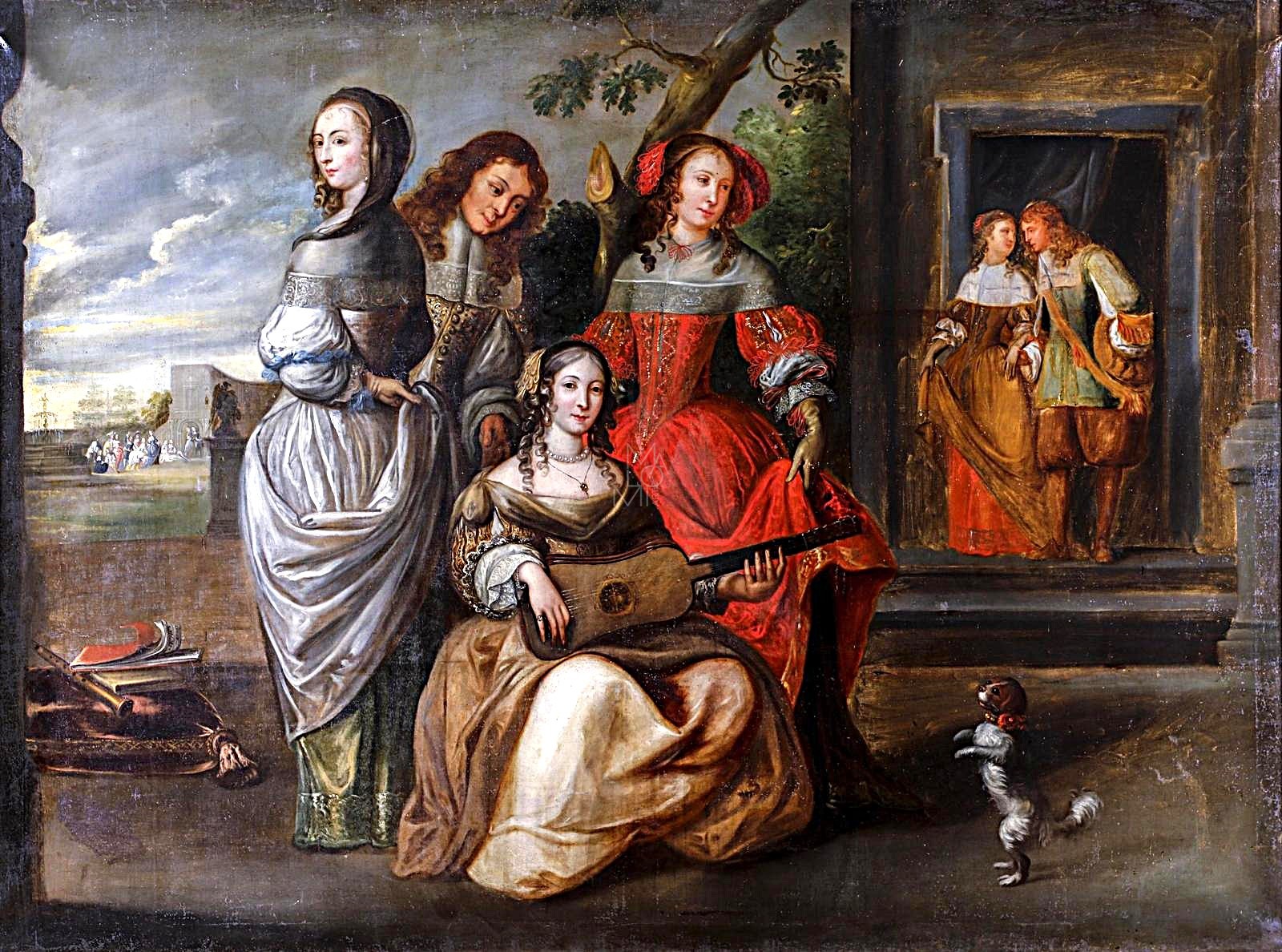
Monumental 17th-century flemish painting, large elegant Company Making Music in a Garden 300x240 cm, circle of Jan Brueghel the Younger and Gonzales Coques with contemporary frame
17th century flemish painting old master paintings flanders jan brueghel the younger circle gonzales coques portraiture baroque elegant company garden antwerp school oil on canvas genoese patrician collecting seicento baroque guitar iconography art monume
Monumental 17th-Century Flemish Painting, Large Elegant Company Making Music in a Garden 300x240 cm, Circle of Jan Brueghel the Younger and Gonzales Coques with Contemporary Frame
THE ORDER OF THE GAZE AND THE EXCEPTION OF THE DRAMA
A Critical Study and Iconographic Analysis of an "Elegant Company Making Music in a Garden" from the Antwerp School (17th Century)
- Introduction and Historical-Artistic Framework
The painting under analysis stands as a complex and monumental testament to 17th-century Flemish genre painting, representing a mature outcome of the cultural and economic flourishing that characterized the city of Antwerp during the Golden Age (Gouden Eeuw). The work belongs to an iconographic tradition of extraordinary commercial and curatorial success: that of the "elegant companies" (buitenpartij or conversatie). These compositions were conceived to celebrate courtly manners, moral virtues, and the ostentation of social status by the aristocracy and the wealthy merchant bourgeoisie of the era.
From a compositional and formal standpoint, the canvas reflects an atelier practice that skillfully balances the legacy of the Brueghel dynasty—particularly in the execution of the landscape and botanical elements—with the volumetric elegance and portraiture mastery of artists such as Gonzales Coques and Christoffel van der Lamen.
The exceptional element that elevates this canvas above more common, static contemporary conversation scenes lies in its deeply dramatic and "theatricalized" narrative structure. This narrative hinges upon the disruption of a courtly idyll by a sudden, tragic event, orchestrated according to the precise tenets of Baroque rhetoric regarding the expression of the passions (affetti).
The spatial arrangement follows a clear narrative progression, presenting a visual score divided into three distinct conceptual movements. On the left, the Apollonian order prevails—a zone dominated by serenity, music, and the static portraits of the patrons. At the center, this equilibrium is abruptly shattered by the emotional collapse of a swooning figure, a narrative pivot that introduces tension and dynamic movement. Finally, on the right, the scene softens into lyrical indifference and the romantic intimacy of a couple isolated within a loggia, offering a philosophical reflection on the co-existence of private tragedy and everyday life.
- The Antwerp-Genoa Axis: The Context of Ligurian Patronage and Its Dynamics
The historical-artistic analysis of this grand composition cannot be separated from its centuries-old provenance within the collecting networks of the Ligurian nobility. During the 17th century, the Republic of Genoa and Flanders were bound by a dense and unbreakable web of financial, commercial, and diplomatic exchanges. The Genoese bankers, acting as the financial backbone of the Spanish Empire, had amassed vast fortunes, allowing them to acquire the finest artistic productions in Europe. The elite patrician families viewed art from Antwerp as the ultimate symbol of prestige, refinement, and cultural sophistication.
This privileged relationship was officially inaugurated by Antoon van Dyck’s legendary stay in Genoa between 1621 and 1627. The Flemish master trained the eyes of Ligurian patrons to appreciate a superb style of portraiture, characterized by regal poses, aloof gazes, and a tactile rendering of shimmering satins. This celebrated elite archetype firmly established the patrician demand for high-society representation, laying the groundwork for successive masters.
Gonzales Coques, whom contemporaries aptly dubbed "the little van Dyck", became the ideal response for patrons who desired the same aesthetic and qualitative standards of the great master but preferred them declined into a more intimate, anecdotal, and narrative cabinet format, perfectly suited to decorate the private salons of the Palazzi dei Rolli, which served as the ultimate domestic destination for these highly sought-after cabinet pieces.
A crucial role in this commercial and artistic network was played by the Genoese workshop of the brothers Lucas and Cornelis de Wael. Their studio in the city was not merely a site of pictorial production but a true logistical and cultural hub for the entire Flemish community in Italy, acting as a vital trade clearinghouse and commercial customs node for all artistic imports coming out of Antwerp. The de Waels welcomed northern artists in transit, offered them institutional protection, and acted as intermediaries with the local nobility.
Concurrently, they regularly imported whole crates of paintings from Antwerp by sea to satisfy the demand of discerning collectors. A fascinating detail from contemporary customs registries reveals how these artworks were packed with meticulous care in sheets of waxed canvas to protect them from sea salt during long months of navigation, only to be unpacked directly in the Ligurian ports and shown in preview to the most influential merchants.
For a Genoese patrician, commissioning a painting depicting a garden concert was also a calculated political and philosophical statement. In the oligarchic Republic of Genoa, social stability relied upon the concept of conversazione civile (civilized conversation) and harmony among the various ruling families. Displaying an aristocratic group playing in perfect accord within one's salon served as a direct metaphor for good governance and the civil order of the Republic itself.
In the ancient archival inventories of prominent Genoese galleries, such as those of the Spinola or Balbi families, canvases of this complexity were often recorded under the laconic and generic description of "Landscape with small figures from Flanders" or "Music scene of the Antwerp School". This inventory anonymity should not be misconstrued: the appraisers of the era were not ignorant of the painter's name, but rather applied a classification tied to the intrinsic value of the "Flemish manner," which was considered a certificate of the highest commercial prestige in its own right.
- Compositional Analysis and Tripartite Structure
The scenography of the painting is organized according to a rigorous tripartite reading scheme, which unfolds from left to right, moving the spectator through antithetical emotional and narrative registers—a device typical of the grand theatrical and figurative traditions of the Seicento.
The Left Section: Apollonian Order and Atelier Harmony
The left side of the work is dominated by a core of four characters arranged in a carefully calculated pyramidal hierarchy. This portion is distinguished by a marked static quality and a level of detail that directly recalls official court portraiture. The figures do not participate in the dramatic action unfolding at the center; instead, they offer themselves to the observer as models of formal grace. The brushwork in this sector privileges the virtuoso rendering of material textures—the sheen of satins, the translucency of pearls, the opacity of velvets—freezing the characters in a suspended and authoritative atmosphere.
The Central Section: Emotional Collapse and Baroque Rhetoric
The geometric and emotional center of the canvas is occupied by the disruptive event: a young woman, overcome by a sudden swoon, abandons her lifeless body onto the knees of the surrounding figures. Around her, a frantic chain of psychological and physical reactions erupts. Faces contort in anxiety, hands stretch out to test her pulse and support her weight, while behind the group, a man raises his right arm toward the sky with an open hand, visually codifying the classic theatrical gesture of invocation or dramatic astonishment. This focal point of the drama converts the elegant company into a representation of literary, historical, or theatrical import, where the brushwork becomes swifter, more summary, and dynamic to match the movement of the bodies.
The Right Section: Lyrical Indifference and the Architectural Loggia
Moving toward the far right, the dramatic tension dissolves to make way for an intimate, idyllic register. Framed by the shadow of a monumental classical arch of Palladian flavor, a young pair of lovers isolates themselves visually and psychologically from the central tragedy. The man leans toward the lady, seeking her gaze, while she responds with a gentle tilt of her head. Slightly below them, other figures sit on the ground in total tranquility. This deliberate fragmentation of emotional responses within the same scene allows the author to infuse the composition with spatial and conceptual realism, highlighting the co-existence of courtly life, private tragedy, and romantic detachment.
- Stylistic Focus and Close Examination of the Faces
The macroscopic details observed in the individual characters of the left section reveal the hand of a painter endowed with a solid graphic culture and a profound knowledge of the tenets of Franco-Flemish fashion from the mid-17th century, a period datable with precision to between 1650 and 1665 based on the evolution of costume. The careful analysis of these details reveals the adoption of strict evolutionary criteria of contemporary men's and women's fashion: the ladies' hair conforms to the canons of short, thick curls known as "à la garçon" or to spiral ringlets baptized "serpenteaux," while ornaments are enriched by bright vermilion silk bows woven into the hair, and jewelry celebrates the use of large teardrop pearl necklaces and pendants. On the male side, the attire records the definitive abandonment of the old ruffs in favor of the flat white collar known as "a banda" and the introduction of the first monumental wigs.
- The Dama with Red Bows: The first face reveals an incarnate modeled through soft tonal gradations and imperceptible chromatic transitions. The hairstyle, featuring long curls falling onto the shoulders (à la garçon), is embellished with conspicuous red silk bows woven into the locks at the sides of the face. This ornamental detail, clearly derived from the Parisian court of Louis XIV, testifies to the international taste of the patrons. The contrast between the porcelain-like smoothness of the skin and the more vigorous, textured handling of the background tree trunk highlights a precise hierarchical choice in the layering of planes. An anecdote from Antwerp workshops recalls that the red pigment used for such ribbons was often precious kermes lake, extracted from dried insects and reserved exclusively for the garments of high-ranking patrons.
- The Dama with the Black Veil and Teardrop Pearl: The second female portrait shows a figure in a three-quarter profile, characterized by a high, uncovered forehead framed by short blonde curls. Her head is enveloped by a falling dark veil, a type of headdress (huke) associated with the sober elegance of the upper classes in the Spanish Netherlands. A monumental teardrop pearl stands out on her ear, rendered with a single impasto touch of lead white to capture the ambient light. Her penetrating gaze, directed squarely at the spectator, establishes a tense and formal psychological dialogue.
- The Guitarist and the Lesson of Peter Lely: The face of the seated musician in the foreground represents the lyrical pinnacle of the left section. Her idealized physiognomy, large languid eyes, and regal posture closely recall the models of English court and Franco-Flemish portraiture, codified by Antoon van Dyck and continued by his principal spiritual heir, Sir Peter Lely. The adornment of the neck—a sumptuous string of pearls paired with a dark geometric pendant—and the spiral curls (termed serpenteaux at the time) brushing her exposed décolleté identify this figure as the allegorical pivot of the compositional harmony.
- The Cavalier with Flat Collar: Behind the ladies, the male portrait offers a counterpoint of masculine austerity. The man sports a thick head of wavy brown hair—an anticipation of the allonge wig—and wears a wide, flat white collar without rigid lace, known as a "band collar" or "hunting collar," which replaced the monumental ruffs of the turn of the century starting in the 1640s. His face is modeled with deeper shadows and sharper graphic lines, following a turn of the head intended to direct his gaze toward the drama unfolding on the right.
- Dialectics of Technique: An Examination of the Figures Seated on the Ground in the Right Section
A crucial node for understanding the executive hierarchy of the work lies in the qualitative analysis of the secondary characters seated on the ground in the right sector, directly beneath the architectural loggia. Close observation of these figures allows one to evaluate whether the canvas maintains the exceptional formal rigor displayed in the portraits on the left, or whether it shows a deliberate relaxation of technique attributable to workshop assistance.
When a close executive comparison is made, it becomes apparent that the left section, operating under the structural paradigm of a donor portrait group, is resolved in the foreground through an extremely dense micro-brushwork and porcelain-like sfumato, dedicated to the miniaturistic virtuosity of pearls and embroidery. Conversely, the right section, relegated to the background on the ground, assumes the functional weight of pure staffage and genre scene, where the execution intentionally transitions into a fluid, rapid, and sketchy handling (a macchia) designed to support the overall volumetric synthesis and the correct maintenance of the general perspective.
From close observation, a deliberate variation in the pictorial handling emerges, guided by precise perspective and functional laws:
- The Technique of Summary Handling and "Staffage": Unlike the porcelain-like, highly finished execution found in the guitar player, the faces and drapery of the characters lounging or sitting on the right are handled through a swifter, more abbreviated and summary technique. The physiognomic traits do not seek portrait-like precision but are resolved with rapid structural strokes—the so-called a macchia painting—useful for defining the volume of bodies in space without overburdening the viewer's eye.
- The Material Differentiation of Fabrics: While on the left the satin of the golden dress is investigated thread by thread, capturing every single luminous refraction, the garments of the figures on the ground on the right show flatter color fields and less blended chiaroscuro transitions. The highlights on the folds of their clothing are synthetic rather than descriptive. This subordination of detail is not synonymous with a lack of skill, but is rather a technical virtue of the master (or a highly qualified assistant), necessary to generate the correct depth of field.
- The Coherence of Anatomy: Instead of manifesting the formal uncertainty or structural stiffness typical of later copyists, the figures show excellent anatomical poise; the shifts in the torso, the twists of the necks, and the naturalness of the foreshortenings confirm that the underlying underdrawing belongs to the master's original design.
This programmed executive variance confirms the intrinsic nature of the work: a canvas designed to exhibit maximum portrait virtuosity in the foreground (the left side, intended to immortalize the actual faces of the Genoese patrons) and to entrust the lateral and background portions (the right side) with the task of populating the courtly scene according to the codified modules of Flemish staffage.
- The Baroque Backdrop: Pictorial Meteorology and the Rendering of the Sky
The far left of the painting opens onto a wide vista of landscape caught in the distance, where the mastery of the atelier expresses itself in a passage of pure Baroque meteorology. The rendering of the sky and the clouds does not constitute a mere decorative filler but assumes a fundamental structural and semantic importance within the visual machinery.
In the Flemish Seicento, the depiction of the sky responded to codified formulas that were nonetheless reinterpreted with a strong naturalistic spirit. The celestial portion of the work is crossed by large clouds heavy with moisture, alternating with wide openings of pale blue light that clear the horizon. This specific treatment of atmospheric light is the distinctive hallmark of the circle of Jan Brueghel the Younger. The execution follows a fluid and rapid pace based on superimposed glazes: the artist uses a palette dominated by pearly grays, cerulean tones, and touches of burnt umber to render the vaporous and heavy volumes of clouds pregnant with impending rain, creating the typical effect of the changing northern sky.
A fascinating technical curiosity related to Antwerp landscape painting concerns the use of smalt (smaltino), a pigment made of ground glass containing cobalt, widely used in the 17th century to paint the blue tones of skies. Over the centuries, smalt tends to alter due to chemical interaction with the oil binder, shifting toward grayish or slightly greenish tones. The current melancholy and leaden tone of the sky visible in the canvas suffers in part from this natural historical process, which nonetheless amplifies the sense of emotional suspension surrounding the entire composition.
From a narrative standpoint, the sky performs a subtle psychological function. The gathering of dark clouds toward the center and the right acts as a visual and meteorological echo to the human drama of the fainting spell taking place in the garden. Conversely, the brightest and clearest light concentrates on the left side, illuminating like a true halo the monumental figure of the woman with the black veil. The landscape tank thus establishes a symbiotic dialectic with the Baroque affetti, transforming nature from an inert background into an emotional mirror of the action.
- Dimensional Analysis and the Spatial Value of the Contemporary Frame
An indispensable factor for a correct critical and museographical comprehension of the artwork resides in its imposing and stately physical proportions. The work measures three hundred centimeters in width by two hundred and forty centimeters in height, a monumental spatial development that encompasses the structural volume and scale of its exquisite contemporary frame.
From the perspective of architectural interior history and Seicento furniture design, this specific metric extension provides precise diagnostic evidence regarding the nature of its Genoese patronage:
- Destiny within the Palazzi dei Rolli: A canvas of these proportions was never intended for an ordinary domestic environment or a modest study cabinet. Such a majestic format was conceived tailored to a specific architectural and decorative scheme, expressly designed to occupy the walls of monumental reception halls, courtyards of honor, or vast grand salons within the patrician palaces of Strada Nuova or Via Balbi in Genoa. The painting was positioned at a calculated height to engage in perspective dialogue with the vaulted ceiling frescoes, capturing the natural raking light flowing from large windows overlooking inner courtyard gardens.
- The Structural Function of the Contemporary Frame: The presence of an original framing device, structurally integrated with the canvas support, significantly elevates its antiquarian profile. In the 17th-century Ligurian and Flemish traditions, the frame did not serve a purely insulating or protective role; instead, it functioned as an active "plastic window." Its molded, carved, and period-gilded profile worked to heighten the perspectival depth of the Brueghelian park, visually bridging the painted shadow of the loggia on the right with the real marble moldings and gilded stuccowork of the exhibition room.
- The Structural Tenacity of the Textile Support: Supporting a canvas surface of this scale without exhibiting localized structural failure requires an exceptionally robust wooden chassis carpentry. The co-existence of the contemporary frame has insulated the textile matrix against deformation caused by tensile stress and centuries of environmental shifts, thereby ensuring the ongoing flatness of the paint film and preventing the formation of localized lifting or pigment cleavage.
- Symbolism and Iconography in the Flemish Golden Age
Flemish and Netherlandish genre painting of the 17th century hides a dense allegorical fabric beneath a veneer of apparent verism. Every object and creature inserted into the canvas fulfills a well-defined semantic function, organizing itself into a complex map of symbols where the educated observer of the period could decipher layered meanings and precise moral admonitions.
The various iconographic motifs arrange themselves into distinct conceptual currents. The primary instrument, the Baroque guitar, embodies the concepts of conjugal harmony, temperance, and the balanced tuning of human passions, offering an idealized vision of virtue. Closely aligned with this emotional core is the standing spaniel or lapdog, a classical allegory for marital fidelity and the virtue of Fides, acting as a visual manifesto of patrician devotion and domestic prosperity. Finally, on the opposite baseline, the books abandoned on the ground introduce the underlying theme of Vanitas, symbolizing the transience of earthly knowledge and intellectual pleasures in the face of time's inexorable passage.
- The Baroque Guitar and the Dialectic of Accord: The five-course stringed instrument held by the lady in the foreground constitutes the axis of the painting's allegorical meaning. In Baroque culture, stringed instruments were the preferred symbols of Conjugal Harmony and tempered virtue. The concept resided in the physical necessity of tuning: just as strings must undergo an exact and coordinated tension to produce a pleasing sound, so the marital union and the stability of the State required harmony, patience, and temperance among the parties. A well-known Dutch treatise of the era noted, with a touch of irony, that "a woman who knows how to tune a lute will know how to govern her home with equal wisdom".
- The Lapdog in Pose and the Virtue of Fidelity: In the lower right corner, a small pet dog is depicted standing upright on its hind legs, looking toward the musical group. Derived directly from the canine iconography established by Van Dyck in his portraits of the children of Charles I, the animal embodies the virtue of Fides (conjugal fidelity) and devotion to the family. Its presence in a domestic and luxurious context also served as a status symbol, explicitating the economic well-being and civil serenity of the patron family. In the workshop chronicles of the time, it is said that Flemish painters loved to insert these small spaniels because they were the favorites of noblewomen, who often paid an extra fee to have their pets faithfully portrayed.
- The Books on the Ground and the Occult Vanitas: On the opposite side (lower left), one notes several open paper volumes cast on the ground in partial disorder. This detail inserts a subtle note of Vanitas into the work. The juxtaposition of music (a temporal art par excellence, which vanishes the very instant it is produced) with books symbolizes the transience of earthly knowledge, worldly pleasures, and human passions in the face of the inevitability of time and the tragic event simultaneously occurring at the center of the scene.
- Atelier Practice: Collaboration "A Quattro Mani" in Antwerp Workshops
A close analysis of the pictorial surface, aided by macro photographs of the details, allows for a fundamental observation regarding the technical execution of the painting, revealing a production structure typical of the 17th-century Flemish artists' guilds (the Guild of Saint Luke in Antwerp). We are confronted here with a highly refined example of painting "a quattro mani" (by two hands).
In the large northern workshops of the 17th century, the division of labor was a key factor in satisfying the high demand of the art market. The exponents of the Brueghel dynasty (such as Jan Brueghel the Younger and his circle) were universally celebrated as masters of landscape and still life, but they often encountered limitations in the anatomical and dramatic rendering of human figures on a large scale. It was therefore an established practice for the landscape master to layout the spatiality of the canvas—painting the wide, cloudy sky with its gray-blue intonation, the background vegetation, and the central arboreal screen—and then entrust the reserves left for the characters to a painter specialized in studio figures (staffage).
A fascinating anecdote related to the Guild of Saint Luke reveals how strictly regulated these collaboration contracts were: painters split the commissions based on the percentage of surface painted or the importance of the portraits inserted. Often, the landscape painter completed the painting leaving actual "reserves", which were literal blank parameters left unpainted upon the canvas fabric, where the figure master would subsequently insert the focal narrative protagonists.
In the case of this canvas, the exceptional executive fineness impressed upon the faces of the left section indicates the direct intervention of a first-rate master within the circle of Gonzales Coques. The fluidity of the highlights on the fabrics and the complex geometric composition of the central drama blend seamlessly with the dense foliage and the background of Brueghelian flavor. The surface shows a perfectly coherent and uniform craquelé (the aging network of the paint film), testifying to the fact that the pigments and oil mediums used by the two different workshop specialists belonged to the same chronological session and the same material standards of 17th-century Antwerp.
- Bibliographical References and Historical Sources
For the historical, critical, and iconographic contextualization of this work within the Franco-Flemish sphere and its specific channel of collecting reception in the Ligurian area, the following monographic studies, scientific contributions, and archival repertories are indicated:
- Boccardo, P. (2004). L'età di Rubens: dimore, committenti e collezionisti genovesi. Milan: Skira.
- Ertz, K. (1984). Jan Brueghel der Jüngere (1601-1678): Die Gemälde mit kritischem Oeuvrekatalog. Freren: Luca Verlag.
- Franits, W. (2004). Dutch Seventeenth-Century Genre Painting: Its Stylistic and Thematic Evolution. New Haven: Yale University Press.
- Glanville, H., & Tagliaferro, G. (Eds.). (2018). Genova e l'Europa fiamminga: Opere, artisti, mercanti e collezionisti tra XVI e XVII secolo. Genoa: Università degli Studi di Genova.
- Lisken-Pruss, M. (2011). Gonzales Coques (1614-1684): Der kleine Van Dyck. Turnhout: Brepols Publishers.
- Mirimonde, A. P. de (1975). Astrologie et musique dans l'art des ancients Pays-Bas. Geneva: Minkoff.
- RKD – Netherlands Institute for Art History (The Hague). RKDimages / RKD Research Databases. Archival registries online concerning Christoffel van der Lamen, Gonzales Coques, and the Brueghel dynasty.
- Conclusions
The "Concerto in Garden with Elegant Company" stands as a work of high intellectual and technical caliber, a perfect synthesis of the aesthetic demands of the Flemish Baroque and the taste of the grand Genoese patrician patronage. Through formal and iconographic analysis, the painting reveals a profound conceptual density, where the harmony of music, the rhetoric of drama, and the stillness of the romantic idyll dialogue within a natural space orchestrated according to the canons of the Brueghel workshop.
The executive skill found in the portraiture of the individual characters, balanced by the wise summary execution of the staffage on the right, the complex atmospheric weave of the celestial backdrop, the imposing monumental scale of 300x240 cm complete with its period frame, and the refined allegorical texture (from the guitar to the lapdog, up to the dialectic of Vanitas) confirm that the work is not the product of a provincial or late copy, but rather the erudite outcome of a collaboration "a quattro mani" between Antwerp specialists, intended to satisfy the high aesthetic demands and visual splendor of the bankers of the Superba during the European Golden Age.