Baroque triumph and rocaille anticipations: a critical study on a pendant of "nature vive" by Giuseppe Pesci
- Meta Title: Giuseppe Pesci (Monogrammist A.V.) - Pair of Baroque Still Lifes Prima Tela
- Meta Description: Rare pair of nature vive paintings by Giuseppe Pesci (Parma, d. 1722), 113x81 cm. Baroque still lifes in unlined original canvas with coeval twisted frames.
- Artist: Giuseppe Pesci (Parma, active late 17th – early 18th century, d. 1722), historically identified as the Monogrammist A.V.
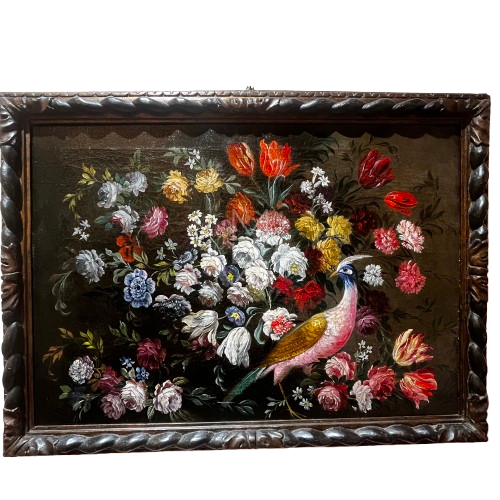
- Subject: A pair (pendant) of nature vive depicting opulent floral garlands (variegated tulips, open roses, peonies) and exotic avifauna specimens.
- Period: Late Emilian Baroque / Early 18th Century (circa 1695–1710), Duchy of Parma and Piacenza.
- Medium: Oil on original canvas.
- Dimensions: 113 x 81 cm each (stretcher size).
- Condition Report: Pristine prima tela (unlined) condition. Structurally sound original textile supports, period strainers, and excellent preservation of the original paint film with a uniform age craquelure.
- Framing: Housed in their original, hand-carved, twisted (a intaglio tortile) giltwood frames with authentic historical patina.
Baroque triumph and rocaille anticipations: a critical study on a pendant of "nature vive" by Giuseppe Pesci
- Historical-critical introduction: Giuseppe Pesci between Emilia and Parma
The landscape of genre painting in Emilia during the late 17th and early 18th centuries has undergone a profound season of critical rediscovery. Within this context, the figure of Giuseppe Pesci (also recorded in historical catalogues as the Monogrammist A.V.) emerges as a refined and sophisticated interpreter of still-life painting—or rather, "natura viva", given the vibrant inclusion of faunal elements. Active predominantly within the territories of Parma and Piacenza, Pesci maintained close ties with the prestigious commissions of the local landed aristocracy, including the Sanvitale family in Fontanellato, the Pallavicino family, and the Meli Lupi family at the Rocca di Soragna—where archival records document specific payments issued to him in June 1706 [INDEX].
For an extended period, Pesci's artistic identity remained obscured by a signed monogram. The historical acronym "Monogrammist A.V." derives from initials discovered on the reverse of a period frame at the Ritiro di San Pellegrino in Bologna, which was paired with a floral composition featuring a parrot. Modern connoisseurship and specialized scholarship have firmly reattributed this entire nucleus of works to the hand of the Parmese master, who passed away in Parma in 1722. The two paintings under analysis sit squarely at the qualitative zenith of his mature production.
- Philological and spatial analysis: the prima tela condition, coeval framing, and metric modulus
From a strictly material, dimensional, and conservation-based perspective, this pair of paintings exhibits an exceptional degree of historical and bio-artistic purity:
- The monument format: Measuring 113 x 81 cm, each canvas conforms to the traditional, monumental "quadro da stanza" (room-sized painting) format. This specific horizontally oriented metric modulus fulfilled the need to rhythmically punctuate the gallery walls of noble reception halls, offering a surface area large enough for an analytical immersion into botanical detail.
- The original canvas (prima tela): The complete absence of invasive relining or structural interventions (foderatura) bears witness to the pristine structural integrity of the original textile support. This rare condition allows one to appreciate the native reactivity of the ground layer, preserving the crisp plasticity of the brushwork and the original impasto of the pigments without the flattening distortions typical of 19th- or 20th-century restorations.
- The coeval frame: The relationship between the painted surface and its original frame is not merely decorative, but represents a semantic extension of the pictorial space. The hand-carved, twisted (a intaglio tortile) wooden artifact manifests a stylistic transition between the plastic pomp of the late Baroque and the structural lightness of the early decades of the 18th century. It encloses and amplifies the 113 cm width, projecting the dark background space out toward the viewer and heightening the three-dimensionality of the floral garland.
- Iconographic and compositional analysis: the evolution of the floral genre in the pendants
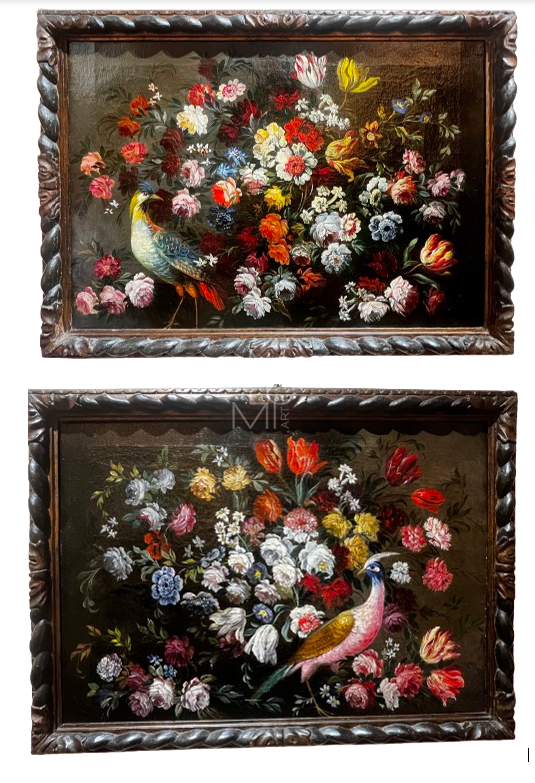
The canvases present a sumptuous, overflowing explosion of botanical species arranged in a deceptive randomness that masks a rigorous geometric, symmetrical, and specular calculation, carefully orchestrated to operate within the fixed 113 x 81 cm spatial parameters:
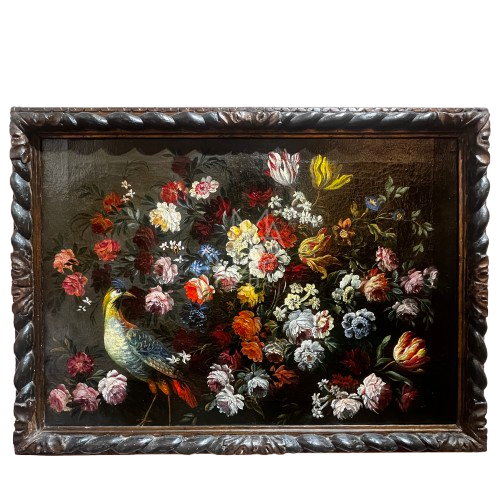
- The first canvas: The principal mass of flowers concentrates on the right quadrant, where an abundance of variegated tulips, open roses, peonies, anemones, and delicate wildflowers emerges from a dark background of clear Caravaggesque and Porporiane lineage. The exotic bird is positioned on the left, directing its gaze inward.
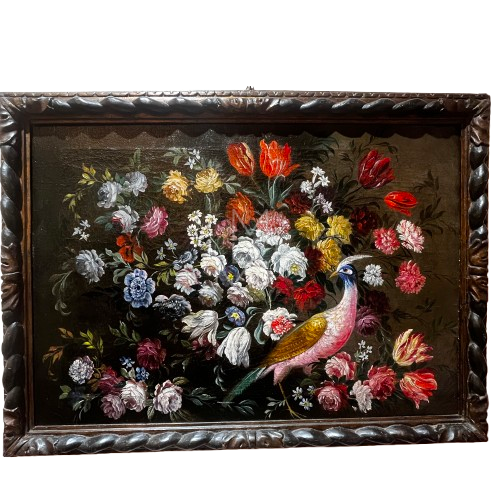
- The second canvas (pendant): The compositional trajectory is specularly inverted to generate a flawless optical balance on the wall. The floral diagonal ascends from the lower-left toward the center-right, while the exotic animal is repositioned on the right wing. Its long, dark-green feathered tail sweeps down toward the lower-left corner, echoing the rhythm of the lower floral swag.
When contrasted with the geometric stiffness of mid-17th-century Northern still lifes, Pesci’s approach within this spatial field reveals a precocious sensitivity toward the oncoming rocaille aesthetic:
- The palette: Alongside dense vermilions and chalky whites, the artist introduces vibrant accents of sulfur yellow, fuchsia, and delicate pastel tones, such as the soft pink breast of the second avian specimen.
- The dynamics of light: Light does not strike the floral block uniformly; rather, it slides analytically across individual petals, rendering the crisp, fragile texture of the tulips and the silky weight of the roses.
- The foreshadowing of transience: The coexistence of turgid buds and drooping, wilting petals evokes the allegorical underpinnings of the memento mori and vanitas typical of the Baroque tradition, here softened by a pre-18th-century decorative grace.
- Exotic ornamentation and encyclopedic knowledge: avifauna between wunderkammer and court aviaries
The inclusion of exotic avifauna, complete with iridescent plumage and bizarre crests, elevates the compositions from static still lifes to sophisticated pieces of "natura viva". Iconographically, Pesci's choice reflects the cultural horizon of late-Seicento encyclopedic collecting. The two specimens—which synthesize the physiological traits of the golden pheasant, the bird of paradise, and the Malayan fowl—operate as pictorial translations of the natural wonders (mirabilia) that populated the wunderkammern of the Po Valley aristocracy.
This specific figurative thread links directly to the scientific and leisure habits of the Farnese court and its noble circle. Within the ducal gardens of Parma and suburban estates like the Reggia di Colorno (often dubbed the "Versailles of the Farnese"), the maintenance of lavish aviaries and menageries (ménageries) for rare birds was a premier geopolitical status symbol. The Farnese dukes—particularly Francesco Farnese (1678–1727), a contemporary of Pesci—cultivated a deep interest in zoology and exoticism as expressions of intellectual dominion and political prestige.
Pesci depicts these birds with an analytical precision bordering on taxonomic illustration, suggesting first-hand observation of living or taxidermied specimens. The proud gaze of the creatures and the virtuosic rendering of their feathers—which gradate from bronzed gold to soft pinks—render the bird a "mirror of rarity." Set within the balanced symmetry of the 113 x 81 cm format, they engage in a dialogue with the botanical complexity of the flowers, celebrating the princely desire to categorize and domesticate the natural world.
- The "dark background" between caravaggesque heritage and po valley solutions: a comparative technical analysis
The execution of the dark, atmospheric backgrounds in this pair of canvases represents a crucial stylistic indicator for understanding the dissemination of still-life painting across Emilia between the 17th and 18th centuries. Close inspection reveals that Pesci’s dark background is never a flat, neutral void, but rather a complex, vibrant, and multi-layered surface.
The artist utilizes a preparation typical of the late-Baroque Po Valley school, applying a rich, oily imprimitura composed of earth pigments (umber and raw Siena) mixed with carbon black and binding oils. Upon this dark baseline, the painter works "a risparmio" (leaving the background exposed) for areas of deep shadow, while building up the volumes of the flowers and birds by working from dark to light through successive glazes (velature). This technical method yields a controlled chiaroscuro contrast: the background absorbs light rather than reflecting it, pushing the foreground floral elements toward the viewer with a stereoscopic effect.
To appreciate the originality of this solution, one must compare it to Pesci's Farnesian and Emilian contemporaries:
- Felice Fortunato Biggi (known as "Il Milanese", active in Parma): A contemporary of Pesci and court painter to the Farnese, Biggi preferred darker backgrounds that veered toward warmer, bituminous, and reddish tones, aligning more closely with Roman naturalism. While Biggi’s backgrounds envelop the subject matter in a fused, pasty manner, Pesci maintains a sharper, more graphic separation between the background plane and the garland.
- Ilario Spolverini: Best known for battle scenes and court pageantry, Spolverini’s rare still-life backgrounds tend toward an airy, atmospheric softness influenced by Genovese and Venetian Baroque art, characterized by plum-gray tones and distant landscape openings quite distinct from Pesci's intimate chiaroscuro rigor.
- The Bolognese school (from Felice Rubbiani to Giovanni Paolo Castelli, called "Lo Spadino"): While Spadino inherited a saturated, highly theatrical Roman variation of the dark background, the Bolognese line contemporary to Pesci increasingly brightened its backdrops, inserting architectural ruins or twilight skies. Pesci, conversely, deliberately adheres to a dense, compact dark background. This choice isolates the floral and faunal elements within an atemporal dimension, updating the severity of the Lombard-Emilian Caravaggesque tradition with the delicate details typical of the early Settecento.
- Critical synthesis: the semantic unity and collecting impact of the pendant
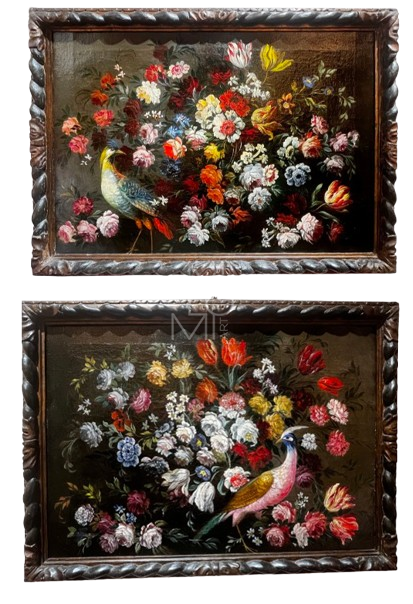
Viewed in their entirety, this pair of still lifes constitutes a pendant of exceptional historical and artistic merit, conceived from the outset as a single semantic, visual, and spatial entity. The architectural regularity of the two 113 x 81 cm modules and the specular counterpoise of the compositions—anchored by the calibrated placement of the two exotic birds—reveal the intended domestic function of the canvases, designed to flank a space symmetrically within an elite interior.
In these two paintings, Giuseppe Pesci achieves a remarkable synthesis: the structural weight and luminous depth of the high Baroque meld with a coloristic grace, a pastel palette, and a taxonomic curiosity that anticipates both the Enlightenment and the Rococo. The exceptional prima tela state of conservation, paired with the coeval twisted frames, preserves the authentic pictorial matter and the original spatial relationships intended by the master. This pair of works stands as an indispensable stylistic benchmark for tracing the evolution of the "natura viva" within the Farnese duchy, restoring Giuseppe Pesci to his proper place as an autonomous and highly sophisticated master of Emilian genre painting.
Appendix: specialized bibliography
- Arisi, F., Natura morta piacentina, emiliana e altitalia, Piacenza, 1995.
- Benati, D. (ed.), La Natura morta in Emilia Romagna: dalle origini al Settecento, Milan, Electa, 2000.
- Cirillo, G. - Godi, G., "Le nature morte della Rocca di Soragna e il pittore Giuseppe Pesci," in Parma per l'Arte, New Series, fasc. I-II, 1996.
- Godi, G., Fasto e decadenza degli interni farnesiani: la pittura di genere a Parma tra XVII e XVIII secolo, Parma, 2004.
- Salerno, L., La natura morta italiana 1560-1805, Rome, Bozzi, 1984.