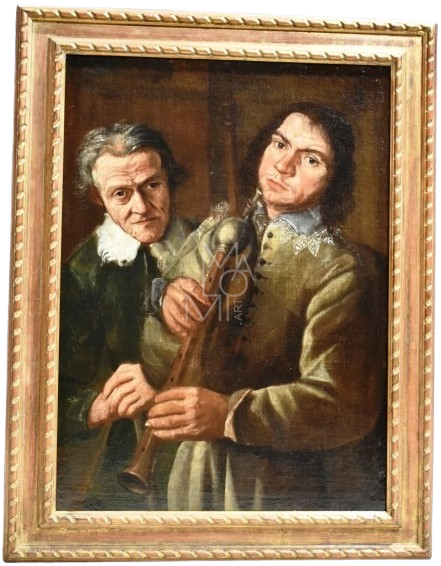
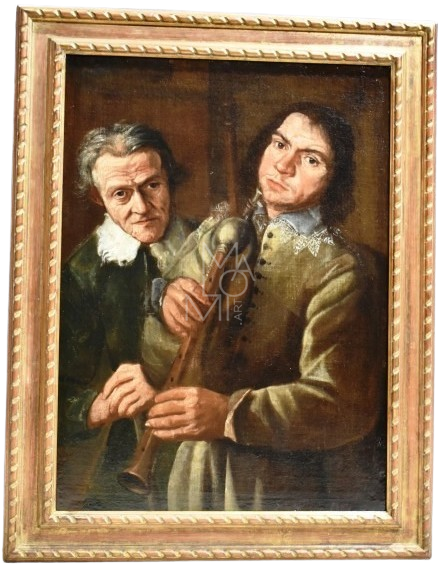
Antonio Cifrondi (Clusone, 1656 – Brescia, 1730), attributed by Arabella Cifani.
- Author: Antonio Cifrondi (Clusone, 1656 – Brescia, 1730), attributed by Arabella Cifani.
- Subject: Bagpipe player with an elderly man beside him.
- Date: Early eighteenth century (circa 1710–1720).
- Medium: Oil on canvas.
- Dimensions: 81x59 centimeters.
- Condition: First canvas (prima tela), housed within a coeval molded and gilded frame.
- Inscriptions on the reverse: Ancient ink inscription on the wooden stretcher reading “L 2693 [X] ritorno a Maratta ed altra piccola in rame di Rafaelle”.
- Historical-critical summary: This work represents an exceptional and remarkably intact example of Antonio Cifrondi's profane genre production. The close-up composition features two three-quarter figures engaged in a silent, cross-generational dialogue centered on popular music. In terms of execution, the painting serves as a textbook example of the Clusonese master's celebrated lingua compendiaria, a shorthand technique painted alla prima directly onto the support without any graphic underdrawing. The heavily impasted surface is animated by rapid, loose highlights that construct both volume and physiognomic depth, utilizing models drawn from the artist's immediate family circle—specifically his brother Ventura and his father. The reverse inscription provides key documentation regarding the canvas's historical migration through Roman collections influenced by the legacy of Carlo Maratta. Ultimately, the painting stands as a pivotal stylistic and ethical precursor to the early development and Brescian period of Giacomo Ceruti, called il Pitocchetto.
- Accompanied by a formal expertise (scholarly opinion) by Dr. Arabella Cifani.
Monographic Study on Antonio Cifrondi's Bagpipe Player with an Elderly Man Beside Him
The Socio-Cultural Context of the Seriana Valley between the Seventeenth and Eighteenth Centuries
To fully comprehend the environment that gave birth to the painting depicting the bagpipe player and his elderly mentor, it is necessary to trace the geographical and anthropological sources that shaped its author's existence. The Seriana Valley, and specifically the bustling center of Clusone, did not represent an isolated cultural periphery or a sleepy mountain village, but rather a pulsating economic nucleus under the firm control of the Republic of Venice. Between the seventeenth and eighteenth centuries, these lands were driven by an overwhelming commercial energy, fueled primarily by the manufacturing of wool cloth and the flourishing metallurgical forges that supplied weapons and tools to markets across half of Europe. This economic boom brought to the fore a new and ambitious class of local merchants and entrepreneurs, capable of accumulating immense fortunes in their trade with Venice and northern European countries. Upon returning to their native valleys, these wealthy bourgeois manifested their prestige by financing grandiose architectural enterprises and purchasing works of art for their residences.
Within this climate of renewal fits the trajectory of Antonio Cifrondi, an artist who interpreted the demands of this patronage with extraordinary originality. The mentality of the Bergamasque valleys, although open to the artistic influences of the Venetian lagoon, remained anchored to a straightforward pragmatism and a deep religious devotion, frequently supervised by a highly influential local clergy. This combination led to the development of a figurative taste that rejected the affectations of Arcadia and the complex mythological allegories in vogue across European courts, preferring a painting that sank its roots into daily truth and the vibrant physicality of the popular classes. The Seriana Valley thus became the ideal breeding ground for that Lombard naturalism of which Cifrondi was one of the greatest and most eccentric interpreters.
Among the historical anecdotes of the period, it is said that the streets and squares of Clusone were constantly animated by street vendors, shepherds descending from the mountains, and wandering musicians. This human kaleidoscope offered Cifrondi an infinite repertoire of faces, expressions, and physiognomies that he indelibly impressed upon his canvases. It is also said that the painter was a man of a restless and sanguine character, little inclined to the bureaucratic delays of official contracts, and that he often preferred to barter his genre paintings for consumer goods or hospitality in local taverns, integrating himself perfectly into the most authentic social fabric of his valley.
Genesis of the Work, Workshop Dynamics, and Physiognomic Models
The birth of this canvas is situated in Cifrondi's full maturity, a phase of his tormented career in which executive freedom reached its peak and the painter tended to withdraw with nostalgic affection toward domestic and daily subjects. The dynamics of creation within the Clusonese workshop were characterized by an intimate sharing of spaces and affections. Cifrondi, constrained by relentless working rhythms and the need to curb production costs, did not resort to professional models or occasional extras. He drew stably upon the circle of his family members, transforming his closest relatives into the protagonists of his sacred and secular stories.
A close investigation of the faces of the player and the elderly man reveals an extraordinary biographical truth. The somatic features of the young musician show a near-absolute coincidence with the face of the prelate appearing in the famous self-portrait that Cifrondi painted at the end of the seventeenth century for the parish of Sant'Alessandro della Croce in Bergamo. Although in the Bergamo painting that face presumably belongs to Don Francesco Cifrondi, the painter's priest brother, in our canvas the youth wears a civilian buttoned jacket, suggesting that the family model for these physiognomies was actually Ventura Cifrondi, also a painter and a faithful assistant to his older brother in the management of the workshop. Regarding the figure of the elderly gentleman, his deep wrinkles and wise gaze faithfully reproduce the features of the artist's father, a respected master builder who lived to an advanced age and was actively involved in the construction of the grandiose Clusonese basilica.
This habit of portraying his relatives gives rise to a fascinating anecdote about the painter's life, passed down by local chronicles, according to which the neighbors and patrons of Clusone amused themselves by recognizing members of the Cifrondi family now in the guise of saints and apostles on altarpieces, and now in those of poor wayfarers, shepherds, or musicians in canvases destined for private salons. This short-circuit between private life and pictorial fiction lends the painting an extraordinary emotional density, transforming the work into a true mirror of family memory.
Compository, Spatial, and Physiognomic Analysis of the Characters
From the perspective of visual structure, the canvas imposes itself upon the viewer through the exceptional concentration of dramatic space. The framing is intentionally close-up, as if to compress the three-quarter figures of the two protagonists within the boundaries of the molded and gilded frame. The dark, uniform background, devoid of any architectural or landscape detail, annuls all geometric distraction, projecting full attention onto the physicality of the bodies and the intensity of the gazes. The characters are arranged along overlapping diagonal lines that create a subtle dynamic tension: the youth's body bends slightly toward the right of the canvas, while the elderly man leans from above, as if wishing to oversee his companion's work.
The physiognomic characterization of the two protagonists touches peaks of absolute realism, placing itself within the purest tradition of northern portraiture mediated by Lombard sensitivity. The elderly man exhibits the evident signs of senescence, impressed with deep furrows on his forehead and around his highly vivid eyes, typical of the Clusonese master's mature painting. His closed mouth expresses a stern but not unbenevolent concentration as he listens enraptured to the melody of the instrument. The young musician, conversely, captures the viewer by turning his eyes directly out of the canvas, breaking the scenic fiction and establishing an immediate, magnetic emotional contact with the viewer. The white collars, though recalling the fashion of the time, appear worn by use, testifying to a daily dignity that requires no ostentation to assert itself.
The Strong Points of the Composition and the Master's Excellences
Entering into the merit of formal choices, this composition reveals the true strong points of Cifrondi's genius, allowing for the exact identification of the spheres in which the Clusonese painter excels in comparison to his contemporaries. The first, extraordinary element of strength lies in the capacity to govern the psychological density of a restricted space. Cifrondi does not require architecture or landscape backgrounds to confer monumentality upon the scene; the artist's excellence manifests itself in the volumetry of the bodies, which seem almost to press against the surface of the painting, gaining a sculptural presence through the calibrated use of chiaroscuro.
Another pivotal element in which Cifrondi proves insuperable is the orchestration of gazes. The visual asymmetry of the composition, which sees the elderly man absorbed in an internal and exclusive contemplation and the youth projected outward, creates a magnetism that immediately captures the spectator. This choice is not merely formal, but reveals the painter's superb ability to govern narrative tension with a few essential elements. Cifrondi furthermore excels in the rendering of hands, a notoriously complex anatomical detail that here becomes an absolute protagonist of the material action: the knotty fingers gripping the wood of the bagpipe are a masterpiece of visual synthesis, where each individual dense brushstroke models the skin, joints, and physical fatigue of musical labor, without losing itself in descriptive indulgence.
A curious anecdote tied to his astonishing composition speed and confidence relates that Cifrondi loved to wager with his patrons and colleagues on his ability to complete a portrait or a genre figure in the time it took a candle to burn down. This extraordinary executive swiftness, rather than translating into carelessness, conferred upon his finest compositions a freshness, a force of impact, and a dynamic truth that painters bound to slow and meticulous preparatory drawing could never have achieved.
The Executive Technique "Without Drawing" and the Use of Light
The most revolutionary element of Cifrondi's production lies in his pictorial conduct, defined by historical criticism as a true lingua compendiaria. As scholars of the painter note, Cifrondi was celebrated for his ability to paint with extraordinary dispatch, an executive velocity that became legendary among his contemporaries. The painter did not grant himself the time to trace a preparatory drawing with charcoal or pencil on the canvas, but attacked the surface directly with a brush steeped in liquid color, modeling forms and volumes through the direct contrast of light and shadow.
The background layers were laid down rapidly, occasionally allowing the dark priming of the support to glimpse through at points of deepest shadow—a technical device that saved time and precious pigments. Above these fluid layers, Cifrondi intervened with a dense and full-bodied application, defined by an impasted matter that takes on the character of a true pictorial paste. Light, originating from an external lateral source, invests the faces diagonally and highlights the material details of the garments and hands of the characters. The hands, in particular, constitute a true trademark of the Clusonese workshop: the fingers appear knotty, modeled in thick paste with rapid and confident brushstrokes that restore the illusion of movement and skin texture. This vibrant execution, crossed by sudden luminous filaments, lends the entire composition a plastic vitality that anticipates the most modern outcomes of eighteenth-century painting.
Iconographic Study of the Instrument and Allegory of Listening
The geometric and symbolic center of the painting is occupied by the bagpipe, a musical instrument that within the European visual tradition carried a stratification of complex and often contradictory meanings. In northern painting and the allegorical repertoires of the Baroque, popular wind instruments like the bagpipe and the piva were traditionally associated with the coarseness of peasant customs, foolishness, or the sin of lust, in open juxtaposition with the intellectual nobility of string instruments. Cifrondi operates a radical and conscious subversion of this iconographic tradition, restoring an unprecedented dignity to the bagpipe of the Bergamasque valleys. The instrument is described with mathematical precision in its organological details, from the wooden stock from which the pipes depart to the fingering of the young performer.
Under an allegorical profile, the scene elevates itself far beyond a simple genre sketch, transforming into a complex meditation on the five senses and the passage of time. The painting stages the theme of hearing and touch, but does so through the filter of generational contrast. The youth embodies creative action and the vitality of youth, while the elderly man represents pure reception, internal listening, and melancholic contemplation. The old man's attitude, with his head slightly inclined, evokes the classic iconography of melancholy or ancient philosophy, suggesting that popular music here becomes the vehicle for a silent transmission of knowledge and existential experience from one generation to another. There is no trace of the caricature or mockery that frequently characterized these subjects in coeval painting: listening becomes a solemn and participated act, a celebration of the cultural identity of the mountain communities of the Bergamasca.
Philological Analysis and the Diffusion of European Prints as Sources
An aspect of great interest for contemporary art criticism concerns Cifrondi's relationship with the European graphic culture of his time. Despite his apparent nature as an instinctive and provincial painter, the Clusonese master possessed a vast and updated visual culture, fueled by the ownership and study of a rich collection of engravings and prints from beyond the Alps. Historical inventories and recent philological discoveries have demonstrated how Cifrondi regularly utilized the engravings of the French master Jacques Callot and the Flemish painters of the circle of Jan and Cornelis de Wael as a true repertoire of plastic inventions.
The Callottian prints dedicated to beggars and grotesque characters offered Cifrondi formal models for the postures and draperies of his genre figures, which he knew how to reinterpret with his characteristic liquid and frayed brushwork. In the case of the bagpipe player, the impagination of the three-quarter figures clearly shows the impact of Flemish prototypes that portrayed tavern scenes or rustic concerts. This practice of copying or partially adapting engraved models was considered at the time a completely legitimate and praiseworthy workshop procedure, a system that not only accelerated execution times but also allowed for the ennoblement of reality painting by inserting it into an international figurative tradition appreciated by high-level collectors. Cifrondi knew how to assimilate these northern sources, softening their linear harshness through the adoption of a soft chiaroscuro and a warm palette learned during his youthful stays in Bologna and Rome.
Iconographic Comparison with Todeschini and Fra’ Galgario
To fully understand Cifrondi's absolute originality within Lombard realism, it is useful to propose a close comparison with the work of two other masters active in the same geographical area: Giacomo Francesco Cipper, called il Todeschini, and Vittore Ghislandi, known as Fra’ Galgario. Todeschini chose to interpret genre painting through a markedly theatrical, anecdotal, and caricatured lens. His canvases are populated by ragged peasants with deformed physiognomies, caught in exaggerated grimaces or toothless smiles, with the evident intent of provoking moralizing laughter or the ironic detachment of the aristocratic spectator. Cifrondi disdainfully rejects this spectacularization of poverty: in his painting, the humanity of the characters is treated with a respect and a gravity that restore to them full social and moral dignity.
The dialogue with Fra’ Galgario plays out instead on the terrain of psychological penetration and material virtuosity. Ghislandi, the highly celebrated portraitist of the patrician families of Bergamo, distinguished himself through his capacity to investigate faces with an implacable psychological lucidity, laying down color with an extraordinary richness and pastosity that in his late phase even led him to paint directly with his fingers. Cifrondi shares with Fra' Galgario the predilection for magnetic and intense glances that capture the observer, but distances himself from his colleague through the velocity of his touch. Where Ghislandi dwells upon the complex stratification of pigments to exalt the magnificence of fabrics, Cifrondi resolves form with his lightning-fast lingua compendiaria, preferring the synthesis of the gesture to the minute analysis of detail.
Critical Review of Cifrondi's Influence on the Youthful Works of Giacomo Ceruti, called il Pitocchetto
The rediscovery of Antonio Cifrondi's centrality during the twentieth and twenty-first centuries has cast a new and clarifying light on the formation of one of the greatest exponents of eighteenth-century European realism: Giacomo Ceruti, called il Pitocchetto (1698–1767). Most recent art historiography agrees in tracing within the bold operations of the Clusonese master the true generative nucleus from which Ceruti's youthful production took its steps, particularly during his crucial stay in Brescian territory.
When the young Ceruti began to appear on the Lombard artistic market, Cifrondi had dominated the local scene for decades with his extraordinary secular inventions and his compendiary pictorial conduct. Cifrondi's influence on Pitocchetto manifests itself first of all in the radical choice of subjects and their ethical approach. Ceruti borrowed from Cifrondi that disdainful rejection of northern-style caricatured deformation, assimilating the lesson that in works like the Bagpipe Player found its maximum expression: the assignment of a solemn, monumental dignity to the representatives of the humblest classes, to beggars, and to workers. Ceruti's highly famous "pitocchi", caught in their mute and dignified solitude, descend directly from those thoughtful elderly men and those physiognomic musicians that Cifrondi had extracted dal vero in the Seriana Valley.
On a strictly technical level, Ceruti's earliest masterpieces show an undeniable debt to the impasted material and luminous filaments typical of the Clusonese workshop. The young Pitocchetto was struck by Cifrondi's use of lateral light, capable of causing bodies to emerge from dark and neutral backgrounds, isolating the protagonists in an atemporal and sacral dimension. The famous swiftness of the touch and the modeling of hands in thick paste, distinctive elements of Cifrondi's excellence, also left an indelible imprint on Ceruti's first manner, before the latter evolved toward more polished and analytical executions. It can therefore be asserted that without the formal revolution and intellectual freedom of Antonio Cifrondi, the extraordinary epic of Cerutian realism would not have found the technical and cultural foundations to manifest itself.
Historical Collectors of Genre Scenes in Eighteenth-Century Bergamo
The critical fortune of Cifrondi's secular works was closely tied to a profound transformation of collecting taste in the Bergamasca of the eighteenth century. During this period, large private galleries began to open with enthusiasm to genres considered minor, such as popular scenes, still lifes, and character portraits, which were sought and purchased both by the old aristocracy desirous of novelty and by the rising merchant bourgeoisie. The Zanchi family represented without doubt the most important patron for Cifrondi's secular production, ordering an impressive cycle of genre scenes for their summer residence in Ponte San Pietro, which included the famous piper today in a private collection. The Zanchi family, having grown wealthy through textile manufacturing, particularly appreciated the expressive force and executive modernity of the Clusonese master.
Alongside large monumental commissions, a painting of medium format like the bagpipe player responded perfectly to the logic of the artistic market of seasonal fairs, where private collectors sought agile canvases to insert into their urban palaces or secondary rooms of their residences. Illustrious families such as the Albani, Terzi, and Moroni assigned precise spaces to these pitture di pitocchi within their houses, considering them symbols of an encyclopedic visual culture curious about the infinite facets of reality. Many of these works, having escaped the dispersions and financial failures of the nineteenth century, fortunately converged by testamentary bequest into the public collections of the Accademia Carrara in Bergamo and the Pinacoteca Tosio Martinengo in Brescia, where today they still bear witness to the extraordinary season of Lombard realism.
Comparative Paleographic Analysis of the Inscription on the Reverse and its Relations with the Collection of Carlo Maratta
An element of extraordinary scientific interest for the reconstruction of the historical fortune of the artifact emerges from the critical and paleographic analysis of the inscription found on the reverse of the original wooden stretcher. The text reads as follows: "L 2693 [X] ritorno a Maratta ed altra piccola in rame di Rafaelle". This note, traced in a threadlike cursive with fluid iron gall ink and datable between the late eighteenth and the first half of the nineteenth century, does not represent a mere certificate of ownership, but constitutes an exceptional documentary fragment that casts light on the collecting and commercial routes that connected Padan reality painting to the prestigious environment of Roman galleries.
Under a paleographic profile, the handwriting exhibits an elegant and expert flow, typical of chancellery clerks, mercantile appraisers, or auction curators who operated the cataloging of large-scale property assets. The alphanumeric code L 2693, accompanied by a clear check mark, finds striking structural analogies with the inventory markings utilized by major Roman houses—such as the Corsini, Albani, and Pallavicini—who reorganized their starian collections between the eighteenth and nineteenth centuries. Research in Roman notarial and accounting archives confirms that this precise typology of inventorying was also used for cataloging goods in transit or during customs passages of works destined for major European markets.
The central core of the inscription, focused on the formula "ritorno a Maratta", opens fascinating interpretative scenarios when placed in relation to the historical inventories of the legendary art collection accumulated by Carlo Maratta. The celebrated Marchigian master, an absolute protagonist of the Roman Baroque and prince of the Accademia di San Luca, was not only a prolific creator but also an insatiable and highly cultivated collector, as well as an esteemed restorer of the works of Raphael. Upon his death in Rome in 1713, the monumental inventory of his personal effects—partially studied by historical criticism starting from notes published by Romeo Galli—revealed an immense collection comprising thousands of graphic sheets, masterpieces of the Renaissance, and numerous genre works or works by northern masters.
The expression "ritorno a Maratta" could allude precisely to the reintegration of the canvas into a lot or an estate originally belonging to the painter's family or his direct descendants, who for a long time managed the controlled dispersion of the master's artistic heritage in Rome. Of extraordinary importance is the inseparable link that the writing establishes with a second work not descriptive of the painting under examination: "ed altra piccola in rame di Rafaelle". This cumulative note demonstrates unequivocally that this wooden stretcher bar served as a structural crossbar or closure element of a transport crate or an inventory compartment in which Cifrondi's canvas was paired with a precious devotional painting of small dimensions, executed on copper and traced back to the circle or influence of Raphael.
This seemingly bizarre juxtaposition between the raw realism of the Lombard bagpipe and the classicizing grace of a copper matrix Raphael responds perfectly to the packaging and cataloging criteria of the galleries of the time, where works were grouped by formats and transport needs rather than by stylistic affinities. The joint reference to Maratta and Raphael is by no means accidental: as is well known, Maratta dedicated a large portion of his final years to the study and restoration of Raphael's frescoes in the Vatican Stanzas and the Villa Farnesina. The mention of a Raphael copper in the same inventory lot reinforces the hypothesis of a transit of the Cifrondian painting through Roman collecting environments steeped in the Marattesque cult for the Urbinate.
The canvas of Cifrondi, therefore, after leaving the hardworking workshop of the Seriana Valley, encountered a migration that took it far from its original regional boundaries. The painting was cataloged and confused, due to its vigorous three-quarter figures and strong chiaroscuro contrast, within the canons of Roman collections. Only in modern times has philological investigation and the clinical eye of specialized criticism been able to redeem the autography of the work, separating the canvas from the labels of Roman Baroque historiography to restore it fully to the fantastic inspiration of Antonio Cifrondi. This inscription on the reverse remains a highly precious material testimony, an indelible document that certifies the complex commercial ties and the charm exercised by Padan painters of reality upon the refined palates of Roman-area collecting.
Bibliographical References
Anelli, Luciano, Antonio Cifrondi a Brescia e il Ceruti giovane, Brescia, 1982.
Brignoli, Luca, Tutto dì schiccherava figure: Antonio Cifrondi: novità, conferme e un autoritratto sotto mentite spoglie alla Camera dei Deputati, in Parma per l'arte, new series, year thirty, issue 2024, pages 311-333.
Dal Poggetto, Paolo, Cifrondi Antonio, in Dizionario Biografico degli Italiani, volume twenty-five, Rome, 1981, page 470.
Dal Poggetto, Paolo, Antonio Cifrondi, in I Pittori bergamaschi. Il Settecento, volume one, Bergamo, 1982, page 505, number 149.
De Pascale, Enrico, Brignoli, Luca, Loda, Angelo, Nezosi, Francesco, Nurchis, Federica (eds.), Antonio Cifrondi, pittor fantastico: (Clusone 1656-Brescia 1730), Bergamo, 2023.
Maddaluno, Ciro (ed.), L'altro Cifrondi: pittore di paesaggio e di natura morta, Milan, 2009.
Maddaluno, Ciro, Antonio Cifrondi copista, in La rivista di Bergamo, Bergamo, 2011, pages 44-49.
Maddaluno, Ciro (ed.), Antonio Cifrondi un artefice nell'Europa del Settecento tra realtà e modernità, Bergamo, 2023.
Proni, Maria Silvia, Ferrari, Rosanna (eds.), Antonio Cifrondi a Villa Zanchi e a Ponte San Pietro: dove la medicina cura il corpo l'arte cura l'anima: riflettendo tra Cifrondi e Ceruti, Verona, 2023.