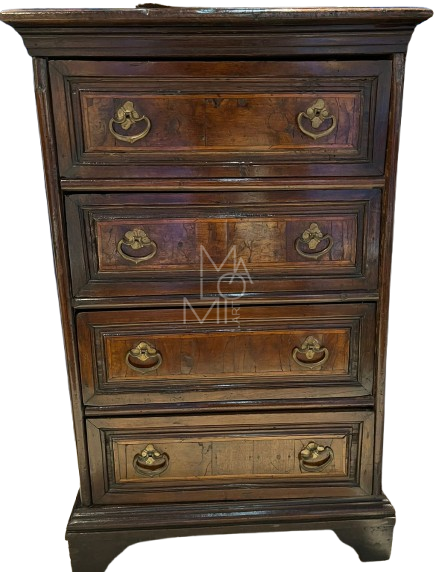
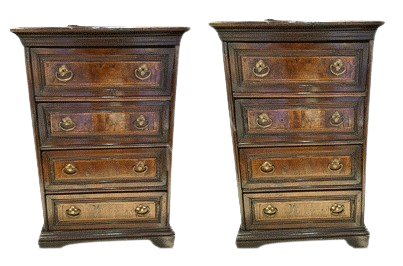
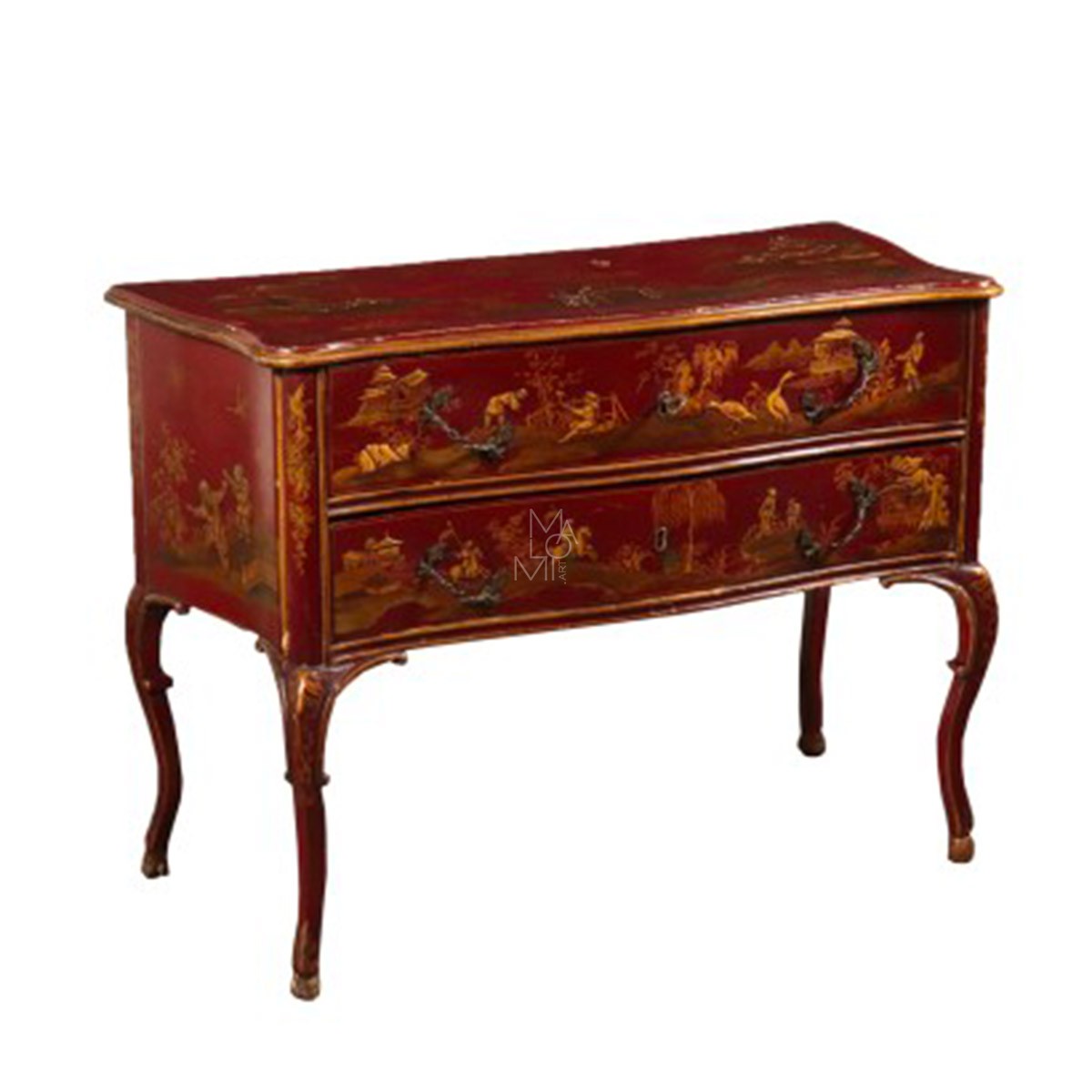
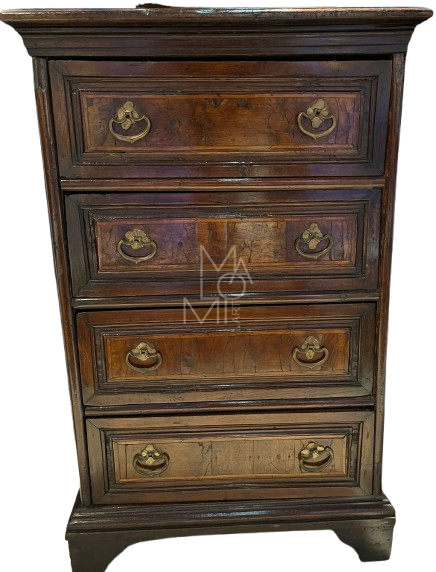
Pair of small baroque walnut burl chests of drawers, bergamo 17th century
- object type: pair of small vertical chests of drawers (minor canterani or bedroom canteranini)
- period: 17th century (mid-seventeenth century, circa 1650-1670)
- provenience: northern italy, lombardy region, bergamo school (orobic valley workshops)
- dimensions: 61 x 38 x 96 h cm
- primary woods: solid walnut (juglans regia), book-matched figured walnut burl veneer (radica di noce)
- secondary woods (internals): alpine silver fir (abies alba) utilized for the horizontally-laid backboards, drawer sides, and bottoms
- hardware: original sand-cast bronze pendant tear-drop handles and keyhole escutcheons mounted on lobed four-leaf clover (quadrifoglio) plates
- supports: bracket feet sculpted in the traditional fratinato monastery style
- condition report: excellent original condition, preserved in first patina; exhibiting characteristic age-related craquelure on the veneer, natural drying shrinkage fissures, and secular sliding wear on the drawer runners
Historical-Artistic Study: A Pair of Seventeenth-Century Lombard Walnut Chests of Drawers
Introduction and Historical Framework
Within the landscape of seventeenth-century Italian cabinetmaking, Lombard furniture production occupies a position of preeminent significance, distinguishing itself through a structural rigor that marries a sober yet profound plastic articulation. This essay analyzes a pair of walnut chests of drawers of Lombard origin, datable to the mid-17th century. These artifacts constitute an exceptional testament to minor Baroque furnishings.
The Lombard seventeenth century was heavily influenced by the political and cultural transition linked to Spanish domination and the spiritual and aesthetic impact of the Borromean Counter-Reformation. In this context, domestic furnishings of the patrician classes and the rising mercantile bourgeoisie abandoned the exuberance and polychromy of the mature Renaissance. Instead, they oriented toward a more austere monumentality, where volumetric value and the exaltation of the intrinsic qualities of wood species became the cornerstones of design.
The presence of a symmetrical pair of furnishings is not accidental, but rather responds to specific requirements of representation and axial organization of interior spaces typical of seventeenth-century palaces. An intriguing curiosity concerns precisely the use of paired furniture in marriage contracts of the period. Frequently, in the dowries of noble brides from Bergamo and Milan, pieces of furniture were commissioned in specular pairs to symbolize the equal union of the two families and the balance of the new household, becoming physical custodians of the most precious linens and goods meticulously detailed in notarial registers.
Structural Analysis, Proportions, and the Peculiar Intended Use
From a typological perspective, the furniture pieces present themselves as vertical chests of drawers consisting of four superimposed elements. The element of greatest scientific interest resides in their small dimensions, measuring 61 centimeters in width, 38 centimeters in depth, and 96 centimeters in height. In Baroque cabinetmaking, the scale reduction of a monumental piece of furniture could respond to three different historical functions: bedroom or studiolo furnishing, intended for safeguarding precious objects; commissions tailored for constrained architectural spaces; or traveling furniture destined for country residences.
An analysis of these specific measurements reveals an unusual geometric development. Exhibiting a distinctly vertical proportional ratio, the upward thrust of the piece is amplified by the pronounced reduction in depth. Such a slender depth, amounting to less than two-thirds of the width, constituted a precise technical choice designed to avoid obstructing corridors and passageways in noble palaces while maintaining a monumental visual facade.
Although the term settimino (seven-drawer chest) is philologically linked to nineteenth-century production, this pair anticipates its functional philosophy by more than a century, configuring themselves as minor canterani for transit spaces. The height of 96 centimeters aligns perfectly with the height of coeval pier tables, allowing the top surface to serve as an honorable display base for small bronzes or hourglasses.
The subdivision into four vertical modules yields an identical internal storage capacity for each drawer. An anecdote connected to daily life in the seventeenth century reveals that these millimetrically designed drawers were often equipped with small secret compartments, operated via concealed wooden levers hidden within the runners, intended to hide love letters or alchemical and medicinal formulas during the years of religious inquisitions. The flawless correspondence of measurements between the two elements confirms their simultaneous execution by the very same workshop using identical wooden templates (modani).
Cabinetmaking and the Choice of Wood Species: Walnut and Burl
The selection of materials fully reflects the canons of Lombard carpentry of the period, frequently defined as "the civilization of walnut." The primary carcass is constructed entirely of walnut wood (Juglans regia), historically prized for its compactness, resistance to pests, and extraordinary suitability for polishing and patination. The aesthetic and technical focal point of the artifacts lies in the drawer fronts, where the transition from geometric rigor to Baroque fluidity is achieved through the insertion of walnut burl panels.
Burl wood, harvested from the knotted growths at the base of the tree trunk, exhibits a tormented, swirling, and heavily chiaroscuro grain. The cabinetmaker masterfully exploited the contrast between the linearity of the structural walnut, used for the molded frames enclosing the drawers, and the pictorial texture of the internal burl. This technique engenders an effect of illusionistic depth.
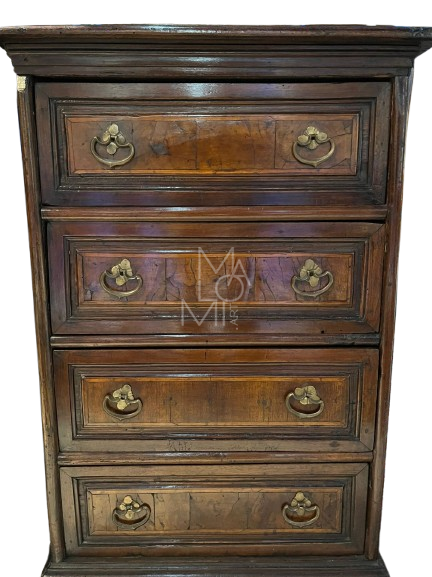
An unprecedented diagnostic detail emerges from a close inspection of the fronts: the uppermost drawer features a solid burl front occupying the entire surface, devoid of the internal framing border, intended to visually lighten the upper portion of the piece immediately beneath the large molding of the top. The lower drawers, conversely, display the classic riserva structure with applied relief moldings.
The surface exhibits characteristic settling fissures, known as craquelure, which testify to the natural behavior of the thin burl veneer over centuries. An ancient workshop recipe for preserving this luster involved the use of walnut oil clarified in the sun and mixed with hydromelic amber resin, an orally transmitted secret that imparted a persistent fragrance and a waterproof finish akin to deep, reflective water.
Decorative Apparatus and Bronze Components
The ornamentation of the furniture eschews complex figurative carvings or applied sculptures, relying instead on the modulation of moldings and the application of metallic hardware. Each lower drawer is enclosed by a prominent, deeply molded frame that creates a play of geometric highlights and shadows, defining the visual space of the piece. The handles and keyhole escutcheons, executed in cast and shaped bronze, do not fulfill a merely utilitarian function but act as genuine points of light upon the dark surface of the wood.
The handle belongs to the celebrated "pendant" typology with a lobed four-leaf clover (quadrifoglio) plate, a classic staple of Baroque furniture hardware in Northern Italy. The mobile pendant features a broken V-shaped profile with differentiated thicknesses that increase toward the base to ensure a firm grip. The sinuous and plastic line is typical of the mature seventeenth century, predating the shift toward fixed horizontal handles fashionable in the eighteenth century.
The metallic surface displays all the distinctive traits of pre-industrial metallurgical manufacture, such as sand or earth casting, which leaves small pitting imperfections and porosities due to air bubbles trapped within the liquid metal during pouring. Craftsmen subsequently refined the pieces by hand using files and chisels to eliminate casting flashes, rendering each piece unique. The bronze currently exhibits a warm, natural "old gold" oxidation, surrounded on the burl by a faint dark ring caused by the centuries-long sedimentation of wax around the metal hardware.
A curious archival anecdote reveals that bronze founders of the period were occasionally accused of witchcraft or heretical alchemy due to the green and blue flares produced by adding secret minerals to the alloy—expedients employed to achieve exceptional hardness and a coloration that mimicked pure gold to the eyes of salon guests.
Constructive Technique of Drawer Bottoms and the Use of Fir Wood
Direct examination of the bottom of an extracted drawer provides fundamental diagnostic elements confirming the authenticity of the chests of drawers. In seventeenth-century Lombard workshops, internal and non-visible components were crafted from secondary woods, and analysis has scientifically verified the exclusive use of silver fir (Abies alba). The single board composing the bottom displays a wide, figured grain with the typical dark, sound knots of naturally seasoned timber.
The grain orientation is arranged longitudinally, from side to side of the drawer, enabling the wood to release humidity-driven expansion movements toward the flanks, thereby preventing it from pushing against and warping the precious walnut front. The joinery reveals the typical technique of a bottom nailed into a rabbet, where the board simply rests within a lower recess of the sides and back, secured by large, hand-forged iron nails with a quadrangular section.
On the wooden surface, traces left by the carpenter's tools remain clearly visible, such as the diagonal ridges of the jack plane left intentionally rough. Over centuries, the continuous friction of the drawer against the internal runners has created a characteristic glossy wear along the lower edges, termed "sliding patina."
A curiosity regarding the use of fir resides in the folklore of pre-Alpine carpenters. It was believed that harvesting silver fir exclusively during the waning moon of January imparted a magical property that prevented woodworm infestation and rendered the wood unresponsive to shifts in humidity—a myth that in reality cloaked the wise empirical observation of the period of minimum sap flow in the plant.
Analysis of the Backboard and Heavy Carpentry
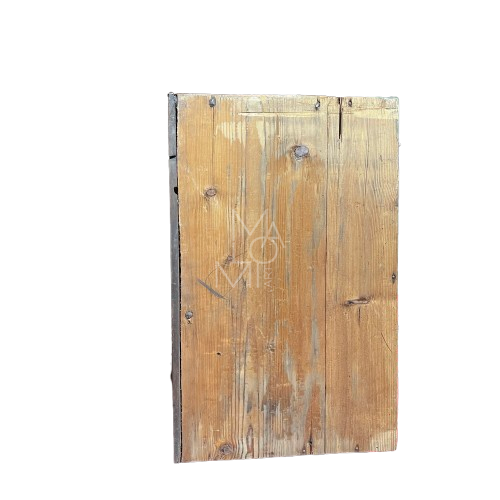
Examination of the reverse of the furniture offers definitive confirmation of seventeenth-century manufacture. The backboard presents itself intact, constructed according to the older technique of horizontally arranged fir boards, shiplapped or butt-jointed over one another to provide maximum structural rigidity to the carcass. These are thick planks, often exceeding two centimeters, engineered to support the weight of the entire piece and withstand the mechanical stresses exerted by the drawers.
The surface displays a rough, partially splintered a gatto (cat-scratched) finish, typical of manual primary reduction using large two-man pit saws in hydraulic sawmills. The reverse highlights distinct separation lines between the planks due to the natural drying shrinkage of the wood over the centuries.
The ancient perimeter nailing shows the typical dark "scorching" of the wood around the insertion points, caused by the centuries-long oxidation of the iron in contact with the tannins and moisture of the fibers. The dark, matte coloration of the wood is the classic "wall patina," the result of centuries of dust accumulation and smoke from candles or fireplaces, impossible to replicate with modern chemical stains.
A fascinating anecdote recounts that the backs of furniture pieces were sometimes lined internally with old period broadsheets, public decrees, or even pages from decommissioned missals to protect clothing from the dust of the rough fir, inadvertently transforming the reverse of furniture into unintentional archives of social micro-history.
The Diagnostics of Fastening the Top Panel
An analysis of the joint between the upper walnut panel and the load-bearing structure of the backboard reveals the constructive protocols required to prevent the top itself from warping. The securing of the top never relies on modern through-screws or metallic brackets, but rather on a tongue-and-groove or half-lap joint combined with the use of organic adhesives. The rear edge of the top features an L-shaped recess into which the head of the first horizontal backboard plank slots perfectly.
The joint was clamped hot using animal hide or bone glue, derived from boiling animal remains, which penetrated deeply into the fibers to create a powerful bond that crystallized over centuries into a brownish-black hue. To assist the glue, the cabinetmaker applied a series of hand-forged iron nails driven diagonally from the bottom upward to intercept the core of the underlying walnut top.
Because the structural walnut of the top and the silver fir of the backboard possess different shrinkage coefficients, their seasonal movements over centuries have created an imperceptible and irregular line of light along the joint, serving as the clearest witness to the biological age of the piece. The continuity of the dust patina across the backboard and the top confirms that the components coexisted from inception and have not undergone dismantling.
Among restorers, a common curiosity dictates that the quality of ancient bone glue was such that, in the event of structural stress, the wood would fracture at a new point rather than fail along the seventeenth-century glue line, proving the extraordinary chemical endurance of these natural components.
The Socio-Political Context and the Connection Between City and Province
To fully comprehend the genesis of this pair of minor chests of drawers, it is indispensable to analyze the peculiar geopolitical ecosystem of the Bergamo territory toward the mid-17th century. Bergamo represented the westernmost edge of the Domini di Terraferma (Mainland Dominions) of the Most Serene Republic of Venice, separated from the Spanish-ruled Duchat of Milan by the mighty Venetian Walls of Città Alta. This frontier condition generated a fortunate cultural anomaly: while politically answerable to the Venetian Senate, stylistically the city gravitated strongly within the Milanese orbit.
The profound spirituality of the Borromean Counter-Reformation and the strict ceremonial protocols of the Spanish court influenced local patrician taste, yielding furniture characterized by geometric lines of Lombard-Spanish imprint that eschewed ostentatious carvings and gilding in favor of a solid pragmatism. The manufacture of this pair of furniture pieces is the direct outcome of the economic bond uniting Bergamo Alta, the center of noble power, with its province and pre-Alpine valleys, such as the Val Seriana and Val Brembana.
Città Alta was the seat of grand patrician residences requiring symmetrical furnishings for Baroque salons, while the valleys constituted the heart of material production, rich in silver fir forests and woodcarving workshops. Artistic workshops in the province, such as the Fantoni in Rovetta, received prestigious commissions from the urban nobility.
Furthermore, the seventeenth century was the era of sumptuary laws, enacted to curb the excessive display of private wealth. In this climate, domestic furniture of distinction had to express luxury in a cultured and dissimulated manner. A pair of entirely gilded pieces would have been judged socially inappropriate, whereas the prestige of these small Bergamasque canterani resided in the rarity of the specular pair and the laborious selection of walnut burl—a message of wealth that was discreet and intellectual.
Timber Trade Routes Between the Valleys and the Orobic Plain
The coexistence of high-value woods and secondary structural timbers within the same piece of furniture reflects a precise map of seventeenth-century mercantile flows. In the Bergamo region, the timber trade was a complex infrastructural network linking the high alpine mountains to the urban centers of the plain. The sourcing of silver fir occurred in the forests of the Upper Val Seriana and Upper Val Brembana, and its transport harnessed the motive power of the Serio and Brembo rivers via the technique of river rafting (fluitazione).
During spring floods caused by snowmelt, logs were bound into large rafts steered by lumberjacks (borat) and stopped at valley watermills to be sawn into planks, before being transported on wagons toward the markets of Bergamo Bassa, specifically in the areas of Borgo Palazzo and Borgo San Leonardo. Walnut and its precious burl followed an opposite route, originating from the pedemontane hilly terrains and the clearings of the mid-valley.
Harvesting burl required a laborious process: merchants purchased old walnut trees at the end of their productive cycle not for the trunk, but to unearth the underground stump where the fibers twisted to create spectacular knots. The block was carefully excavated, washed, and left to season for years before being reduced into thin sheets of veneer.
The meeting point of these two distinct routes was represented by grand markets such as that of Clusone for the Val Seriana and the celebrated Fair of Sant'Alessandro in Bergamo at the end of August. This fair attracted merchants from all over Northern Italy and was the moment when workshops acquired precious reserves of burl and cast bronzes originating from the metallurgical foundries of the Val Seriana and Val Trompia. This circuit ensured that a Bergamasque workshop could simultaneously command the most elastic fir to withstand the humid climate and the most figured burl to satisfy the aesthetic ambitions of the grand families of Città Alta.
Mapping of Orobic Public Collections for Stylistic Comparisons
To trace direct comparisons with this pair of Bergamasque chests of drawers, it is essential to map the public institutions and museum complexes of Bergamo and its province, which preserve nuclei of seventeenth-century furnishings sharing the same constructive lexicon.
The premier site is Palazzo Moroni, located in via Porta Dipinta in Città Alta, currently a property of the Fondo Ambiente Italiano (FAI). Built in the mid-17th century, it preserves its coeval furnishings intact within its reception rooms and studioli, where several examples of minor chests of drawers and canterani arranged in symmetrical pairs can be found, featuring book-matched walnut burl reserves and the identical structure of superimposed drawers with deeply molded profiles. This allows for the verification of the exact functional use of these transit furniture pieces within Baroque settings.
A second fundamental stop is represented by the Accademia Carrara which, alongside its world-renowned pinacoteca, treasures within its storerooms and select galleries precious nuclei of decorative arts derived from historic patrician bequests. The seventeenth-century Lombard-manufactured chests of drawers preserved here display the same constructive protocols, such as the rough finish of the internal parts and the use of horizontal fir planks for the backboards, typical of civic craftsmen active in Bergamo during the second half of the seventeenth century.
Finally, venturing a few kilometers outside the city toward the Val Seriana, the Museum of Sacred Art San Martino in Alzano Lombardo represents the pinnacle for the study of Orobic cabinetmaking, thanks to its three monumental Baroque Sacristies. The wooden furnishings, born from the collaboration between the Fantoni workshop of Rovetta and that of Giovan Battista Caniana, offer the highest technical compendium of the region: executive details, such as the selection of local silver fir as a secondary wood laid longitudinally and hand-forged nails, are identical to those applied to exceptional domestic furniture, representing an indispensable touchstone to validate the Bergamasque origin of the analyzed chests of drawers.
The Economic Impact of Venetian Taxation on the Riverine Timber Trade
Behind the superb craftsmanship of Bergamasque joiners lay a complex customs and geopolitical reality that heavily conditioned material costs. In the seventeenth century, the Republic of Venice exercised ironclad control over strategic raw materials, and alpine timber was considered a primary asset, fundamental both for the naval arsenal in the lagoon and as a source of fiscal revenue for the coffers of San Marco. The rafting of fir logs along the Serio and Brembo rivers was therefore regulated by a dense network of duties, taxes, and monopolies that affected internal prices asymmetrically.
Venetian governors in Bergamo applied a dual-pronged protectionist policy. On one hand, timber destined for local construction and internal artisan workshops within the Bergamasque district enjoyed subsidized tariffs, aimed at supporting the mainland economy and ensuring the loyalty of the Orobic valleys to the Most Serene Republic. On the other hand, any attempt to export timber across the border—namely toward the neighboring and rival Spanish Duchy of Milan—was struck with prohibitive customs duties applied at frontier outposts such as Ponte San Pietro or along the Adda River.
This fiscal bottleneck generated a curious market dynamic: alpine fir, despite being of sublime quality, remained relatively inexpensive within Bergamasque borders because valley merchants were forced to sell off surplus timber on the city market to avoid heavy Venetian export taxes or the risk of smuggling, which was punished with imprisonment or forced service on the galleys. Artisan workshops in Bergamo could thus access premium structural timber at highly competitive prices.
At the same time, heavy Venetian fiscal pressure on the waterways compelled major cabinetmaking families like the Caniana to rigorously optimize material usage. In the structures of chests of drawers, the thickness of the fir and the precision of the half-lap cut of the upper top responded also to a logic of wise material conservation, reducing workshop waste to a minimum to maximize profit on civic commissions which, due to the economic crisis of the mid-seventeenth century, demanded the highest executive quality without tolerating unjustified increases in supply costs.
Reference Bibliography
The scientific study of seventeenth-century Bergamasque cabinetmaking and the correct attribution of artifacts in their original patina rest upon a specialized bibliographic corpus that, over recent decades, has codified the technical and stylistic peculiarities of Orobic workshops. The foundational texts for contextualizing this pair of minor chests of drawers range from general surveys of regional furniture to monographs dedicated to the great dynasties of valley woodcarvers.
The indispensable starting point is constituted by the works of Cleto Cuadri, particularly the volume entitled Il mobile bergamasco, published in Bergamo in 1982, which first isolated the constructive characteristics of Orobic canterani, highlighting their geometric rigor and predilezione for burl paneling. Complementing this study is the monumental research coordinated by Enrico Colle, entitled Il mobile barocco in Italia: arredi e decorazioni d'interni dal 1600 al 1738, published in Milan in 2000, a key text for understanding the diffusion of paired furniture and the subordination of furnishings to the laws of architectural axiality in mainland palaces.
For the analysis of raw materials and workshop techniques, an enormously significant theoretical contribution is offered by Giuseppe Beretti’s text, Strutture e legni dei mobili italiani: linee guideline per la classificazione e il restauro, published in Milan in 2006. This manual allows for the decoding of the scientific use of alpine silver fir as a secondary wood and the technological transition of hand-forged nailing at the turn of the Renaissance and mature Baroque eras.
Specific to the Orobic territory is the study by Graziella Colmuto Zanella, entitled L'arredo ligneo a Bergamo tra Seicento e Settecento, appearing in the proceedings of the Ateneo di Scienze, Lettere ed Arti di Bergamo in 1995, which minutely analyzes the relationship between the patrician commissions of Città Alta and the artisan workshops of the Val Seriana and Val Brembana.
Finally, to comprehend the excellence of local carpentry and its links to sacred and profane architecture, historical monographs on the Fantoni family remain fundamental, among which stands out the volume by Rossana Bossaglia, I Fantoni di Rovetta, published in Vicenza in 1978, alongside studies by Riccardo Panigada on the sacristies of Alzano Lombardo, which illustrate timber trade routes and walnut burl veneering techniques that find a direct match in the drawers of the analyzed furniture.
Documentary Appendix with the Transcription of Period Inventories
The historical reconstruction of the material culture of the seventeenth-century Bergamasque region cannot bypass the analysis of archival documents. The primary source for attesting the presence, value, and placement of furniture within noble residences is constituted by post-mortem inventories or dowry deeds drawn up by civic notaries.
These texts, written in a blend of notarial Latin and vernacular Lombard chancellery script, describe furnishings with great terminological precision, offering a valuable testament to the use of furniture in specular pairs. Below is the paleographic transcription and critical analysis of two significant extracts of period inventories, preserved within the notarial funds of the State Archives of Bergamo.
Document I: Extract from the Register of Notary Giovanni Battista Suardi
Dating: Bergamo, October 14, 1664
Fund: Notarile di Bergamo, folder 3422, deed 89
Context: Inventory of moveable property found in the palace of the late Noble Francesco Moroni in Città Alta, compiled for the protection of heirs.
«In primis, nel Salotto detto de' Paesaggi, posto all'incontro della loggia verso il giardino. Item due Canterani picoli compagni, overo Cassettiere da camera, fatti di bon legno di Noce schietto con li suoi fondamenti et facciate di Radica di Noce tutte listate di cornici alti. Haventi ciascuno quattro cassetti cum li suoi pendenti et bocchette di bronzo fuso et lavorato a mano. Poggiano li detti sopra i suoi piedi intagliati a foggia di mensola fratinata. Li quali mobili stanno collocati in pendant, uno da una parte et l'altro dall'altra della porta grande che introduce alla Galleria, et sono stimati per la loro rarità et congiuntura scudi quaranta l'uno.»
The critical analysis of this first document is illuminating. The term «compagni» unequivocally indicates the paired nature of the furnishings (pendant), while the expression «Canterani picoli [...] alti» matches perfectly with the slender proportions and narrow width of the studied artifacts (61 cm). The description of the «facciate di Radica di Noce tutte listate di cornici» confirms the practice of framing the figured panels with solid walnut profiles in high relief, while the reference to «piedi intagliati a foggia di mensola fratinata» validates the use of this specific supporting base in Bergamasque production during the third quarter of the XVII century.
Document II: Extract from the Dowry Deed of the Noble Caterina Terzi
Dating: Clusone, May 3, 1678
Fund: Notarile della Val Seriana, notary Pietro Alessandro Carminati, register 12
Context: Listing of moveable goods and ceremonial textiles constituting the dowry for the wedding with Noble Gerolamo d'Alzano.
«Nota de' mobili et robba che la detta Signora Sposa porta per la sua dote nella nuova casa. [...] Item una copia di Canteranini picoli da studiolo, di braza due in altezza et larghi poco più d'un braccio, fabricati dalle maestranze di Serio cum li suoi interni di legno d'Abeto bianco delle nostre montagne per conservazione delle robbe senza tarlo. Mostrano le mostre dinanzi operate cum Radiche elette et nodose, guarniti di maniglie di ottone o bronzo sagomate a fogliame. Destinati a stare simmetrici sotto la gran specchiera della Camera nuziale, valutati lire cento e venti della moneta di Milano.»
This second document introduces the interesting use of ancient units of measurement. The Bergamasque braccio (equal to approximately 65.9 centimeters) finds an extraordinary correlation with the actual physical measurements of the pair under examination. A piece of furniture «braza due» high corresponds to roughly 130 centimeters at the maximum of monumental estimation, but the reduction to a minor canteranino, described as wide «poco più d'un braccio», reflects to the millimeter the 61 centimeters of width of your pair.
The explicit mention of «interni di legno d'Abeto bianco delle nostre montagne» constitutes the definitive documentary proof of how the choice of this secondary wood was not a poor makeshift, but a precise and proud technical specification of the Val Seriana, aimed at the «conservazione delle robbe senza tarlo», uniting the igroscopic virtues of the conifer with the protection of the precious textile dowries enclosed within the drawers.