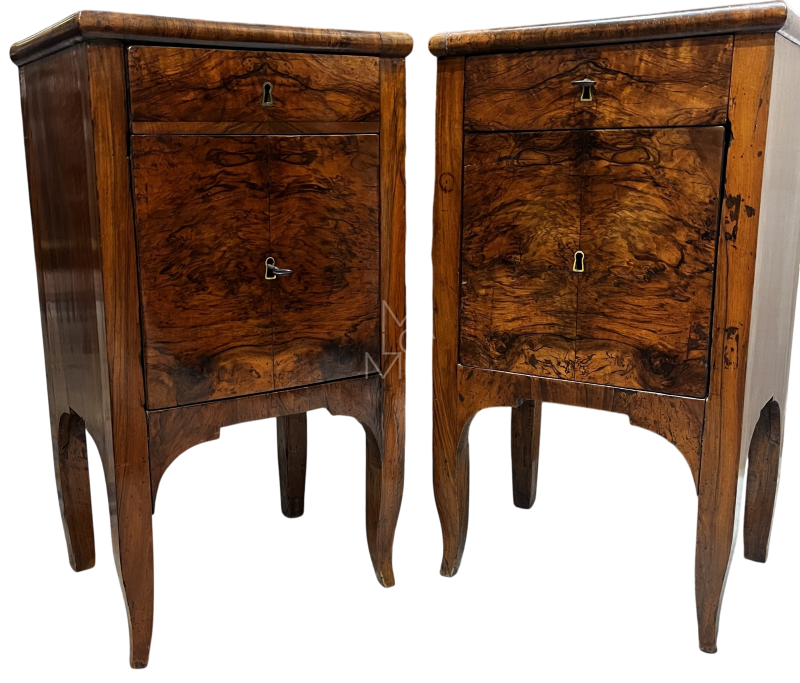
Pair of eighteenth-century Lombard neoclassical walnut burl nightstands
Technical Catalogue File of the Work
Typology: Pair of nightstands / bedside cabinets (night-time storage furniture).
- Period / Style: Full Neoclassicism, second half of the eighteenth century (circa 1775–1790).
- Cultural Sphere: Lombard cabinetmaking production (Po Valley manufacture).
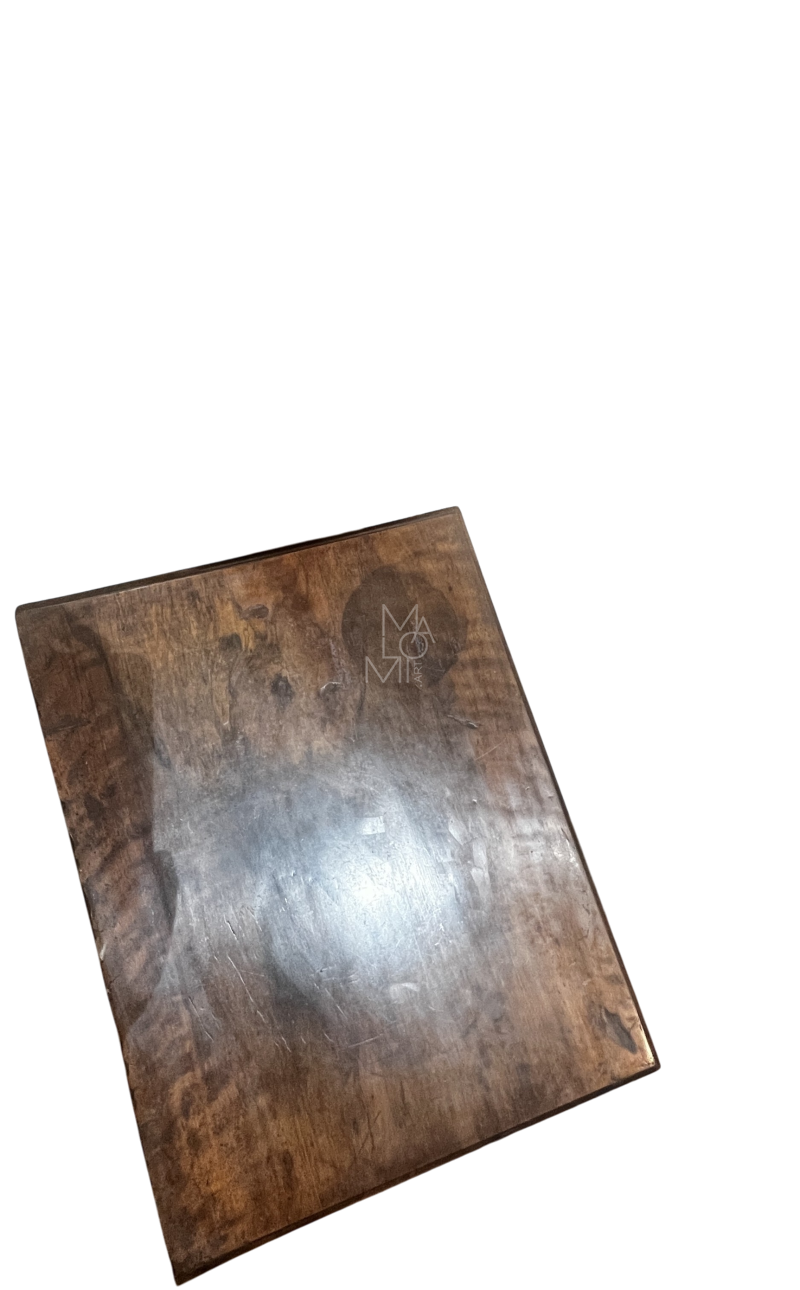
- Primary / Exterior Woods: Solid walnut (heartwood / "durone") utilized for the tops and the main load-bearing framework; flamed walnut burl veneer (radica di noce) on the front façade (drawer and door).
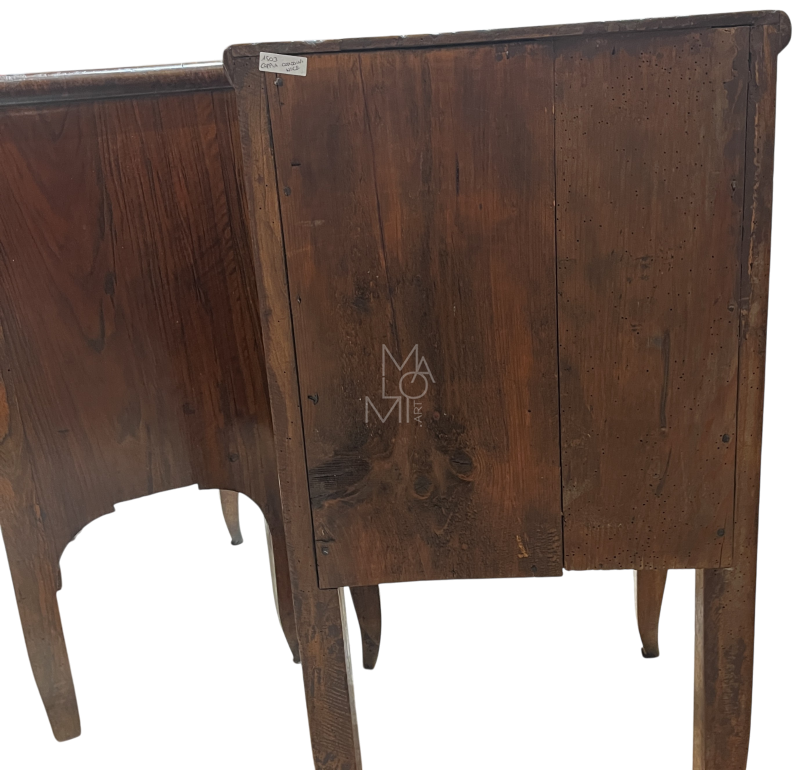
- Secondary / Interior Woods: Structural framework (three-board vertical back panel, drawer linings, bottoms, and the internal door panel) in fir wood (Abies alba).
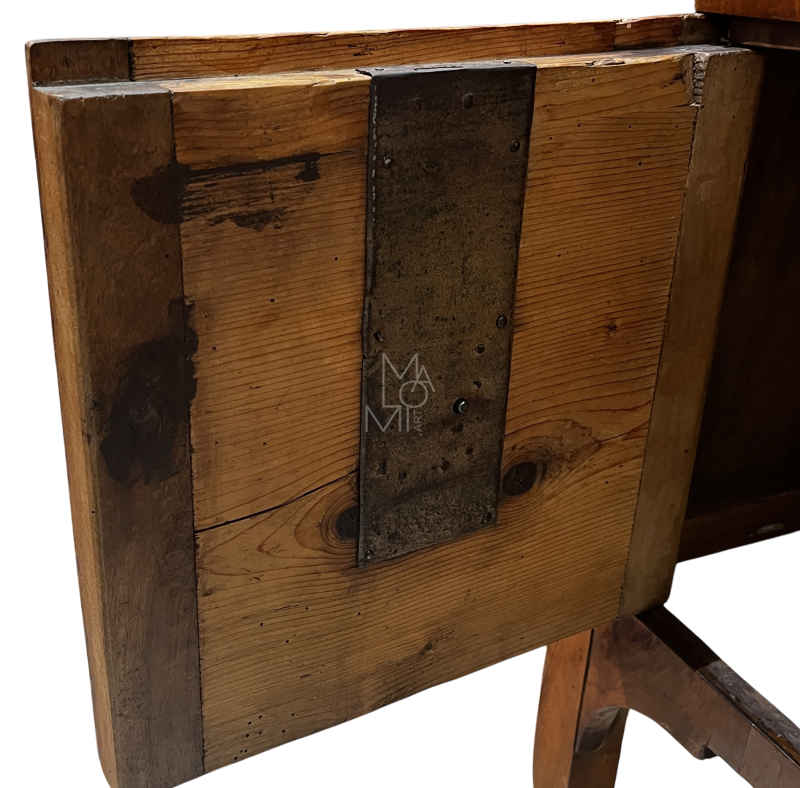
- Hardware / Metal Mounts: Coeval wrought iron box locks forged by hand; drop/escutcheon keyholes in cast and chiseled bronze; original coeval keys with flattened ring handles.
- Dimensions:
- Width: 45.0 cm
- Depth: 36.5 cm
- Height: 81.0 cm
Critical Judgment and Philological Evaluation
Proportions and Spatial Modules
Xylographic and Cabinetmaking Quality
Diagnostics of the State of Conservation
The storage furniture in late-eighteenth-century Lombardy: a historical-artistic and analysis of a pair of neoclassical nightstands
Introduction and historical-geographical framework
The metamorphosis of taste in Habsburg Milan
When immersing oneself in the study of Italian decorative arts of the second half of the eighteenth century, Lombardy immediately reveals itself as one of the most fertile, dynamic, and innovative workshops of cabinetmaking experimentation in all of Europe. At this precise historical moment, the complex stylistic transition from the sinuous splendor of the barocchetto to the geometric rigor of neoclassicism finds a unique and original interpretation in the Lombard territory, deeply influenced by the broader cultural and political renewal brought by the Habsburg rule. Under the enlightened reign of Empress Maria Theresa of Austria and the subsequent reforms of her son Joseph second, the city of Milan and the surrounding provinces experienced a true urban and architectural revolution, led by Enlightenment intellectuals and architects of the caliber of Giuseppe Piermarini. This powerful wave of renewal soon transferred from the monumental exteriors of public buildings to the intimate and private spaces of noble residences and the rising high bourgeoisie, where an urgent need for a new visual order was felt. The splendid pair of nightstands under examination is placed precisely in this vibrant cultural atmosphere, dating back to the second half of the eighteenth century, an era in which furniture stripped away the gilded redundancies of the past to rediscover the purity of lines, geometric symmetry, and the intrinsic dignity of local woody species.
The evolution of private space and the birth of the modern nightstand
In this fascinating period of transition, the need to redefine the spaces of daily life and particularly the bedroom pushed local cabinetmakers to conceive furniture capable of merging practical functionality with the highest formal composure. Before the advent of neoclassical sensitivity, the very concept of a nightstand as a twin element, intended to be positioned symmetrically at the sides of the bed, was not yet rigidly codified in Italian society. Often, in the bedrooms of previous decades, generic small tables, mismatched cabinets, or even travel furniture adapted for the occasion were used. It is precisely in the second half of the eighteenth century that the philosophical and formal search for symmetry, fueled by the rediscovery of antiquity and the influence of French archaeological treatises, introduced the custom of the mirror-image pair in night furniture. The influence of great master cabinetmakers active in the territory defined a language based on geometric purity and the conscious enhancement of materials, a characteristic clearly visible in the sober yet sophisticated architecture of these two artifacts, conceived to dialogue perfectly with each other and to bestow a sense of harmonious regularity upon the noble alcove.
Structural analysis and morphology of the support
The integrated stiles and the Lombard broken line
If we observe the structure of this pair of nightstands from a morphological point of view, we can appreciate an elegant and subtle stylistic transition, in which structural solidity merges harmoniously with the slender lightness typical of the neoclassical line. The pieces of furniture are supported by four finely molded and arched supports, which are not elements applied or added later as would frequently happen in nineteenth-century mass productions, but constitute an integrated, continuous, and organic extension of the main supporting stile of the furniture. This specific structural solution, characterized by an internal curvature with an ogival or depressed arch that visually lightens the base of the furniture, constitutes a typical signature of the Po Valley and Lombard manufacturing of the period, particularly of those refined artisan workshops active between Milan, Bergamo, and Brescia. The feet, while maintaining a very slight and almost nostalgic reminiscence of the sinuous lines of the rococo in their internal curvature, profile themselves toward the outside with a sharp edge and a tapering downward that accentuates their verticality, giving the entire structure a sense of balanced lightness and formal stability that definitively breaks away from the heaviness of previous decades.
The secret of stability and workshop customs
In the busy workshops of the era, the creation of arched supports carved directly from the stile required considerable technical skill and a substantial waste of precious material, as it forced the craftsman to work on solid blocks of large dimensions, discarding a significant portion of the wood to obtain the desired curvature. The old cabinetmakers passed down the secret of carefully selecting logs that already presented a natural curvature of the fibers near the roots, precisely to ensure that the foot, once shaped, maintained maximum structural resistance and did not risk splintering under the weight of the furniture. The molding that runs along the external profile of these supports therefore does not have a merely decorative function, but serves to cleverly capture the ambient light, creating a play of shadows that further slims the figure of the nightstand and hides the actual thickness of the solid wood necessary to guarantee the centuries-old stability of the furniture.
Material technology: solid walnut and the heartwood
The choice of heartwood and its physical properties
The choice and treatment of the woody species undoubtedly represent the qualitative core of these furnishings, made mainly from first-choice solid walnut wood. The front and the top section of the furniture stand out for the use of a solid surface obtained from the so-called durone. In the technical language of xylotomy and historical cabinetmaking, the durone identifies the internal, older, and denser portion of the tree trunk, known scientifically as heartwood, which develops in the above-ground part of the plant. This wooden section is characterized by high density and compactness, which guarantee extraordinary structural stability over time and a natural resistance to the attack of wood-boring insects compared to the sapwood, which is the outermost and softest part of the trunk. The chromatic depth of Lombard walnut heartwood, due to the centuries-old accumulation of tannins, resins, and natural pigments that darken the fibers during the slow growth of the tree, gives a natural luster and a high aesthetic value to the visible surface.
The myth of the grain pattern and the seasoning of the wood
Among the many curiosities related to this material, there is the fact that eighteenth-century carpenters attributed almost magical properties to the heartwood of the walnut, linked to the cycles of the moon and the period of cutting. It was firmly believed that trees felled during the winter solstice in the hilly areas of Lombardy provided a heartwood with an exceptional marezzatura, that is, with that wavy and iridescent pattern of the fibers which, refracting light in different ways, almost seems to move when observed from different angles. The grain pattern of the walnut was considered a sign of absolute prestige and the wealthiest patrons were willing to pay astronomical sums to have tops carved from centuries-old trees that displayed these tormented veins. The long and wise seasoning in the open air, which often lasted over a decade in the courtyards of Milanese workshops, allowed the heartwood to stabilize definitively, preventing the top from warping or cracking once placed in domestic contexts heated by winter fireplaces.
The decorative apparatus of the front: burl wood and coeval hardware
The virtuosity of the book-matching and the symbolism of the knots
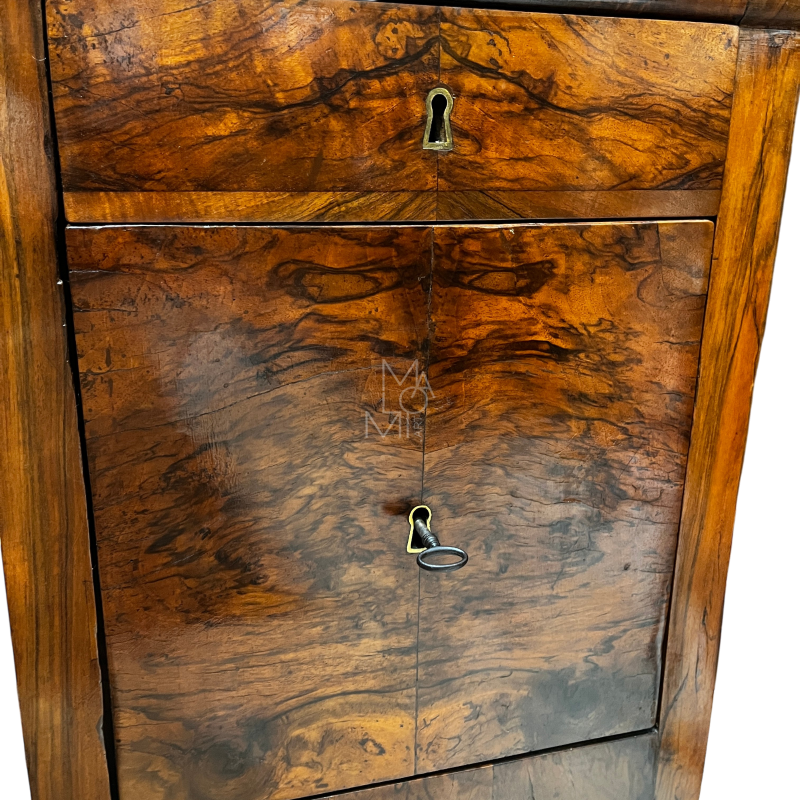
The front of the two pieces of furniture is conceived according to a rigid and scholarly criterion of symmetry and specularity, aimed at enhancing the overall complementarity typical of bedroom furniture in pairs. Immediately below the solid top, a register divided into two functional orders develops, consisting of an upper drawer and a lower door, both richly veneered in a precious and flamed walnut burl wood. The cabinetmaker demonstrated true virtuosity by arranging the sheets of burl wood according to the complex technique of book-matching, mirroring the sections cut consecutively from the same block to create a geometric and specular pattern that recalls the veins of marble or curious anthropomorphic figures. At the time, the visual interpretation of the figures generated by the whorls of the burl wood, namely the small dark and concentric knots formed by the growths of the trunk, was a common and intellectual pastime in salons, and owning a piece of furniture with a burl wood of suggestive shapes was a source of great pride and conversation among the guests of the palace.
The philological value of eighteenth-century hardware
The front is completed and embellished by the presence of beautiful coeval hardware, which includes the keyholes and the relative keys in bronze or wrought iron, historically made by casting or chiseling. In the modern antiques market and in the critical study of antique furniture, the preservation of the original locking mechanisms and their relative escutcheons constitutes a very rare and precious indicator of philological integrity, capable of documenting the local metallurgical techniques of the late eighteenth century. The upper escutcheon shows a delicate shaping that integrates with the stringing of the drawer, while the lower key features a flattened ring handle typical of ancient Po Valley manufactures. Often these keys were kept with extreme care and passed down as small treasures since losing the original key involved the difficult forcing of the box lock, an operation that risked irretrievably damaging the precious surrounding burl veneer.
Internal structures and supporting elements: fir wood
The construction economy and the use of Alpine fir
While the exterior of the nightstands is entirely dedicated to the ostentation of prestige and domestic luxury through the use of walnut and burl wood, the internal structure, the drawer bottoms, and the rear back panel respond instead to criteria of pure functionality, solidity, and construction economy, having been made of fir wood. The use of fir as a secondary or structural wood represents a fundamental constant in northern Italian cabinetmaking, favored by the happy geographical proximity to the large Alpine and pre-Alpine forests that guaranteed a constant and low-cost supply of this species. Fir offered cabinetmakers exceptional properties of lightness and ease of working with a plane, allowing rapid roughing and assembly of the parts not intended for sight, significantly reducing the overall weight of the furniture to facilitate its frequent movement within large residences.
The dynamics of woods and environmental adaptation
The wisely combined use of walnut for the exterior and fir for the interior also hides a fundamental technical reason related to the dynamics of wood as a constantly living material. Fir is a remarkably elastic and soft wood, capable of excellently absorbing the micro-oscillations and hygrometric movements that the noble exterior wood inevitably undergoes due to the changing seasons and the humidity level. Acting as a true natural shock absorber, the fir back panel prevented the internal tensions of the furniture from unloading onto the delicate veneered surfaces of the front, thus avoiding over time the formation of cracks or the detachment of the precious sheets of walnut burl wood, a construction secret that has allowed these artifacts to reach us intact.
Philological analysis of the back panel and construction techniques
The traces of the jack plane and visual authenticity
A close examination of the rear part of the artifact offers us crucial elements for the validation of its authenticity and for a correct historical dating of the work. The back panel appears divided into vertical boards of fir wood, placed side by side according to the most genuine artisan customs of eighteenth-century Lombardy. The surface finish clearly shows the typical traces of manual work with the sbozzino, a particular jack plane that leaves a characteristic texture on the wood, slightly wavy and decidedly irregular to the touch. This surface, devoid of the geometric flatness and perfection found in industrial processes or nineteenth-century remakes, constitutes the tangible signature of the eighteenth-century craftsman, who rightly did not need to finish to a mirror polish the parts destined to remain permanently resting against the bedroom walls.
The quadrangular nailing and the tannin phenomenon
A diagnostic element of primary importance for the art historian is represented by the anchoring system of the back panel to the walnut structure, entrusted to large quadrangular-section nails forged by hand one by one in the smithies of the era. These nails present an irregular head beaten with a hammer, completely different from the industrial wire nails that would spread starting from the mid-nineteenth century. Over the decades, the prolonged contact between the iron of the nail and the natural moisture contained in the fibers of the wood generated a chemical phenomenon of oxidation that released into the surrounding wood the typical dark halo caused by the reaction with tannins. This detail, virtually impossible to replicate artificially in a credible way, excludes any recent removal or replacement of the back panel, confirming the absolute integrity of the rear structure of the furniture.
Structural analysis of the internal door and the lock
The reinforcement frame and animal glue residues
An examination of the interior of the door reveals a further fascinating detail of the construction wisdom of ancient Lombard workshops. To prevent the natural warping of the door due to the strong tension exerted by the burl wood applied to the external face, the cabinetmaker created a solid perimeter frame in solid walnut that encloses a central panel of fir wood. Along the joint lines of these elements, the crystallized residues of the animal glue of the period are still perfectly visible, a complex mixture based on bones or hides that was heated hot in the workshops. This glue, assuming over time a brown, vitreous coloration darkened by age, acts as a formidable chronological indicator and testifies to the genuineness of the assembly methods used before the advent of modern synthetic adhesives.
The technology of the box lock
The internal face of the door houses the coeval wrought iron lock of the box type, a true small masterpiece of artisan mechanical engineering of the time. The lock is protected by a thick rectangular iron plate forged by hand, whose surface imperfections clearly tell of the blacksmith's work on the glowing iron. Fixed to the frame by means of manual split-head period screws, the lock operates a single-throw mechanism that is still perfectly functional. The fact that such an ancient mechanical device retains its functionality intact after more than two centuries attests not only to the excellent quality of eighteenth-century artisan metallurgy, but also to the extraordinary care with which these pieces of furniture have been kept throughout family generations.
Historical dimensions and considerations on conservative diagnostics
The metrology of neoclassical furniture and its proportions
The definitive metric data, which record a width of forty-five centimeters, a depth of thirty-six and a half centimeters, and a height of eighty-one centimeters, confirm the perfect adherence of the artifacts to the canons of metrology and neoclassical Lombard design. These measures were by no means accidental, but responded to very precise proportional modules derived from the Milanese braccio, the unit of measurement in force in the territory before the introduction of the Napoleonic metric system. The relationship between the contained base and the vertical momentum of eighty-one centimeters responds to the aesthetic need of the era to create furnishings that did not occupy excessive planimetric space, but stood out with grace, rigor, and elegance against the decorated or wallpapered walls of the bedrooms of patrician palaces.
The good preservation and the value of time
An in-depth informative investigation allows us to classify this pair of nightstands in the prestigious category of good preservation. The pieces of furniture do not show structural failures or macroscopic warping, a clear sign that the solid support and the internal fir structures worked in perfect harmony over time. The restoration works detected on the external surface, such as the revival of the spirit and shellac polishing applied by buffer or the superficial cleaning of the hardware, are completely physiological interventions that have not affected the authenticity of the pieces.
Comparative bibliography
Methodological and historical-artistic references in Chicago style
Alberici, Clelia. Il mobile lombardo. Milano: Gorlich Editore, 1969.
Alberici, Clelia. Il mobile neoclassico in Italia. Milano: Electa, 1978.
Baccheschi, Edi. Il mobile neoclassico in Italia. Milano: Gorlich Editore, 1964.
Besta, Massimo and Renzo Mongiardino. Arredi e interni lombardi del Settecento. Milano: Il Polifilo, 1982.
Colle, Enrico. Il mobile neoclassico in Italia: arredi e decorazioni d'interni dal 1775 al 1800. Milano: Electa, 2005.
De Guttry, Irene. Il mobile italiano dal Rinascimento agli anni Trenta. Roma: Laterza, 1996.
González-Palacios, Alvar. Il tempio del gusto: le arti decorative in Italia fra classicismo e barocco. Milano: Longanesi, 1886.
Lankheit, Klaus. Il neoclassicismo nella cultura e nell'arte lombarda. Firenze: Sansoni, 1972.
Morazzoni, Giuseppe. Il mobile neoclassico italiano. Milano: Gorlich Editore, 1955.
Ponte, Giovanni. Ebanisti e falegnami della pianura padana nel Settecento. Mantova: Editoriale Sometti, 2001.
Rosa, Gilda. I mobili nelle civiche collezioni milanesi. Milano: Martello Editore, 1963.
Sambonet, Gianguido. Tecnologie costruttive e legni del mobile antico italiano. Torino: Umberto Allemandi, 1994.
Venturi, Adolfo. Storia dell'arte italiana. Vol. 11, L'architettura e l'arredamento del Settecento. Milano: Hoepli, 1939.
Zecchin, Luigi. I legni da ebanisteria nella tradizione padana del Settecento. Venezia: Arsenale Editrice, 1988.