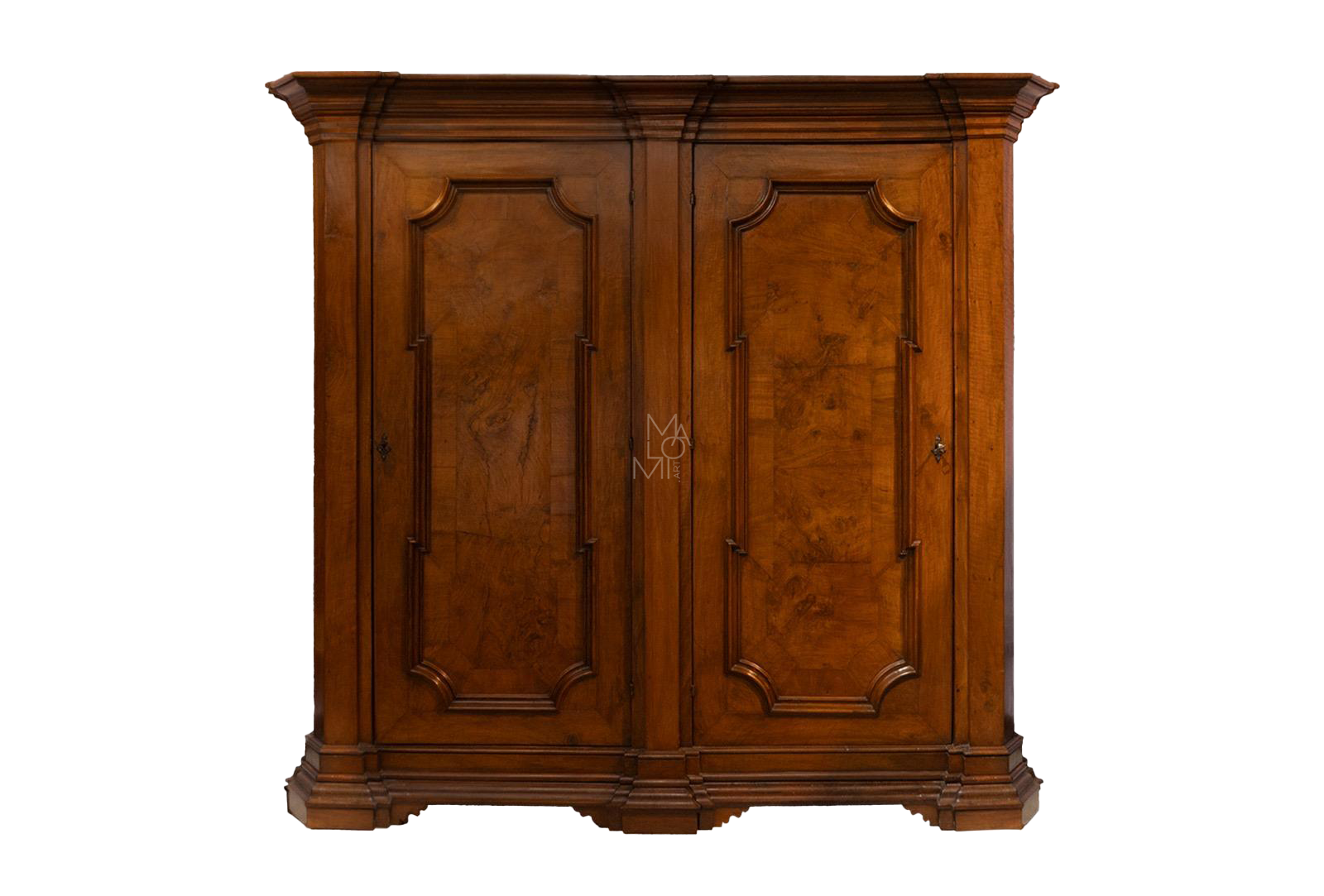
Lombard pantry 17th century.
- Period: Second half of the 17th Century (c. 1670–1690)
- Style: North-Italian / Po Valley Late Baroque (Emilia-Lombarda)
- Medium: Solid walnut, walnut burr (burl walnut) veneer
- Condition report: Intact, untouched original condition; un-restored with original period patina
- Hardware: Coeval, original wrought iron and burnished bronze lock plates and key
- Dimensions (Width x Depth x Height): 200 x 40 x 240 cm
The Baroque Cabinet-Making in the Second Half of the Seventeenth Century: Architecture and Matter
- Introduction and historical-cultural framing
The second half of the seventeenth century represents a period of extraordinary maturation for the European decorative arts. In Italy and within the main continental manufacturing centers, the transition from the early Baroque to a phase of mature monumentality is directly reflected in the conception of domestic and noble furniture. The piece of furniture ceases to be a simple functional object and transforms into a true architectural machine. This evolution responds to the need of the rising bourgeoisies and the aristocracy of the time to manifest their social status through sumptuous interiors, where scenography and symmetry govern the living space.
- Architectural and structural characteristics of the piece of furniture
The work under examination is configured as a cupboard or large two-door cabinet of exceptional proportions (measuring 200 x 40 x 240 cm), characterized by a marked vertical impetus balanced by a rigorous geometric scanning. The monumental structure refers directly to coeval architectural treatises.
- The molding: The upper crowning features an overhanging and complex molding, designed to visually connect the furniture with the coffered or frescoed ceilings of the time.
- The central body: Divided into two large symmetrical fields, the central axis is marked by a pilaster strip that acts as an element of interruption and visual stability.
- The base: The solid and shaped base echoes the mixtilinear scheme of the molding, anchoring the furniture to the ground with a continuous profile that lightens its overall mass thanks to small carved feet.
- Geographies of Baroque cabinet-making: the Po Valley manufacturing sphere
The morphological and ornamental analysis of the artifact allows narrowing the field on the production area, leading decisively towards the Po Valley area, with particular reference to the territories included between Emilia (the Parma-Modena-Bologna axis) and southern Lombardy.
In the Po Valley courts of the second half of the seventeenth century, the transition towards the late Baroque translates into furnishings capable of mediating between Roman solemnity and Northern European geometric composure. Unlike the Roman Baroque, dominated by exuberant sculpture, gilding, and the use of gilded wood carved with anthropomorphic motifs, Emilian and Lombard cabinet-making elects "natural" wood as the absolute protagonist.
The predilezione for walnut burr paneling, enclosed within strongly projecting and geometric frames, is a distinctive trait of the ducal workshops of the Farnese and Estense areas. Emilia, in particular, develops a unique taste for "parade" furniture characterized by severe yet lively lines in their profiles, where monumentality is not given by applied decoration, but by the superb quality of the wood essence and the geometric rigor of the moldings.
- Comparative analysis with coeval architectural treatises
The reduction in scale of monumental architecture in favor of cabinet-making furniture is a theorized and codified phenomenon. This cupboard manifests a close relationship with sixteenth and seventeenth-century treatises, particularly with the works of Sebastiano Serlio and Iacopo Barozzi da Vignola, whose texts continued to be the essential handbook for master builders and cabinet-makers of the XVII century.
- Derivation from the architectural order: The facade of the piece of furniture is set according to the rules of a building's front. The lateral pilaster strips and the false central pilaster strip, which serves as a door-stop, echo the logic of the giant order, tripartitioning the vertical space.
- The molding and Vignola's "Regola delli cinque ordini": The majestic cyma with a straight and reverse throat, interspersed with mirrored fillets, faithfully applies the proportions of the entablature of the Corinthian or Composite order theorized by Vignola. The transition from the base to the central body follows the same proportional rules found in the podia of Baroque church facades.
- Serlio's geometric decomposition: The design of the doors, characterized by mixtilinear panels with canted and re-entering corners (ears), reflects the geometric studies on rustication and portals contained in Sebastiano Serlio's Libro Extraordinario. The cabinet-maker treats the surface of the wood just as an architect would treat the stone of a palace, creating a play of reliefs and recesses that exploits raking light to generate plastic depth on a piece of furniture only 40 centimeters deep.
- Material analysis: walnut and walnut burr
The choice of materials represents the qualitative core of this cupboard. The seventeenth century is defined by art historians as "the age of walnut" due to the extensive use of this noble wood essence.
- The walnut wood: Used for the entire load-bearing structure, it guarantees durability, resistance to pests, and a compact grain suitable for molded carving.
- The walnut burr: Obtained from the excrescences at the base of the trunk or roots of the tree, it is used in thin sheets for the central panels of the doors. Its characteristic burl texture, rich in natural knots and flames, creates a strong chiaroscuro contrast and an intrinsic pictorial effect that eliminates the need for polychrome decorations or gilding.
- Cabinet-making technique and decorative features
The piece of furniture stands out for the very high technical skill of the "open book" or book-matched grain working of the burrs, a technique that requires a meticulous selection of the wood sheets to achieve a perfect symmetry within the panels.
- The mixtilinear panels: The doors house large veneer panels enclosed by projecting geometric frames with canted corners and broken profiles, a typical motif of the late Baroque repertoire.
- The coeval hardware: The presence of original keyholes and keys in wrought iron or burnished bronze testifies to the attention to detail and the integrity of the artifact.
- The "untouched" state of conservation: The exceptionality of the piece lies in its original condition. The absence of invasive restorations, the preservation of the period patina, and the integrity of the surfaces allow for the appreciation of the natural oxidation of the wood, a fundamental element for authentication and market valuation in the antiques trade.
- Conclusions and historical-artistic evaluation
In conclusion, this cupboard in walnut and walnut burr constitutes a primary material document for the study of Baroque furniture of the Po Valley matrix from the second half of the seventeenth century. Its monumental dimensions and shallow depth (40 cm) suggest an original placement in a state room or gallery, placed against a wall so as not to obstruct passage while maintaining a monumental scenic impact. The balance between the geometric rigor derived from the lessons of Vignola and Serlio and the vibrant texture of the burr elevates this artifact from an object of utility to a total work of art, a mirror of an era dominated by a taste for wonder and the solemnity of forms.