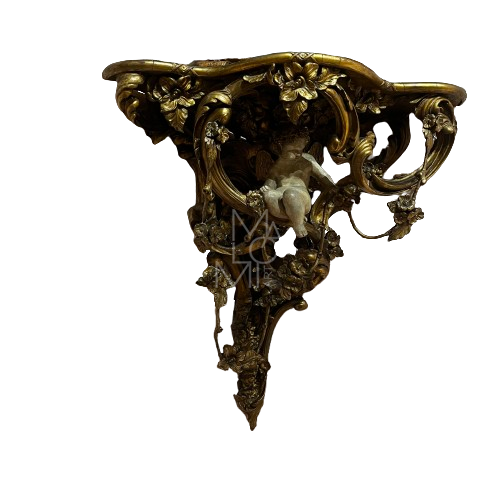
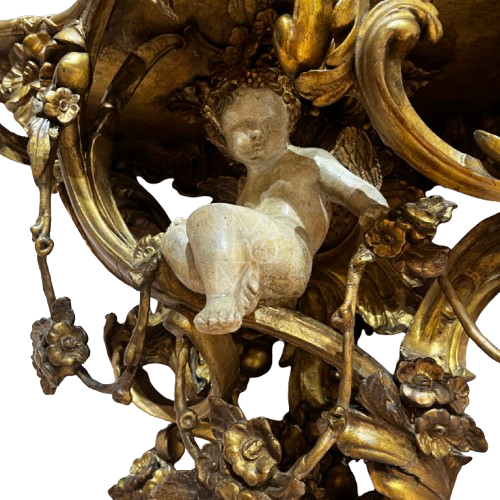
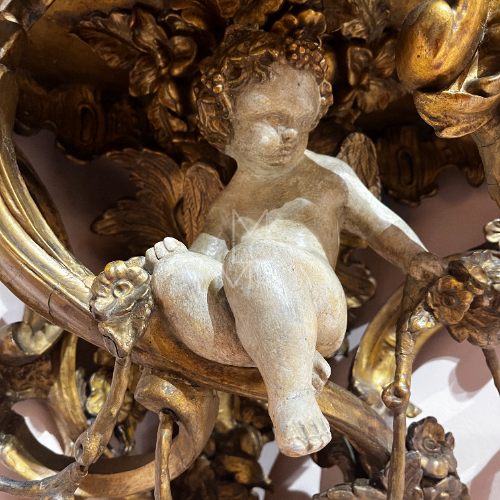
Genoese barocchetto carved and gilded wood corner bracket with a winged putto
Early eighteenth century (circa 1720–1730)
- Object: Monumental corner bracket (cul-de-lampe)
- Period: Early eighteenth century (circa 1720–1730)
- Provenance: Genoa, Liguria (Italy)
- Style: Genoese barocchetto (Ligurian Regency Rococò)
- Medium: Profoundly pierced and carved linden or stone pine wood, Bologna gesso composition ground, red Armenian bole, pure gold leaf water-gilding with dual finish (agate-burnished highlights and matte/dead recessed tones); the putto's flesh tones executed in a light matte ivory polychrome finish.
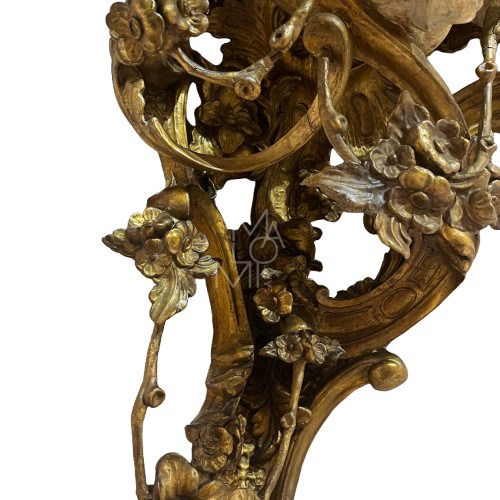
- Iconography: Central figure of a winged infant or putto executed in high relief, dynamically seated amidst sinuous racemes, fully undercut five-petaled wild roses, and master scrolls decorated with curled acanthus leaves.
- Dimensions: 50 cm width x 50 cm depth x 70 cm height (50x50x70 h cm)
- Condition report: Exceptional structural condition. Genuine period patina displaying a natural and gradual wear of the gold leaf, allowing the underlying red clay bole to surface gracefully on the most exposed ridges; fine and stable hygrometric settling lines along the grain of the wood, fully consistent with chronological age and absolute authenticity. Completely free from modern over-gilding or industrial stucco integrations.
- Museum parallels: The carving syntax and sculptural handling of the shaft exhibit strong affinities with the ceremonial console tables and mirrors preserved in the historical house-museums of Genoa, specifically within palazzo Rosso and palazzo Spinola di Pellicceria.
The triumph of the sinuous line: the gilded and carved corner bracket with putto in Genoa's barocchetto style
Introduction: genesis of a sculptural micro-universe
Within the history of European decorative arts, corner furniture represents one of the most complex design challenges for cabinetmaking and the art of carving. This typological form, commonly referred to as an angoliera when ground-standing or a cul-de-lampe when configured as a hanging wall bracket, arose from a precise and compelling architectural need, namely to enhance the interstitial spaces and dim corners of patrician salons. Over the course of the eighteenth century, this object evolved radically, transforming from a simple functional element intended to occupy a spatial void into a true plastic and scenographic manifesto.
The specimen under examination, a corner bracket in carved and gilded wood dominated by the central figure of a putto, stands ideally at the intersection of grand parade wood sculpture and the most refined ceremonial furnishings. This essay intends to analyze the work through a historico-critical lens, examining its overall morphology, the stylistic idiosyncrasies of the Ligurian school, the organic apparatus, and the executive techniques. Particular attention is devoted to the activities of the workshops of the period, whose secrets were jealously guarded and strictly protected by rigid guild statutes.
- Typological profile and architecture of corner furniture
The gilded corner bracket featuring an inverted pyramidal shaft and a lower termination does not merely respond to requirements of pure utility, but configures itself as a sophisticated element of spatial mediation. The overall vision reveals a monumental aerial structure secured to the wall that encloses a spatial volume defined by the measurements of fifty centimeters in width, fifty centimeters in depth, and seventy centimeters in overall height. This precise volumetric coordinate saturates the wall corner, emphasizing its upward thrust in the upper portion and its pyramidal taper downward in the terminal section. The vertical axis is entirely dominated by a skillfully pierced shaft that acts as a sort of spiritualized telamon, entirely intended to support the grand, shaped under-top frieze. The transition between the different registers develops through broken lines and scroll attachments, expressly conceived to capture the dim light of ambient candles and project it into the shadows typical of architectural corners within noble palaces.
A fascinating anecdote related to this specific typological form concerns the rigid customs of the Genoese nobility in arranging ceremonial rooms. Frequently, these pieces were commissioned in series or in symmetrical pairs to adorn the four corners of a ballroom or a boudoir. Curiously, within the inventory ledgers of the Ligurian aristocracy, these furnishings were not recorded simply as movable furniture, but rather under the entry of real estate or fixed fixtures, since their design was so intricately linked to the geometric layout of the room and the corner stuccowork as to render them an integral part of the walls themselves. Moving such a bracket to another palace almost always meant having to readjust its marbles and curvatures, thereby compromising the original, perfect visual harmony.
- Ligurian specificity: the Genoese barocchetto in the early eighteenth century
The comprehensive morphological analysis allows the artifact to be firmly anchored within the context of Ligurian manufacture from the first half of the eighteenth century, at the height of the so-called Genoese barocchetto. In this specific chronological watershed, Genoa developed an entirely autochthonous variation of transalpine taste, welcoming the demands for grace, asymmetry, and lightness arriving from Regency France, without however renouncing the plastic robustness and vibrant expressiveness typical of the local seventeenth-century tradition. This tradition was bound hand in foot to great masters of sculpture such as Filippo Parodi and the painter Domenico Piola himself, who profoundly influenced carvers with his fluid and exuberant designs.
The workshops of the bancalari and Genoese carvers demonstrate in this work an extraordinary expertise in bending wood along snapping, nervous lines. In the ceremonial brackets of this school, the ornamentation becomes extraordinarily aerial. The volutes are not merely juxtaposed elements, but segments of a continuous line that wraps around itself with an undulatory dynamism that evokes, in an almost subliminal manner, the movement and energy of marine waves. The inclusion of the putto in the round reflects the very same theatricality that governed the majestic galleries of mirrors in the palaces of via Balbi and strada Nuova. In this manner, the aristocratic splendor and wealth of the Republic of Genoa were translated into a domestic furnishing micro-universe of the highest caliber.
On a historical level, it is interesting to note that the Republic of Genoa had enacted strict sumptuary laws aimed at limiting the ostentation of wealth, forbidding the excessive use of gilded brocades and precious finishes in clothing and carriages. However, the Genoese nobles astutely circumvented these prohibitions by pouring their immense capital into the interior decoration of their private palaces. Because the salons were accessible only to a restricted circle of guests and foreign diplomats, the use of pure gold leaf on corner brackets and consoles did not fall under the strict scrutiny of sumptuary magistrates, turning carved furniture into the preferred channel for celebrating the family's lineage.
- The putto in Ligurian fresco: the suggestions of Domenico Piola and Gregorio De Ferrari
To fully comprehend the physiognomy and posture of the putto carved upon the bracket, it is indispensable to place it in direct relation to the extraordinary development that this figure underwent in Ligurian fresco painting between the late seventeenth and early eighteenth centuries. Indeed, in no other Italian pictorial school did the putto acquire such a structural and choreographic significance as in the grand Genoese decorative enterprises led by Domenico Piola and his brilliant son-in-law Gregorio De Ferrari. These two masters radically transformed the heritage of carnally Baroque putti of Roman or Emilian lineage, ushering them toward a dimension of pure airiness, lightness, and whirling dynamism that would directly influence wood carvers in the city's workshops.
In the vast compositions of Domenico Piola, such as those adorening the rooms of palazzo Rosso or the vaults of the basilica of the Santissima Annunziata del Vastato, putti do not serve as simple spectators or winged extras, but form a true living architecture. Piola paints them in dense, swarming flocks, intertwined with flower garlands and large draperies, virtually capable of supporting the heavy painted architectural quadratura. The workshop of Piola, the celebrated casa Piola, functioned as a true coordination center for all the arts, where carvers regularly went to purchase or copy the master's designs. It is precisely from this graphic repertoire that the carver of the bracket borrows the physiognomy of the small face and the particular rendering of the hair in compact curls, conceived to be read sharply even from a great distance.
The transition toward the more mature barocchetto was accomplished, however, through the painting of Gregorio De Ferrari, whose style is characterized by an exhausted sensuality and a suppleness of limbs that borders on mystical asceticism or the most unbridled hedonism. In his masterpieces at palazzo Rosso, such as the frescoes of spring or summer, De Ferrari's putti seem devoid of bone weight, as if made of the same gaseous matter as the clouds that host them. Their legs and arms elongate in bold, asymmetric torsions, defying the laws of gravity.
The putto carved on our corner bracket is directly affected by this De Ferrarian formal revolution. His unstable posture on the edge of the volute, with one leg raised and the body leaning forward, faithfully replicates those compositional devices that Gregorio used to infuse a sense of perennial mutation and instability into his scenes. There is also a specific curiosity linked to the construction site of palazzo Rosso, where archival documents testify how Gregorio De Ferrari worked closely with the carvers of the Parodi household, personally climbing the scaffolding to correct with clay the three-dimensional models of putti in wood or stucco that were to adorn the frames of his own vaults. This total osmosis between painting and sculpture explains why the bracket under consideration seems almost a fragment of a Genoese fresco miraculously translated into three-dimensional matter and coated in gold.
- Comparative visual analysis: the collections of palazzo Rosso and palazzo Spinola
To scientifically validate the origin of the corner bracket and highlight its high level of execution, it is of fundamental importance to establish a direct visual comparison with intact furniture models preserved in the main house-museums of Genoa, with particular reference to the historical collections of palazzo Rosso and palazzo Spinola di Pellicceria. These museum complexes house rare examples of console tables and parade brackets that share not only the ornamental grammar with our piece but the very same engineering conception of space.
Within the eighteenth-century rooms of palazzo Rosso, one can admire splendid wall tables attributed to the circle of the Parodi family that show a handling of the sculptural shaft entirely comparable to that of our bracket. Specifically, the device of seating a dynamic figure of a putto atop a node of master volutes constitutes a recurring stylistic signature. A close visual comparison between the face of the infant on our bracket and that of the crown-bearing or mirror-bearing putti in palazzo Rosso reveals a striking identity in the use of the gouge to hollow out the eye sockets and in defining the hair locks, which appear puffy and plastic in the exact same manner. The course of the large lower scroll also finds a precise philological parallel in the console supports of the gallery of palazzo Rosso, where the line bends with the same undulatory elasticity, demonstrating a shared vocabulary among the carvers active for the Durazzo and Brignole Sale families.
Equally revealing is the comparison with artifacts from palazzo Spinola, where the preservation of the furnishings in their original setting allows one to appreciate the reaction of the gold leaf under the same dim lighting conditions. In the dining rooms and adjacent salons of the Pellicceria residence, there are barocchetto hanging brackets and sconces that exhibit the exact same boldness in the pierced carving of the lower racemes. The supple, free stems that float in the void below the central shaft of our bracket find a technical equivalent in the floral work decorating the mirror frames and torchère bases of palazzo Spinola. In these pieces, one encounters the same dual-finish gilding technique, with agate-burnishing reserved only for the outermost petals and acanthus leaf edges, while leaving the backgrounds matte to create that artificial depth that stands out in the dim light of palace corners. This coincidence of constructive and stylistic details reinforces the attribution of the furniture to the most exclusive circle of early eighteenth-century Ligurian production.
- Morphology of the putto and organic syntax of the racemes
Close observation of the different registers of the work allows for the decoding of the complex plastic interaction established between the anthropomorphic figure and the surrounding phytomorphic apparatus. The transition between the stability of the upper portion and the articulation of the lower zone varies and reveals a sculptural mastery of rare sensitivity, where each individual element seems to sprout naturally from the adjacent one.
Anatomical analysis of the putto
At the center of the three-dimensional space, the figure of the winged infant detaches itself from the background through a high relief so pronounced as to border on the full round. The face presents the soft, idealized features typical of Arcadian infancy, and is framed by short hair carved into small, compact curls that recall the shape of small plant fruits. The body is caught in a dynamic and unstable pose, seated transversely upon a large wooden volute. The right leg appears flexed and raised in the foreground, while the left elongates softly downward, generating a visual diagonal that decisively breaks the rigidity of the wall's geometric corner. Unlike the brilliant gold of the structures, the flesh tones of the putto present a light, matte polychrome finish, skillfully turned toward shades of ivory and flesh. This technical and pictorial device isolates the human figure from the rest of the metallic composition, conferring upon it a soft, natural consistency under the reflections of light.
The under-top frieze and upper attachments
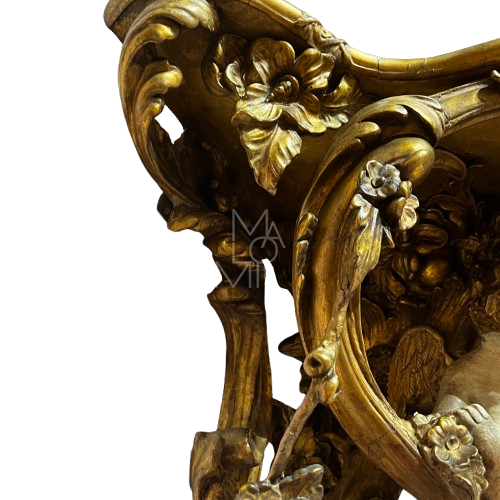
The upper crowning is entirely defined by a projecting cornice with a sinuous course, originally conceived to follow the curvilinear profile of the upper top in precious marble. The under-top frieze is further embellished with large inverted scroll elements and prominent open-corolla floral motifs, whose fleshy petals create a strong plastic detachment relative to the surrounding linear edge. Immediately below the angle of maximum projection, massive acanthus volutes develop along a diagonal course, acting as a spiritualized capital and connecting the weight of the top to the underlying structure.
Pierced carving and lower racemes
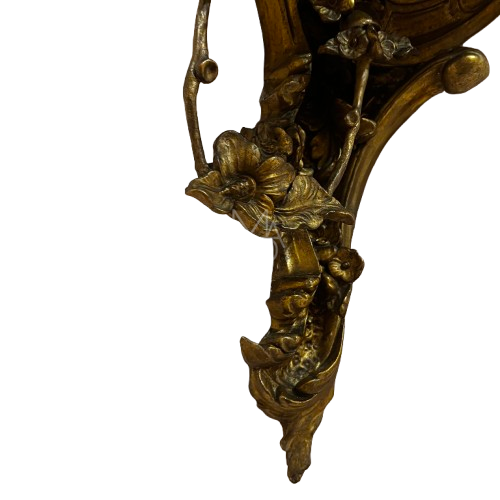
The lower section of the bracket shaft reveals the entirely pierced and light course of the composition. From the central stem sprout sinuous racemes rich in foliated details and five-petaled wild roses carved in the round. These decorative elements physically detach themselves from the load-bearing structure by means of thin, supple stems that float freely in the void, defying the intrinsic fragility of the wooden material. The rear space, left completely empty by the carver, allows natural or artificial light to pass through the furniture from side to side. This stratagem projects a jagged, shifting shadow onto the rear wall that doubles the scenographic effect of the furnishing, changing in intensity depending on the hours of the day.
Within the context of Genoese workshops, the carving of these minute parts was considered a specialization so complex as to require the intervention of different craftsmen compared to those who roughed out the main structure. The most celebrated masters of carving jealously guarded secret formulas for softening the wood prior to carving, often leaving it to soak in special oils or plant essences for several months. This treatment rendered the fibers of the linden or stone pine so elastic as to allow the execution of those incredibly thin and supple stems that we admire in the lower section of the bracket, minimizing the risk of catastrophic fractures during the most delicate gouge strokes.
- Material analysis: techniques of carving and gilding
The value of the work lies in the extraordinary quality of the workmanship and surface finish, executed according to a rigid and immutable artisanal protocol that required months of dedication. The very choice of wood was fundamental. Soft, homogeneous woods devoid of hard knots were preferred, perfect for accompanying the artist's hand in the deepest modulations of the carving. The joint lines still visible on the reverse and the fine settlement cracks along the fibers bear witness to the natural and healthy hygrometric movements of the wooden support over the centuries, confirming the absolute authenticity of the artifact.
Once the sculptural phase was completed, the furniture was subjected to ammannitura, namely the application of successive layers of Bologna gesso mixed with hot animal glue. This surface was meticulously smoothed with sharkskin or thin iron wires to eliminate every single roughness without clogging the minute details of the carving. There followed the application of Armenian bole, a fluid clay of a red or brown hue that served as a tonal base and adhesive for the subsequent application of the extremely thin gold leaf. On the highest relief points of the furniture, where the wear of time has acted most decisively, this red bole surfaces today, enriching the piece's patina with a warm chromatic vibration that collectors define as the soul of antique furniture.
The final phase consisted of gilding and subsequent burnishing, executed with a skillful decorative alternation. The flat surfaces of the moldings, the most exposed crests, and the edges of the petals were energetically rubbed with an agate stone to compress the gold particles and achieve a brilliant, mirror-like luster. Conversely, the hollowed-out depths, the internal recesses of the buds, and the veins of the leaves were left matte, creating an artificial chiaroscuro contrast that amplified the geometric depth of the artifact and enhanced its general pictorial quality.
An interesting curiosity related to water gilding concerns the environmental conditions under which gilders had to operate. Within the Genoese workshops, during the laying of the gold, it was strictly forbidden to open doors or windows, and even the apprentices had to move with extreme slowness. The pure gold leaf was indeed so thin and volatile that a simple cough or a sudden draft of air could have caused it to fly away, wasting a precious and costly material. Master gilders often worked in hot, sealed environments, holding their breath at the exact moment they brought the gold leaf into contact with the wet wood, an almost ascetic ritual that imparts an aura of artisanal sacredness to these artifacts.
Conclusion: the scenographic invention of space
In conclusion, the corner bracket of the Genoese barocchetto configures itself as a perfect and accomplished example of eighteenth-century domestic theater. It fully embodies the desire of the Ligurian aristocracy to transform private living space into a perennial, dynamic, and profoundly illusionistic scenography. The work bears witness to the extraordinary capacity of a high-level workshop to bend the rigidity and resistance of wooden matter to the fluidity of pure motion. Through the splendor of pure gold leaf and the harmony of forms, the maker succeeded in celebrating light, the grace of infancy, and the triumph of nature, gifting us an artifact suspended between the solidity of architecture and the lightness of a golden dream.
- Bibliographical references
Alizeri, Federico. Guida artistica per la città di Genova. Genoa: Tipografia di Gio. Grondona q. Giuseppe, 1846.
Baccheschi, Edi, ed. Mobili liguri del Settecento. Milan: Görlich, 1962.
Belloni, Venanzio. L'alto artigianato a Genova dal XV al XVIII secolo. Genoa: Cassa di Risparmio di Genova e Imperia, 1966.
Boccardo, Piero, and Clario Di Fabio, eds. Il Settecento a Genova: Agli estremi della della pittura. Milan: Electa, 1999. Exhibition catalogue (Genoa, Palazzo Ducale, May 22 - September 12, 1999).
Caraceni, Poleggi Poleggi, and Fiorella Caraceni Poleggi. Il mobile in Liguria. Genoa: Sagep, 1984.
Chiarini, Marco. "Filippo Parodi e la scultura decorativa a Genova." Antichità Viva 11, no. 5 (1972): 34–47.
Colle, Enrico. Il mobile barocco in Italia: Arredi e decorazioni d'interni dal 1600 al 1738. Milan: Electa, 2000.
Failla, Maria Beatrice. "La committenza d'arredo a Genova nel Settecento: Intagliatori, bancalari e doratori tra specchiere e consolles." Studi di Storia dell'Arte 14 (2003): 185–214.
González-Palacios, Alvar. Il Tempio del Gusto: Le arti decorative in Italia fra classicismo e barocco. I ducati meridionali, le isole e la Liguria. Milan: Longanesi, 1984.
Morazzoni, Giuseppe. Il mobile genovese. Milan: Görlich, 1949.
Parma, Elena, ed. La scultura in legno in Liguria dal Gotico al Barocco. Genoa: Tormena, 2001.
Rotondi Terminiello, Giovanna. "L'intaglio ligneo a Genova nel primo Settecento: La bottega dei Parodi e l'influsso franceses." Bollettino d'Arte 67, no. 15 (1982): 89–104.
Varni, Luisa. Ebanisti e intagliatori liguri del Settecento. Genoa: Compagnia dei Librai, 1992.