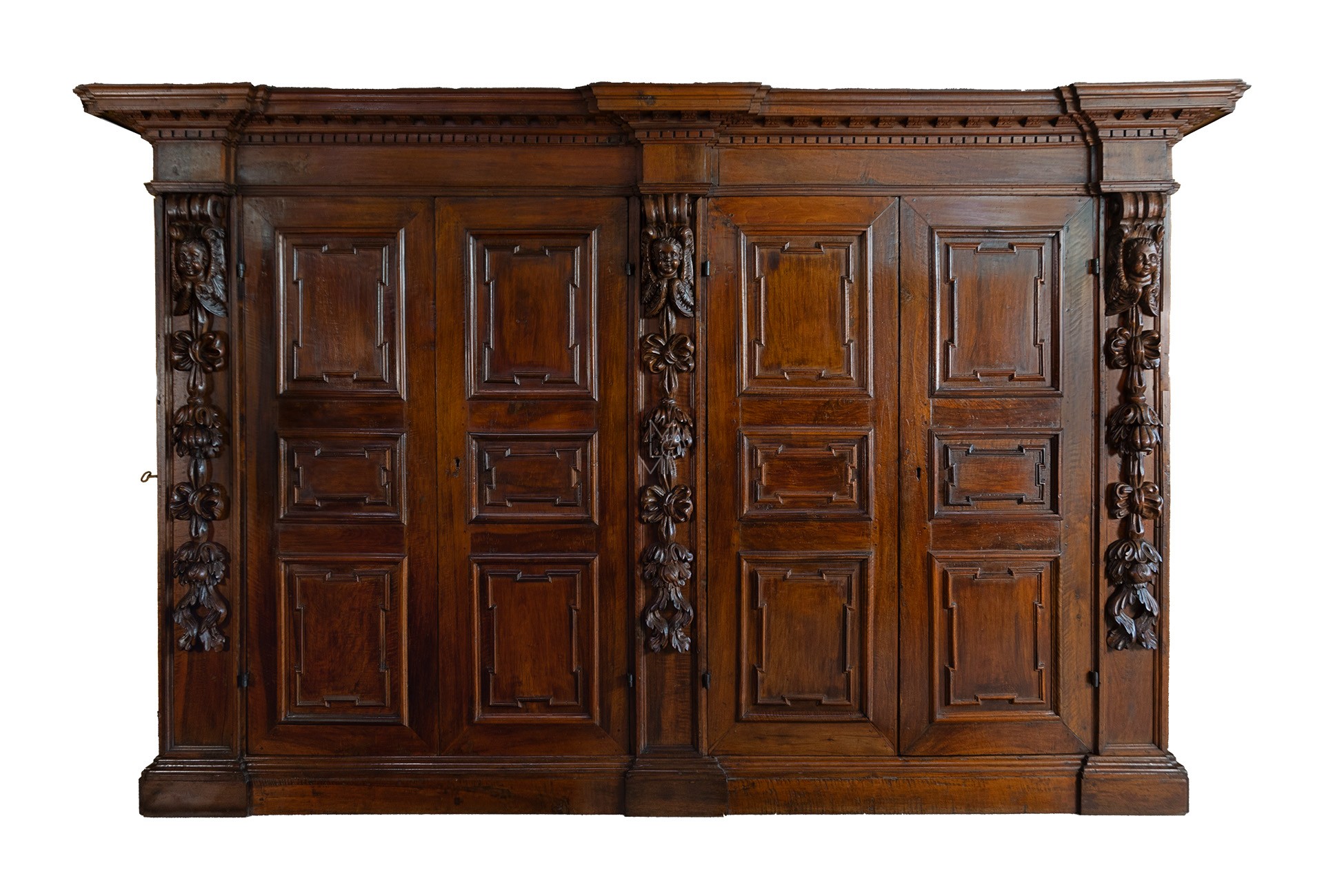
Fantoni wardrobe from the 17th centur
- Object Typology: Monumental Parade Wardrobe / Armoire
- Period: Baroque (Late 17th – Early 18th Century)
- Attribution: Fantoni Workshop / Circle of Andrea Fantoni (Rovetta, Bergamo) [1, 3]
- Medium: Solid walnut wood (Juglans regia)
- Dimensions: Length 420 cm | Depth 90 cm | Height 245 cm
- Special Features: Concealed lateral gunsmith compartment, anthropomorphic and phytomorphic high-relief carvings, classical dentil entablature.
- Condition Report: Excellent state of conservation relative to its age, structurally sound, displaying a rich, genuine historic patina.
The Architectural Epiphany of Wood: The Monumental Parade Wardrobe from the Fantoni Workshop
- Introduction and historical-critical framework
Within the landscape of cabinetmaking (stipetta) and woodcarving of the Lombard Baroque, the production of monumental furniture serves as a veritable architectural extension of interior space. The work under examination—an imposing Baroque parade wardrobe measuring 420 cm in length, 90 cm in depth, and 245 cm in height—stands as a tangible manifesto of this artistic current, leading the observer directly into the creative heart of the renowned Fantoni Workshop of Rovetta.
Active for generations throughout the valleys of Bergamo, the Fantoni dynasty masterfully synchronized structural engineering with a sculptural exuberance reminiscent of Michelangelo. In doing so, they translated Counter-Reformation dictates and seventeenth-century aristocratic opulence into solid walnut wood. This piece transcends the definition of a mere domestic container; it functions as a highly scenographic parade structure designed to captivate the viewer, redefine its spatial surroundings, and broadcast the patron’s prestige through a sophisticated plastic treatment of matter.
- Structural analysis and architectural composition
The furniture exhibits a monumental layout clearly derived from classical architecture, governed by rigorous symmetry and a meticulous calculation of proportions.
- The rhythmic facade: The front elevation, spanning a majestic four hundred and twenty centimeters, rejects flat, static surfaces. Instead, it is organized into a binary, alternating sequence, where three imposing sculptural pilasters partition the space and divide the wardrobe into two large, mirrored sections.
- The modulation of the panels: The main bays feature symmetrical doors—totaling four primary leaves—masterfully adorned with raised, curvilinear geometric paneling. These elaborate molded frames dialogue with the warm grain and deep luster of the solid walnut, creating a geometric matrix that mitigates the visual weight of the massive wooden structure.
- The entablature and the lower register: The vertical thrust of the pilasters finds its resolution at a height of 245 cm in a stately, highly projecting cornice, enriched with dense, classical-style dentil molding. At the lower extremity, the entire structure rests upon a robust and theatrical molded plinth base, visually elevating the artifact from the floor.
- The sculptural apparatus: the pilasters of the Fantoni school
The qualitative pinnacle of the wardrobe resides in the three sculptural pilasters that serve as the visual pillars of the facade. These elements are not treated as two-dimensional architectural reliefs, but rather as freestanding or high-relief monumental sculptures.
The dense, deeply carved intaglio reveals the stylistic hallmarks of the Rovetta workshop. At the apex of each pilaster emerges a refined winged cherub head, characterized by a serene yet dramatic facial expression. Beneath these angelic visages cascade dense festoons of fruit and foliage, bound by knotted draperies and ribbons interwoven with acanthus leaves. This decorative profusion serves a dual purpose: a structural one, by concealing the joins of the large furniture modules, and a symbolic one, celebrating abundance and the artist's total mastery over raw material.
- Comparative analysis within the critical literature of the workshop
To fully grasp the historical and artistic placement of this piece, it is essential to connect the wardrobe to the graphic designs and furniture models documented in the seminal monograph “La Bottega dei Fantoni” published by Ferrari Editore. Within the corpus of preparatory drawings conserved at the Fondazione Fantoni in Rovetta, the design of large-scale parade furniture reveals a continuous formal osmosis between ecclesiastical and secular domains.
The layout of a facade punctuated by pilasters adorned with putti and botanical swags finds a direct equivalent in the famous sacristy furnishings executed by Grazioso the Elder and Andrea Fantoni in Alzano Lombardo. However, while in liturgical furniture the sculptural apparatus yields to sacred iconography or theological medallions, in this secular example, the Fantoni style shifts toward a profane celebration of rural prosperity and dynastic power. The specific typology of the projecting dentil cornice and the deep geometric paneling align this piece with the grand wardrobes described in the Ferrari volume, confirming the workshop's habit of adapting identical workshop drawings (cartoni) for both urban patricians and wealthy parochial patrons.
- Polyfunctionality and secrecy: the side door and specialized storage
Beyond its undeniable aesthetic merit, the piece reveals an ingenious functional complexity tailored to the lifestyle of high-ranking seventeenth-century patrons. The exceptional depth of 90 cm significantly maximizes the internal capacity of the compartments. Of extraordinary historical and collecting interest is the presence of the left side door, specifically engineered for the storage of specialized sporting equipment.
This high-cabinetmaking technical solution satisfies two core requirements of Baroque aristocratic life:
- Security and preservation: Valuable assets and hunting accoutrements—symbols of status and privilege—were housed in a lateral access bay, completely concealed from the solemnity of the front presentation.
- Design integrity: Placing the specialized compartment on the side panel preserves the symmetrical rhythm of the main front doors, leaving the harmony of the parade presentation undisturbed while providing a discreet, functional space integrated into the thick shoulder of the frame.
- Conclusion and art-historical assessment
In conclusion, this monumental specimen measuring 420x90x245 H cm stands as a masterwork of Baroque Lombard cabinetmaking from the Bergamo region. The excellent state of preservation of its volumes, the boldness of its projecting cornice, and the extraordinary figurative density of the carved pilasters firmly support its attribution to the inner circle of the Fantoni production. It is an object that breaks past the boundaries of mere furniture to become wooden architecture—an immortal testament to an era when theatrical grandeur and technical virtuosity united to celebrate the status of the patron.
- Bibliographical references
- Alberti, G. (Ed.), L'architettura del mobile civile nella Lombardia barocca, Milan, Silvana Editorial, 2014.
- Banzato, D. & Spiazzi, A. M., Scultura e intaglio ligneo tra Seicento e Settecento nelle valli orobiche, Venice, Marsilio, 2009.
- Ferrari, L., La Bottega dei Fantoni: storia, modelli e passaggi generazionali di una dinastia di intagliatori (1650-1780), Clusone, Ferrari Editore, 1998.
- Morandotti, A., Arredi di parata e decorazione plastica d'interni: il ducato di Milano e i suoi territori, Turin, Allemandi, 2011.
- Rossi, F., Il corpus dei disegni della Fondazione Fantoni di Rovetta, Bergamo, Monumenta Bergomensia, 2005.