Eighteenth-century Parmese barocchetto solid walnut lyre center table
- Type: Center table / Academic refectory parade table
- Period: 18th century (mid-eighteenth century, Farnese-Bourbon transition period)
- Origin: Northern Italy, Emilia, Parmese area (Duchy of Parma and Piacenza)
- Material: Solid walnut wood (Juglans regia)
- Dimensions: 207.5 cm (length) x 92 cm (width) x 81 cm (height)
- Condition report: Excellent structural integrity, preserved in its original period wax-polished patina
The center table in the Emilian culture of living: a historical-artistic analysis of a eighteenth-century Parmese table
Introduction and historical context in the Duchy of Parma
In the landscape of eighteenth-century Italian decorative arts, the Duchy of Parma and Piacenza represents a privileged observatory for understanding how politics and dynastic shifts could shape the very form of everyday objects. The solid walnut center table under examination, originating from the Parmese area and dating back to the mid-eighteenth century, fits perfectly into a period of extraordinary cultural fecundity. The history of this territory is marked by the crucial transition between the ancient and solemn Farnese dynasty, which ended in seventeen thirty-one, and the advent of the Bourbons in seventeen forty-eight under Duke Philip and his highly educated consort Louise Élisabeth of France, daughter of Louis fifteenth.
This political change was not merely a rotation of power, but it triggered a genuine revolution in taste. The local nobility, eager to please the new sovereigns and emulate the splendor of Versailles, began to radically renew the furnishings of their urban palaces and country residences. In the workshops of the Parmese master cabinetmakers, a fertile stylistic syncretism took place. On one hand, the robust and proud Po valley construction tradition survived, tied to imposing structures and the use of monumental timber; on the other hand, international trends made their way forward, permeated by the sinuous and asymmetrical grace of transalpine rococo. The table under study magnificently embodies this transition, standing as an ideal meeting point between Farnesiano solidity and Bourbon elegance.
Material analysis and the carpentry of the tabletop
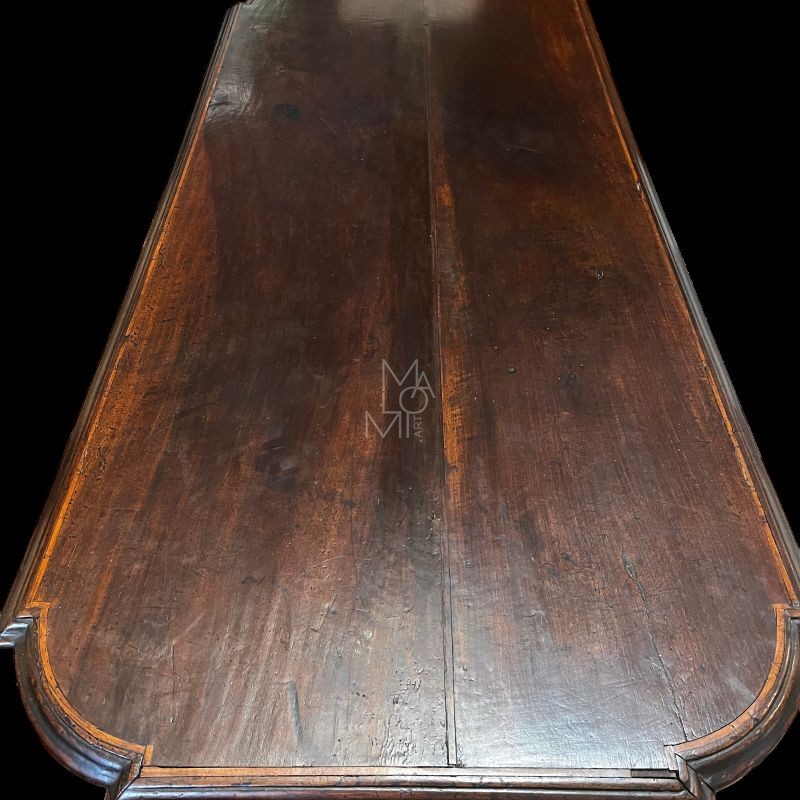
A close examination of the artifact immediately reveals the extremely high execution level of local carpentry, starting with its imposing proportional dimensions measuring two hundred and seven and a half centimeters in length, ninety-two centimeters in width, and eighty-one centimeters in height. For its construction, solid walnut was used exclusively, the timber of choice for high-ranking furniture in northern Italy, celebrated for its compactness and its warm brown-golden tone which time has enriched with a soft wax patina.
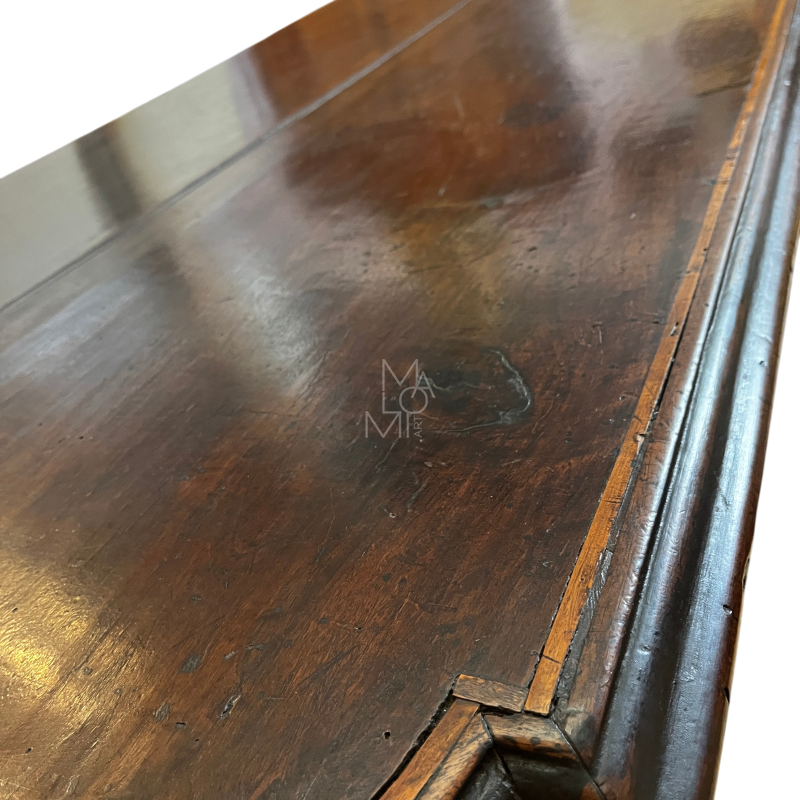
The constructive physiognomy of the top deserves special attention because it reveals the technical secrets of eighteenth-century cabinetmaking. Contrary to what might appear to a superficial glance, the supporting surface is not carved from a single plank, but rather from the specular juxtaposition of two large planks joined longitudinally in the center through a perfect grain-to-grain joint. The craftsmen of the era were well aware that using a single board of such dimensions would carry an almost certain risk of warping and cracking due to the natural hygrometric movements of the wood. By pairing two mirror-image planks, the internal tensions counteracted each other, ensuring the stability of the top over the centuries.
To ennoble and protect this structure, the complex technique of framing comes into play. The perimeter of the top is indeed enclosed by a thick solid walnut frame, assembled at the corners with precise forty-five-degree miter joints. This frame houses a refined bevel decoration that faithfully follows the mistilinear profile of the piece of furniture. The sharp edges of the rectangle are thus gently smoothed at the four corners by a sinuous line, creating a molding that cabinetmakers of the time termed a softened owl-beak profile, conceived to lighten the visual impact of the wood thickness and protect the corners from the frequent bumps of palace life.
The under-table apron and the secrets of gouge carving
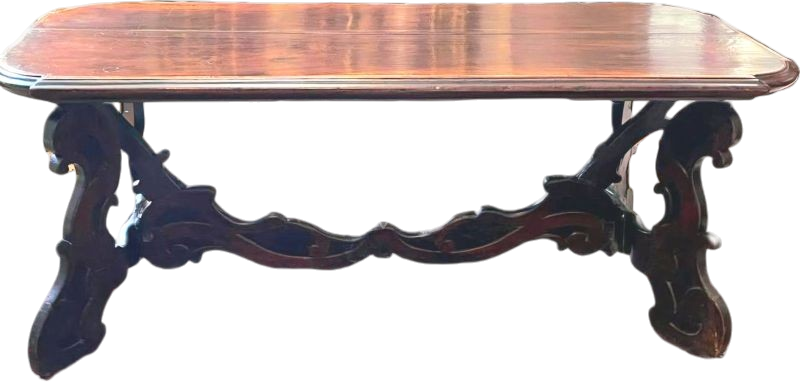
Moving down with the analysis below the tabletop, attention focuses on the large perimeter apron, which constitutes the true aesthetic centerpiece of the furniture. The most relevant feature of this element lies in the total absence of drawers. Although in many tables for common use in the Po valley the presence of drawers under the top was the norm for storing documents or cutlery, in models intended for high representation it was preferred to preserve the absolute formal integrity of the structure. The absence of cuts, internal runners, or metal elements such as keyholes and handles allows the walnut apron to develop in a continuous and majestic manner along the entire perimeter.
The lower edge of this high apron is enriched by a masterful carving work featuring a foliated motif. This decoration, drawing from the late-baroque repertoire of acanthus leaves, is not a subsequent application but is carved directly from the solid wood. To achieve this effect, the carver used a combination of two distinct techniques. Initially, he carried out a low relief on the background, removing the surrounding wood by a few millimeters so as to bring out the silhouette of the foliage. Subsequently, he intervened with the wise use of the deep gouge. With curved blade chisels, the craftsman hollowed out the internal veins of the leaves, creating pronounced undercuts and concave grooves. This workmanship did not respond only to an aesthetic whim, but to a precise lighting necessity. In eighteenth-century salons, illuminated exclusively by candles and natural light filtered through the windows, a deep carving allowed to capture every minimum ray of light, generating intense shadows and chiaroscuro contrasts that gave life and movement to the entire vegetal frieze.
The metamorphosis of the support, the evolution of the lyre and the cabriolet foot
The lower load-bearing structure represents the most fascinating aspect of the table, offering a perfect example of how traditional forms evolved under the influence of court fashions. The lateral supports do not consist of the classic isolated legs positioned at the corners, but they develop according to the monumental typology of the refectory table, historically associated with monastic dining halls and great Renaissance libraries. However, the severity of the ancient model is completely reinterpreted here through the filter of eighteenth-century sensitivity.
The two side uprights are carved in the shape of a monumental reversed lyre. The silhouette moves through a sequence of opposing scrolls, curves, and counter-curves that dialogue symmetrically. To give structural stability to the entire architecture, a robust central wooden stretcher intervenes, namely a longitudinal tie-rod that unites the two lyre sides by means of mortise and tenon joints, locked by visible wooden pegs. Even this connecting element is not straight, but follows a mistilinear course that accommodates the plastic rhythm of the furnishings.
The feet of the table, in the part that discharges the weight to the ground, show the tangible sign of the Bourbon stylistic transition. Abandoning the squared and rigid plinth typical of the early Farnesiano eighteenth century, the Parmese master carpenter modeled the extremities according to a cabriolet finish. This term, borrowed directly from carriage designers and French chairs of the era of Louis fifteenth, indicates a graceful bending of the wood ending in a small scroll or molded block. In this way, the imposing mass of the table seems almost to rise from the ground with unsuspected lightness, demonstrating how Parmese cabinetmakers knew how to combine the structural solidity required by local patrons with the airy grace of European rococo.
The role of the furniture in the passante salon, anecdotes and court life
To fully understand why this table was finished with such care on all four sides, it is essential to reconstruct its historical placement within the Emilian noble palace. In eighteenth-century residences of Parma and Piacenza, internal architecture revolved around the salon passante. This environment was an immense rectangular hall located on the piano nobile, characterized by large windows arranged on the short sides that overlooked the public street and the internal courtyard at the same time, allowing light to literally cross the building.
The salon passante was a polyvalent and monumental space, devoid of a fixed intended use. It was not a dining room, nor a private living room, but the stage for dynastic representation. Furnishings intended for this space had to be strictly center-room pieces. Placed in the middle of the hall, under large Murano or Bohemian glass chandeliers, our lyre table welcomed visitors, acting as the visual pivot of the room. On ordinary days, its surface hosted large majolica vases from Parma or porcelain vessels filled with pot-pourri and fragrant spices, necessary to freshen the air of the large environments.
A curiosity tied to the court life of the time concerns the extraordinary modularity of these spaces during ducal feasts. On the occasion of balls, diplomatic receptions, or musical academies – events that were highly frequented in eighteenth-century Parma, famous for its passion for melodrama – the salon passante was completely emptied. Thanks to the robustness of the lyre supports and the stability of the framed top, the table was easily moved by servants to be temporarily pushed against the walls, leaving the central space free for dancing. Conversely, during gala banquets, multiple tables of this typology were joined longitudinally in the center of the hall to form a single, immense head table. The total absence of drawers on the long side allowed the guests to sit on elegant chairs made of cane or velvet without any structural interference, ensuring that ease and comfort which the new Bourbon etiquette considered indispensable.
The antithesis with the revolution of Petitot and critical conclusions
The historical-artistic importance of this table is also measured by its relative chronology, standing in partial antithesis to the great neoclassical revolution introduced in Parma by the French architect Ennemond Alexandre Petitot. Arriving in the Duchy in seventeen fifty-three as the first court architect, Petitot imposed a radical purging of the rococo taste, introducing ahead of time a severe and geometric classicism inspired by Greek and Roman models. In the furniture designed by Petitot for the Bourbon court, curves were banished: table legs became straight, fluted columns, corners returned to being strictly right-angled and decorated with rosettes, and foliage motifs were replaced by Greek frets and laurel festoons.
The lyre table studied belongs in all probability to that brief and fascinating lapse of time that precedes the stylistic hegemony of Petitot, or it testifies to the cultural resistance of the artisan workshops in the Parmese province, which continued to produce furnishings tied to the sinuous line of the barocchetto to satisfy an aristocratic patronage not yet aligned with the severe rigor of the court. In conclusion, this artifact is not only an excellent example of cabinetmaking in walnut, but a true historical document. Through the framing of its top, the expert gouging of its phytomorphic carving, and the monumental grace of its lyre supports with a cabriolet finish, it tells us the story of an era in which Italian architectural solemnity and French courtly lightness were able to merge into a work of timeless harmony.
Footnotes
[1] Giuseppe Beretti, Il mobile nei secoli: il Settecento in Emilia e in Italia settentrionale (Bologna: Pendragon, 2011), 34.
[2] Alvar González-Palacios, Il tempio del gusto: le arti decorative in Italia fra classicismo e barocco (Milan: Longanesi, 1986), 112.
[3] Gianguido Sambonet, L'ebanisteria parmense del Settecento e i suoi legami con la cultura francese (Turin: Allemandi, 1995), 45.
[4] Enrico Colle, Il mobile rococò in Italia: arredi di corti e dimore nobiliari (Milan: Electa, 2003), 89.
[5] Clelia Alberici, Il mobile lombardo (Milan: Görlich, 1969), 76.
[6] Beretti, Il mobile nei secoli, 52.
[7] Giuseppe Cirillo and Giovanni Godi, Le arti minori a Parma: dal tardo barocco al neoclassicismo (Parma: Silva, 1989), 143.
[8] Andrea Bacchi and Luciana Martini, I mobili di Palazzo Farnese a Piacenza (Piacenza: Cassa di Risparmio di Piacenza e Vigevano, 1990), 67.
[9] Sambonet, L'ebanisteria parmense, 78.
[10] Colle, Il mobile rococò in Italia, 94.
[11] Marco Pellegri, Ennemond Alexandre Petitot: l'arte a Parma nella seconda metà del Settecento (Parma: Battei, 1972), 201.
[12] González-Palacios, Il tempio del gusto, 135.