Chest of drawers in walnut and walnut burl, 18th century
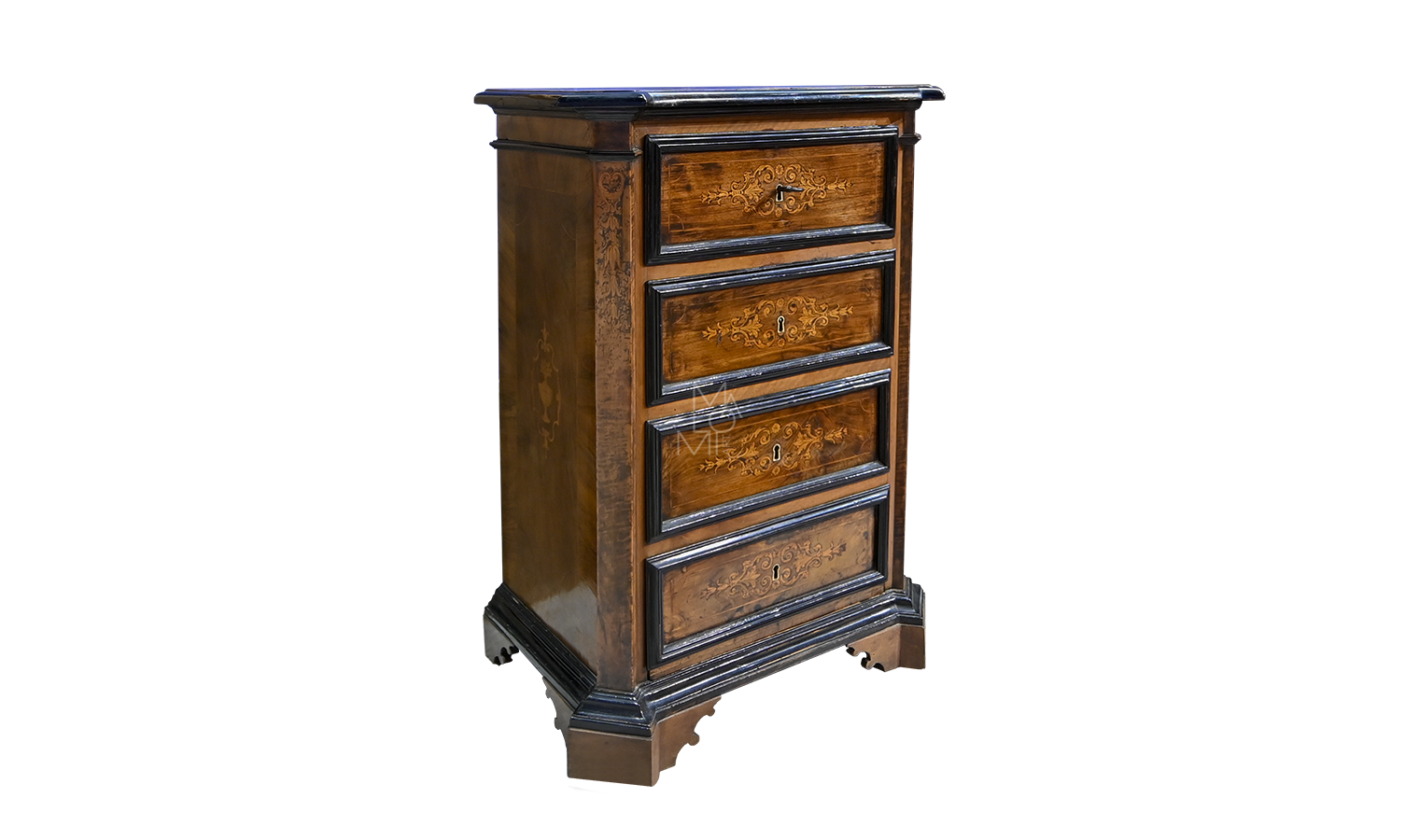
- Typology: Baroque small commode with four drawers (antique miniature chest of drawers)
- Period: Late seventeenth century / Early eighteenth century (late 17th century - Louis XIV style)
- Origin: Northern Italy, Lombardy region (Brescia-Bergamo manufacture)
- Dimensions: 72 x 45 x 96 h cm (rare collector’s proportions)
- Primary Materials: National walnut burl (historically known as Brianza burl), walnut wood, ebonized moldings
- Inlay Essences: Maple, boxwood, and light fruitwoods
- Internal Structure: Solid poplar and fir wood
- State of Conservation: Excellent, in its first patina with original shellac finish
Academic Historical-Artistic and Structural Essay
A masterpiece of Lombard Baroque cabinetmaking: the inlaid small commode from the Brescia-Bergamo area of the late 17th century
Introduction and typological framework
Within the context of Italian furniture production at the turn of the 17th and 18th centuries, the typology of storage furniture underwent a profound formal and dimensional evolution. The transition from the monumental 17th-century canterano to more agile and proportioned structures responded to the changing needs of the Baroque aristocracy, who shifted toward a compartmentalization of living spaces and formal refinement in small private or state rooms.
The artifact object of this study constitutes a rare and superb example of a four-drawer Baroque small commode, whose diminutive measurements of 72 x 45 x 96 h cm place it within the restricted and exclusive category of collector's pieces or high-representation furniture.
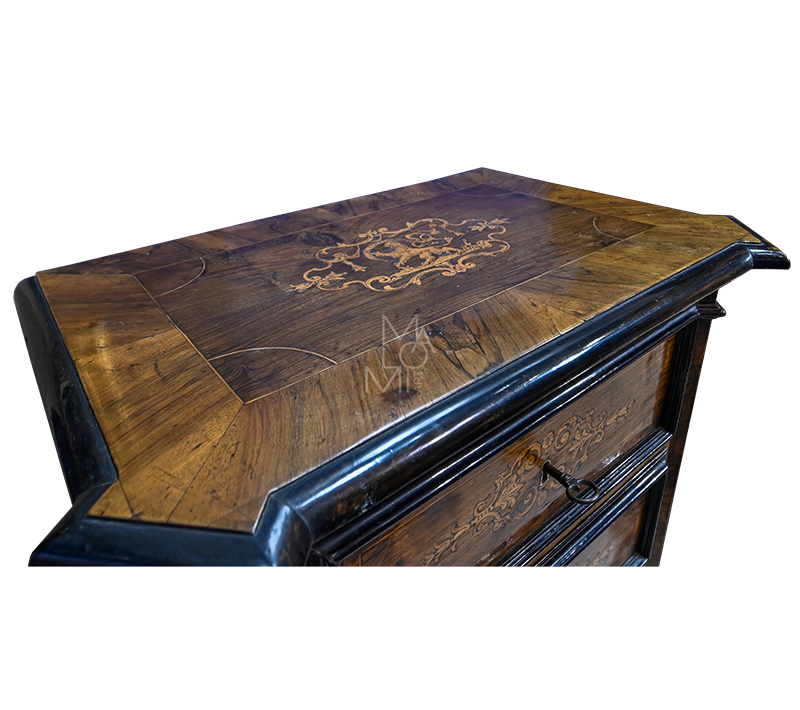
Characterized by a front with canted corners, the piece develops a rigorous architectural layout typical of the Louis XIV period, where the severity of the lines is tempered by a highly rich superficial decorative apparatus. The structure combines containment elements with a refined visual plasticity, achieved through the chromatic and material contrast between dark ebonized woods and warm burl veneer panels.
The socio-political context of the Brescia and Bergamo territories in the late 17th century
To fully comprehend the genesis of a piece of furniture of such significance, it must be contextualized within the peculiar geopolitical framework of eastern Lombardy at the close of the seventeenth century. The areas of Brescia and Bergamo constituted the so-called Domini di Terraferma (Mainland Dominions) of the Most Serene Republic of Venice, serving as hot border territories directly adjacent to the Duchy of Milan, which was under Spanish rule at the time.
This frontier positioning favored the development of a highly competitive local noble and merchant class, determined to assert its prestige both against the central Venetian government and toward the influential Milanese houses. The local patriciates of Brescia and Bergamo utilized the architecture of their urban palaces and the magnificence of their interior furnishings as genuine instruments of political and social legitimization.
From an economic perspective, the Brescian territory and the valleys of Bergamo enjoyed extraordinary prosperity driven by firearms manufacturing, mining, the textile and yarn trade, and metalworking. This widespread wealth sustained an educated and demanding patronage, capable of financing workshops of the highest order.
The cabinetmaking of this region absorbed the influences of French classicist rigor and the exuberance of the Roman Baroque, blending them with the sober solidity of the local construction tradition. A piece of reduced proportions but decorated with the utmost care, such as this small commode, responded perfectly to the fashion of the receiving rooms or private cabinets within provincial noble palaces, where local lords conducted high-finance affairs, managed land holdings, or guarded their most precious assets.
Stylistic and iconographic analysis, and the heraldry of the "De Forti Dulcedo"
The furniture manifests a decorative language of extraordinary conceptual density, entirely devoid of narrative interruptions. The front of the four drawers is punctuated by shaped geometric reserves hosting complex inlays of floral scrolls and phytomorphic motifs. The front canted pillars house a vertically developed candelabra motif, crowned by stylized mascarons, chalices, and foliated elements. The sides are not left bare – a feature found only in highest-profile commissions – but present a splendid twin-handled vase with flowers at the center of a geometrically book-matched reserve, a Baroque allegory of prosperity, rebirth, and spiritual connection.
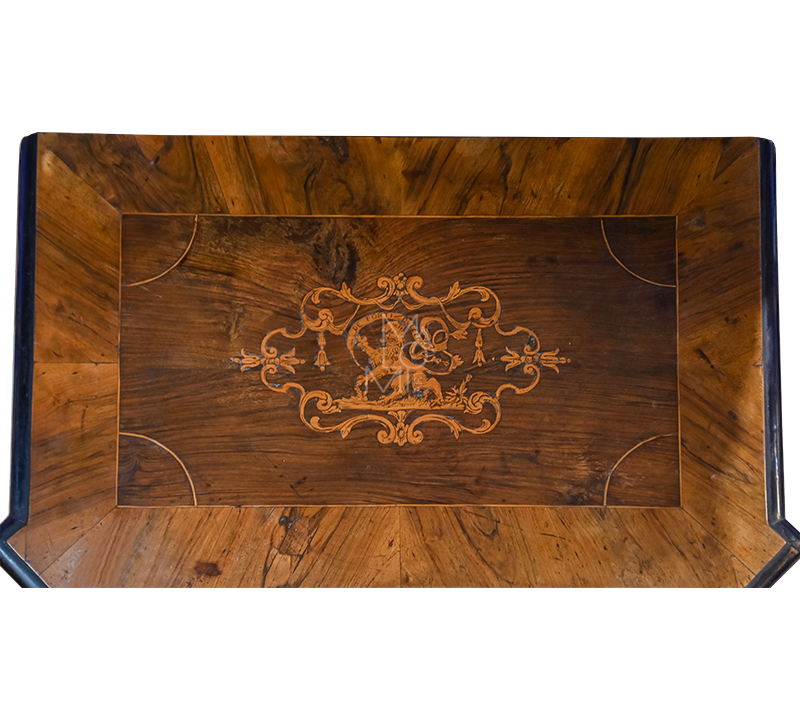
The element of greatest historical-artistic significance, however, lies in the top panel, where a monumental light-wood inlay cartouche is set. At the center of the reserve features a lion rampant holding a scroll with the Latin inscription De forti dulcedo, meaning "Out of the strong came forth sweetness."
This motto derives its theological and literary origin from Samson's famous biblical riddle contained in the Book of Judges, formulated after finding a swarm of bees and their honey inside the carcass of a lion he had slain. The sacred text highlights the stark contrast between the predator and the sweetness of the nourishment derived from it.
Although this specific motto is historically linked also to the numismatic symbology of the House of Este in the Duchy of Ferrara, where it was introduced by Alfonso I d'Este, its iconographic union with the figure of the lion rampant on an artifact with distinct Lombard construction characteristics allows us to attribute the original commission with almost absolute certainty to the noble Grattarola family, sometimes recorded as Grattaroli. This house was historically rooted and highly influential precisely in the central-eastern area of Lombardy, between the provinces of Bergamo and Brescia, confirming the destination of the small commode as a dynastic, heraldic, and celebratory piece for a palace of local significance.
Geopoetics of the material: national walnut burl and the Lombard tradition
The aesthetic impact of the small commode is dominated by the skillful use of national walnut burl, historically defined within the local cabinetmaking tradition as Brianza burl or Ferrara burl depending on the supply channels and the processing of the craftsmen. This raw material does not represent a separate botanical variety, but rather the recovery of the basal section or root burl of the walnut tree, where the irregular and distorted growth of the fibers generates a woody tissue dense with morphological anomalies and of great pictorial effect.
Cabinetmakers active in the Brescian and Lombard area at the end of the 17th century understood the pictorial and chiaroscuro potential of this imperfect wood. The surface of the furniture shows an exceptional density of bird's-eyes, meaning small, closely spaced spherical knots, and chromatic shading capable of shifting from golden honey to deep brown.
The execution technique is that of rigorous period thick veneering, known as lastronatura: the burl sheets were manually sawn to a significant thickness between two and four millimeters, far removed from the microscopic industrial veneers of the contemporary era.
These sheets were then book-matched to create a perfect visual symmetry. The entire composition was enclosed and disciplined by thin stringing in light woods such as maple or boxwood, which provided edge relief, and by thick moldings in ebonized wood, typically dyed pearwood or ebony. The absolute black of the molding thus acts as a graphic counterpoint, offering a visual containment that fixes the Baroque flaring of the burl within the boundaries of architectural rigor.
Construction archaeology: back panel, drawers, and internal structures
Moving into the diagnostic and structural examination of the piece, the internal and non-visible parts offer documentary proof of its material and chronological genuineness. The back panel is composed of large planks of poor local wood, identifiable as poplar or fir, cut by manual saw. The surface shows the characteristic original rough finish from the roughing plane, free from the serial regularity typical of 19th-century machine tools, and appears darkened by a deep natural oxidation accumulated over more than three centuries.
A detailed analysis of the drawer morphology reveals the adoption of pre-industrial construction techniques standard for the Po Valley area of the late 17th century. The bottom of each drawer is made of butt-joined poplar planks and is not inserted into lateral grooves; instead, it is nailed directly flush under the edges of the sides and the rear backboard, avoiding the grooving typical of later productions.
The nails used are hand-forged one by one, recognizable by their irregular, flattened quadrangular heads. The intermediate runner planes, also called frames, act as internal dividers and show typical wear from prolonged friction along the contact points with the guide strips, proving an organic and secular movement of the individual drawers.
The dimension of security: the lock and the engineering of the secret compartment
The technological apparatus related to the security of the furniture deserves separate mention. Inside the first drawer stands a monumental box lock in hand-forged and hot-wrought iron. The metal plate features a surface shaped by the strikes of the hammer on the anvil and houses a spring mechanism with a gear for a complex bit key. The box is entirely mortised by hand into the drawer's counter-front and anchored by period metal pins, preserving the absolute integrity of the whole.
The most fascinating aspect of this small commode's engineering, however, lies in the integration of a refined secret mechanism. The bottom of the drawer houses a raised box structure that creates a hidden space, a genuine double bottom not perceptible when the drawer is partially inserted.
To this ingenuity corresponds, on the structural plane of the furniture, a calibrated interruption of the intermediate runner plane, which does not reach the rear back panel. This generates a vertical concealed space at the back of the furniture, designed to accommodate the protruding box of the upper drawer. This interior design solution, common in high-end Baroque cabinetmaking of the Lombard-Venetian area, responded to the need to guard valuables, coins, ciphered correspondence, or confidential documents away from prying eyes.
State of conservation and museographical considerations
The small commode presents itself in an exceptional state of conservation, definable as being in its first patina. The external wooden surface shows signs of a spirit finish, executed with natural shellac applied by pad, which has kept the original transparency and depth of the burl unaltered. This has allowed the piece to avoid those aggressive chemical bleaching and sanding interventions that unfortunately characterize many speculative 20th-century restorations.
Further archaeological testimony of the piece's history is the paper label applied to the center of the back panel, which serves as an archaeometric indicator of authenticity. Close analysis shows a period laid paper, presumably 19th-century, subject to natural yellowing and humidity stains defined as foxing.
The paper still bears faint traces of cursive calligraphic ink and presents pinholes related to an early inventory pinning. This paper fragment acts as a true historical seal, linking the piece to an ancient palace inventory and protecting its authenticity against any hypothesis of partial or total reconstruction.
In conclusion, due to the extraordinary convergence of small dimensions, quality of the burl, rarity of the heraldic program, and structural complexity of the secret compartment, this small commode stands as a material document of primary interest for the history of Lombard decorative arts, fully worthy of inclusion in a museum collection or a sophisticated private collection of Baroque furniture.