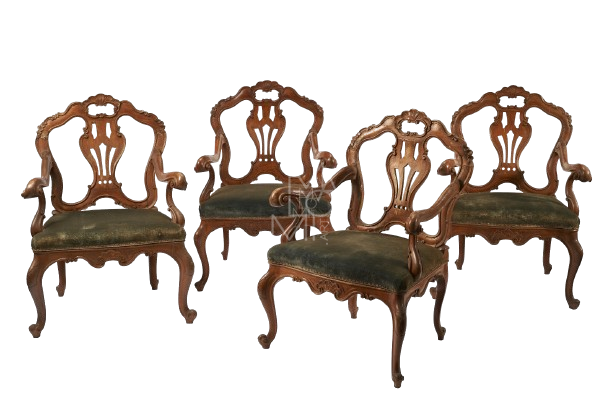
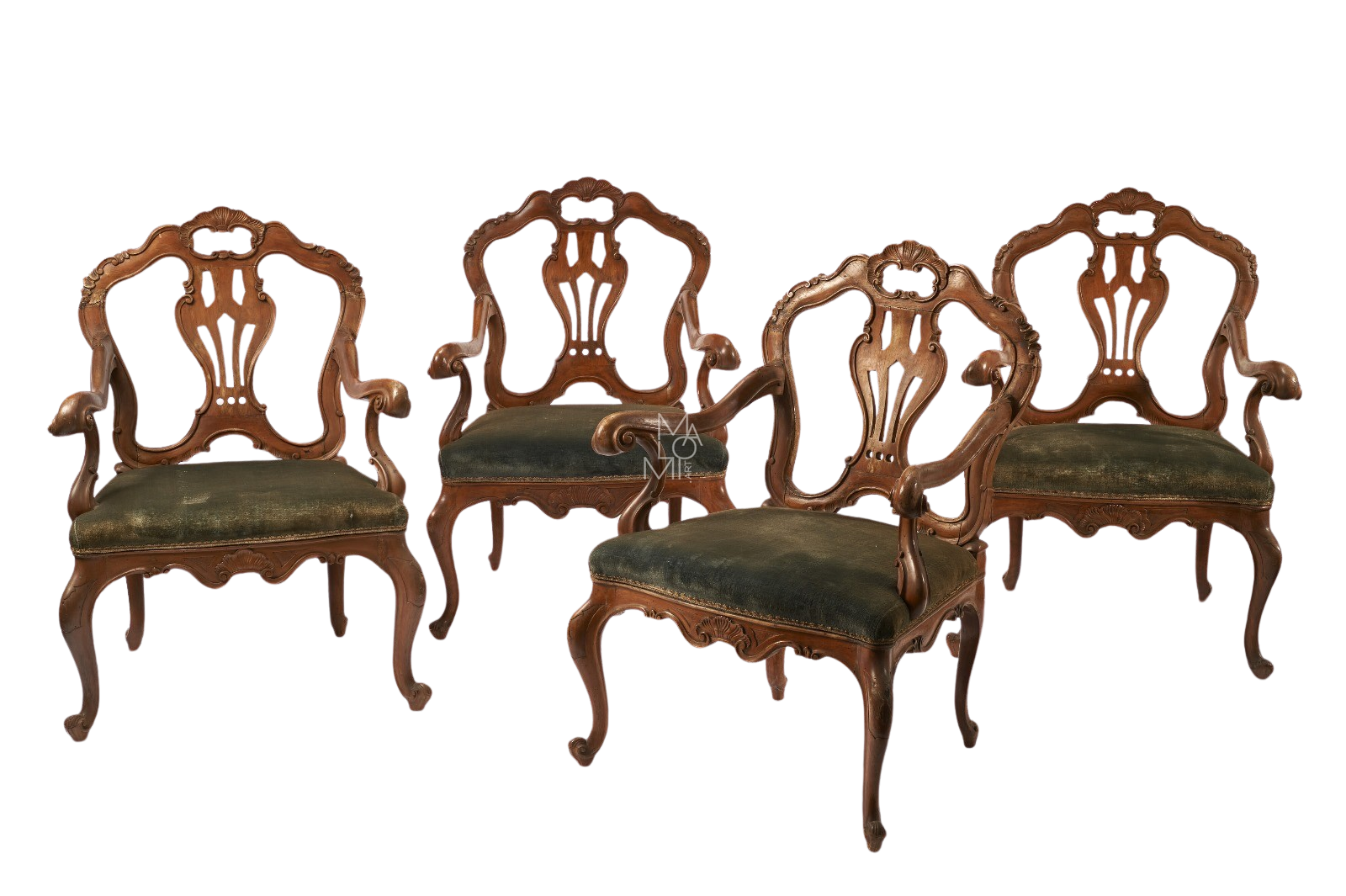
A rare set of eight Venetian-Lombard cabriole armchairs in solid walnut, Brescia, mid-eighteenth century
"Set completo di otto poltrone barocchette del XVIII secolo in legno di noce massello in prima patina, suddivise in due lotti da quattro rivestite in velluto oro e velluto verde bosco, scuola bresciana."
- Typology: Suite of eight parlor armchairs (enfilade)
- Period: Circa 1750–1765
- Cultural sphere: Eastern Lombardy, Brescian school (Venetian-Lombard transition)
- Material: Hand-carved solid walnut (Juglans regia)
- Condition report: Outstanding, preserved in its authentic prima patina. The wooden frame shows an untouched secular oxidation with historical flight holes smoothed and vitrified by centuries of traditional waxing.
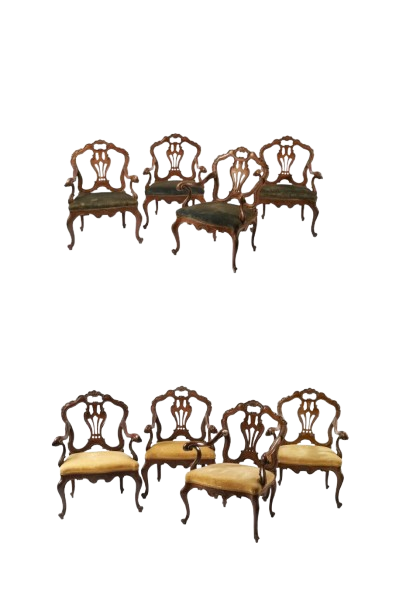
- Upholstery: Premium velvet over traditional hair-stuffed seats; structurally identical, the set is chromatically divided into four gilt-ochre and four forest-green elements.
Functional Elegance of the Eighteenth Century Between Lagoon and Mainland
The eighteenth century represented the golden age of European cabinetmaking and artistic carving, an era in which chairs and armchairs evolved from rigid symbols of status into objects capable of combining maximum comfort with the decorative requirements of aristocratic salons. The monumental corpus of eight solid walnut armchairs under examination—a production that masterfully embodies the transition between the mature Barocchetto and the transitional Rococo—constitutes an extraordinary material document for understanding this stylistic evolution. This exceptional set, observed in a magnificent prima patina (original surface) that preserves centuries of stratified wax, historical dust, and light, shares the exact same structural typology and a refined velvet upholstery across all specimens. However, the nucleus is visually divided into two groups of four due to a chromatic differentiation within the same fabric, with four elements upholstered in gilt-ochre velvet and the remaining four in a deep forest-green velvet.
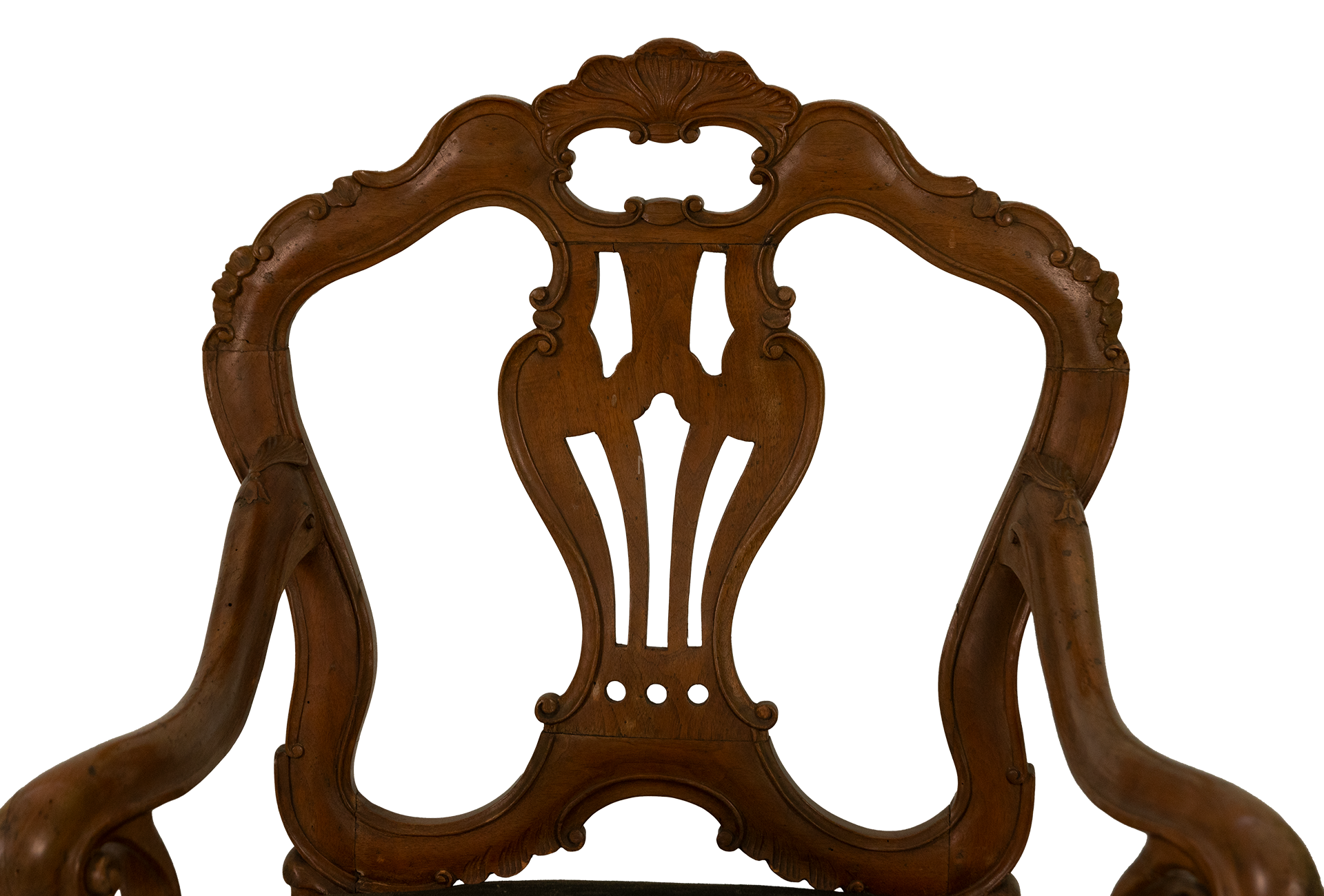
The morphological analysis of these seats immediately reveals the complex architecture of eighteenth-century Venetian-Lombard furniture. The openwork, ventilated backrest, dominated by a central splat pierced in the shape of a slender vase or lyre, dialogues harmoniously with the sinuous lines of the armrests. The latter, set back from the front stiles, develop with a fluid whiplash motion that terminates in a perfectly smooth scroll, entirely devoid of vegetal elements. The apron of the seat rail displays a lively undulating contour, embellished at its center by a carved shell (coquille) that mirrors the one positioned on the cresting rail of the backrest. The support is provided by four cabriole legs that discharge the weight onto elegant, raised scroll feet.
Critical Contextualization and Formal Attribution to the Brescian School
Critical inquiry into this corpus irrevocably shifts the attributional center of gravity away from the workshops of the lagoon capital toward the important manufacturing center of Brescia and its hinterland. Although the overall silhouette recalls the airy lightness of Venetian seats—conceived so as not to weigh down the spatial perception of salons overlooking the Grand Canal—the plastic execution resonates with the rigor and concreteness characteristic of the marangoni (carpenters and carvers) of the Lombard mainland. In the workshops of central Venice, particularly those supplying the complex decorative campaigns of Palazzo Rezzonico or Palazzo Pisani, the decorative shell was frequently resolved into an asymmetrical rocaille. This technique was utilized by master glassmakers and carvers alike to create the illusion of continuous movement, resulting in a tormented motif fused with fluid, almost liquid marine or vegetal elements deeply influenced by the French ornamental repertories of Juste-Aurèle Meissonnier.
Conversely, the carving visible on this set of armchairs maintains a geometric composure and a balanced symmetry that act as the true visual and structural axis of the furniture. The total absence of acanthus leaves or floral festoons along the course of the armrests constitutes a deliberate stylistic choice of the Brescian school, aimed at exalting the purity of the structural line and the extraordinary quality of the walnut timber. This dense, compact, and beautifully grained raw material was selected and seasoned with obsessive care far from the saline mists of the lagoon, guaranteeing a structural stability that has allowed the mortise-and-tenon joints to endure through the centuries without showing signs of sagging or the typical warping that plagues tender Venetian woods such as wild cherry or poplar. A lesser-known Brescian technical detail consisted of securing the internal joint with a small invisible wooden peg—a constructive astuteness foreign to the swift, performance-oriented execution of Venice, which was often concerned solely with superficial scenic effect.
Seat Morphology and the Social Phenomenon of Aristocratic Paniers
A suggestive curiosity regarding the morphology of these seats lies in the pronounced outward splay of the armrests and their distinct setback relative to the front line of the seat rail. This sophisticated technical solution was not a mere aesthetic caprice of the carver, but a pressing necessity tied to the aristocratic fashion of the period and the complex etiquette of eighteenth-century salons. The eighteenth century was the era of monumental female skirts supported by paniers—elaborate cages made of whalebone or metal hoops that vastly distended the hips of dresses, forcing noblewomen into measured and calculated movements.
A lady of the period would have found it impossible to sit on a traditional chair equipped with forward-projecting armrests without dramatically crushing or wrinkling the costly fabric of her silk, brocade, or damask gown. Brescian master cabinetmakers therefore designed these armchairs so that the seat remained completely unobstructed at the sides, allowing the volumes of velvet and textile to expand laterally in a triumph of folds and drapery. In this manner, the daily act of sitting was transformed into a veritable theatrical performance of social rank, enabling the noblewoman to seat herself with absolute grace without compromising the infrastructure of her attire—a detail that contemporary society chronicles never failed to note with witty admiration in reports reaching as far as Milan and Paris. There even existed a rigid code of conduct in Brescian salons, where the distance between the armrests of the chairs determined the hierarchy of guests invited to the delicate ceremonies of morning coffee and hot chocolate.
The History of Collecting in the Valleys and Ville di Delizia
The history of collecting within this specific border area between Veneto and Lombardy reveals anecdotes of great sociological interest, tied to the early nineteenth-century rediscovery of furniture featuring exposed noble woods. While ultramontane collectors and the great art dealers of Paris or London obsessively sought out the polychrome lacquers, pastiglia work, or lavish gilding of Venetian palaces, the rising industrial bourgeoisie of Brescia and Bergamo developed a highly cultivated, autonomous, and strongly identity-driven taste for solid walnut furniture. Historical families associated with the first major metallurgical industries of the valleys and the textile mills of the plains began to scour countryside estates and the splendid ville di delizia (pleasure villas) of Franciacorta and Lake Garda to reacquire the grand furnishings of the aristocratic past.
A celebrated anecdote of the era recounts the heated antiquarian disputes that arose during judicial sales or the complex hereditary divisions of the great Brescian houses, where the presence of a complete enfilade—that is, an intact set of eight or twelve matching seats—was considered the true linchpin of prestige for an entire gallery or estate. The choice to upholster the entire nucleus with the same velvet fabric, albeit declined in the two noble colors of gold and forest green, underscores a historical desire to maintain material continuity while visually differentiating the arrangement of the furnishings within the conversation rooms. Many of these sets were unfortunately broken up at the end of the nineteenth century to provide dowries for daughters or to furnish the new urban palaces of the emerging middle class. This phenomenon renders the discovery and preservation of a cohesive, numerous group in prima patina like the one under examination an event of extraordinary rarity and immense historical value in today's antiquarian market. It is said that a well-known Brescian antiquarian of the early twentieth century, determined not to divide a lot of eight similar armchairs, went so far as to trade an entire plot of vineyard in Franciacorta for them, testifying to the almost sacred value attributed to the numerical integrity of parade furnishings.
The Social Nexus Between the Brescian Mainland and the Lagoon Capital
Behind the production of these eight armchairs lies a profound social and economic nexus that bound the merchant bourgeoisie and the agrarian nobility of Brescia to the patriciate of the lagoon city. From a political standpoint, Brescia was a loyal and strategic subject of the Most Serene Republic of Venice; however, from a cultural and philosophical perspective, it maintained a fierce independence rooted in its own rural philosophy. The Brescian landed nobility accumulated immense wealth through a scientific, rational, and precociously Enlightenment-driven management of plantations, forges, and manufactories—a pragmatism that clashed openly with the lavish, theatrical, and sometimes dissipated lifestyle of Venetian patricians confined within the narrow spaces of the lagoon.
When Brescian patrons ordered furnishings for their residences, they demanded a reflection of the latest Venetian fashions so as not to appear inferior to the representatives of the central government, yet they categorically rejected the use of lacquered or gilded softwoods, which they considered ephemeral, fragile, and devoid of real economic substance. Thus was born the masterpiece of the Venetian-Lombard synthesis, wherein the formal verve and structural sinuosity of Venice were disciplined, purified, and rendered eternal by solid walnut worked with robust and severe Brescian skill. This philosophy translated into a home conceived to endure across generations, where furnishings were not meant to deceive the eye with a superficial lacquer finish, but were required to proudly display the deep grain of the wood and the perfection of the joints—tangible symbols of the honesty, concreteness, and solidity of the commissioning family.
Philological Comparisons with the Furnishings of Historic Venetian and Lombard Palaces
To fully comprehend the monumental caliber of this set of eight armchairs, it is indispensable to establish a close visual and structural comparison with the corpuses of seats preserved within the most important patrician residences along the Venetian-Lombard axis. The first inevitable parallel is found within the reception rooms of Palazzo Lechi in Montirone, an extraordinary outpost of eighteenth-century Brescian decorative culture. In the halls of the palace, the walnut armchairs exhibit an identical rationalization of Rococo lines: the armrests renounce typical Venetian vegetal ribbing to focus on the purity of the terminal scroll, showing a shared artistic intent and, perhaps, the hand of the very same workshop. Conversely, shifting the investigation toward Venice, Palazzo Mocenigo at San Stae preserves series of armchairs that adopt the same openwork backrest with a lyre splat, but the lagoon execution differs due to the employment of wood lacquered in pastel tones or gilded, where the thickness of the timber is reduced to a minimum to privilege the illusion of an almost immaterial lightness.
Another fundamental term of comparison is offered by the historical furnishings of Palazzo Fenaroli Avogadro, in the heart of Brescia, where period inventories describe in detail the presence of seating in solid walnut and precious velvets intended for noble conversation. In these variants, the carved shell on the apron assumes a function of geometric continuity entirely identical to that found in our nucleus, acting as a visual hinge between the stability of the legs and the flexibility of the seat. Further west, within the collections of Palazzo Moroni in Bergamo, one finds transitional consoles and armchairs that bear witness to the same Lombard rigor, in which the robustness of exposed wood prevails over applied decoration. This dense network of comparisons demonstrates that the eight armchairs under examination are not an isolated exploit, but fit perfectly into the official language of the mainland nobility, who were capable of dialoguing on equal terms with the Venetian capital while modifying its aesthetic codes according to a more severe and monumental sensibility.
Material Diagnostics and Paleography of Brescian Carving in Structural Detail
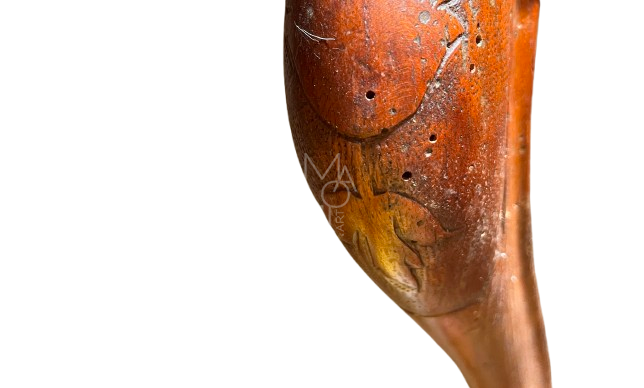
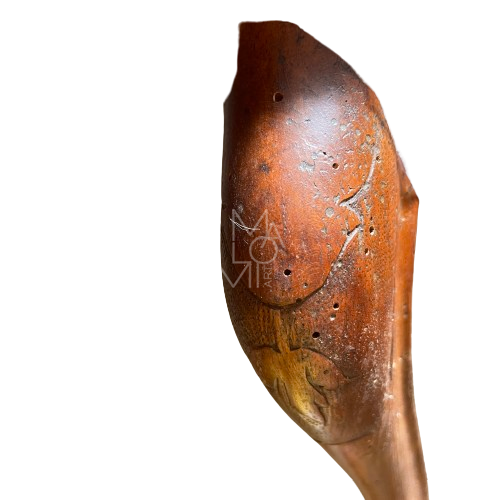
A close examination of the upper portion of the support stile, corresponding to the knee of the cabriole leg, offers a constellation of diagnostic elements that incontrovertibly confirm the Brescian-Lombard attribution. This section of the frame configures itself as a veritable material palimpsest in which it is possible to decipher both the specific workshop culture of the master carver and the conservation biography of the furniture through the centuries. The element of greatest scientific significance for dating and verifying the authenticity of the artifact is represented by the dense and uniform surface pitting generated by the historical activity of wood-boring insects. Within the field of antiquarian expertise, the morphological analysis of flight holes constitutes the primary criterion for distinguishing between a surface in prima patina and a historical fake or a heavily restored piece of furniture. In the detail under examination, the holes appear morphologically smoothed at the edges, devoid of sharp crests, and with a decidedly burnished and darkened interior. This configuration is the macroscopic result of the "vitrification" process of the patina; over the centuries, atmospheric dust, soot from fireplaces, and the natural oxidation of the tannins in the walnut wood stratified over the holes, which were progressively occluded and polished by periodic wax-and-cloth maintenance executed in the ancient estates dominating the mainland.
A fascinating anecdote related to ancient domestic maintenance practices in the Brescian valleys reminds us that housewives or servants charged with the care of precious furnishings did not use modern chemical oils. Instead, they relied on traditional mixtures of pure beeswax dissolved in turpentine, occasionally enriched with walnut husk (mallo di noce) to reinvigorate the tone of the wood. This domestic ritual, faithfully repeated from generation to generation, gradually filled the cavities excavated by beetles, transforming the furniture’s points of weakness into an irrefutable proof of antiquity. If the piece had been subjected to chemical stripping or abrasive sanding during the nineteenth or twentieth century, the edges of the holes would be sharp, the interior would show the light color of live wood, and whitish residues of plaster or wood paste would be visible. The continuity of the finish layer, which uniformly envelops both the flat surfaces and the cavities of the holes, certifies instead the absolute integrity of the furniture's eighteenth-century skin.
The Morphology of Carving and the Flattened Leaf of the Lombard Region
From a purely stylistic point of view, the knee of the leg is ennobled by a carved reserve housing a stylized leaf motif pointing downward. The salient character of this decoration lies in its extremely low relief, resolved through a technique defined as rilievo schiacciato (flattened relief) or deep incision, far removed from the plastic and projecting exuberances of international Rococo. While Venetian cabinetmaking favored the application of rich, three-dimensional acanthus leaves with tendrils branching off the structural frame at this junction, the workshops of Brescia and the eastern Lombard region preferred a graphic and geometric approach. The carving does not alter the architectural profile of the leg but conforms to it, limiting itself to creating a chiaroscuro effect that animates the play of light on the swelling curve of the walnut. The veins of the leaf are incised with clean strokes of the gouge, denoting a confident hand that mastered the hardness of the walnut wood. This ornamental choice, rigorous and calibrated, reflects that taste for decorative sobriety that distinguished furnishings destined for the nobility and wealthy bourgeoisie of the mainland, where the exhibition of luxury resided in the quality of the material and the cleanliness of form rather than in the redundancy of ornament.
The walnut wood utilized for the leg manifests the classic deep, warm hue of antique timber that has undergone a long process of photolysis and atmospheric oxidation. The color, which veers toward brown and amber shades with golden highlights in the areas most exposed to light, is the result of the century-long interaction between sunlight and the natural chemical components of the wood, particularly lignin and tannin. The surface micro-texture also reveals a dense network of tiny, historical dents and signs of use, which constitute the charm and documentary value of period furniture, imparting an inimitable tactile softness to the surface. The presence, in the upper portion of the image, of a modern transparent plastic protective film bears witness to correct practices of handling and preventive conservation. This expedient preserves the delicate hygrometric balance of the wood during phases of transport or storage, protecting the surface from accidental mechanical friction or sudden spikes in relative humidity that could trigger unwanted structural movements within the ancient wooden joints.
Reasoned Bibliography of Comparison for Venetian-Lombard Cabinetmaking
To support this thorough historical-artistic reconstruction, a specialized body of literature allows for the weaving of useful documentary and stylistic comparisons:
- Alberici, Clelia. Il mobile lombardo, Milan, Görlich, 1969.
Comparative note: A fundamental text for understanding the transition from Baroque to Rococo in the provinces of Brescia and Bergamo; it accurately describes the use of solid walnut and the Lombard rationalization of the decorative shell motif. - Baccheschi, Edi (ed.). Il mobile veneziano del Settecento, Milan, Görlich, 1962.
Comparative note: Essential for analyzing the formal genesis of the openwork backrest with a lyre splat and for verifying, by contrast, the greater structural severity and geometric purity of mainland specimens over lagoon prototypes. - Colle, Enrico. Il Mobile Rococò in Italia. Arredi ed ebanisti nei secoli XVII e XVIII, Milan, Electa, 2003.
Comparative note: Offers an encyclopedic overview of stylistic flows and the movements of itinerant cabinetmakers across the Po Valley, focusing specifically on the treatment of whiplash armrests and the development of the scroll foot. - Morazzoni, Giuseppe. Il mobile veneziano del '700, Milan, Treves, 1927.
Comparative note: Within its historic photographic plates, several examples of Venetian-Lombard seating attributed to Brescian craftsmen can be found, characterized by the same frame devoid of heavy carvings on the stiles. - Saba, Donatella. Ebanisteria e interni patrizi a Brescia nel Settecento, in «Arte Lombarda», N.S., 1994.
Comparative note: An illuminating archival study investigating the economic relationship between Brescian patrician patronage and the adaptation of furnishings in ville di delizia to match the fashions of the lagoon capital.