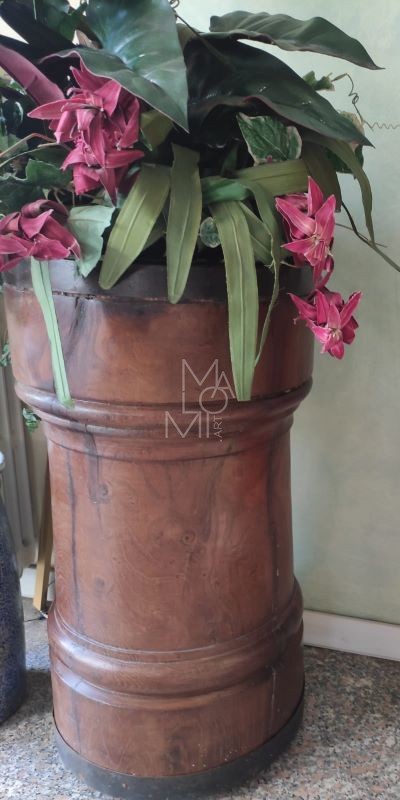
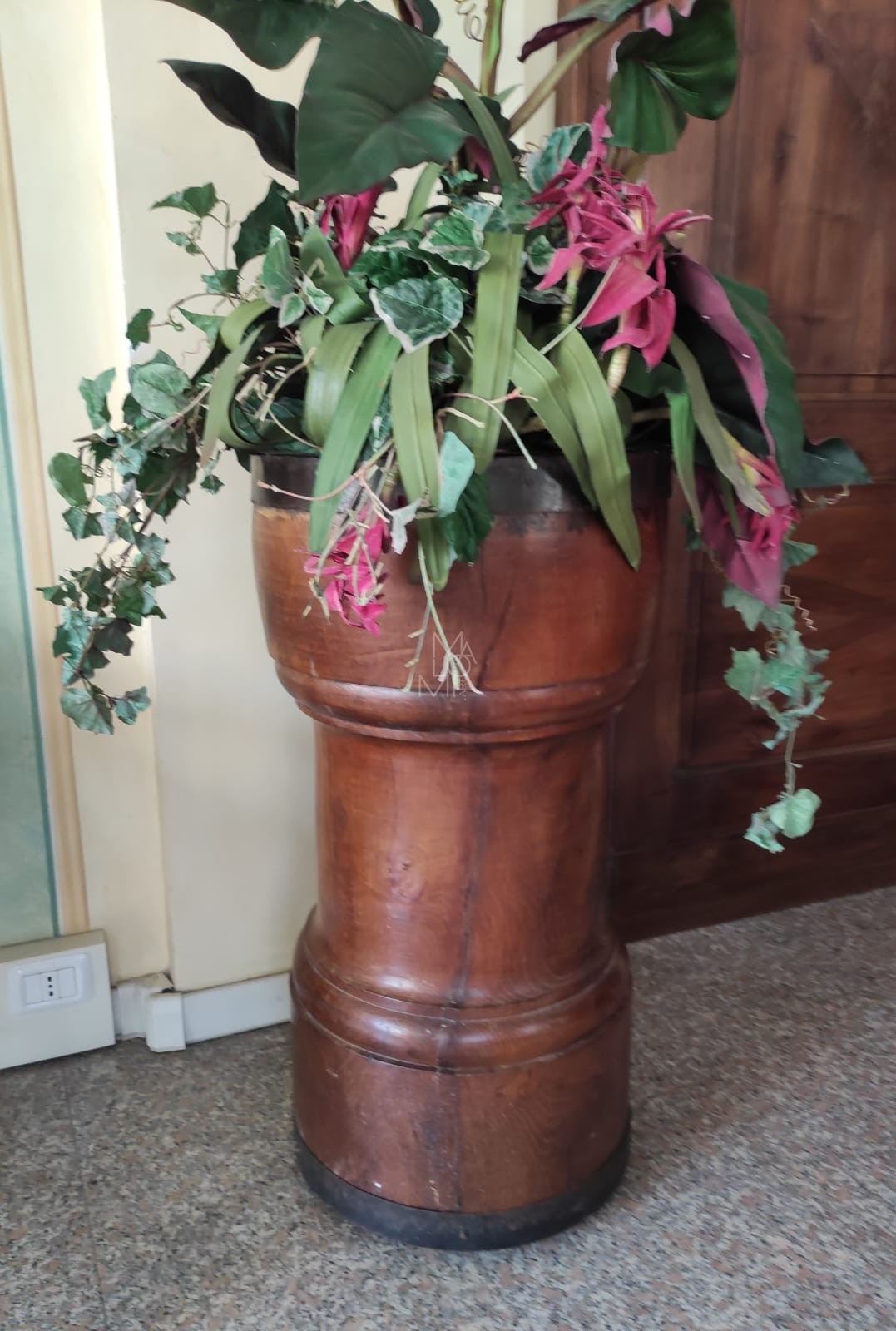
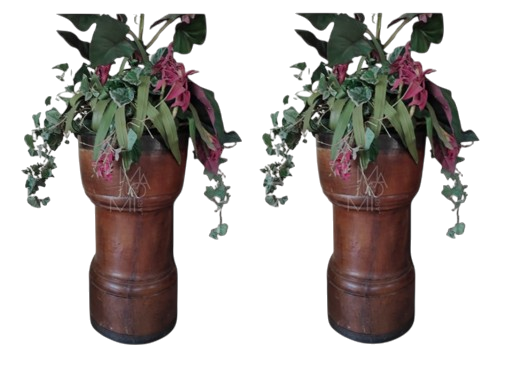
A pair of late seventeenth-century Lombard planters in solid elm and embossed copper
Technical specifications
- Object type: Pair of indoor planters / Ceremonial pot holders
- Period: Late seventeenth century (circa 1680–1700)
- Origin: Lombardy, Italy (State of Milan)
- Materials: Solid elm wood, hand-embossed copper interior basins, hot-forged wrought iron structural rings
- Dimensions: Height 92 cm × Maximum diameter 45 cm
- Condition report: Excellent overall state of preservation. The wooden structures remain perfectly stable, retaining their original historical patina. The copper and iron elements are structurally sound, showing minor signs of historic oxidation consistent with age and botanical use.
The rustic ceremonial furniture: a historical-artistic analysis of a pair of elm and copper planters from late-seventeenth-century Lombardy
Introduction: the context and the object of study
Within the landscape of seventeenth-century Italian decorative arts, furniture production in the Po Valley, and specifically in the Lombard region, is distinguished by a peculiar combination of structural robustness and measured plastic rigor. The work under examination, a pair of planters in solid elm with embossed copper pot holders and iron reinforcement rings at the extremities, represents a material document of extraordinary interest. Chronologically attributable to the late seventeenth century, between 1680 and 1700, these structures do not configure themselves as simple functional furnishings, but rather as ceremonial elements capable of dialogue with the interior architecture of patrician residences or high-bourgeois patronages of the era. They move along that thin boundary separating artistic cabinetmaking from high-specialization artisanal craftsmanship. Their monumentality, expressed by a height of ninety-two centimeters and a diameter of forty-five, immediately evokes the atmosphere of the grand reception halls of the period, where living nature was literally integrated into the ceremonial paths of the nobility.
- The material choice: solid elm and the aesthetic of solidity
The use of elm as the primary essence in solid wood constitutes a precise geographical and functional indicator. In seventeenth-century Lombard cabinetmaking, although walnut remained the wood of choice for the most finely carved ceremonial furniture, elm was widely employed for its extraordinary mechanical resistance, hardness, and low propensity to crack under load. Characterized by an interlocking grain and broad, flame-like veining, elm confers a vigorous texture to the planters, typical of a concrete and severe Baroque style, far removed from the frivolousness of the subsequent Rococo era. The choice of solid wood responds to a precise structural necessity, as the furniture had to support the combined weight of the copper container, wet earth, and botanical apparatus, while ensuring vertical stability over an accentuated height.
A curiosity related to this material resides in the popular beliefs of the time. In the Po Valley, elm was considered an almost sacred wood, historically linked to the cultivation of the vine, which was traditionally wedded to this tree. Utilizing elm for furnishings intended to contain vegetation was therefore not only a choice dictated by the solidity of the matter, but also carried an ancestral symbolic value of fertility and deep connection with the Lombard land. Furthermore, carpenters of the era knew that elm, if maintained in conditions of constant humidity or properly protected, could resist for centuries without rotting, a fundamental quality for an object destined to host plant life.
- Applied metallurgy: embossed copper and Baroque plasticity
The functional and aesthetic heart of the artifact is represented by the embossed copper pot holder. The choice of copper, a ductile metal yet resistant to corrosion caused by the humidity of the earth and watering, demonstrates a deep technical awareness on the part of the artisans. The embossing process, executed cold by working the metal from the reverse side to obtain a positive relief on the front, fits fully within the tradition of Lombard coppersmiths and brassworkers active in the historical districts of Milan, Brescia, and Bergamo. From a stylistic point of view, the embossed surface not only captures the light, creating strong chiaroscuro contrasts typical of Baroque taste, but also acts as an element of chromatic rupture against the golden-brown tone of the elm wood, thereby ennobling the whole.
A fascinating anecdote concerns the perception of copper in late-seventeenth-century residences. While silver was reserved for liturgical tableware or the highest aristocracy, embossed copper represented the material par excellence for the exhibition of a solid wealth linked to the self-sufficiency of the territories. In the inventory records of Milanese patrician families of the period, copper vessels were described with great detail, sometimes equated to actual sculptural works. The manual hammering of the surface, left intentionally vibrant, allowed the planters to shine even in the dim light of monumental halls, reflecting the light of torches and candles with a golden warmth that contemporaries considered extremely welcoming and luxurious.
- Furniture engineering: iron rings and structural reinforcements
A technical detail of crucial historical-constructive significance is the presence of wrought iron rings at the extremities of the planters. In the late seventeenth century, ironwork never played a purely ornamental role, but was an integral part of the furniture's statics. Elm, despite being extraordinarily robust, is a living wood that reacts significantly to hygrometric variations, especially when placed in direct contact with humid elements or positioned in semi-open spaces such as porticoes or reception halls exposed to drafts. The iron rings, hot-forged by pre-Alpine ironworks, act as actual structural containment bands. They prevent the solid wood from opening or deforming radially under internal pressure or under the weight of the copper basin, translating an engineering necessity into a dark graphic mark that rhythms the vertical momentum of the stem.
In the workshops of the time, the application of these bands was considered a high-precision operation. The iron ring was forged slightly narrower than the diameter of the wood. It was then heated until incandescent, expanding sufficiently to be fitted onto the elm trunk. By cooling suddenly with water, the iron contracted violently, gripping the wood in an eternal vice. This union between the carpenter's mastery and the blacksmith's strength gave the furniture an aura of indestructibility that responded to the Baroque desire to challenge time and the decay of matter.
- Morphological analysis, proportions, and context of use
The dimensions of the object delineate a silhouette that is both slender and monumental. The forty-five-centimeter diameter guarantees a stable base of support and an optimal internal capacity for the cultivation of prized plants. The height of nearly one meter responds to the Baroque logic of visual perception, which mandated elevating plant nature to the level of the observer's gaze, ideally integrating it with the wall painting cycles or the mirrors of the room. The symmetry of the pair suggests a binary placement, designed to frame an entrance portal, the sides of a grand monumental fireplace, or the terminal points of a perspectival gallery, according to the dictates of the interior scenography of the time.
The custom of displaying plants in pairs within rooms stemmed from a precise court etiquette. Guests entering the salon had to be greeted by perfect symmetry, reflecting the political and social order of the host. Monumental plants symbolized human control over wild nature, a theme dear to Baroque philosophy. Moving between these planters meant walking through an interiorized garden, where the scent of the leaves mingled with that of precious woods and waxes, transforming the visitor's experience into a multisensory journey curated down to the smallest detail.
- The socio-political context of late-seventeenth-century Lombardy
To fully comprehend the genesis and patronage of this pair of planters, it is necessary to immerse the object into the peculiar historical fabric of Lombardy during the final decades of the seventeenth century, a territory then subject to Spanish domination through the State of Milan. This period, often dismissed hastily by past historiography as an era of pure decadence, was in reality a phase of profound economic and social reorganization. The great landed aristocracy and a new, dynamic business bourgeoisie invested heavily in land and in the construction or renovation of grandiose noble residences, both in urban centers and in the countryside, giving rise to the celebrated phenomenon of the villas of delight.
In this political theater, domestic furnishings assumed a primary role for the ostentation of rank. The Spanish style, historically rigid, ethical, and extremely formal, had progressively merged with the magnificence of the Roman Baroque and with Lombard pragmatism. Furnishings had to express stability, prestige, and power. A pair of monumental solid planters was not a simple utilitarian item, but a visual symbol of territorial roots and wealth. During the governance of the final Spanish governors, receptions in the villas of Brianza or along the Naviglio Grande were occasions for crucial political alliances. Exhibiting sumptuous furnishings made from local materials meant demonstrating one's economic strength and loyalty to the crown, without, however, renouncing pride in one's own manufacturing roots.
- Daily use and Baroque botanical culture
The functional analysis of the planters reveals anthropological dynamics and daily habits characteristic of court life and seventeenth-century sociality. Between the end of the seventeenth century and the beginning of the eighteenth, the European aristocracy was struck by a veritable veneration for botany, particularly for lemons, citrons, and bitter oranges, as well as for exotic plants arriving from the Americas and the Orient. Possessing citrus plants north of the Apennines was an extreme luxury that required constant care and adequate structures. During the warm months, these planters were displayed outdoors in formal Italian gardens to welcome guests along the avenues. With the arrival of the first autumn colds, the artifacts were transferred indoors, into galleries or special orangeries, becoming integral elements of the interior architecture.
The practical management of the artifact implied a precise interaction between different workers and the household servants. The inclusion of the removable copper pot was a fundamental practical device that prevented damage to the wood. Court gardeners could tend to the plant, repot it, or fertilize it outside the palace, and then reposition it within the elm stem once it was ready for display in the salons. Moving these furnishings at full load was a minor domestic event that required the coordinated effort of several servants. An anecdote of the era recounts how household masters recommended cleaning the iron rings with walnut oil before every major reception, to prevent rust from staining the precious liveries of the servants or the silk gowns of the ladies who brushed against the pots during dances.
- Woodturning techniques of the period
The morphological analysis of the planter reveals the application of sophisticated macro-mechanical skills, attributable to the guild of turners, who enjoyed statutes and privileges distinct from ordinary carpenters. In the late seventeenth century, turning solid elm presented significant technical complexities due to the hardness of the wood and its irregular grain. To shape an elm block with a diameter of fully forty-five centimeters, Lombard workshops could not rely on common foot-pedal lathes. It was necessary to use the wheel lathe, a complex machine where continuous rotational movement was generated by an assistant turning a large drive wheel connected to the main axle via ropes. This constant rotation allowed the master turner to focus exclusively on guiding the chisel, reducing the risk of dangerous kickbacks that could ruin the wood or injure the artisan.
The process began with a long preparation of the piece. The trunk was roughed out with axe blows and left to rest in dry environments to discharge the last tensions of the sap. Once mounted on the lathe, the artisan used gouges of decreasing sizes to hollow out the central narrowing and define the succession of hollows and rounds that characterize the stem. The surface finishing was a work of infinite patience. Since sandpaper did not exist, the smoothing of the elm was performed using dried horsetail leaves, a plant rich in silica known as scouring rush, or pieces of squared fish skin. This treatment imparted a silky sheen to the surface, enhancing the natural flame of the elm, which was finally protected with a mixture of beeswax and boiled linseed oil.
- Stylistic comparison: Lombard Baroque versus Roman and Venetian models
The pair of planters offers a perfect point of comparison to highlight the divergent interpretations of the Baroque language across the different geopolitical entities of the Peninsula. The Italian Baroque was not a monolithic stylistic movement, but a galaxy of regional idioms closely connected to the material resources and ideologies of local courts. In the Republic of Venice, Baroque furniture was influenced by the lagoon's pictorial tradition and commercial contacts with the Orient. Coeval Venetian production sought lightness, supple movement, and the dissolution of the wooden mass through minute carvings or through the use of surfaces entirely lacquered and painted with floral motifs. Conversely, the Lombard artifact expresses a terrestrial and rigorous stability, linked to the culture of the Po Valley, where the planter remains firmly anchored to the ground through a massive cylindrical plinth.
The comparison with the Roman Baroque further accentuates this diversity. In the Rome of popes and great cardinals, dominated by the influence of Gian Lorenzo Bernini, ceremonial furniture was conceived as a monumental and theatrical sculpture. Roman pot holders favored lime or poplar wood, soft essences that lent themselves to being carved with figures of putti, telamones, sphinxes, and rich acanthus garlands, all covered in a dazzling gold leaf gilding intended to reflect the magnificence of the Church. The Lombard planter counters this theatrical pomp with an aesthetic of formal and structural concreteness. Its monumentality does not rely on the fiction of gilding or the hyperbole of the undulating line, but on the declaration of the power of natural material. The elm wood is left exposed, solid and structured, celebrating an aristocratic luxury that is sober, severe, and deeply tied to the manufacturing reality of its own territory.
- The typological evolution of the indoor planter in the transition to the eighteenth century
The transition from the seventeenth to the eighteenth century marks one of the most radical structural and aesthetic mutations in the history of European furniture. This transition sanctions the gradual moving past of the mature Baroque in favor of the sinuous lines of the Barocchetto and the Rococo, reflecting upon the typological evolution of indoor planters. While the pair of Lombard planters under examination embodies the pinnacle of the seventeenth-century conception, characterized by monumentality and a sharp separation between wood and metal, the first decades of the eighteenth century completely dismantle these assumptions. The pillar or column structure is progressively abandoned in favor of tripod planters supported by arched legs that join in a central knot, or console-planters supported by elegant cabriole legs ending in scroll feet.
Furthermore, the eighteenth century witnessed an organic fusion of materials that erased the clear distinction visible in our artifact. The metallic container disappeared from view, becoming entirely encased and masked within shaped wooden aprons. Embossed copper often gave way to painted porcelain, thanks to the opening of major European manufactories like Meissen or Doccia, which introduced notes of vivid and refined color into the salons. The socio-spatial function of the furnishing changed as well. Natural wood yielded to surfaces entirely lacquered in pastel tones of ivory or light green. Planters no longer served to host large citrus trees to impress guests, but transformed into graceful jardinières for the center of the room or the boudoir, dimensioned to hold small cut flowers or seasonal bulbs, responding to a new ideal of domestic comfort and intimacy that would characterize the entire culture of the Age of Enlightenment.
- History of furniture and decorative arts in Lombardy
- Alberici, Clelia. Il mobile lombardo. Milan: Görlich, 1969.
- Colle, Enrico. Il mobile barocco in Italia: Arredi d'arte e di corte tra Sei e Settecento. Milan: Electa, 2000.
- Comba, Maria. Ebanisteria e carpenteria nella pianura padana del XVII secolo. Turin: Umberto Allemandi, 1994.
- Rosa, Gilda. I mobili nelle dimore lombarde. Milan: Edizioni d'Arte Grafiche Gualdoni, 1963.
- Socio-political context, economy, and villa life in the State of Milan
- Arese Lucini, Francesco. Le grandi dimore patrizie milanesi del Seicento. Milan: Società Storica Lombarda, 1982.
- Capra, Carlo. La Lombardia spagnola (1535-1706): Istituzioni, società, mentalità. Venice: Marsilio, 2002.
- Sella, Domenico. Lombardia prima della rivoluzione industriale. Bologna: Il Mulino, 1979.
- Baroque botanical culture and winter gardens
- Azzi Visentini, Margherita, ed. Il giardino veneziano e padano nel Seicento: Confronti con il modello lombardo. Florence: Leo S. Olschki, 1998.
- Fagiolo, Marcello, ed. La villa nel Seicento e Settecento in Italia: Architettura, arredo e natura. Rome: De Luca Editori d'Arte, 2001.
- Tagliolini, Alessandro. Storia del giardino italiano: Dal Rinascimento al Barocco. Florence: La Casa Usher, 1988.
- Wood technology, turning, and applied metallurgy
- Mannoni, Tiziano, and Enrico Giannichedda. Archeologia della produzione: Tecniche di lavorazione del legno e del metallo in epoca moderna. Turin: Einaudi, 1996.
- Syme, J. Houston. The Turner's Craft: Woodturning Techniques and Lathes in Seventeenth-Century Europe. London: Routledge, 1985.
- Tucci, Pier Luigi. La lavorazione del rame e del ferro battuto nell'artigianato padano del Sei e Settecento. Brescia: Grafo Edizioni, 1991.
- Exhibition catalogues and regional stylistic comparisons
- Bacchi, Andrea, and Luciana Martini, eds. Andrea Brustolon 1662-1732: Il Michelangelo del legno. Milan: Skira, 2009. (For stylistic comparison with the Venetian area).
- González-Palacios, Alvar. Il tempio del gusto: Le arti decorative in Italia fra classicismo e barocco. 2 vols. Milan: Longanesi, 1984. (For general stylistic comparison and the Roman area).