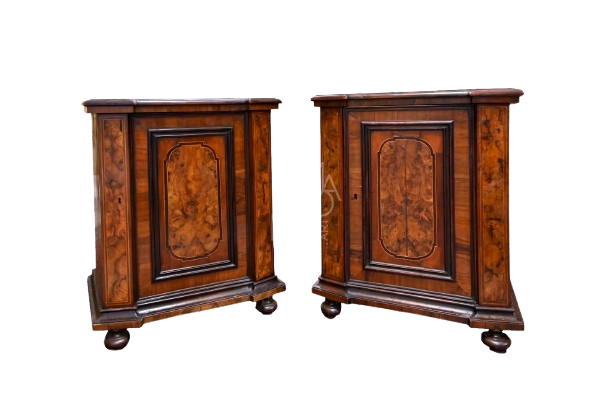
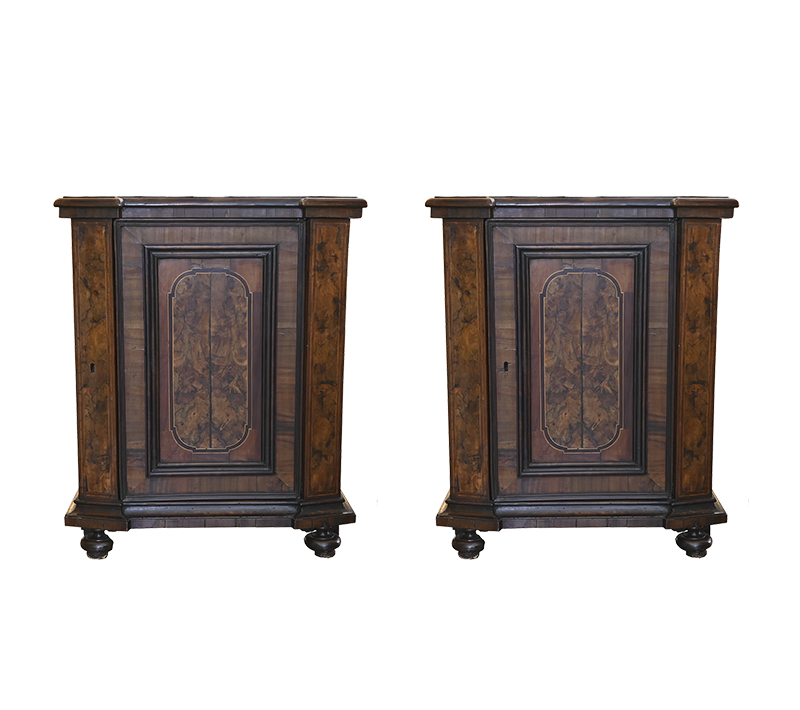
A pair of early eighteenth-century Brescian barocchetto cabinets in walnut burr
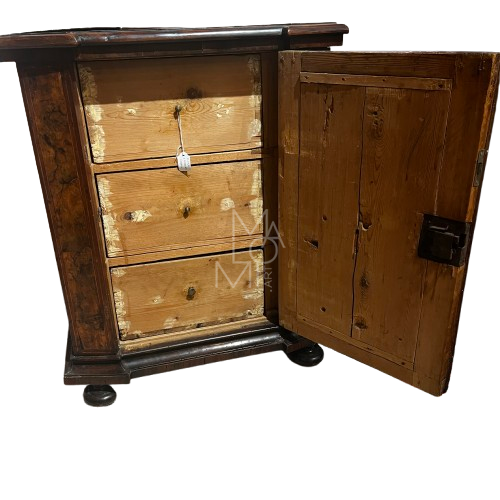
- The document cabinet: Conceals a stack of three hand-dovetailed silver fir drawers secured by a robust, hand-forged wrought-iron box lock, functioning as a private archive or coin cabinet (stipo).
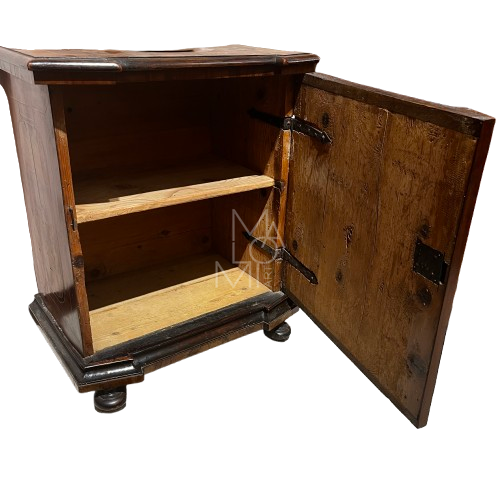
- The stipo-commode: Features an open lower compartment divided by a thick silver fir shelf and an ingenious hinged lift-up top. This zenithal aperture reveals a concealed, recessed upper well designed to discretely house a majolica or porcelain chamber pot (pitale).
- Period: Early 18th Century (1710–1740)
- Origin: Lombardy, Brescian school
- Dimensions: 71 x 50 x 82 cm
- Materials: Solid walnut, walnut burr veneer, silver fir (interiors and backboard), ebonized fruitwood, wrought iron, cast brass.
A Historical-Artistic and Structural Analysis of a Pair of Early Eighteenth-Century Lombard Cabinets in Walnut Burr
Introduction and the Context of Lombard Cabinet-making in the Eighteenth Century
Within the dynamic landscape of the Italian decorative arts, early eighteenth-century Lombardy represents a territory of extraordinary cultural synthesis. The transition from the monumental rigidity of seventeenth-century Baroque to the first measured concessions of grace and symmetry characteristic of the Barocchetto finds its highest expression in storage furniture, such as small cabinets, credenzas, and commodes. The pair of furniture pieces examined here perfectly embodies this delicate artistic shift. The combined use of solid walnut and precious burl veneering responded to the sophisticated taste of a high-ranking patronage, who desired furnishings capable of harmonizing with the renovated palatial architectures of Milan and its neighboring provinces. The presence of two elements that are exteriorly identical yet differentiated in their interior arrangements bears witness to a high functional value and a refined workshop design that went far beyond mere consumer-grade cabinet-making.
During this specific historical period, patrician residences were undergoing a profound spatial metamorphosis, abandoning vast, single reception halls in favor of smaller, more intimate and specialized rooms, such as rear chambers (retrocamerini) and private reading cabinets. In these spaces, privacy and the administration of personal estates required furniture of exceptional craftsmanship and discretion. A historical curiosity linked to this period concerns workshop contracts, in which the nobility often demanded that twin furniture pieces be crafted from the exact same tree trunk or root burl. This was requested to ensure absolute chromatic and figurative continuity across the veneered panels, a detail that inextricably linked the aesthetic destiny of the two units from the very moment the timber was selected at the sawmill.
Morphological Analysis and the Selection of Materials between Walnut and Burr
The choice of materials represents the pivotal element defining the quality, prestige, and chromatic rendering of these artifacts. For the primary load-bearing structural framework, the cabinet-maker opted for straight-grained and blond walnut, a timber renowned for its long-term stability and its ability to impart a warm undertone to the entire composition. Conversely, the precious walnut burr—meticulously harvested from the gnarled excrescences and deep roots of the tree—was employed in thick sheets via the lastronatura technique to create sharp, almost pictorial chiaroscuro contrasts. The tormented, highly figured, and dense grain of the burr was frequently likened by contemporaries to natural landscapes or moving clouds, fueling lengthy debates within eighteenth-century academies regarding nature's intrinsic ability to act as a painter in its own right.
To delineate these organic reserves, the artisan inserted dark, slender stringings and moldings made of a dense fruitwood, such as pearwood, specially treated and stained to achieve an ebonized finish. This calibrated juxtaposition between the rigorous geometric linearity of the walnut and the unpredictable waviness of the burr generates a controlled visual dynamism typical of Lombard Baroque classicism. Among eighteenth-century workshop anecdotes, it is said that cabinet-makers used to lightly moisten the burr with vegetable extracts or warm oils prior to the final polishing. This was done not only to enhance its variegated pattern but also to evoke, in the eyes of the patron, the tactile preciousness of hardstones and rare marbles that adorned the most sumptuous noble chapels of the region during that period.
Geometric Development and Decoration of the Surfaces
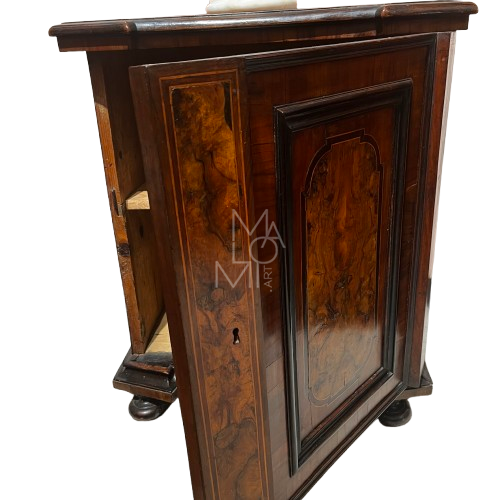
The furniture develops according to precise rules of symmetry and perspective modularity. The upper top is not conceived as a purely neutral or utilitarian surface; rather, it offers itself to the viewer as a genuine perspective canvas. The geometric marquetry strictly circumscribes the space, guiding the observer's eye toward the exact center, which is dominated by a large, shaped burl cartouche. This refined planar decoration anticipates the transition toward the concept of centrist furniture, designed to be appreciated from multiple angles and distances within the room. Descending toward the main facade, the single door is flanked by two raised, canted corners (spalle scantonate). The canting—namely, the geometric practice of planing down the corners of the case at a forty-five-degree angle—constitutes a fundamental hallmark of Lombard architectural and furniture design.
This design choice breaks the monumental rigidity of the quadrangular block, imparting a sense of plasticity and a modulation of shadow that significantly lightens the visual impact of the structure. The decoration of the door mirror-images the geometric motif of the top, ensuring rigorous visual coherence. Furthermore, each individual burl reserve is isolated and embellished by sophisticated perimeter stringing. This calligraphic detail acts as an internal frame, accentuating the relief effect of the central mirror relative to the background panel and demonstrating the extraordinary mastery of symmetrical lines possessed by the craftsmen involved.
Interior Space Organization and Functional Versatility
The true uniqueness and curatorial charm of this pair lie in the functional asymmetry of their interiors, which is cleverly concealed behind a perfectly twin exterior aesthetic. The first cabinet houses a single, robust horizontal shelf made of silver fir, configuring itself as a classical storage space intended to accommodate vessels, precious volumes, or everyday utensils. The second cabinet, by contrast, conceals behind its door a series of stacked drawers entirely finished by hand. This specific configuration transforms the artifact into a refined coin or document cabinet (stipo), expressly conceived for the custody of small valuables, domestic inventories, confidential letters, or dynastic seals.
A fascinating historical curiosity regarding these study cabinets relates to the frequent presence of secret compartments or double bottoms, known in antiquity as segreti. These were activated by small hidden pins or pressure-release mechanisms, designed to conceal alchemical formulas, testaments, or ciphered political correspondence during the turbulent transition years between foreign rulers in the Lombard territory. The presence of two such differing interiors suggests that the cabinets were destined for fixed, symmetrical positions within the same room, fulfilling entirely different practical needs while preserving the unbroken, specular decorum of the surrounding architectural space.
Supporting Elements and the Flattened Onion Foot
The base of the furniture rests stably upon feet shaped in the guise of a flattened onion. This element, despite its modest dimensions, holds crucial importance for both the correct dating of the piece and its static and visual equilibrium. While the height of the seventeenth century favored full onion feet—markedly spherical, heavily turned, and monumental, which weighed down the silhouette of the furniture—the first half of the Lombard eighteenth century tended to compress and taper these forms. The profile of the foot thus became ovoid and depressed, expanding laterally.
This morphological transition allows for a smoother transition between the pronounced protrusion of the molded lower plinth and the floor surface, conveying a sensation of slight suspension while maintaining the necessary solidity. Each foot is carved from a single block of solid walnut turned by hand, as evidenced by the subtle and charming asymmetries detectable among the various supports. A small anecdote linked to the daily life of these ancient manufactories recalls that the feet were the parts most exposed to moisture during the cleaning of terracotta or Venetian terrazzo floors. For this reason, cabinet-makers finished the lower underside with mixtures of pitch and resinous oils to protect the timber from decay and the attacks of wood-boring insects.
Structural Analysis of the Interior Compartment and Constructional Diagnostics
Opening the door reveals precious constructional details fundamental for the study of artisanal techniques and for diagnosing the authenticity of the pieces. The overall measurements of seventy-one centimeters in width, fifty centimeters in depth, and eighty-two centimeters in height confirm the canonical proportions of a compact bedchamber cabinet. While the exterior surfaces display the luxury of the burr, the internal structures respond to criteria of pure functionality and workshop economy, utilizing exclusively silver fir wood, a pre-Alpine conifer selected for its optimal elasticity and long-term durability. The drawer fronts, crafted from solid silver fir, exhibit distinct residues of hot animal bone glue along their edges, signaling millimetric manual corrections made during construction to ensure smooth sliding within the wooden runners.
The sides of the drawers reveal the presence of robust dovetail joints executed entirely by hand, while small, cast-brass button knobs stand out at the center. Of exceptional historical value is the locking system of the drawer cabinet, which features a sturdy, hand-forged wrought-iron box lock applied directly to the reverse of the door—likewise lined in silver fir—by means of clenched antique nails. The iron strike plate, visible on the opposite jamb, ensured an airtight seal against any attempt at forced entry. The natural oxidation of the silver fir wood, which veers toward warm, deep, and amber tones due to centuries of contact with air and the conifer's internal resins, constitutes an irreplaceable scientific indicator for differentiating these original artifacts from late nineteenth-century historicist replicas.
Comparative Study of the Second Cabinet and Analysis of the Load-bearing Ironmongery
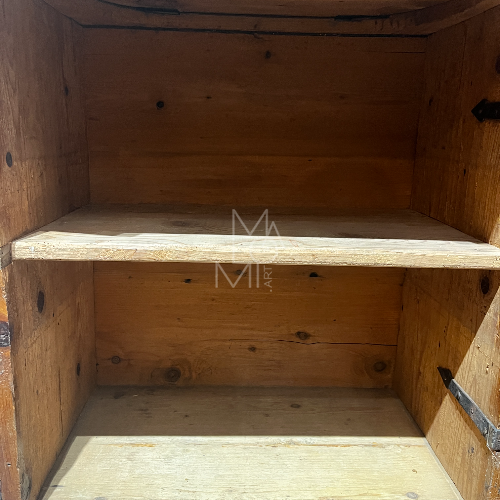
A close examination of the second cabinet of the pair, characterized by an open compartment with a single horizontal shelf, allows for the completion of the philological study of Lombard furniture of the period. The large median shelf is crafted from high-thickness solid silver fir wood, a technical choice indispensable for preventing the shelf from warping under the prolonged weight of the stored goods. The internal silver fir walls show the typical marks left by the artisan’s hand plane, with a lignin oxidation that is perfectly specular to that found in the first cabinet, confirming that both pieces were born contemporaneously within the same workshop.
Furthermore, opening the door highlights the internal hinges, structural elements of vital importance for supporting the weight of the massive veneered leaf. These consist of long strap hinges, also known as tail hinges, crafted from hot-forged iron and terminating in a characteristic arrow or lance-head shape, typical of the Po Valley blacksmithing tradition between the seventeenth and eighteenth centuries. Visual analysis of the metal highlights the signs of an ancient conservative cleaning that removed the dark stratification of centuries-old rust, leaving the iron surface with a bright gray coloration and a slight porosity, while fully preserving its structural sturdiness and original attachment configuration.
Analysis of Volumetric Perspective and the Thickness of the Veneer
Observing the furniture from an enfilade perspective, with the door partially open, offers an extraordinary diagnostic opportunity to study the third dimension of the arredo, analyzing the spatial relationship between the decorative exterior thickness and the internal structural skeleton. The edge of the door leaf clearly reveals the considerable thickness of the burr sheet applied over the core wood. In early eighteenth-century Lombard cabinet-making, this veneer (lastrone) was sawn manually with substantial thicknesses ranging between two and four millimeters—a technological datum that sharply differentiates these pieces from the paper-thin industrial veneers produced from the nineteenth century onward.
The dark, raised molding that frames the central mirror protrudes sharply, creating a fascinating play of shadows that enhances the tridimensionality of the facade. The angular framing also allows one to appreciate the complex joinery of the canted corner, which is not a simply chamfered block of wood, but the result of a forty-five-degree geometric interlocking of the side panels. This was specifically engineered to counteract the natural torsional stresses of the wood and prevent structural deformations over the centuries. The visual contrast between the exterior surface polished with beeswax and the matte silver fir interior left in its natural state highlights the authentic biological aging of the artifact.
Stylistic Mapping and Geographical Attribution within the Brescian Territory
The combination of the constructional and aesthetic details analyzed thus far allows for the narrowing of the geographical investigation to a precise production area of the Venetian Terraferma, namely the province of Brescia. Unlike contemporary Milanese cabinet-making, which was heavily influenced by the restless, undulating, and whimsical lines of French Rococo, Brescian production of the first half of the eighteenth century retains a more austere, monumental soul, bound to the rigor of architectural proportions. Brescian furnishings do not seek movement through the curvature of surfaces; instead, they entrust the sense of dynamism to the chromatic contrasts of the burr and the dense ebonized moldings. The canting of the corners directly mirrors the volumetric solutions of the Botticino stone portals that adorned the palazzi of the city's historic center.
A solid attributional hypothesis leads to the flourishing urban workshops concentrated along the axis of Via San Faustino in Brescia, where master marquetry cutters operated, specializing in supplying furnishings for local patrician families such as the Martinengo and the Fenaroli. Furthermore, one cannot exclude the cultural influence of the celebrated Bergamasque workshop of the Fantoni of Rovetta. Their models, bound to the monumental cutting of veneers and the use of dark, high-relief moldings, were widely assimilated by artisans active in the Brescian valleys—particularly in Val Sabbia, a territory historically renowned for excellence in the ironworking of locks and for the abundance of high-quality silver fir and walnut timber.
Analysis of the Backboard and Criteria of Structural Integrity
The observation that the backboard of the cabinets was crafted using the same silver fir wood and the same rough finish as the interior constitutes the decisive evidence for the scientific validation of the artwork's integrity. In early eighteenth-century Brescian workshops, the construction of the rear portion of furniture responded to precise functional and environmental logics. The backboard is not formed by a single panel; rather, it comprises multiple silver fir boards arranged horizontally and joined together by a simple rebate joint. This specific horizontal grain direction represents a solid and highly targeted choice of art carpentry. It horizontally bound the vertical flanks of the cabinet, containing lateral stresses and preventing the case from widening or bowing outward under the weight of the upper top.
This ancient construction technique allowed the boards to move independently in a vertical direction, accommodating the expansion and contraction caused by variations in domestic humidity without transmitting dangerous tensions to the noble walnut burr flanks. The rear surface clearly shows the irregular grooves left by the scrubbing plane and manual saws, marks that carpenters did not eliminate since the back was destined to remain permanently resting against the room's wall. The silver fir boards are secured to the frame by period nails forged one by one by hand, characterized by a quadrangular section and a coarse, flat head. The perfect chromatic alignment between the gray-brown oxidation of the backboard and that of the internal compartments excludes any partial dismantling or substitution, certifying the absolute historical coherence of all structural components of the pair.
The Functional Archaeology of the Hinged Top and the Commode Hypothesis
A further and extraordinary structural peculiarity, emerging from an in-depth investigation of the cabinet with an open compartment and a single shelf, introduces an element of exceptional interest for the history of customs and daily life in eighteenth-century aristocratic residences. Indeed, the upper top of this specific specimen is not fixed as it appears at a superficial glance, but is ingeniously conceived to lift up via a system of concealed hinges. This zenithal opening lays bare a lowered, blind compartment carved out directly above the first usable level of the cabinet. The conformation of this hidden housing and its geometric proportions lead to the formulation of a solid and fascinating archaeological-functional hypothesis: the cabinet was originally designed to accommodate a chamber pot inside, commonly referred to as a pitale.
Within the domestic universe of the Lombard and Brescian Barocchetto, the fusion of highly decorative exterior cabinet-making with the most intimate and prosaic physiological functions was by no means experienced as a contradiction, but rather as the pinnacle of aristocratic comfort and refinement. Prior to the widespread adoption of modern bathrooms, which would only appear in noble floor plans in the late nineteenth century, personal needs were managed directly within private bedchambers or adjacent rear dressing rooms. However, the etiquette of the time dictated that the instrument of such a function be rigorously concealed from the sight of guests and high-ranking servants. The solution lay, therefore, in the perfect mimicry of the cabinetry.
The top of the furniture, richly inlaid with geometric motifs and centered by the superb walnut burr cartouche, served as a perfect visual disguise. Closed, it presented itself as a luxurious bedchamber or study cabinet, suitable for supporting silver candlesticks or rare porcelain knick-knicks from Meissen. Once lifted, it revealed its real, protected destination of use. The chamber pot—which in the wealthiest Brescian residences could be made of prized Faenza majolica, painted porcelain, or even chased silver bearing the family's heraldic ciphers—found its lodging in a lined compartment that prevented it from tipping over.
A technical curiosity linked to the diagnostics of these rare commodes or dressing furniture lies in the chemical-physical analysis of the wood patina inside the upper housing. Very often, the bottom of these silver fir compartments shows localized wear and dark ring marks left by the base of the vessel, accompanied by traces of ancient protective varnishes based on natural resins and particularly thick beeswax. This insulating treatment was generously applied by cabinet-makers in the province of Brescia to waterproof the silver fir boards against unavoidable fumes and acidic droplets, which would have otherwise corroded and compromised the structural integrity of the cabinet's corner within a few years.
The discovery of this secret housing also resolves the question regarding the structural differentiation of the pair, exalting the logic of their complementarity. While the twin specimen with stacked drawers was entirely consecrated to intellectual and civil functions—configuring itself as a documentary safe, patrimonial archive, and custodian of the marquis's private letters—the cabinet with a lift-up top and open compartment was dedicated to bodily well-being and personal care. Positioned symmetrically at the sides of the master bed or the large reception mirror, the two cabinets offered a comprehensive response to the needs of the aristocratic day, demonstrating how the colte craftsmanship of the early Brescian Settecento knew how to bend the superb beauty of the walnut burr and the geometric rigor of sumptuary laws to the most pragmatic and daily requirements of palace life.
Sumptuary Laws and the Discipline of Appearances in the Brescian Territory
The austere and measured elegance of this pair of cabinets finds a precise and fascinating historical justification in the sumptuary laws enacted by the Republic of Venice and rigorously applied within the territory of Brescia. During the eighteenth century, the Serenissima kept strict vigil over its Terraferma provinces through the actions of the Magistrato alle Pompe (Magistrate over Luxury), a body appointed to limit the excessive extravagance of private families. This was done to prevent the financial ruin of noble estates and to maintain a clear political hierarchy relative to the patriciate of the lagoon capital. Sumptuary decrees explicitly forbade the introduction into residences of furniture decorated with precious metals, lavish lacquerings in gold leaf, or gilt-bronze applications of foreign origin.
To circumvent these strict legal limitations without renouncing the display of their social status, Brescian cabinet-makers invented a refined strategy, shifting the pursuit of luxury from superimposed metallic decoration to the exploitation of the natural resources of timber. Walnut burr thus became the chosen medium for bringing to life a luxury that was legal and formally unassailable before the inspections of state officials. The figured patterns of the burr simulated the visual richness of the rarest marbles, while the ebonized moldings visually substituted bronze profiles. This created arredi of extraordinary scenic impact that were nonetheless perfectly compliant with the regulations of the time—eloquent witnesses to an era in which artisanal ingenuity knew how to interpret the complex balances between power, law, and ostentation.
Appendix: Formal Cataloguing Entry of the Asset
- Typology: Pair of historical single-door cabinets (one being a stipo-commode with a lift-up top and chamber pot compartment).
- Cultural Sphere: Lombard cabinet-making of pre-Alpine scope, production from the province of Brescia.
- Period of Realization: Early eighteenth century, historically situable between 1710 and 1740.
- Structural Dimensions: Seventy-one centimeters in width, fifty centimeters in depth, eighty-two centimeters in overall height.
- Exterior Materials and Coverings: Framework in solid walnut, thick veneer (lastronatura) in blond walnut burr, geometric perimeter stringings and high-relief moldings executed in ebonized fruitwood.
- Interior Materials and Backboard: Boards and shelves of silver fir (abete, a pre-Alpine conifer) left in a natural state with a hand-planed finish.
- Ironmongery and Metallic Components: Internal box lock in hand-forged wrought iron, load-bearing strap hinges shaped with an arrow/lance-head terminal, iron perimeter strike plates, drawer button knobs in cast brass.
- Morphological Characteristics: Upper top with geometric marquetry and central burl cartouche; single-door front mirror-imaging the top; raised canted shoulders at forty-five degrees; stable lower supports in the guise of a turned solid walnut flattened onion.
- Interior Configuration: Dual, differentiated functional organization, featuring a first unit equipped with three stacked silver fir drawers assembled with manual dovetail joints, and a second unit equipped with an open compartment with a reinforced silver fir shelf and an upper zenithal hatch.
- Backboard Structure: Silver fir boards arranged horizontally, secured to the framework with hand-forged quadrangular nails.
- Current State of Conservation: Excellent, with an entirely coeval and intact wooden structure across both the exterior burr parts and the internal linings and rear backboard in silver fir. Pregreous conservative cleanings to remove oxidation on the internal metallic ironmongery are noted, alongside an optimal preservation of the burr's original patina.
References in Chicago Style
Alberici, Clelia. Il mobile lombardo. Milano: Görlich, 1969.
Banzatti, Maria Luisa, ed. I Fantoni e il loro tempo: Ebanisteria e scultura lignea tra Bergamo e Brescia. Bergamo: Centro di Studi Fantoniani, 1980.
Colle, Enrico. Il mobile barocco in Italia: Arredi e decorazioni d'interni dal 1600 al 1738. Milano: Electa, 2000.
Disertori, Andrea, and Anna Maria Necchi Disertori. Il mobile lombardo: Riconoscere gli stili, distinguere i falsi. Milano: De Vecchi Editore, 1992.
Panteghini, Ivo. Artigianato e ebanisteria nelle valli bresciane tra Sei e Settecento. Brescia: Grafo, 1994.
Terraroli, Valerio, ed. Settecento bresciano: La cultura, le arti, l'arredo. Milano: Skira, 1997.
Wannenes, Giacomo. Mobili italiani del Settecento. Milano: Leonardo Editore, 1990.