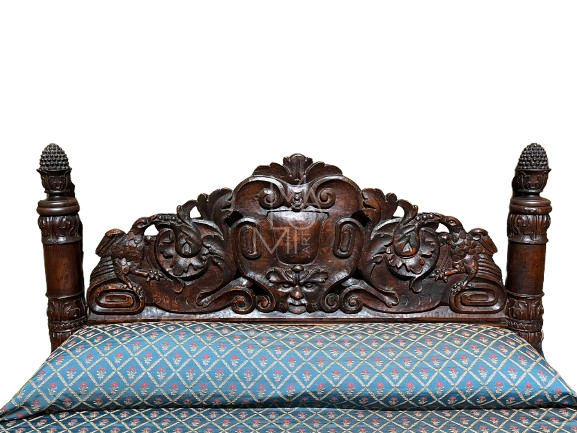
A 17th-century Lombard baroque solid walnut state bed: a masterpiece of Orobic cabinetmaking
- Type: Monumental state bed (lit de parade)
- Period: 17th century (circa 1650–1720)
- Style: Lombard baroque (Bergamo school)
- Material: Premium solid walnut wood (Juglans regia)
- Dimensions: 210 x 170 cm
- Condition: Excellent, displaying a magnificent historical dark patina preserved through traditional beeswax and walnut oil finishes
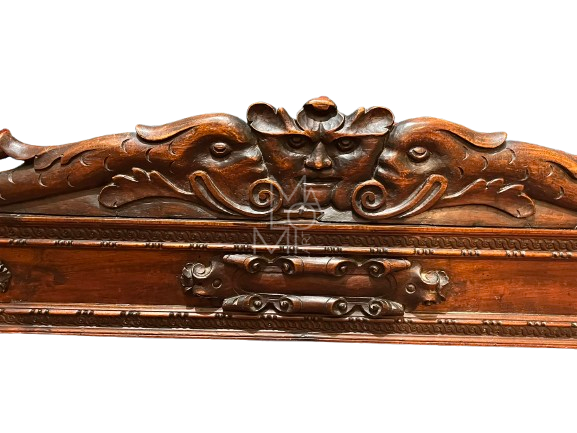
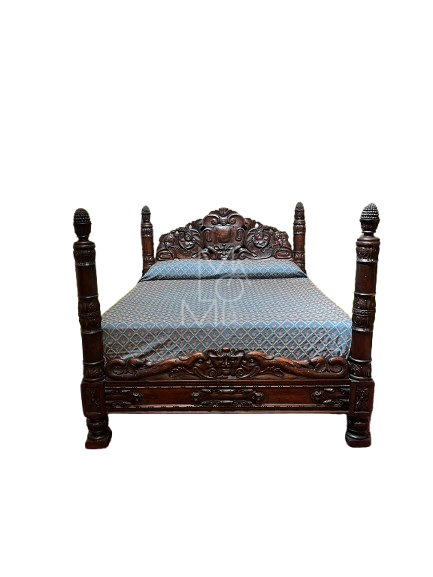
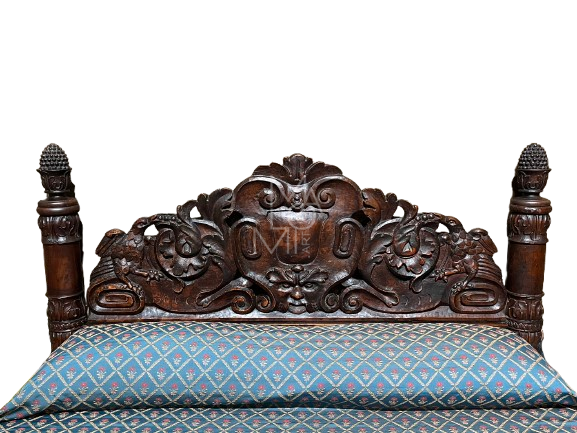
- Description: This rare and monumental solid walnut state bed embodies the zenith of seventeenth-century cabinetmaking from the Lombard-Orobic borderlands. The structure features a towering, curvilinear headboard adorned with deeply carved phytomorphic reliefs, scrolled cartouches, and a theatrical central cresting. It is flanked by four sturdily turned posts decorated with alternate geometric fluting and foliate bands, terminating in finely gadrooned bulbous finials. The footboard mirrors this sculptural vigor, centering an expressive grotesque mask (mascherone) of Mannerist derivation, traditionally serving an apotropaic function as a guardian of sleep. This artifact represents a paramount document of material culture, showcasing the aristocratic taste for permanent, tactile opulence in post-Counter-Reformation northern Italy.
The seventeenth-century solid walnut state bed: A triumph of lombard baroque material culture, theatricality, and cabinetmaking mastery
Historical and artistic introduction: the baroque as an expression of power and theatricality
The seventeenth century marked the rise of the Baroque, a culturally and artistically disruptive movement born in Italy and rapidly spreading across Europe that radically redefined the concepts of space, aesthetics, and domestic decoration within noble residences. Far from the rigorous rationality and geometric proportions of the Renaissance, the Baroque introduced a stylistic language grounded in emotion, wonder, and formal exuberance.
The term itself, derived from the Portuguese barroco, was originally employed by pearl merchants to designate a gemstone of irregular, bizarre, and imperfect form—a clear nod to an aesthetic that was intentionally dynamic and asymmetrical in visual perception, yet incredibly rigorous in its structural conception. In this fascinating cultural context, furniture ceased to be purely functional and was transformed into a veritable political and social manifesto, acting as an extension of the owner's personality and lineage.
Within aristocratic estates and noble palaces of the period, every single piece of furniture became a vehicle to visually manifest the accumulated wealth, genealogical prestige, and political authority of the patron, creating scenery capable of astonishing anyone who entered.
The centrality of the state bed in courtly life
The bed, in particular, assumed a symbolic and ceremonial centrality during this period unprecedented in the history of Western furniture design. It was no longer merely a place destined for private rest or conjugal intimacy; rather, it constituted the visual and conceptual hub of the chamber of state (camera da parata). This environment operated as a highly strategic, semi-public room where the lord received distinguished guests, ratified diplomatic alliances, and displayed his earthly magnificence through the sheer theatricality of the surrounding appointments.
A compelling curiosity linked to this ceremonial practice relates to the fact that the most sumptuous bedchambers were frequently left vacant and untouched for months, if not years, maintained exclusively to welcome the potential, sudden visit of the sovereign or a high-ranking pontifical legate.
The material value of these beds was so substantial that, within the detailed inventories compiled by majordomos upon a nobleman's death, the state bed often appeared as the most financially valuable movable asset of the entire palace, at times surpassing the appraised value of paintings by renowned masters or collections of table silverware.
The material: solid walnut wood and the cabinetmaking tradition
The success and monumentality of seventeenth-century furnishings were intrinsically tied to the rigorous selection of construction materials. The bed under analysis, structured entirely from solid walnut, represents the pinnacle of the ebanistica tradition of the era. Walnut wood, scientifically classified as Juglans regia, was considered the premier material for fine Italian and European cabinetmaking between the sixteenth and eighteenth centuries, long before the subsequent introduction of exotic timbers imported from the Americas, such as mahogany or rosewood.
The reasons for its widespread utilization lay in precise physical and mechanical characteristics well understood by master carpenters. Its extraordinary density guaranteed exceptional structural resistance, which was necessary to support the imposing weight of monumental headboards, testers, and carved posts.
Simultaneously, despite being a hardwood, it possessed a compact grain and a plasticity that permitted the carver to execute deep sculptures, detailed low-reliefs, and complex twists without the risk of splitting, cracking, or splintering during the fabrication process.
Fluid aesthetics and the secret of the patina
From a purely visual perspective, walnut wood is distinguished by its dark, deep, and naturally warm grain. With the passage of time and the biological oxidation produced by contact with the air, this material develops an incredibly captivating bronzed, lustrous patina. This chromatic mutation accentuates the chiaroscuro effects created by the carvings, imparting a unique three-dimensionality and visual dynamism to the flat surfaces. In the seventeenth century, working with solid wood required absolute artisanal mastery and extended periods of time.
An anecdote of the period recounts that the most expert cabinetmakers would purchase walnut trunks while they were still standing in the forests, evaluating their exposure to the sun and winds prior to felling. The planks were then left to season in the shade for over a decade, often being moved from workshop to workshop so that the timber would lose every trace of internal moisture and stabilize permanently. Only after this lengthy preparatory ritual was the solid block sculpted directly with chisel blows, translating the theoretical design into plastic volumes of extraordinary visual impact.
Stylistic and morphological analysis of the artifact: the vigor of the Lombard Baroque
The specimen under consideration aligns perfectly with the stylistic tenets of the Lombard Baroque, a regional variation of seventeenth-century art characterized by robust structural solidity combined with a vigorous, plastic, and highly expressive decorative apparatus. Compared to the aerial extravagances of the Venetian Baroque or the gilded superstructures of the Roman tradition, the Lombard school maintained a sense of proportion and gravity that never succumbed to structural fragility, preferring volumetric impact over ephemeral ornamentation.
The headboard constitutes the narrative and scenographic core of the entire piece of furniture, developing vertically with a sinuous and rectilinear movement that challenges the rigidity of the wooden medium. The upper cresting is dominated by a richly sculpted central pediment, flanked by spectacular scrolled volutes, phytomorphic motifs, and acanthus leaves that unfold symmetrically along the edges. The overall design masterfully plays upon the alternation of concave and convex lines, creating an ascending rhythm that inexorably captures the spectator's gaze.
Vertical supports and the impact of the footboard
At the four corners of the bed rise turned and carved posts that recall the typology of the Pillars of Hercules or the architectural elements of grand classical temples. These vertical supports feature shafts decorated in differentiated zones, alternating fluted portions with dense sections carved with geometric or vegetal motifs, before culminating in spherical or bulbous finials, finely gadrooned, which elongate the entire structure upward. The footboard, though maintaining a visibly lower height so as not to occlude the view of the bed to those entering the room, coherently echoes the decorative richness of the headboard.
At the center of the lower band stands an element of exceptional sculptural interest: a grotesque mask (mascherone) of clear Mannerist derivation, integrated within cartouches and volutes that solidly anchor the feet of the bed to the floor. This detail demonstrates the persistence of late-Renaissance decorative models reinterpreted with the new plastic sensibility of the seventeenth-century Po Valley.
Iconography and symbolism: the language of privilege and protection
No element within Baroque furniture was the result of pure chance or an isolated aesthetic choice, as every single carving responded to a precise iconographic code intended to celebrate the social status, worldview, and spiritual aspirations of the aristocratic class. The ornamental apparatus of this bed skillfully unites anthropomorphic, zoomorphic, and vegetal elements into a single symbolic narrative.
The grotesque mask positioned on the footboard, for example, originally performed an apotropaic function inherited from classical architecture. Within the specific context of a bed, this severe countenance operated symbolically as a guardian of sleep, protecting the intimacy of rest from external threats, illnesses, and the malignant spirits of the night.
The significance of acanthus leaves and cartouches
The acanthus leaves and floral motifs wrapping around the columns and headboard are, conversely, an ancient symbol of immortality, rebirth, and triumph—a vegetal blessing designed to assimilate the piece of furniture into an element of living, flourishing nature, serving as a metaphor for the biological prosperity and temporal continuity of the family lineage. Finally, the scrolled cartouches visually recall parchment rolls and official state documents, implicitly evoking nobility of birth, held feudal titles, and the legitimacy of the power exercised by the decorating family.
The decorative ensemble thus creates a visual microcosm in which the owner recognizes and reaffirms his social supremacy every time he accesses his private domain, transforming the moment of rest into an act of dynastic celebration.
Proportions, dimensions, and spatial arrangement within seventeenth-century residences
From a metric standpoint, the appointment presents imposing dimensions, measuring two hundred and ten centimeters in length by one hundred and seventy centimeters in width. These unconventional measurements testify to the monumental destination of the bed and reveal its original architectural integration within noble palaces. In seventeenth-century Europe, the bedchambers of the aristocracy were environments of vast proportions, characterized by soaring coffered ceilings and walls decorated with complex frescoes or lined with precious hangings of velvet and silk brocade.
A bed measuring one hundred and seventy centimeters in width did not merely satisfy a requirement for the physical comfort of the owners; rather, it served to volumetrically occupy the space of the room, ensuring that the primary piece of furniture was not visually crushed by the colossal dimensions of the chamber.
Length and the ceremonial function of space
The length of two hundred and then centimeters, remarkable for the era when one considers that the average height of the seventeenth-century population was significantly lower than that of today, reflects the structural necessity to accommodate large ceremonial pillows and protective, heavy bed cloths. Furthermore, it allowed the structure to project majestically toward the center of the room, detaching itself from the walls to permit the lateral passage of servants, physicians, and courtiers during the complex daily rituals of the lord's awakening and retirement.
A historical curiosity exists regarding these dimensions: nobles frequently slept in a semi-seated position, propped up by numerous pillows, because a completely recumbent posture was associated with the position of the deceased—a factor requiring the height of the headboard and the depth of the bed to be calibrated to accommodate this specific ceremonial and superstitious habit.
The socio-cultural context: the Baroque in the territory of Bergamo and the identity of the Orobic nobility
To fully comprehend the genesis of a monumental piece of furniture in solid walnut from the seventeenth century, it is indispensable to situate it within the specific historical, political, and social fabric of the Bergamasco region during the 1600s. In this tumultuous historical period, the territory of Bergamo was not an isolated entity, but a strategic and exceedingly wealthy borderland, placed under the firm dominion of the Republic of Venice, of which it represented the westernmost extremity of the Domini di Terraferma, yet culturally and commercially oriented toward the Duchate of Milan, which was then under the iron control of the Spanish crown.
This dual geographical and political polarization shaped a local nobility endowed with unique traits within the Italian landscape: fierce, deeply attached to land management, dedicated to mercantile affairs, and characterized by a rigorous, austere, and Counter-Reformation religiosity.
Unlike the courtly aristocracy of Rome or Turin, Bergamasque patricians such as the Moroni, Terzi, or Suardi founded their power upon a solid landed and manufacturing base linked to the production of woolen cloths and iron extraction in the valleys. Vacuous or excessively ephemeral luxury was viewed with suspicion by the Orobic mentality, which demanded instead that wealth be expressed through durable, solid, and tangible artifacts capable of resisting time and testifying to the economic stability of the house before the representatives of the Serenissima.
Palazzi of Bergamo Alta versus villas of the plains: geographies of power and otium
The Bergamasque nobility structured its social and economic hegemony through a precise residential duality that pitted the urban palaces of Bergamo Alta against the grand villas of the Orobic plains. Atop the hilly cliff protected by the imposing Venetian Walls, urban palaces developed predominantly vertically due to the constraints of the medieval urban fabric, displaying severe and discrete facades to the exterior, yet revealing monumental staircases and frescoed state rooms within, where solid walnut beds dialogued with painted architectural quadratures.
On the plains, by contrast, seventeenth-century villas shed all spatial constraints, developing horizontally as imposing countryside estates that united the comforts of a summer residence with the management of agricultural funds. In these rural dwellings, the state bed maintained an even more massive and vigorous presence, functioning as a veritable rural throne from which the lord administered feudal justice and received the tenants and smallholders of the territory.
Trauma and rebirth: the plague of 1630 and Baroque reorganization
The plague epidemic of 1630 imposed a profound and tragic watershed in the history of the Bergamasco region, decimating over half of the urban and rural population. However, far from decreeing the economic decline of the nobility, the trauma of the contagion accelerated its internal reorganization. The passing of entire secondary family branches brought about a vertiginous concentration of inheritances, lands, and capital into the hands of the few surviving aristocrats, who suddenly found themselves with enormous financial resources to reinvest in the renewal of their palaces and the support of local artisanal workshops.
On a cultural level, the dramatic proximity to death fueled a fervent, theatrical, and cathartic religiosity. Within homes, this climate translated into a psychological imperative to exorcise the precariousness of earthly existence through the immortal solidity of wooden matter. The sculptural vigor of the carvings, the choice of incorruptible solid walnut, and the abundance of protective symbols on state beds were born precisely as a visual shield against the uncertainties of time.
Dynasties of Orobic patronage: the case of the Moroni family
Among the great dynasties that shaped the artistic and social identity of Bergamo, the Moroni family represents the archetype of a patriciate capable of blending mercantile enterprise with the most refined patronage of furniture and architecture. Originating from Albino in the Seriana Valley, the Moroni built their economic fortune through the intensive cultivation of mulberry trees and the lucrative trade of silk, subsequently investing their earnings in vast landed properties. In the mid-seventeenth century, Francesco Moroni initiated the construction of the monumental palace on Via Porta Dipinta in Bergamo Alta.
To decorate the rooms of the piano nobile, the family engaged the celebrated painter from Crema, Gian Giacomo Barbelli, who executed frescoes rich in audacious perspectives and mythological allegories. In these spectacular salons, the Moroni installed a collection of walnut furniture of exceptional quality, commissioned directly from the finest cabinetmaking workshops of the Bergamasco, demonstrating how local Baroque furniture served as the tactile and volumetric pillar of a total scenographic space.
The control of ostentation: sumptuary laws of the Republic of Venice and the Orobic bed
The display of luxury within state bedchambers had to contend not only with the limits of space or the dictates of fashion, but also with the rigid penal apparatus erected by Venetian magistracies. The Republic of Venice—concerned by the progressive impoverishment of patrician estates, depleted by the extravagant expenditures incurred to compete for social prestige, and moved by the necessity to curb a hedonistic drift contrary to republican sobriety—established special magistracies since the Middle Ages, such as the Provveditori sopra le Pompe. Over the course of the seventeenth century, sumptuary sanctions and proclamations fell with exceptional severity precisely upon bedchambers, considered the locales most exposed to ceremonial excess and the ostentation of private fortunes.
Venetian decrees issued in the 1600s expressly forbade the use of gold and silver threads for bed curtains, banned embroidered velvets of foreign provenance, and even limited the number of ceremonial pillows and the preciousness of decorative fringes applied to testers. Sanctions for violators were severe, ranging from heavy pecuniary fines that directly struck the family's finances to the public confiscation of the prohibited goods.
Within the lands of the Bergamasco, this legislative asphyxiation produced an unexpected and highly fascinating artistic effect. Unable to decorate alcoves with the most precious and rare textiles without incurring the penalties of San Marco's inspectors, Orobic nobles elegantly circumvented sumptuary restrictions by shifting financial investment and scenographic magnificence from the textile to the fixed support.
The Bergamasque Baroque bed concentrated its opulence in the direct sculpture of solid walnut wood: the deep carvings of the headboard, the plastic grotesque masks, and the turned columns did not fall under the prohibitions that targeted gold fabrics and lace. By choosing to exalt the majesty of local timber over ephemeral textile sfarzo, the local nobility formally respected the letter of the sumptuary laws while betraying their spirit, giving life to a monumental piece of furniture of extraordinary plastic and structural value that escaped the seizures of the Provveditori unscathed.
Structural differences: the Bergamasque model versus the French model à la duchesse
The morphological investigation of seventeenth-century resting furniture highlights a profound conceptual and constructive divergence between the Lombard-Bergamasque school and coeval models from across the Alps, which were dominated by the influence of the court of Versailles. The Bergamasque bed under analysis qualifies as a closed, architectural structure rigidly defined by matter. The four vertical corner posts physically support the framework of the bed and delimit a stable space in which walnut wood remains the undisputed visual protagonist. Conversely, the French model known as à la duchesse, introduced during the reign of Louis XIV and destined for enormous fortune during the Regency period, responds to a logic of structural disappearance and the triumph of the textile apparatus.
The bed à la duchesse is characterized by the total absence of front supporting columns. The tester, instead of resting upon wooden corner posts, is suspended directly from the ceiling or anchored to the rear wall via concealed metallic brackets, projecting cantilevered over the entire surface of the mattress. This engineering innovation eliminates the monumental footboard and front wooden posts, leaving the bed visually enclosed only by a continuous flow of curtains and faux draperies.
While the Bergamasque specimen celebrates the proud stability of local carpentry through the immediate visual impression of its turned columns in solid walnut and its protective mask in low-relief, the French taste of the duchesse pursues an aerial and theatrical aesthetic where wood serves solely as a hidden frame for the display of precious silks from Lyon and damasks, transforming the bed into a cloud of floating fabric devoid of visual corner barriers.
Technical specifications of polishing and finishing in Bergamasque cabinetmaking
In seventeenth-century Bergamasque Baroque cabinetmaking, the finish was not considered a mere operation of superficial protection, but the culminating act of the entire constructive process. Before applying any substance, the surface of the solid wood had to be prepared with sharpened steel scrapers and finely sanded using dried horsetail (equiseto), a silica-rich marsh plant widespread along the rivers of the plains that acted as a natural ultra-fine sandpaper. To uniform the color and accent the chiaroscuro of the carvings, artisans utilized a mordant derived from boiling the green husk of the walnut fruit.
Contrary to popular belief, shellac (gommalacca) was not utilized in this period, as it spread through Italy only starting from the eighteenth century. The true protagonist of seventeenth-century finishing was the union of boiled linseed oil, which nourished the wood deeply while protecting it from moisture, and pure virgin beeswax. The wax was applied warm, forced into the carvings with stiff bristle brushes, and finally polished by rubbing vigorously with warm woolen cloths, yielding a soft, deep luster that enhanced the three-dimensionality of the sculpture without creating artificial vitreous effects.
Antiparasitic protection of state beds
Safeguarding solid wood furniture from the attacks of wood-boring beetles (tarli) was an absolute priority for the majordomos of Bergamasque palaces. Beyond selecting the heartwood of the walnut tree, which is naturally rich in tannins toxic to larvae, artisans utilized preventive treatments based on raw walnut oil, which saturated the pores of the wood and deprived pests of necessary oxygen. To repel adult insects and prevent egg deposition within the crevices of the headboard, they turned to local botanical essences such as the essential oils of lavender and spike lavender, whose terpenic components functioned as potent natural repellents.
This aromatic essence was regularly incorporated into the polishing wax, guaranteeing prolonged protection over time. In cases of active infestation, bitter decoctions of wormwood or garlic juice diluted in vinegar were injected into the galleries, exploiting sulfurous properties to sterilize the timber. Daily maintenance also dictated the placement of cloth bags filled with dried lavender flowers behind the imposing cresting of the headboard, combining the efficacy of biological protection with the aristocratic fragrance that characterized the state rooms of the epoch.
Conclusion: the historical and antique value of the furniture
The Baroque bed in solid walnut from the seventeenth century transcends its original nature as a domestic artifact to stand as a historical-artistic document of absolute significance for Italian culture. It embodies the perfect synthesis between the evolution of constructive techniques in Old Regime carpentry and the complex aesthetic orientations of an era dominated by a taste for ostentation and plastic beauty.
Today, an artwork of this caliber retains immense antique value, amplified by the rarity of Baroque beds that have reached the present day intact, given that many specimens were destroyed or heavily modified in subsequent centuries to adapt them to modern metal frames. The deep luster of the walnut, joined with the sculptural vigor of its protective carvings, continues to exert that theatrical and magnetic charm that Lombard master cabinetmakers had masterfully impressed into the timber over three centuries ago to celebrate the immortality of the great Orobic houses.
Academic bibliography
Alberici, Clelia. Il mobile lombardo. Milano: Görlich, 1969.
Bistort, Giulio. Il Magistrato alle Pompe nella Repubblica di Venezia: studio storico. Venezia: Deputazione di storia patria per le Venezie, 1912.
Carandente, Giovanni. Il patrimonio artistico delle grandi famiglie bergamasche. Venezia: Alfieri, 1974.
Dominici, Riccardo. I Fantoni: quattro secoli di bottega di scultura a Rovetta. Bergamo: Monumenta Bergomensia, 1978.
Verlet, Pierre. Les meubles français du XVIIIe siècle. Paris: Presses Universitaires de France, 1956.