18th-Century Antique Corner Bureau: Walnut Burl Sloping Desk from Lake Garda
antique corner bureau18th century italian furniturewalnut burl secretary desklake garda antique furniturebrescian cabinet makingtrentino geometric marquetryluxury italian antiques
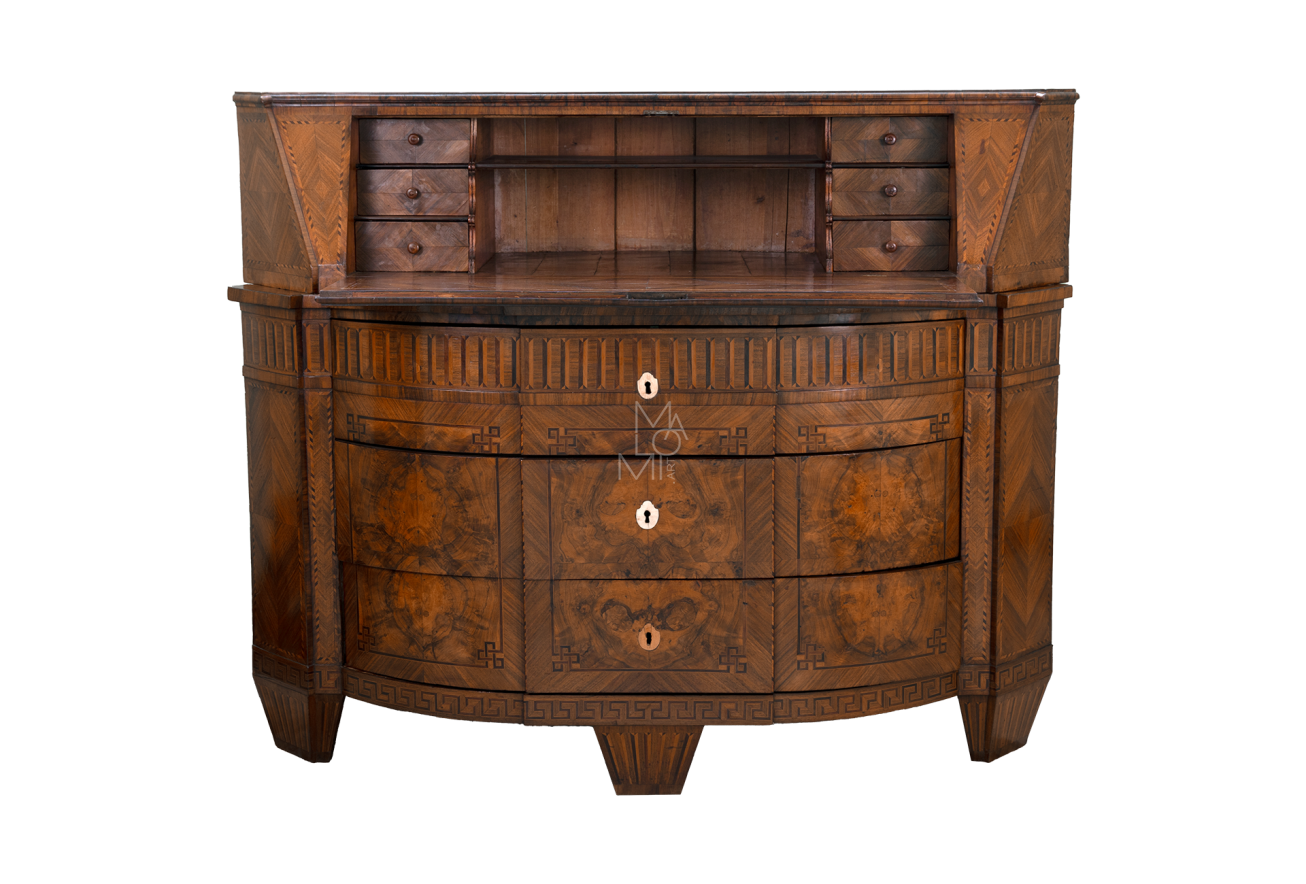
Antique 18th-century corner bureau-cabinet from the Lake Garda region. Fine Italian walnut burl sloping desk with bone escutcheons, geometric marquetry, and fitted interior. Dimensions: 152x122x80 cm. Masterpiece of Brescian and Trentino cabinet-making.
- Typology: Sloping corner bureau-cabinet (Bureau en encoignure)
- Period: Second half of the 18th century
- Origin: Lake Garda region (Brescian-Trentino border, Northern Italy)
- Dimensions: Height 152 cm | Width 122 cm | Depth 80 cm
- Timber & Materials: Book-matched walnut burl veneer; maple and boxwood (light stringing); stained walnut and ebony (dark inlays); poplar and silver fir (internal carcass)
- Ornamental Inlays: Simulated vertical fluting beneath the top; continuous rectilinear Greek key meander on the plinth; diamond-patterned sides with compressed dog-tooth herringbone borders
- Hardware & Fittings: Cold-carved, shield-shaped bone/ivory lock escutcheons; flush-mounted hinges; dark turned wooden knobs inside the cabinet
- Fitted Interior (Scarabattolo): Central open compartment; four lateral drawers featuring a sinuous, double-curved undulating profile
Cabinet with moved flap on the concave front, from Upper Garda dating from the second half of the 18th century.
The crescent-shaped flap, of particular shape and proportion, is made of various fruit woods, including walnut, bois de rose, maple, walnut root and rosewood.
On the front are three external drawers and the calatoia. On the inside of the calatoia are a series of three small drawers stacked on each side. The cabinet is pleasantly adorned with geometrically-patterned inlays and fillets with inverted truncated pyramid supports, also inlaid, of good solidity. Shows some minor signs of wear, structurally sound, overall in good state of preservation.
Restoration of use
Dimensions in centimetres
Length 152
Depth 122
Height 80