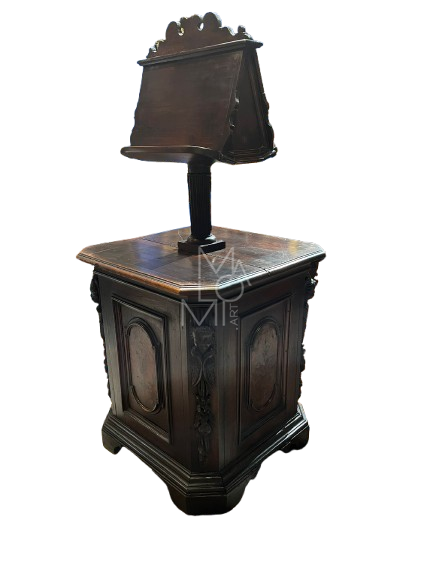
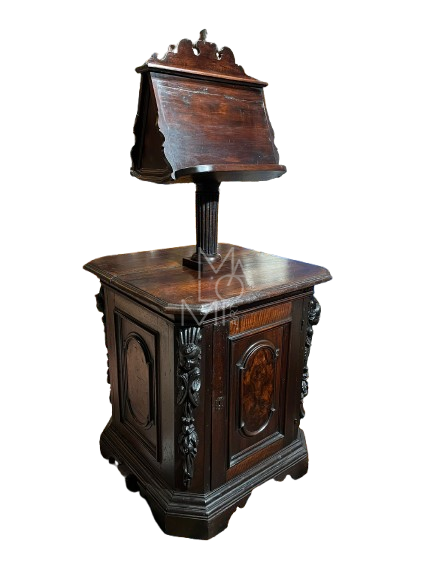
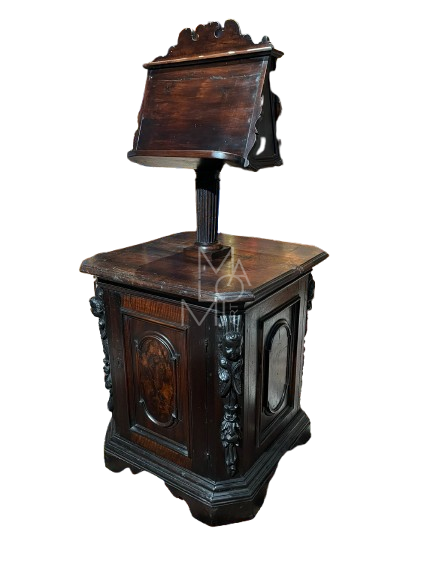
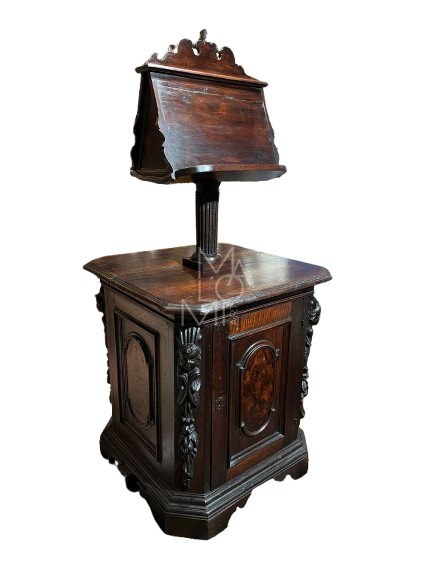
17th-century Baroque solid walnut choir lectern (Badalone) – Brescian workshop, Franzoni family provenance
Baroque choir lectern, antique badalone, 17th-century solid walnut, Brescian ebanisteria, walnut burl veneer, carved caryatids, ecclesiastical antiques, Franzoni family Brescia Modena, high-period Italian furniture.
- Typology: Central choir lectern (badalone da centro)
- Period: 17th century (High Baroque)
- Geographical Origin: Lombardy, Brescian region (Val Sabbia workshops / urban Brescian school)
- Historical Provenance: Private collection of the noble Franzoni family of Brescia (branch relocated to Modena)
- Materials: Solid walnut, thick walnut burl veneer (lastronatura), wrought iron and bronze hardware
- Dimensions: 95 x 95 x 221 cm (cabinet base: 95x95 cm; total height: 221 cm)
- Condition Report: Excellent structural integrity, original period patina preserved; minimal physiological wear consistent with age
This critical essay offers a comprehensive and structured analysis of a mid-17th-century central badalone (choir lectern) in solid walnut (95x95x221 cm), a masterpiece of Baroque liturgical furniture from the Brescian area of Lombardy. This work represents a sublime synthesis of ritual requirements, master cabinetmaking, and the refined sculptural lexicons of the Counter-Reformation era.
The socio-political context and the role of religion in the Brescian fabric
To comprehend the very existence and monumental magnificence of such an artifact, one must look into the reality of 17th-century Brescia, a territory defined by a complex geopolitical and social identity. The Brescian province constituted one of the key frontier strongholds of the Republic of Venice (the Domini di Terraferma), wedged between the borders of the Spanish-ruled Duchy of Milan and the spheres of influence of the alpine territories tied to the Holy Roman Empire. This borderland position translated into a militarized society, fiercely proud of its local autonomy from Venice, yet constantly disrupted by political tensions, banditry, and sharp economic disparities between wealthy urban merchants and the populations of the mountain valleys.
Within this framework of geopolitical precarity, further amplified by the collective traumas of the century—such as the devastating plague of 1630, recurrent famines, and the decline of traditional textile industries—the Catholic religion became the true social and economic cement of the territory. The Church was not merely a spiritual institution, but the structural axis of daily, civil, and welfare life. Under the impetus of powerful religious orders (Jesuits, Philippines, Franciscans) and guided by the spiritual legacy of Saint Charles Borromeo’s reforms, social life reorganized around a dense network of parishes, monasteries, and, above all, lay confraternities.
The latter, capillary spread through both urban quarters and the most remote valley villages, offered citizens a subsidiary welfare system and a powerful communal identity. Participation in liturgical rites, public processions, and the embellishment of churches became the primary arenas for communities to express their cohesion. Financing a sacred furnishing for one's parish or convent was therefore not an act of mere private patronage, but a collective civil and devotional duty. In a rigidly hierarchical society, the church interior was the sole theater where the common populace and the nobility shared the same physical and emotional spaces, united in an unceasing plea for expiation and divine protection against the evils of the time.
Architectural typology and liturgical function of the central lectern
Commissioned to occupy the spatial nucleus of wooden choir stalls within monastic or collegiate churches, the badalone directly responded to these specific demands for the reorganization and monumentalization of the Catholic faith. Counter-Reformation guidelines mandated that solemn liturgy return to the center of the viewer's visual and emotional experience. In this light, sacred music (plainchant or Gregorian chant) was no longer to be an isolated whisper, but a powerful, choral offering of praise. Standing at an imposing height of 221 cm with a base nearly one meter square, this furnishing was configured as a true piece of center-room stage machinery, designed to coordinate the actions of choristers arranged hemicyclically within the choir stalls.
Its architectural layout obeys a rigorous dual logic that reconciles practical efficiency with representative solemnity. The massive lower section constitutes a secure, localized repository—a wooden vault expressly conceived to safeguard precious, monumental liturgical volumes (antiphonaries and graduals) from wear, tear, and dust. Above this base, the elevation of the central baluster shaft projects the double-sided sloping desk into the upper space. This structure enabled the simultaneous consultation of two different texts or the collective reading of the same score from a significant distance by multiple singers at once, optimizing visibility in an era when the internal lighting of churches depended solely on the flickering of candles and natural light.
The history and use of monumental choir books
The texts positioned upon this badalone were no ordinary prayer books, but antiphonaries and graduals of extraordinary proportions (frequently exceeding 80x60 cm when opened), serving as true monuments in parchment. They were written entirely by hand on heavy sheets of sheepskin or calfskin, where Gregorian square notation and sacred texts were rendered in oversized characters using highly contrasting inks (black and red) to enable an entire group of singers to read the same score simultaneously from several meters away.
To protect these illuminated masterpieces, the covers were constructed from thick wooden boards bound in stamped leather, reinforced at the corners with massive bosses and cornerpieces of bronze or wrought iron. The total weight of a single volume could easily exceed 15 or 20 kilograms. The double-sided slope of the badalone allowed it to accommodate two different books or two sections of the same liturgical service, while the lower cabinet functioned as a proximity archive where volumes for the various liturgical seasons (Advent, Lent, Easter) were stored and alternated on the desk according to the calendar, transforming the movement of the singers around the furniture into a solemn, sacred dramatic action.
Structural syntax, burl veneer, and anthropomorphic sculpture
From a technical and cabinetmaking perspective, the piece exhibits extraordinary structural integrity, anchored by the selection and masterly use of solid walnut—a stable, high-density wood species historically associated with prestigious Italian furniture. To withstand the natural wood movements caused by variations in humidity and to support the heavy loads of the upper section, the entire structure is assembled using traditional mortise-and-tenon joinery, reinforced with hidden wooden dowels, without the use of visible metallic joints.
The lower cabinet is visually dominated by the central door (measuring 95x95 cm), whose robust geometric frame accommodates a deeply stepped molded relief. The door opens on internally fixed pintle hinges (or a becchetto), allowing the imposing panel to swing open 180 degrees, while the lock is finished with a discreet wrought iron or bronze escutcheon. The decorative focal point of the panel consists of a refined oval reserve in thick walnut burl veneer (lastronatura). The master cabinetmakers deftly exploited the natural imperfections and contorted fibers of the burl wood (the so-called occhiolinature and fiery grain patterns) as a virtual abstract pictorial surface, creating a calculated chromatic and luminous contrast against the deeper, more uniform tones of the surrounding solid walnut frame.
Carved in high relief directly from the structural corner posts are vertical supports that resurrect the classical motif of caryatids and atlantes. The human torsos emerge with plastic vigor from the wood before seamlessly transitioning into geometric tapers, volutes, and turgid foliate motifs in the lower section. Each figure is crowned by an inverted scallop shell, a characteristically 17th-century ornamental element acting as a Baroque transition capital to the upper cornice.
This sculptural density introduces a dynamic play of chiaroscuro, while the central baluster shaft—hewn from a single block of solid walnut to bear the vertical load and distribute it symmetrically via an internal through-peg and a square plinth—is channeled by deep vertical fluting inspired by classical Doric and Corinthian orders to impart an upward thrust to the composition. At the summit, the gable-roofed structure of the desk features side panels carved into broken volutes and robust book-rest ledges, with an inclination designed to minimize candle glare on the parchment pages. An openwork apical crest (cimasa) crowns the entire composition, serving as its ultimate visual and spiritual finial.
The map of cabinetmaking workshops and woodcarvers in the Brescian territory
The genesis of an artifact of such structural and expressive complexity belongs within the extraordinarily dense network of workshops, laboratories, and family dynasties that divided the sacred and profane commissions of the Brescian province during the 17th century. This artistic landscape operated along two distinct lines: on one side were the urban workshops, heavily influenced by sophisticated architecture and the ceremonial furniture style of Venetian and Milanese stamp; on the other were the fierce valley workshops, characterized by a vernacular and vigorous sculptural approach.
The school of the Val Sabbia represented the beating heart of Brescian woodcarving. Alongside the celebrated Pialorsi family (known as the Boscaì) of Levrange, other exceptional family nuclei flourished, such as the Bonomi of Avenone, the Bertoli, and the Obertini, who worked walnut with Brescian chisels forged in the renowned local metal foundries. These valley workshops passed technical secrets from generation to generation through a rigid apprenticeship system in which young boys learned to carve high reliefs directly out of the structural timber of the furniture pieces.
Concurrently, the Val Camonica absorbed alpine and Tyrolean influences. Workshops like that of the Ramus family in Edolo or, later, the Petroboni in Vione, specialized in grand wooden altarpieces of cembran pine, while the Simoni family distinguished themselves in complex apparatuses capable of blending interior architecture with decorative cabinetmaking. In the Val Trompia, known primarily for its gunsmith foundries, woodworking shops dedicated themselves to a more austere, geometric production linked to structural framework and sacristy furnishings.
In the city of Brescia, urban workshops acted as central nodes for coordination and cultural mediation. Figures such as Orazio Olmi iunior (active also in the province and in Travagliato) and craftsmen closely tied to the Fantoni of Rovetta (whose influence extended from the Bergamasque region to Franciacorta and the Brescian Sebino via an extensive commercial correspondence) introduced a tempered geometric syntax into their work. While exploiting the extraordinary plastic skills of the mountain sculptors who traveled down to the city, urban workshops disciplined the exuberance of the Baroque by inserting classical moldings, smooth burl veneer fields, and proportions borrowed from contemporary architectural treatises. They successfully wedded the plastic force of the valleys to the erudite taste of urban patrons.
The lineage of the Franzoni family of Brescia and their relocation to Modena
The documented provenance of this badalone traces its ownership back to the art collections and private liturgical furnishings of the Franzoni family of Brescia, binding its fate to a specific and fascinating genealogical chapter: the relocation of the lineage to Modena.
The Franzoni (or Franzone), an ancient and noble house originating from the Brescian stock and the Val Camonica, consolidated vast wealth during the 17th century through land ownership, timber trade, and control of alpine grazing rights. Like many members of the Terraferma nobility tied to Venice, certain branches of the family chose during the course of the 17th century to redefine their political and commercial orbits. Shifting political fortunes, the pursuit of new tax exemptions, or strategic dynastic alliances prompted a branch of the Franzoni family to cross the borders of the Brescian territory and establish themselves in the Estense Emilia, specifically in Modena.
This geographical displacement did not sever their cultural ties to their homeland; on the contrary, the family brought along their movable patrimony, their furnishings, and their ceremonial liturgical apparatuses as tangible symbols of the status, antiquity, and rank of their house. The badalone thus became not only a devotional focal point within their new Modenese residence or the family chapel they funded in their adopted homeland, but also a manifesto of dynastic pride.
To exhibit a central piece of furniture of this caliber within the Emilian context—carved from the superb solid walnut typical of the Lombard valleys and adorned with caryatids of such vigorous expressiveness—was a public reaffirmation of their origins and of the cabinetmaking refinement of the Brescian land from which the Franzoni family came. In the inventories of relocated noble families, imposing furnishings like badaloni often figured as the most prized items, handed down through generations under strict entailments (fidecommessi) to prevent their dispersion and to preserve the historical legacy of the house.
The vernacular and devotional aspect in Baroque Brescia
The vigorous, unyielding expressiveness of the caryatids on this badalone, devoid of aristocratic idealization, profoundly reflects the social and religious ethos of 17th-century Brescia. The spirituality of the Brescian region during this period was distinguished by a visceral, dramatic popular piety deeply tied to corporeality. Rural and urban communities lived their faith not as an abstract theological debate, but as a continuous sensory experience, wherein the sacred had to be seen, touched, and physically perceived to be understood.
Within this cultural framework, mountain woodcarvers inevitably transposed the actual physiognomy, temperament, and labor of their own people directly into the timber. The faces of the anthropomorphic figures supporting the structure of the badalone abandon the cold grace and canonical proportions of courtly portraiture; instead, they exhibit pronounced features, stern countenances, prominent cheekbones, and square jawlines that unmistakably mirror the facial traits of contemporary Brescian peasants, woodsmen, and miners.
This "vernacular" aesthetic aligned perfectly with the pastoral strategies applied by Counter-Reformation decrees: to move the affections and convert hearts, the sacred had to be made close and familiar. The worshiper or chorister approaching the badalone did not encounter remote, indecipherable deities or allegories, but recognized in the supporting figures the very dignity of human toil—exemplified by the atlas bending his torso under the structural weight of the furniture piece—ennobled and redeemed through its deployment in the service of the liturgy and the Word of God.
Devotion was thus articulated through the sheer tangibility and richness of the worked material. The exuberance of the carving, the turgor of the acanthus leaves, and the spectacular grain patterns of the burl veneer operated not as mere displays of virtuosity for its own sake, but as a collective votive offering. In the 17th-century mindset, the more labor-intensive, physically demanding, precise, and masterfully executed the woodcraft, the more tangibly the artifact manifested the community's submission, gratitude, and reverence to the divine. Consequently, the Brescian badalone transcends its utilitarian role to become a living historical document: a faithful mirror of its contemporary society, wherein the technical mastery of the rural artisan served as the direct interpreter of the profound, laborious, and collective faith of his people.
Conservation and antiquarian valuation
Today, a badalone of this caliber, backed by such a distinct and historically documented provenance tied to the Brescian-Modenese house of the Franzoni family, represents a rarity of exceptional significance for the antiquarian market and historical cabinetmaking studies. To preserve its splendid original 17th-century patina within an exhibition or private setting, the furniture piece requires spacious rooms with high ceilings, ideally large salons or libraries, where it can be admired from all sides as a free-standing sculptural element.
The conservation of solid walnut mandates that it be kept away from direct heat sources (radiators, fireplaces) and direct sunlight to prevent timber cracking or the lifting of the burl veneer sheets. Maintenance must be carried out exclusively with soft cloths and, periodically, with virgin natural beeswax to nourish the wood fibers, thereby keeping intact the depth of the chiaroscuro and the plastic vigor of the corner carvings.
Reference bibliography
- Alberti, M., La scultura lignea barocca nelle valli bresciane: i Boscaì e le botteghe della Val Sabbia, Brescia, Edizioni Grafo, 1993.
- Borromeo, C., Instructiones fabricae et supellectilis ecclesiasticae (1577), ed. M. Marinelli, Milano, Diocesi di Milano, repr. 2001.
- Bossaglia, R., L'arredo liturgico in Lombardia tra Controriforma e Barocco, Milano, Electa, 1984.
- Franzoni, G. B., Memorie storiche e genealogiche della famiglia Franzoni nel territorio di Brescia e Modena, Modena, Tipografia Estense, 1912.
- Passamani, B., Artigiani e intagliatori a Brescia dal Rinascimento al Barocco, Brescia, Fondazione Civiltà Bresciana, 1988.
- Terraroli, V., Scultura in legno barocca ed ebanisteria di centro in Lombardia, Venezia, Marsilio, 1998.