Walter Furlan mid-century Murano glass seal sculpture - technical data sheet
- Title of the work: Seal
- Author: Walter Furlan (1931-2018)
- Place of production: Murano, Venice (Italy)
- Period and dating: circa 1960 - 1970
- Material and technique: solid glass (a massello), sommerso coloration with iron oxides and manganese dioxide
- Dimensions: 25 x 15 x 14h cm
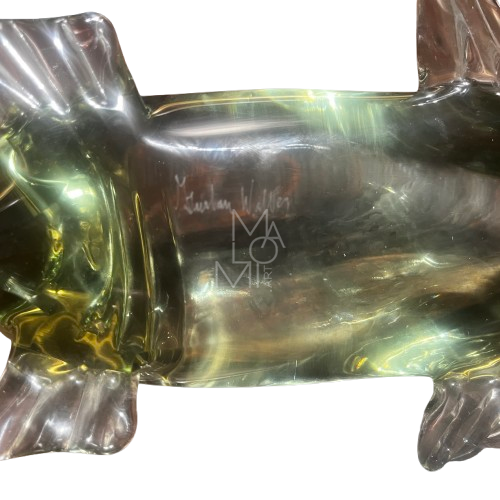
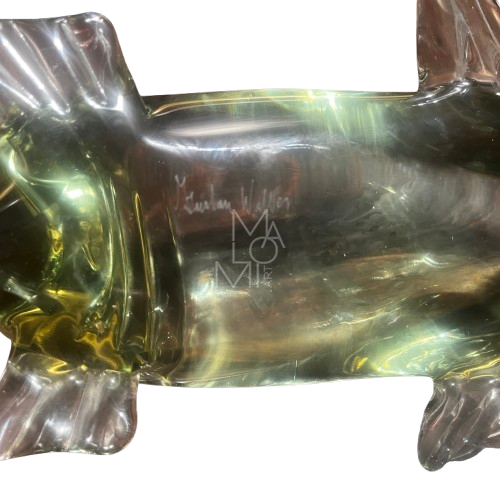
- Inscriptions and marks: autograph signature "Furlan Walter" diamond-point incised cold on the resting base
- State of conservation: excellent; presence of light physiological resting scratches on the base consistent with the age of the artifact
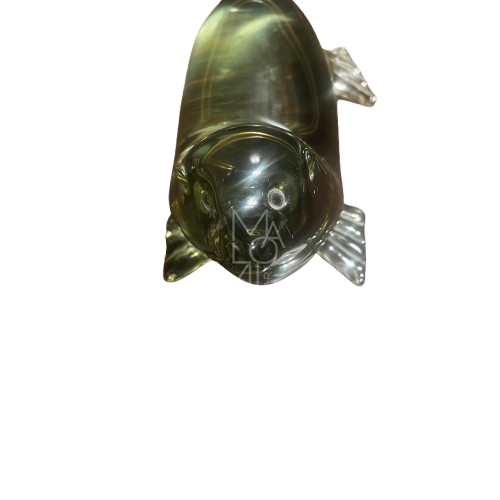
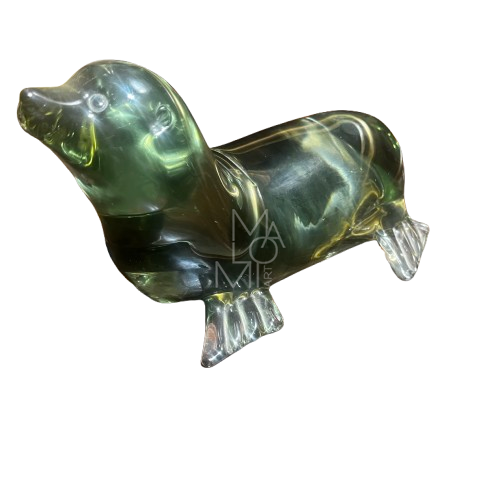
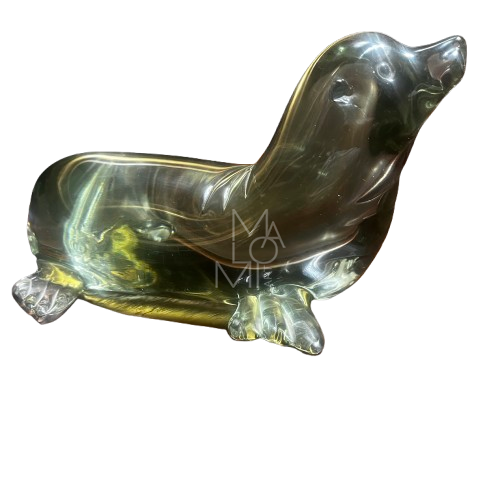
- Critical description: a rare, authentic master-glass zoomorphic sculpture from Murano depicting a seal in a dynamic posture. The piece stands out for its exceptional execution a massello, a high-difficulty technique involving the direct hot-modeling of a solid glass block. The sophisticated chromatic palette features deep smoke-grey tones and warm olive-green gradients, achieved through a meticulously calibrated thermodynamic redox balance of metallic oxides within the crucible. The modernist silhouette favors a continuous, supple contour line, historically positioning this work between the primal monumentalism of Alfredo Barbini and the pure geometric abstraction of Livio Seguso. A choice collector's item, fully historicized and highly sought after within the international high-end mid-century modern market.
The Art Bestiary of Walter Furlan: A Critical-Formal, Epigraphic, and Historical-Market Analysis of the Glass Sculpture "Seal"
Introduction
The zoomorphic sculpture under examination portrays the figure of a seal resting upon a wooden surface, a remarkable masterpiece executed by the Muranese glassmaster Walter Furlan. This work positions itself seamlessly within the rich context of plastic production in mid-twentieth-century Murano, a golden age during which the lagoon island redefined the boundaries of its centuries-old tradition. This specific piece testifies to a crucial and fascinating transition, namely the definitive departure from historical Venetian decorative tenets in favor of the birth of an autonomous, modern sculptural language, strictly emancipated from the mere functionalism of utilitarian objects or traditional furnishing accessories. Through a refined process of geometric synthesis and a quasi-magical mastery over the material in its fluid state, the artist successfully transposed the dynamic qualities of the marine environment into an high-volume glass block. The animal is not merely depicted but rather evoked in its kinetic essence, capturing the viewer's gaze through a continuous interplay of reflections that simulate the wet skin of the mammal within its natural habitat.
- Biographical Profile and Historical Context of the Author
Walter Furlan was born in Chioggia in 1931 and approached the Muranese glass furnaces at a very young age, driven by pressing family necessities. Having lost his father during the hardships of the Second World War, the young Furlan suddenly found himself assuming the role of head of the household to support his mother and younger brother. This premature entry into the labor force led him to tread the earthen floors of the most prominent furnaces on the island, starting with the renowned VAMSA, where he began a rigorous apprenticeship under the guidance of Romano Tosi—one of the most charismatic and technically gifted figures in the lagoon, universally known in the glassmaking community by the nickname Mamaracio. It was within this environment of stern yet invaluable workshop discipline that the young Furlan began to absorb the secrets of hot-glass manipulation, assimilating a strict practice that combined physical labor with the highest aesthetic speculation.
Following the end of the war and the subsequent closure of VAMSA, Furlan’s formative journey continued at the glassworks of Gino Cenedese. In this new setting, he had the privilege of working alongside legendary masters, foremost among them Alfredo Barbini, as well as Gino Forte, affectionately called Peta by his bench colleagues. The concentration of talents within the Cenedese furnace created a unique ecosystem—a true laboratory of experimentation where Furlan developed an tireless dedication combined with a crystalline talent that would earn him the title of master at the young age of twenty.
A celebrated anecdote from his artistic biography recounts how, at the beginning of the 1950s, the young master was deeply struck by encountering reproductions of European avant-garde artworks, particularly those of Pablo Picasso, Joan Miró, Amedeo Modigliani, and Marc Chagall. This intellectual fascination prompted him, during his mature career, to attempt a seemingly impossible challenge: translating the two-dimensionality of Cubist painting and twentieth-century Oneirism into the three-dimensional plasticity of solid glass. The work analyzed herein reflects the artistic sensibility matured during those years of fervor, a golden period characterized by collaborations with prestigious export firms such as Salviati and Pauly, for whom Furlan realized refined zoomorphic specimens destined for an educated international market charmed by the rigor of Nordic and polar forms.
- Morphological and Dimensional Analysis
From a purely spatial perspective, the artwork develops according to precise three-dimensional measurements, with a length of twenty-five centimeters, a depth of fifteen centimeters, and a vertical elevation of fourteen centimeters. Within this proportional matrix, the horizontal dimension dictates the principal compositional rhythm, naturally accommodating the elongated and streamlined anatomy of the marine mammal. Conversely, the vertical thrust is entirely concentrated in the proud torsion of the neck and the raising of the snout, which is directed upward in a posture evoking the moment of emerging from the water or sensory alertness.
This precise plastic choice breaks the intrinsic static nature of the heavy initial glass block, imparting a diagonal and ascendant line of force to the sculpture. The anterior and posterior flippers are not mere decorative appendages but perform a fundamental structural role, serving as weight distribution points and formal connection elements with the wooden display plane. The observer is invited to rotate around the object to appreciate how the contour line never breaks, flowing fluidly from the tip of the nose to the extremity of the tail in a graphic continuum of rare elegance.
- Technological Aspects and the "A Massello" Workmanship
The genesis of this artifact is bound to the complex technique of a massello workmanship, an executory methodology representing one of the most feared yet rewarding challenges for a Muranese master. Unlike traditional blown glass, which relies on lightness and internal emptiness as its stylistic signature, massello entails the direct hot-modeling of a solid, heavy glass mass entirely devoid of internal air cavities. It is a true hand-to-hand struggle between the craftsman and the incandescent material, which must be continuously rotated on the blowpipe or the pontil to prevent gravitational force from causing its collapse or uncontrolled deformation.
Working solid glass demands extraordinary execution speed and a profound empirical knowledge of thermodynamics. The master must calculate by sight the thermal drop of the inner core relative to the outer surface, for if the solid mass cools too rapidly or unevenly, the accumulated internal molecular tensions cause the destructive explosion of the piece—an event experienced in the furnace as a true creative tragedy after hours of strenuous manipulation. To shape the flippers of the seal and the characteristic geometric striation of the lower limbs, Furlan utilized the short tools of the tradition, such as the borselle (tongs) and tagianti (shears), intervening on the glass at temperatures close to one thousand degrees Celsius before its definitive and slow passage into the annealing ovens, known as muffole.
- Glass Chemistry: The Genesis of Smoke and Olive Tones
The refined chromatic palette of the sculpture, dominated by deep smoke-grey inclusions and warm olive undertones, is not the result of superficial coloring or cold application, but constitutes the outcome of precise and fascinating chemical oxidation-reduction reactions occurring within the crucible at temperatures exceeding thirteen hundred degrees Celsius. In the Muranese glassmaking tradition, color is a complex science requiring the millimetric dosing of ultra-pure metallic oxides within the base batch of silica, soda, and lime.
The green and olivaceous hues characterizing the body of the seal derive primarily from the controlled introduction of iron ions. Within the molten glass mass, iron tends to coexist in two distinct chemical oxidation states, each possessing a specific spectroscopic behavior. The bivalent ferrous ion produces a very intense blue-cyan coloration, whereas the trivalent ferric ion yields a more muted yellow or yellowish-brown hue with lower coloring power. To achieve the exact olive shade so beloved by 1960s and 1970s design, masters had to perfectly calibrate the internal atmosphere of the furnace, maintaining it partially oxidizing to balance the simultaneous presence of both chemical species.
In this delicate equilibrium, manganese dioxide intervenes—a compound historically celebrated in Muranese chronicles by the appellation sapone dei vetrai (glassmakers' soap) due to its capacity to cleanse glass of impurities. Manganese acts primarily as an oxidizing agent, yielding oxygen to the molten bath and favoring the transformation of ferrous iron into the more subtle ferric iron, thereby mitigating the blue-green dominant inherent to the iron impurities of silica sand. However, if introduced in calculated amounts exceeding the simple requirement for decolorization, the manganese ion manifests its own chromatic power, veering toward amethyst-purple.
In Furlan's sculpture, a small chemical miracle takes place: the partial optical overlap between the yellow absorption of ferric iron and the purple absorption of manganese causes a mutual partial chromatic cancellation. This phenomenon generates a nearly flat absorption spectrum that the human eye perceives not as a distinct color, but as a warm, soft, and enveloping smoke tone. The monumental thickness of the solid glass amplifies this effect, acting as a variable-intensity filter that accumulates color in the zones of maximum thickness of the torso and thins out to near-total transparency at the snout and the extremities of the flippers.
- Comparative Analysis with the Research of Alfredo Barbini and Livio Seguso
To fully comprehend the artistic stature and originality of this sculpture, it is necessary to establish a rigorous critical comparison with the coeval research conducted by the two greatest innovators of twentieth-century solid glass, namely Alfredo Barbini and Livio Seguso. The Muranese landscape of the era was characterized by a lively intellectual competition, where each workshop sought to develop its own path toward plastic modernity through the use of massello.
The comparison with Alfredo Barbini reveals a deep technical proximity but a diverging formal sensibility. Barbini favored an approach to zoomorphism that could be defined as primitivist and monumental. In his sculptures of birds, fish, or marine mammals, the glass material was treated with imposing thicknesses and surfaces that were frequently corroded or acid-etched, reducing the animal to a static, timeless idol—almost a precious stone sculpted by the force of the elements. Furlan, despite having assimilated from Barbini the capacity to master large masses of glass during their shared years at Cenedese, chose a more lyrical and supple path. His seal does not possess the severe immobility of Barbini's works but retains an anatomical sinuosity and a surface smoothness that exalt its natural grace and ideal mobility.
In contrast, the ideal dialogue with Livio Seguso projects the work toward the territories of the abstract avant-garde. Seguso, moving between the late 1970s and the beginning of the subsequent decade, initiated a process of radical formal purification that would progressively lead him to abandon all reference to natural data, concentrating instead on the creation of pure geometries in transparent crystal juxtaposed with industrial materials such as steel or marble. Furlan's seal positions itself happily in a conscious middle ground: it shares with Seguso the absolute cleanliness of lines and the rejection of anecdotal or sketch-like detail, yet it refuses the transition to pure geometric abstraction. Furlan chooses to remain faithful to figuration, utilizing the fluidity of glass not to negate nature, but to celebrate it in its most noble and essential dimension.
- The Antique and Collectors' Market for Mid-Century Solid Glass
The international market for antiques and high-end modernism has, in recent times, paid an extraordinary and well-deserved critical and economic tribute to the solid glass sculptures realized in Murano during the central decades of the twentieth century. This phenomenon responds to a radical shift in collecting taste and a more mature historical awareness on the part of sector experts.
In the 1960s and 1970s, the presentation of these imposing solid glass sculptures within international showcases such as the Venice Biennale or the Milan Triennale contributed decisively to elevating the lagoon artifact, texturing it from the status of artistic handicraft to that of genuine contemporary visual art. Avant-garde glassworks like Salviati, Cenedese, and Seguso Vetri d'Arte thus fueled an extremely lucrative elite market, whose principal buyers were major North American private collectors and refined Northern European connoisseurs.
A curiosity bound to this market concerns the paradigm shift that occurred between the end of the last century and the present day. While in the 1980s and 1990s the interest of historical collectors focused predominantly on light, highly blown, and polychrome glass of the 1920s and 1930s—such as the celebrated filigree works by Venini or the transparent creations by Carlo Scarpa—the new millennium has witnessed an authentic exploration of interest in the solid glass of the 1960s. Contemporary interior design criticism has recognized in these heavy, monochrome sculptures the perfect visual complements for contemporary living spaces, which are characterized by minimalist design and wide, luminous surfaces.
In the most prestigious international auctions, the valuations of these artifacts are governed by strict criteria of rarity, linked to the chemical complexity of the coloration and the absolute physical integrity of the most exposed parts, such as the thin caudal flippers or the snout. In this scenario, the element that sways the commercial balance and guarantees investment excellence is the presence of the autograph signature incised cold, a detail that transforms the object from a fine furnace production to a unique and historically certified work of art signed by a great master.
- Paleographic and Epigraphic Analysis of the Autograph Signature
A close examination conducted upon the resting base of the artifact offers the opportunity to formulate important considerations of an epigraphic and paleographic nature, which are fundamental for establishing the authenticity and correct chronological placement of the sculpture. The inscription, which bears the legible wording "Furlan Walter", was executed cold on the surface of the glass using a diamond-point stylus. This method of signing represents a consolidated custom among the finest Muranese masters, preferred over the application of hot stamps or paper labels that could deteriorate over time.
The analysis of the ductus reveals an extremely fluid, rapid, and confident script, devoid of those uncertainties, tremors, or retracings that typically characterize apocryphal inscriptions executed in later times by inexperienced hands. The morphology of the individual graphemes highlights a clear personal imprint: the initial capital letter of the surname shows a remarkable vertical stretch that connects without interruption of continuity to the subsequent letters, which are traced in an elegant and energetic cursive. The given name opens instead with a double letter of markedly geometric and decisive strokes, balancing the roundness of the preceding handwriting.
A technical detail of great interest lies in the choice of placement: the inscription was positioned within the central and slightly concave portion of the base. This precise localization has protected the signature from the friction and wear caused by the sliding of the object on furniture surfaces over the decades, preserving the integrity of the incised groove. Furthermore, within the incision, one finds the presence of a very thin, coeval patina of time, which coexists in perfect harmony with the micro-scratches and slight physiological opacifications of the base, confirming unequivocally that the signature was affixed by the master at the very moment the sculpture emerged from the annealing oven.
Conclusions
In final analysis, the "Seal" by Walter Furlan profiles itself as an excellent and accomplished monument to modernist formal synthesis applied to lagoon glass sculpture of the second half of the twentieth century. The work demonstrates how the master succeeded in overcoming the limitations imposed by the intrinsic heaviness of solid glass to attain a dimension of pure visual lyricism. Through a wise orchestration combining the geometric wisdom of the continuous line with the subtle chemical virtues of iron and manganese oxides, the artist delivered an object of extraordinary modernity to the history of design. The autograph signature, analyzed in its epigraphic aspects, stably positions this specimen within the restricted corpus of historicized master glass, confirming its value not merely as a precious collector's piece, but as an authentic testimony to that unrepeatable season in which the fire and sand of Murano conversed with the highest expressions of international visual art.