Venus de Milo in white Carrara marble h 85 cm | Lorenzo dal Torrione
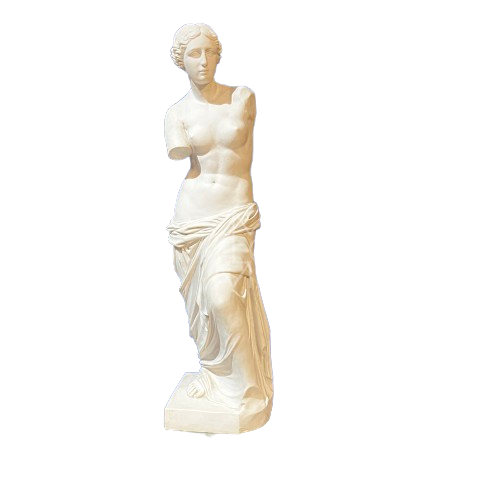
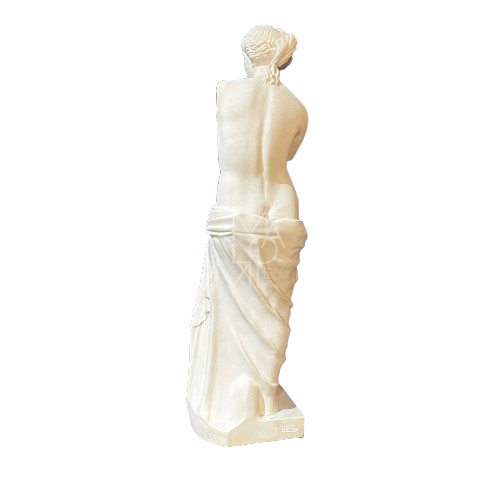
Exquisite Venus de Milo replica in pure white statuary Carrara marble (h 85 cm), hand-carved by master sculptor Lorenzo dal Torrione in Pietrasanta. Features the artist's signature on the drapery.
- Subject: Venus de Milo (philological replica after the Hellenistic archetype in the Louvre Museum).
- Artist: Lorenzo dal Torrione (active in Pietrasanta, trained under Urbano Buratti).
- Period: Second half of the twentieth century (circa 1950s–1960s).
- Material: Solid statuary white Carrara marble.
- Dimensions: Height 85 cm | Width 25 cm | Depth 20 cm.
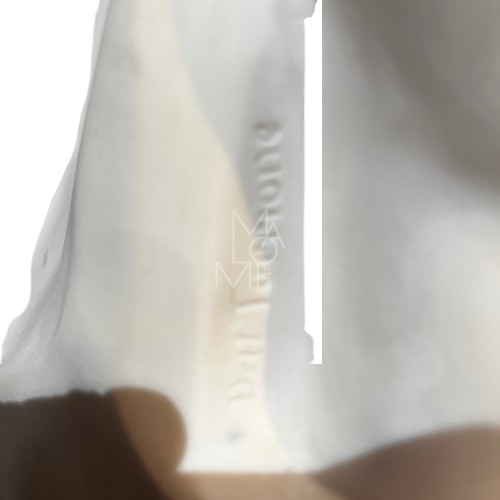
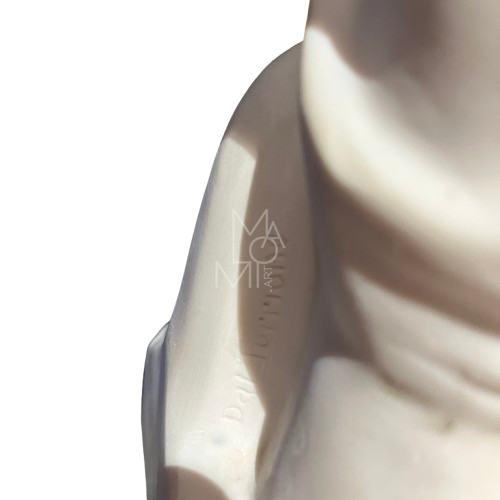
- Signature: Autographed "Dal Torrione" incised with a vertical "V"-profile groove on the rear lower left fold of the drapery.
- Condition report: Excellent; original patina, free of structural fractures or modern restorations.
The Eternal Return of the Classical: Lorenzo dal Torrione’s Venus de Milo in Statuary White Marble
Introduction and Historical-Artistic Context
The work under examination is an exquisite full-round sculptural replica of the world-renowned Venus de Milo, executed by the Tuscan artist Lorenzo dal Torrione. Active in Pietrasanta since the mid-twentieth century—specifically starting from 1952, when he began his apprenticeship under the guidance of the noted master Urbano Buratti—dal Torrione fits organically into that glorious tradition of master craftsmen specialized in the philological reproduction and reinterpretation of the great masterpieces of ancient Greek and Roman statuary. The original Hellenistic archetype, dating back to approximately 130 BC and preserved within the galleries of the Louvre Museum, is here re-actualized through a rigorous technical proficiency that merges academic standards with the material sensibility of twentieth-century Italian sculpture.
A fascinating anecdote links the rebirth of this mythological icon to the specific context of the Versilian workshops. In the mid-twentieth century, the studios of Pietrasanta underwent a profound thematic reconversion. Historically focused on sacred and monumental statuary, local ateliers faced a sudden standstill following the new edicts of the Second Vatican Council in 1962, which drastically simplified liturgical furnishings. It was precisely this historical transition that prompted gifted sculptors such as dal Torrione to turn with renewed vigor toward the classical mythological repertoire and the demands of the international art market, particularly American and European collectors eager to acquire pieces reflecting the aristocratic taste of the eighteenth-century Grand Tour.
The Renaissance of Pietrasanta in the 1950s and Coeval Influences
To fully comprehend the plastic genesis of this Venus, it is essential to immerse oneself in the cultural climate of 1950s Pietrasanta, a decade of extraordinary transition and global artistic ferment. During this period, the Versilian town was shaking off the rubble of World War II, reactivating its art workshops and renowned plaster casting studios. The main piazza and historic meeting spots, such as the Caffè Michelangelo, had become a unique international crossroads where elderly artisans—the living repositories of Renaissance techniques—interacted daily with the global avant-garde. Artists of the caliber of Henry Moore, Jean Arp, and Joan Miró began frequenting local foundries and workshops, attracted by the presence of a matchless workforce capable of translating any formal intuition into stone.
Within this unique atmosphere, the young dal Torrione was directly influenced by a generation of coeval masters who were redefining the very concept of sculpture in Pietrasanta. Alongside the pivotal figure of Urbano Buratti, who instilled in him a strict discipline of drawing and manual roughing-out, dal Torrione looked closely at the work of artist-artisans like Amedeo Santini and the skilled carvers of the historic Cervietti studio. These sculptors maintained a dual artistic identity: on one hand, they were extraordinary interpreters of the Canovian Neoclassical tradition; on the other, they were fascinated by the volumetric purity of modern artistic movements. The influence of this dualism is clearly reflected in the Venus examined here. Although the subject represents a strict retrieval of antiquity, the treatment of the surfaces betrays the lessons of mid-century masters: there is a clear striving for visual synthesis, an elimination of virtuosity for its own sake, and a meticulous attention to the figure's internal monumentality that inevitably responds to a silent dialogue with twentieth-century geometry. The Pietrasanta of those years taught dal Torrione that copying a classical archetype did not mean executing a sterile, mechanical operation, but rather infusing the stone with the vitality of one's own time through a millimetric control of the material.
The Magisterium of Urbano Buratti and the Apprenticeship Years
The true formative axis of Lorenzo dal Torrione's career resides in his human and professional partnership with Urbano Buratti, a master sculptor of exceptional formal rigor and owner of one of the most selective workshops in Pietrasanta. The apprenticeship, which began in the early 1950s, was still structured according to the strict principles of the Renaissance tradition: the young apprentice did not immediately confront the marble block, but spent the first several months exclusively cleaning tools, preparing clay models, and studying geometric drawing from life. Buratti, notorious for his methodological intransigence, demanded that his pupils develop an "absolute eye," capable of discerning at a glance a single-millimeter error in the proportions of a plaster model.
An emblematic anecdote from those years relates that Buratti, in order to test the hand and patience of his young pupil, entrusted him with the roughing-out of a block intended for a replica, leaving him to work for days on end without ever intervening. When dal Torrione believed he had nearly finalized the preliminary form, the master approached and, without uttering a word, drew a thick line with a red grease pencil across one of the statue’s flanks, forcing the apprentice to remove an additional centimeter of material and thereby altering the entire center of gravity of the figure. This empirical and silent instructional method aimed to instill the technique of "reference points" through the use of calipers, proportional compasses, and the pointing machine—fundamental tools that dal Torrione subsequently employed to translate the coordinates of the original Louvre Venus de Milo onto this reduced scale of eighty-five centimeters. The relationship between Buratti and dal Torrione soon evolved from a rigid hierarchy into deep mutual respect; the master transmitted to his pupil not only a profound expertise in using the subbia (point chisel) and gradina (claw chisel), but above all a quasi-mystical veneration for the purity of the block, teaching him to accommodate the hidden veins of the stone rather than forcing them.
Material Analysis: Statuary White Marble
From a material standpoint, the sculpture is carved from a superb block of statuary white marble, historically quarried from the Apuan basins of Carrara. This specific lithotype, celebrated since the era of Michelangelo Buonarroti, stands out within the geological landscape for its exceptionally brilliant, crystalline white ground, combined with a highly compact and homogeneous granular structure. The most prized characteristic of this stone lies in its partial translucent luster when exposed to light—an optical property ideal for rendering the effect of human skin (incarnato), conveying the visual sensation of living flesh rather than a cold, stony surface.
A workshop anecdote recalls how the sculptors of Pietrasanta selected blocks for female figures by carefully striking them with a small iron hammer. The sound emitted had to be clear, silvery, and devoid of dull vibrations; this was the only method to guarantee that the core of the stone did not conceal "hairs" (peli) or invisible micro-fractures, which could potentially shatter the block during the delicate stages of finishing with a chisel. The use of pure solid marble enhances the prestige of the work and distinctly sets it apart from the more economical productions in synthetic marble or reconstituted marble powder widespread in the second half of the century, thereby certifying the exceptional executive value of the piece.
Formal Structure and Geometric-Dimensional Rigor
The metric data record a height of eighty-five centimeters, a width of twenty-five, and a depth of twenty. These proportions, scaled down from the colossal original in the Louvre which exceeds two meters in height, correspond to Neoclassical compositional modules calibrated for intimate viewing within private exhibition contexts, studies, or high-profile libraries. The body of the goddess develops according to a masterful balance based on the Praxitelean chiasmus, wherein the weight shifts entirely onto the load-bearing right leg, while the left leg, bent and slightly advanced, breaks any rigid frontality. The counter-torsion of the torso generates a sinuous, "S"-shaped contour that engages the viewer from multiple vantage points.
The lore associated with the archetype of the Venus de Milo adds conceptual depth to the appreciation of this replica. When the original statue was discovered in 1820 on the Greek island of Milos by a peasant named Yorgos Kentrotas, it emerged from the soil alongside fragments of its arms, including a hand holding an apple, the historic symbol of the island itself. However, due to diplomatic disputes and tumultuous transport conditions en route to France, the limbs were lost forever before reaching the museum. By faithfully reproducing the Venus in her iconic state of mutilation, dal Torrione does not produce an incomplete work; rather, he celebrates the aesthetic of the ancient fragment—a canon that considers the absence of the arms not as a flaw, but as the very secret of its unparalleled formal harmony.
The Aesthetics of the Posterior View and Luminous Interaction
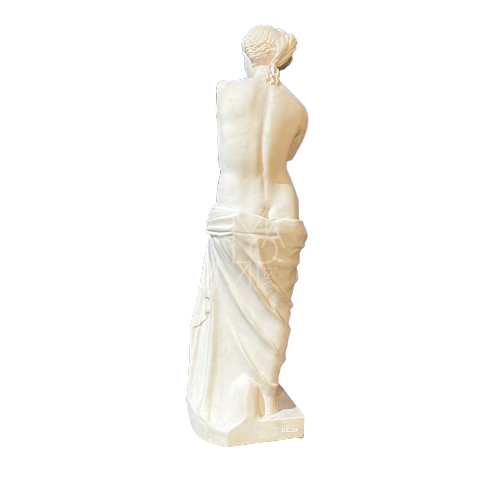
The posterior view of the sculpture highlights the complex three-dimensional spatiality originally conceived in antiquity and faithfully translated by the author. The spine develops along a subtle serpentine line that accommodates the rotational movement of the pelvis and shoulders. An analysis of the rear nude reveals a perfect equilibrium between academic naturalism and classical idealization: the vertebral sulcus is delicately carved, dividing the back into harmonic symmetries, while the scapulae and loins are gracefully suggested, displaying the musculature in a state of tranquil relaxation. In the upper portion, the exquisite craftsmanship of the hairstyle stands out; the hair is parted down the center and gathered at the nape into a volumetric bun (crobylos), with small, wavy tendrils escaping the main coiffure to cascade along the neck.
Within this framework, the posterior drapery and natural light act as interconnected plastic instruments. The transition between the purity of the upper nude and the complexity of the lower garment constitutes the virtuosic core of the sculpture. The fabric rests low on the hips and organizes itself into deep, asymmetrical folds that react to daylight differently depending on the hour. Under raking light, typical of early morning or late afternoon, the relief of the marble crests is dramatically accentuated, casting long, sharp shadows that heighten the perceived depth of the furrows. Under a zenithal or diffused light, the illumination penetrates uniformly within the folds, revealing the micro-textures left by the chisel. This strong chiaroscuro contrast creates a sharp visual counterpoint: the polished back appears as a homogeneous light source with a high luminance value, whereas the lower drapery acts as a "shadow trap," visually and physically anchoring the statue to the ground.
Epigraphy, Authentication, and the Placement of the Signature
A close, autoptic examination of the back of the work reveals the autographed inscription "Dal Torrione", engraved not on the lower geometric plinth, but directly onto the rear garment, within the lower left portion of the cascading drapery. This specific executive choice shifts the analysis from a purely documentarian plane to that of integrated plastic design—a refined expedient utilized to indissolubily merge the master’s identity with the dynamic anatomy of the marble. The characters are executed with a clean, geometric incised groove featuring a wedge-shaped or "V"-shaped internal profile, achieved through a masterful command of the gouge (unghietta) and burin. This technique allows the letters to capture the shadow cast by the overriding fold of fabric, rendering the characters dark and perfectly legible without the need to apply artificial pigments or inks.
The placement of the signature on the garment adheres to a long and highly erudite historical tradition rooted in classical antiquity and the Renaissance. In the Greek and Hellenistic world, sculptors preferred to engrave their names directly onto the body or drapery of figures rather than the base, as the latter was deemed a secondary, architectural element that was sacrificial or replaceable over time. The most illustrious and revolutionary historical precedent is found in Michelangelo’s Pietà (1499) housed in St. Peter's Basilica; a young Buonarroti, seeking to assert his authorship against the doubts of his contemporaries, carved his name across the sash running diagonally over the Virgin's breast. In Neoclassicism and nineteenth-century workshops, this mimesis became standard practice for masters of high-quality replicas: leaving the squared base completely unmarred imitated the excavated state of archaeological marbles. This allowed the collector to display the statue showcasing its pristine frontal view, reserving the discovery of the author's name for a close-up, lateral, or posterior inspection. In this manner, Lorenzo dal Torrione’s signature ceases to be a mere commercial mark and is transformed into an academic seal that elevates the entire lapidary artifact.