Veined alabaster elephant sculpture by Angiolo Vannetti: polymaterial Art Déco animalier
Angiolo Vannetti sculpture, alabaster elephant art deco, polymaterial sculpture 1920s, Italian animalier artists, veined alabaster carving, rare art deco antiques, glass eyes sculpture.
The Plastic Exoticism of Angiolo Vannetti: The Veined Alabaster Elephant as a Synthesis of Primitivism and Early Twentieth-Century Internationalism
Introduction and Historical-Critical Framework
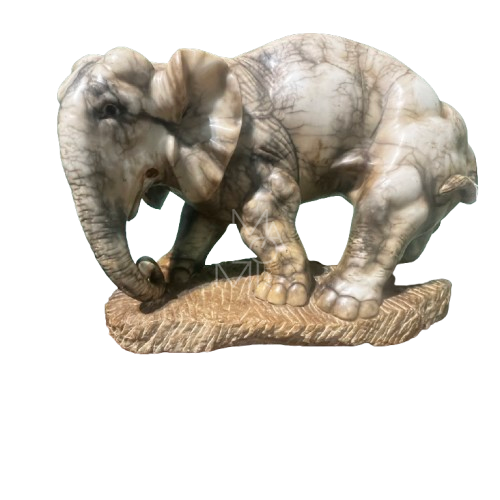
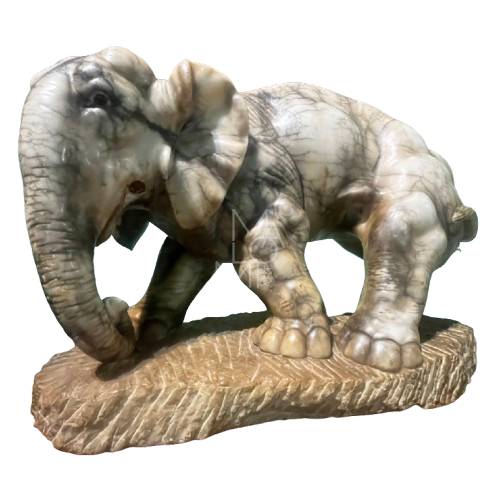
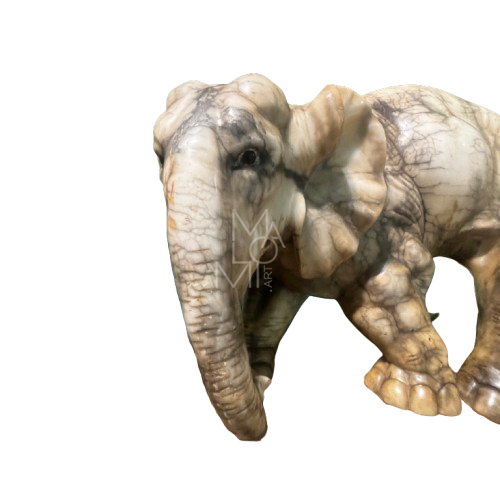
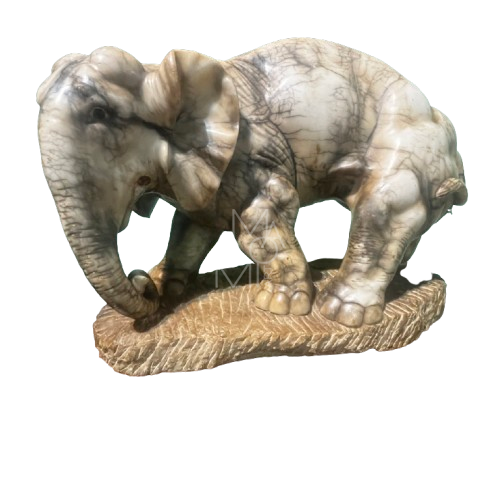
The sculpture depicting an elephant advancing across a rocky base, carved from a choice block of veined alabaster measuring forty centimeters in height, fifty-five in width, and twenty-five in depth, represents a highly significant testament to the evolution of indoor plastic arts in interwar Italy. The work bears the formal and stylistic imprint of Angiolo Vannetti, a master from Livorno born in 1881 and deceased in 1962, whose biographical and professional trajectory exemplifies the figure of the cosmopolitan artist of the early twentieth century. Trained at the rigorous school of the Accademia di Belle Arti in Florence under the authoritative guidance of Augusto Rivalta, from whom he acquired a strict structural naturalism and the ability to plumb the deep psychology of his subjects, Vannetti freed himself early on from regional boundaries. He embarked on a series of memorable journeys that led him to work for major courts and governments across the globe, from the Far East to Latin America.
The artifact under consideration dates to the peak of his expressive maturity, a period in which the artist chose to bring solid, academic-grade plastic skills into dialogue with the vibrant suggestions of avant-garde animalier sculpture. In the exhibition halls and patrician residences of the period, the genre of artists specializing in the representation of the animal world was undergoing a profound metamorphosis, spurred by the spread of the Art Déco taste and a renewed interest in primitive and exotic cultures. Vannetti interpreted this trend not as a mere exercise in copying from life or as a textbook zoological reproduction, but as an opportunity to transfer the very soul of the territories he had traversed into stone. The elephant thus ceases to be a purely ornamental feature and becomes the bearer of an intrinsic monumentality, designed to inhabit the intimate spaces of the cultured patronage of the era.
The Exotic Subject and the Animalier Tradition between East and West
During the 1920s, the European cultural horizon was swept by a fascination with the remote, wherein art collectors constantly sought an escape from industrial rationality through the possession of artifacts that evoked a mythical, untamed elsewhere. Angiolo Vannetti found himself at the center of this international current thanks to his historic stay in Japan in 1927, during which he received the honor of executing important portraits and monuments for the Imperial Court in Tokyo. Period chronicles record an artist deeply moved by Eastern ceremonies and the majestic figures of pachyderms adorning the temples and royal gardens of Southern Asia—visions he accumulated during stops in Shanghai, Singapore, and Tonkin.
Unlike many of his Western colleagues, who could only study exotic subjects in captivity within the menageries or zoological gardens of Paris, London, or Rome, Vannetti enjoyed the rare privilege of observing elephants in their native habitats and ritual contexts. This direct familiarity is reflected in the absolute, proud dignity bestowed upon the subject of the sculpture, which stands in sharp contrast to the anecdotal or caricatured interpretations widespread in minor craftsmanship. Within the Italian panorama of the time, this sensitivity brought him close to the concurrent research of the Gruppo Labronico, the prominent artist association from Livorno to which Vannetti belonged. In a celebrated Milanese exhibition in 1928 at the Galleria Pesaro, he exhibited a series of twelve sculptures entirely dedicated to the animal world with this group, among which dramatic depictions of monkeys and wolves stood out, arousing keen interest among Milanese critics.
Formal, Volumetric, and Dynamic Analysis
The plastic development of the sculpture unfolds through a three-dimensional composition designed to suggest a slow yet unstoppable advancement. The animal is caught in the act of taking a step forward—a movement the sculptor resolves not through a literal description of walking, but by concentrating attention on the muscular tensions and kinetic forces traversing the entire mass of the stone block. Vannetti rejects a superficial polishing that would have uniformized and impoverished the perception of its bulk. Instead, he favors a vigorous, almost expressionistic modeling, wherein every fold and bulge of the epidermis responds to an internal structural logic.
The front portion is dominated by the powerful development of the trunk, which curls inward in a spiral movement that closes the composition on the left side, serving as an ideal visual counterweight to the forward thrust of the body. The large ears, flared open, turn into genuine receptive screens for light, generating a deep alternation of sharp shadows and translucent gleams that heighten the drama of the face. The base, a feature that is far from incidental, is carved directly from the same block with a characteristic geometric treatment of dense vertical grooves that evokes the arid, rugged texture of an African or Asian rocky terrain. This almost primitive plinth stands in dialectical opposition to the soft, full volumes of the elephant's body, enhancing its roundness and muscular turgor by contrast.
Anatomical Focus and the Development of the Posterior Masses
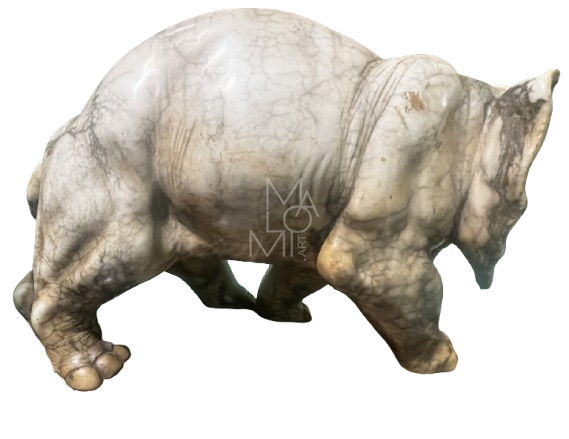
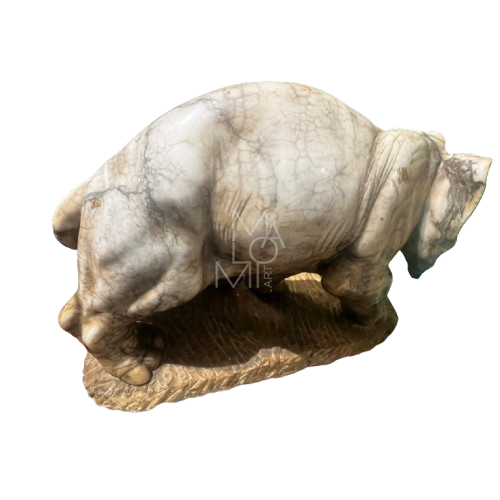
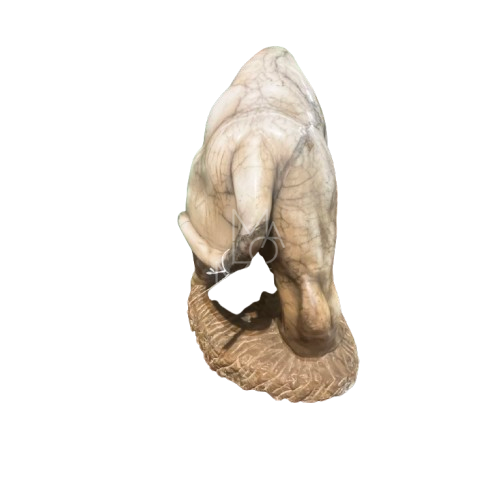
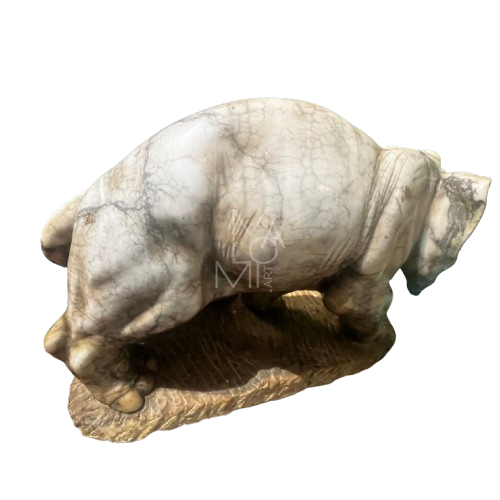
A close examination of the hindquarters and the rear section reveals the extraordinary synthetic audacity Vannetti applied in structuring the broad masses. From this perspective, the sculpture betrays its deep modernist matrix and its proximity to the dictates of international Art Déco. The articulation of the left hind leg displays a turgid gluteal musculature, configured as a monumental hemisphere that discharges the animal's weight to the ground with the solidity of an architectural pillar. The sculptor plays with the terminal volumes through variations of planes that synthesize anatomical complexity into pure, geometric forms—a procedure closely reminiscent of the stylistic research conducted in France by François Pompon, although Vannetti chooses never to arrive at total, polished abstraction, preferring to preserve a profound bond with the vital, pulsing energy of the body.
The elephant's tail, adhering to the buttock and caught in a slight flexor movement, cuts diagonally across the posterior volume, introducing a note of linear dynamism that breaks the geometric monumentality of the pelvis. In axial and zenithal views, it emerges clearly how the body of the pachyderm was conceived according to a wedge-like progression that expands at the belly and then narrows sharply toward the neck, compelling the viewer to move around the work to comprehend its actual spatial occupation. The crest line running along the spine acts as a dividing median axis—a plastic boundary where light fractures and distributes itself asymmetrically, imitating a continuous vibration in the stone that cancels any sensation of static mass.
The Asymmetric Frontal View and the Power of the Face
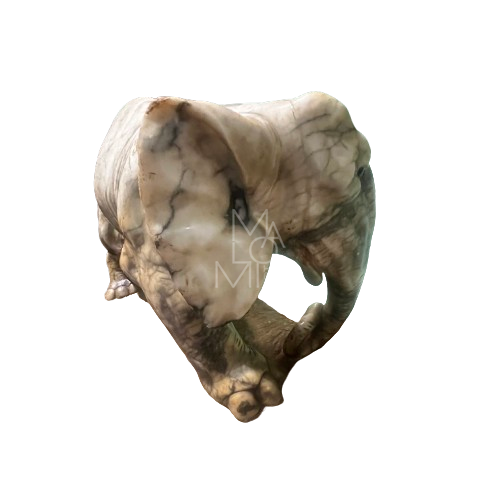
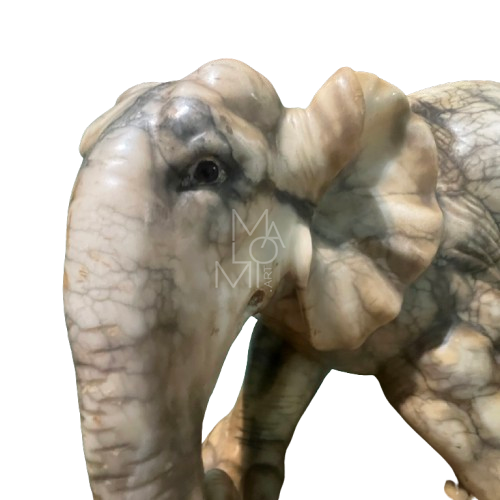
The close-up, three-quarter frontal view brings to light the complex management of solids and voids in the pachyderm's face, revealing extraordinary attention to expressive drama. From this perspective, the large right ear projects toward the viewer like a veritable sail of stone, displaying a calibrated thickness that transitions from the sturdiness of the cranial attachment to the thinness of the outer edge. This element not only increases the visual breadth of the snout but also captures frontal light, creating a vast translucent zone of transition that dialogues with the surrounding dark veins.
Furthermore, an examination of the face highlights the geometric rigor applied to the animal's most complex area. The head reveals large, hypertrophic, and spherical temporal lobes, which accentuate the mighty and almost titanic framework of the figure. The sculptor models the skull through large concave and convex planes, creating a strong transition that captures zenithal light and emphasizes the mineral hardness of the piece. The trunk configures itself as the true load-bearing axis of the frontal composition. Characterized by a dense series of horizontally engraved rings executed with vigor, it discharges the dynamic tension of the head directly toward the base. The slight final twist inward breaks the geometric rigidity of the plane, inviting the observer's eye to follow the rotational movement of the step. The opening of the mouth, visible beneath the attachment of the left ear, is resolved with a deep cut of sharp shadow, which imparts a sense of restrained, fierce vitality to the animal.
The Synergistic Role of the Material and the Phenomenology of Alabaster
In the artistic production of Angiolo Vannetti, the choice of material never represents a purely accidental factor or one subordinated to the conceptual idea; rather, it constitutes a genuine act of co-creation with nature. For this elephant, the artist chose to utilize a single block of veined alabaster, a stone variety characterized by a partial translucency and the presence of dense, dark mineral infiltrations. The mastery of the Livornese master lies in his ability to intuit in advance how the internal development of the geological veins could coincide with and superimpose upon the muscular architecture of the subject.
The charcoal-grey ramifications traversing the elephant's rump and flanks do not fracture the visual perception of the volume. Instead, they seem to flow along the course of the muscular bands, condensing precisely at the flexion points of the joints or within the hollows of the cutaneous folds. On the posterior flank and the back, the wide, smooth surface transforms the stone into a natural canvas where the density of the veins perfectly mimics the porosity and roughness typical of a pachyderm's skin, eliminating the need for extensive chisel work to achieve a realistic effect. In areas where the alabaster appears purer and brighter white, light penetrates deep into the material, returning a sense of organic, vital softness that contrasts beautifully with the intrinsic hardness of the stone support.
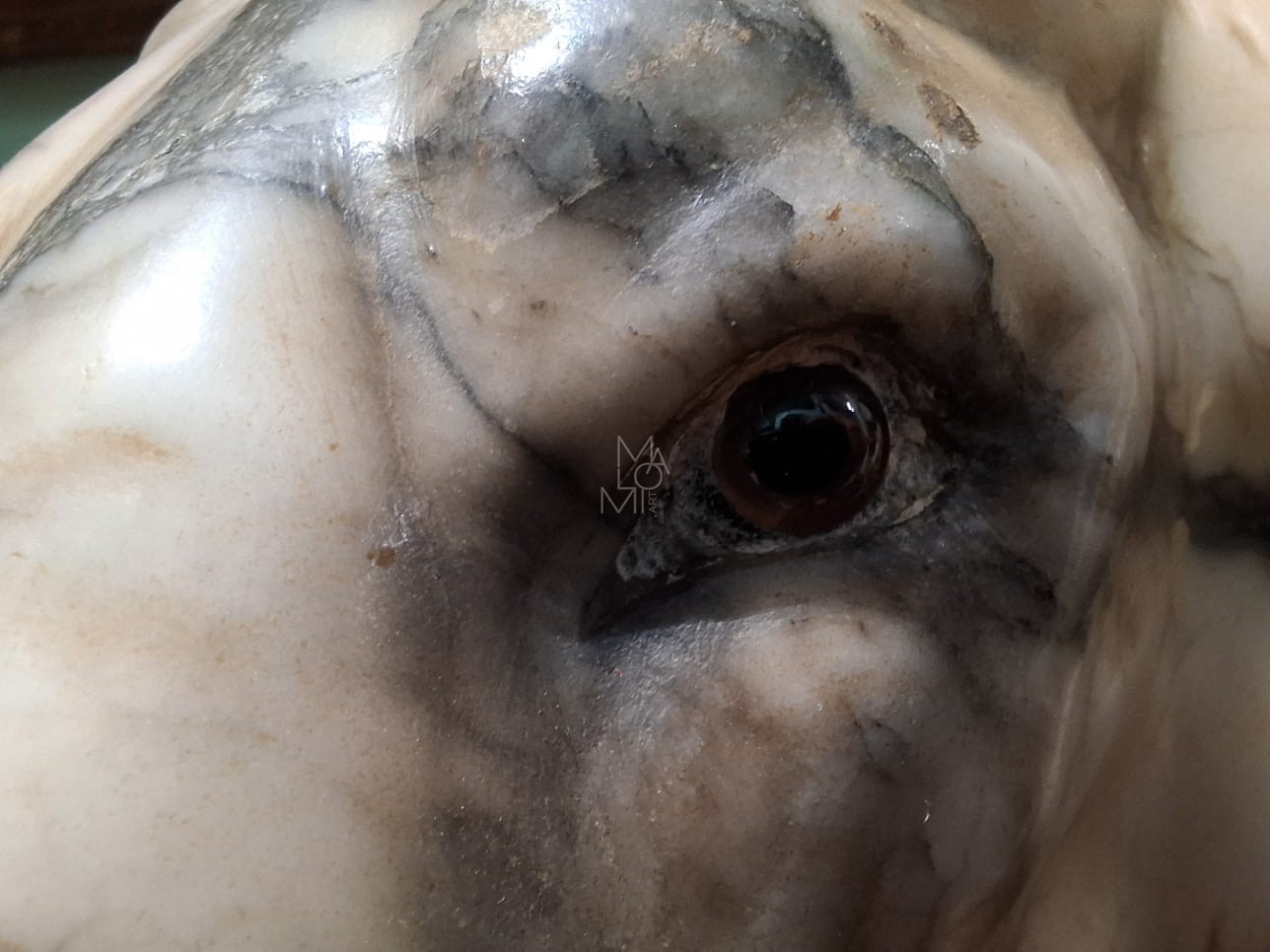
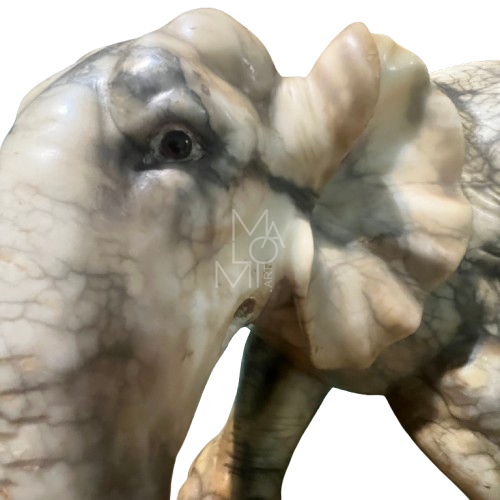
The close-up frontal view demonstrates the absolute precision with which Vannetti oriented the direction of the dark veins to enhance the facial features. A prominent grey vein with an oblique course runs longitudinally across the forehead, connecting the left eye to the attachment of the trunk. This dark line acts as a virtual chisel stroke that underlines the direction of the facial muscles. The natural micro-fractures of the mineral then branch out symmetrically along the sides of the trunk, precisely imitating the texture of the animal's skin and proving that the artist considered the material as an active graphic element for the formal architecture of the work.
Focus on the Polymaterial Taste in 1920s Sculpture
The most surprising and avant-garde stylistic feature of this elephant lies in its nature as an artifact conceived according to the dictates of polymaterial taste, an aesthetic orientation that deeply marked the plastic arts of the 1920s. The overcoming of traditional nineteenth-century purist and monochrome sculpture, historically bound to the dogma of white marble alone or uniform bronze, imposed itself in the first postwar period as an urgent need for rupture and renewal. The juxtaposition of heterogeneous elements did not respond to a simple decorative whim, but aimed to disrupt the traditional perception of form, introducing variations in light refraction and tactile contrasts that amplified the expressiveness of the work.
In international art capitals, and especially in Paris, there was a flourishing of sculptures combining gilded and silvered metals with hard stones, exotic woods, ivory, glass pastes, and lacquers. This multimaterial experimentalism derived in part from the suggestions of historical avant-gardes, such as Futurism and Cubism, which had legitimized the assembly of everyday and industrial elements, but it was reinterpreted by the Déco taste into a key of very high executive luxury and refined eclecticism. Sculptors understood that inserting fragments of reality or exogenous materials created a visual short-circuit capable of enchanting the observer, bestowing upon the artistic object an aura of magical, mysterious, and almost talismanic preciousness.
Angiolo Vannetti fully integrated himself into this international artistic climate, utilizing polymateriality to accentuate the hypnotic and sacred character of the exotic animal. In the visual culture of the 1920s, the elephant was not merely a monumental beast, but a symbol linked to the splendors of Eastern and African civilizations—worlds in which sacred sculpture made extensive use of precious inserts in the eyes and anatomical details. The adoption of this technique by Vannetti demonstrates his desire to transcend the rigid boundaries of academic classicism in order to embrace a modern, decorative plastic style that responded to the desire for wonder and sophisticated luxury expressed by the society of his time.
The Technique of Inset Glass Eyes and the Animation of Stone
The revelation of an executive detail of exceptional rarity, namely the insertion of glass eyes applied within the orbital cavities, constitutes the core of this polymaterial research conducted by Vannetti. Macroscopic examination shows a dark glass hemisphere, finely crafted with a brown iris and a deep black pupil, lodged with millimetric precision inside a socket executed with a drill into the stone. This technique, historically linked to ancient Eastern and Egyptian civilizations and widely exploited in the field of taxidermy, was borrowed by the artist to infuse the sculpture with an effect of extraordinary magical realism.
The insertion of the glass component breaks the continuity of the stone and introduces a glossy, reflective point of specular light that immediately captures the observer's attention. While the alabaster absorbs and diffuses light in a soft, muted manner, the glass eye responds to variations in ambient illumination with a moist brilliance that simulates the vitality of a living eye. This polymaterial solution was reserved exclusively for indoor works destined for the most exclusive and demanding markets, as it required considerable technical skill in securing the elements using colored mastics or dark sealing wax—a workshop device proving that Vannetti considered indoor sculpture a privileged terrain for experimentation, free from the monumental constraints of public commissions.
Historical Notes on Conservation and the Material History of the Artifact
A careful analysis of the material history of the artifact requires a profound reflection on its original integrity and the responses that the stone has provided to the passage of time. On the left portion of the snout, near the mandibular region and immediately beneath the attachment of the ear, a small circular cavity with flared edges can be observed. Close examination and the anatomical position of this cavity allow for the formulation of a precise archeometric thesis, revealing that the hole is neither the result of a geological defect in the stone nor of modern accidental damage. It is, conversely, the original socket executed by the artist for the insertion of the pachyderm's tusks, which were originally made of an aggented, heterogeneous material—most likely ivory, bone, or pure white alabaster itself.
The loss of these protruding elements represents a recurring conservation phenomenon in antique and modern indoor sculpture, as the thinnest parts projecting into space were the first to suffer impacts during relocation or dusting operations in historical residences. The presence of the hole with a truncated-cone section demonstrates that Angiolo Vannetti had provided for a solid mechanical coupling. The brown color variation found inside the cavity is due to the stratification of old fixing mastics, organic bone glues, environmental dust, and protective waxes. This spontaneous sediment constitutes a valuable chronological indicator certifying the authenticity of the piece, confirming that the sculpture has traversed the decades preserving its period patina intact and offering clear evidence of its original multimaterial complexity.
Sculpture for Interior Furnishing and Relations with High-Bourgeois Patronage
To fully understand the critical and commercial success of a work of such executive commitment, it is necessary to analyze the particular bond linking Tuscan sculptors to the patronage of the industrial and financial high bourgeoisie of the first postwar period. The 1920s witnessed a radical transformation in interior architecture, in which patriarchal drawing rooms and reception spaces were progressively stripped of overladen nineteenth-century eclectic furnishings to make room for furniture with geometric lines crafted from precious woods such as ebony or rosewood. In these new spaces, animalier sculpture became a fundamental marker of modernity and elevated social status.
Alabaster, traditionally associated with the artisan workshops of Volterra and often downgraded by academic criticism to a material for commercial souvenir reproductions, was ennobled by artists such as Vannetti, who understood its potential for the luxury market. The bourgeois patronage appreciated the uniqueness guaranteed by the veins of the block, which made serial replication of the work impossible, offering the collector the privilege of a unique piece. The elephant responded perfectly to this domestic imaginary, uniting a fantastic evasion toward a mysterious, dreamed Orient with the reassurance of a form that, while nodding to the geometric syntheses of the Parisian avant-gardes, maintained firm roots in the design and modeling of the great Italian sculptural tradition.
Proposed Chronological Placement and Critical Apparatus
The dating of the veined alabaster elephant requires a comparative analysis between the two central periods of Angiolo Vannetti's maturity: the 1920s and the 1930s. Based on the stylistic, formal, and structural evidence emerging from the three-dimensional examination, a stable chronological placement is proposed at the late 1920s (circa 1928–1931), configuring itself as a crucial transitional work in the artist's production.
In favor of the late 1920s, one notes first of all the primitivism and the influence of Asian travel. The year 1927 marks Vannetti's historic stay in Japan, where he executed portraits for the Imperial Court, followed by stops in Shanghai, Singapore, and Tonkin. Direct contact with the iconography of the sacred elephant and Eastern stone sculpture is reflected in the block-like volumes of the work and the choice of alabaster, a material reminiscent of the hard stones of the Far East. Furthermore, there is a close proximity to the production exhibited in 1928: on the occasion of the Gruppo Labronico exhibition in Milan, Vannetti exhibited twelve works with an animal theme. The elephant under review shares with that nucleus of interior sculptures the same expressionistic urgency and the careful integration between the natural veins of the block and the muscular design.
Finally, the work perfectly illustrates the transition toward the 1930s. In that decade, Vannetti's animalier production converged into the major colonial exhibitions (Rome 1931, Naples 1934) and public monuments (such as the famous Fontana della Gazzella in Tripoli in 1933 or the Tigre in the Cascine Park in Florence in 1939). In the latter, however, the artist abandoned stylization in favor of a more monumental, academic naturalistic verism. The elephant, with its dome-polished back, the polymaterial use of glass, and the geometric "comb-like" base, preserves instead a Déco purity typical of the final years of the 1920s.
Conclusions
In conclusion, the veined alabaster elephant by Angiolo Vannetti configures itself as a masterpiece of early twentieth-century animalier plastic art, a work capable of summarizing within itself the complex cultural dynamics of an era suspended between the rigor of tradition and the allure of international modernity. Through a wise enhancement of the intrinsic qualities of the stone material and the adoption of sophisticated technical solutions—such as the setting of glass eyes and the preparation for multimaterial tusks—the Livornese sculptor succeeded in giving shape to a timeless symbol of strength and dignity. This work is not only a masterful testament to the technical expertise of its author, but also represents a significant chapter in the history of taste and art collecting among the Italian high bourgeoisie of the twentieth century.
Annotated Bibliography
- Sapori, Francesco, La scultura italiana moderna, Libreria dello Stato, Rome, 1949. A panoramic volume of fundamental importance that places the figure and work of Angiolo Vannetti within the broader and more articulated context of national figurative plastic art of the first half of the twentieth century, clearly highlighting the deep connection between the Tuscan school and the international monumental outcomes of his production.
- Ojetti, Ugo, Il gruppo Labronico alla galleria Pesaro, Exhibition catalogue, Milan, 1928. A historical period document of capital critical relevance for the study of the artifact under consideration, as it reviews the Milanese exhibition of 1928 during which Vannetti presented his celebrated nucleus of twelve animalier sculptures, offering valuable and irreplaceable terms of stylistic, chronological, and iconographic comparison.
- Papi, Stefano, Angiolo Vannetti: uno scultore livornese nel mondo, in «Nuovi studi livornesi», volume nine, Livorno, 2001. The most exhaustive and documented modern monographic essay on the artist, indispensable for reconstructing with precision the stages of the journey to the Far East in 1927 and the important commissions for the Imperial Court in Tokyo—crucial turning points for understanding the genesis of exotic subjects within his production.
- Panzetta, Alfonso, Nuovo dizionario degli scultori italiani dell'Ottocento e del primo Novecento, AdArte, Turin, 2003. An essential reference tool gathering the core biographical data of the Livornese master, the annotated list of his participations in national exhibitions, including the Venice Biennales and the Rome Quadrenniales, and a primary fundamental historicization of his works in stone and marble.
- Cresti, Carlo, Architettura e arti decorative a Livorno tra Liberty e Déco, Pacini editore, Ospedaletto, 1985. An in-depth study focused on the cultural context of the artist's origin, highly useful for understanding how the Tuscan and Livornese artistic environment received and reworked the international instances of Déco taste, determinantly influencing the production of luxury furnishings and indoor sculptures.
- Ministero delle colonie, Catalogo ufficiale della prima mostra internazionale d'arte coloniale, Rome, 1931. A historical period catalogue documenting the peak of Vannetti's political and critical success within the sphere of plastic art inspired by African and Asian geographies, marking the moment of maximum reception of his exotic subjects prior to his subsequent shift toward the large monumental sculpture of the 1930s.