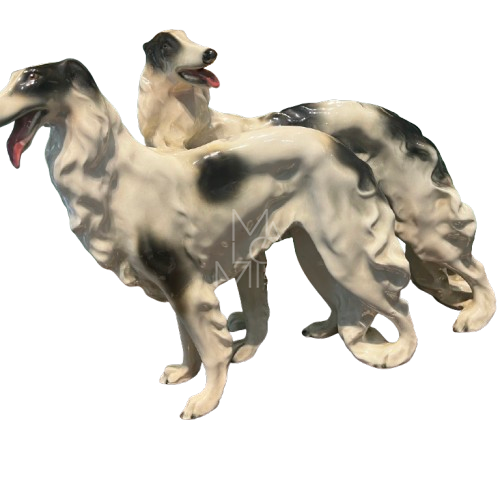
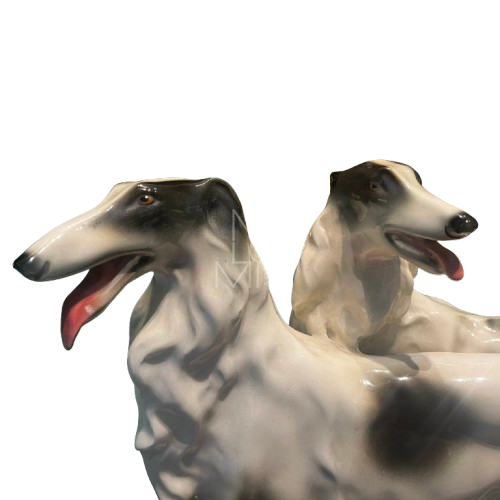
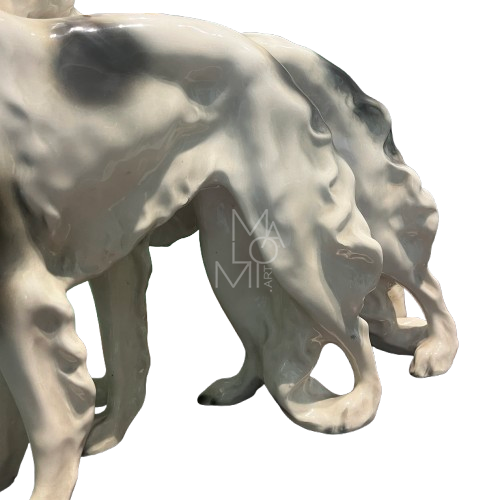
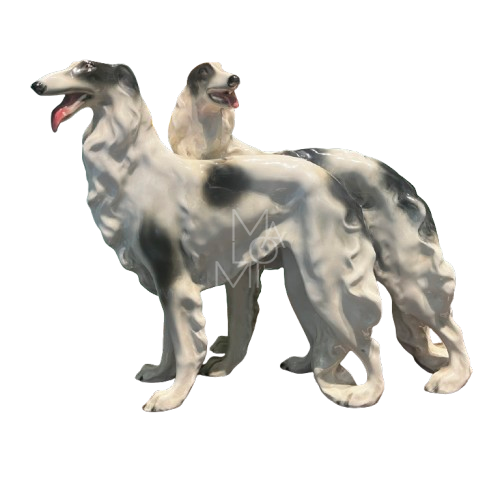
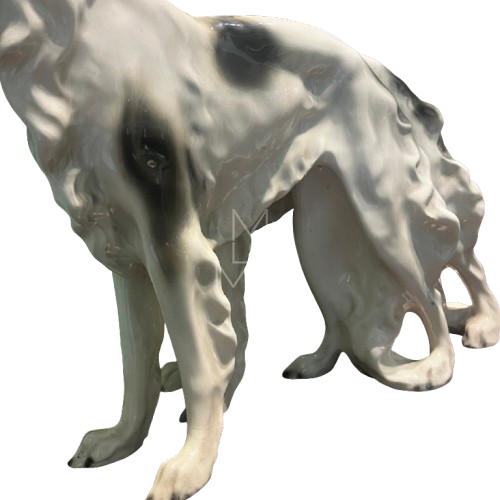
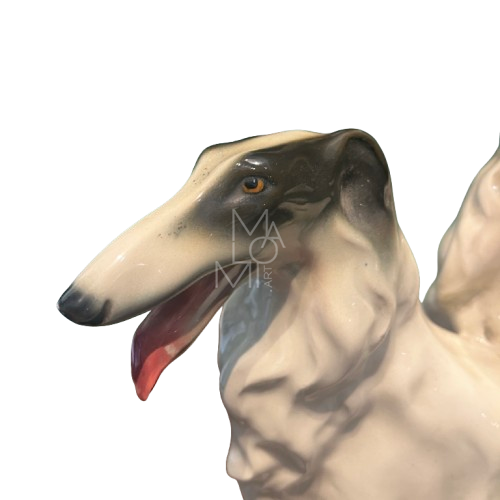
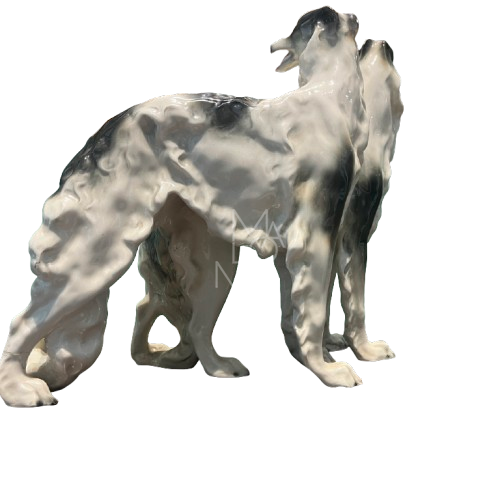
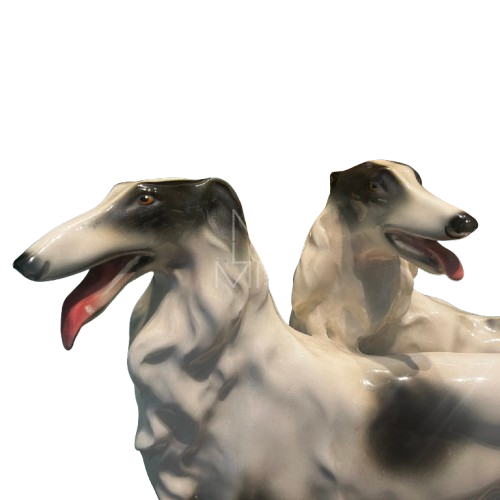
Two Zaccagnini ceramic Russian borzoi greyhounds from 1947: mid-century Florentine art sculpture
- Manufactory: Ugo Zaccagnini & Figli (Florence, Italy)
- Model designer: Attributable to the plastic style of Fosco Martini
- Subject: Pair of Russian Borzoi greyhounds
- Period and dating: April 9, 1947 (incised date on the raw clay base)
- Material and technique: Slip-cast soft earthenware (terraglia tenera), airbrushed underglaze polychrome painting (Ugo Ciardella style) with high-gloss lead crystalline glaze
- Dimensions: Length 45 cm; height 38 cm; depth 15 cm
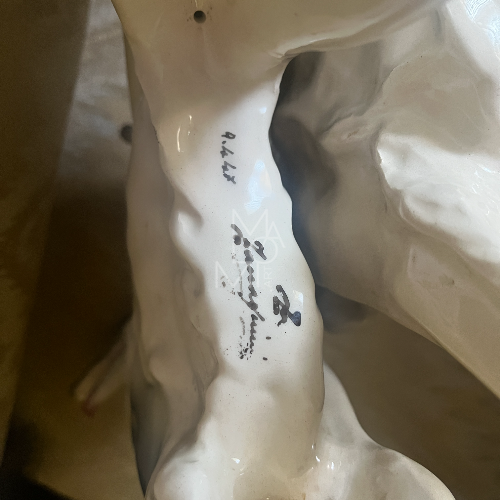
- Inscriptions and marks: Cursive signature Zaccagnini, stylized mountain/crown monogram, and chronological code 9.4.47 brush-painted and impressed under the base
- Style: Mature Art Déco / Twentieth-century animalier sculpture
A Historico-Critical Study and Plastic Analysis of the Sculptural Group "Two Russian Borzois" by the Zaccagnini Manufactory
Introduction and Historico-Artistic Context
Origins and Context of the Florentine Manufactory
The precious sculptural group under examination, modeled in polychrome glazed soft earthenware (terraglia tenera), depicts two specimens of Russian greyhounds, scientifically known as Borzois, captured in a pose that is simultaneously stationary and imbued with a vibrant, latent dynamism. The work is a product of the highest executive caliber attributable to the historical production of Ceramiche Zaccagnini, a manufactory originally founded in Sesto Fiorentino by Ugo Zaccagnini, a former employee of the celebrated Richard-Ginori manufactory, and subsequently relocated to Via Monte Oliveto in Florence. The imposing measurements recorded for the artifact—measuring forty-five centimeters in length, thirty-eight centimeters in height, and fifteen centimeters in depth—represent more than a mere volumetric datum; they testify to a deliberate intent to create a monumental interior object designed to engage with the refined domestic spheres of the wealthy Italian bourgeoisie during the interwar and early post-war periods. Within the landscape of Tuscan decorative arts, the Zaccagnini firm distinguished itself through a pronounced inclination toward modernity, which earned it commissions of enormous institutional prestige. Among the most famous anecdotes associated with the manufactory is the prestigious commission received directly in 1930 from Benito Mussolini, who ordered a pair of monumental parian-style vases in colored majolica destined to become the official wedding gift for the marriage of his daughter Edda to Count Galeazzo Ciano, an event that consecrated the firm at the highest echelons of national renown.
The Myth of the Greyhound in International Taste
The iconography of the greyhound permeated the history of twentieth-century applied arts, emerging as the undisputed symbol of geometric elegance, velocity, and an aristocratic detachment, finding its ultimate celebration during the Art Déco era. Borzois, with their exaggeratedly slender silhouettes, perfectly embodied the aesthetic ideal of the sinuous, undulating line favored by the designers of the period. In the vision of the Florentine manufactory, the animal ceases to be a mere zoological subject, transforming instead into a plastic pretext through which to explore the potentialities of light and the ceramic medium. The choice of this specific canine breed, historically associated with the grand hunting expeditions of the Russian tsars, bestowed an aura of exoticism and nobility upon the artifact. This allowed it to align magnificently with the trends of high European craftsmanship, competing directly with the celebrated porcelain models of the Austrian Goldscheider manufactory or the refined bestiaries of German ceramic firms.
Formal Analysis and Plastic Quality
Compositional Dynamism and Spatial Staggering
The excellent modeling quality of the sculptural group manifests primarily through a complex and calculated geometric articulation of volumes. The master modeler rigorously avoided the rigidity of academic posing by overlapping the two bodies in an asymmetric and staggered manner, thereby creating a refined interplay of three-dimensional planes. The greyhound positioned in the foreground immediately captures the viewer’s visual attention and serves as an anchoring pivot, while the rear specimen, with its long muzzle proudly extended upward, introduces an ascending and rotational movement. This movement compels the observer to mentally shift around the work to fully comprehend its exact spatiality. Although the limbs rest firmly on the horizontal plane of the base, the entire composition is shot through with a potent discharge of nervous tension. The slight flexion of the legs and the pronounced arching of the dorsal line convey the characteristic, snapping readiness of greyhounds, freezing in the clay the instant immediately prior to a feline spring.
Modeling of the Coat and the Plastic Use of Light
Another element of extraordinary merit lies in the plastic treatment of the clay surface, which describes the silky texture of the Borzois' coats with academic prowess. The long coat of the animals is not merely suggested by pictorial decoration; rather, it is sculpted directly into the plastic matter through a series of deep, rhythmic, and fluid undulating furrows, particularly evident along the chest, hind thighs, and tail. This agitated and vibrant surface reacts intensely to ambient light, which glides over the protruding crests and settles in the recessed areas, generating a natural chiaroscuro that emphasizes the muscular volumetry even prior to the application of color. The transition between the powerful musculature of the torso and the structural fragility of the lower limbs and tapered muzzles is resolved with superb plastic harmony, ensuring perfect static stability for a work that remains visually light and slender. The dramatic expressiveness of the heads, characterized by wide-open jaws and tensed tongues, breaks with the convention of the traditional parlor figurine, infusing the ceramic multiple with the freshness and vital impetus of an original artist's sculpture.
Technical and Workshop Aspects
The Underglaze Painting Technique of Ugo Ciardella
From a strictly execution-based perspective, the exceptional aesthetic yield of the sculptural group results from a perfect synergy between plastic modeling and underglaze painting (pittura sotto vernice), a complex technique in which the manufactory's chief decorator, the master Ugo Ciardella, excelled. The process began with the casting of liquid clay into plaster molds, followed, after drying, by an initial high-temperature firing to obtain the so-called biscuit (biscotto) of white earthenware. Upon this porous substrate, the painter intervened freehand using a combination of airbrush and soft-tipped brush. The airbrush was employed to apply the initial gray and bluish shading destined to simulate the depth of the undercoat, while the brush was used to load the wide dark patches. Ciardella utilized pigments rich in metallic oxides—specifically cobalt and manganese oxides to achieve those deep anthracite and black hues—meticulously blending their margins a bagnato (wet-on-wet) onto the surface to prevent sharp, artificial transitions. Subsequently, the artifact was entirely immersed in a crystalline glaze (cristallina), a transparent lead glaze, and subjected to a second firing at approximately one thousand degrees Celsius. The fusion of the crystalline glaze created an everlasting vitreous layer that not only protected the pigment but also endowed the work with extraordinary optical depth, offering the illusion that the dark spots emerged transparently directly from within the ceramic body.
The Contribution of Sculptors and the Walt Disney Department
During the period in which this work was conceived, the Zaccagnini manufactory benefited from collaborations with some of the greatest master sculptors of twentieth-century Italian art. A prominent figure was undoubtedly the animalier sculptor and modeler Fosco Martini, an artist who collaborated intensely with the firm from the 1930s onward, signing legendary models of birds of paradise, herons, and galloping horses. Although Martini had opened his own independent studio in Florence in the post-WWII period, the imprint of his vigorous plastic style continued to profoundly influence the workshops in Piazza Pier Vettori. An intriguing historical curiosity that significantly shaped the skill of the internal modelers during those years lies in the prestigious and exclusive license granted to the firm by Walt Disney Productions beginning in 1938. For two decades, Zaccagnini artisans were tasked with translating the famous American cartoon characters into three-dimensional ceramic sculptures, ranging from Pinocchio to the protagonists of The Three Caballeros. This constant exercise in capturing the expressiveness and exaggerated dynamism of Disney models inevitably influenced the factory’s entire production, refining the decorators' sensitivity in making animal faces incredibly vital and expressive—a peculiarity clearly visible in the intensity of the gaze and the theatrical pose of these two Borzois.
Certification, Marks, and Absolute Chronology
The Historical Evolution of the Monogram with the Crown
An analysis of the marks impressed upon the underside of the base allows for a reconstruction of the salient phases of the factory's corporate history and guarantees its absolute authenticity. Upon the earthenware body, one observes a monogram traced by brush under the glaze, composed of the letter "Z" surmounted by a three-pointed geometric figure resembling a stylized crown. This symbol possesses a fascinating origin closely tied to Tuscan geography: in 1928, with the relocation of production to the new facilities in Via Monte Oliveto, the Zaccagnini family chose to redesign their corporate logo by inserting a three-peaked mountain profile. This was inspired directly by the heraldic coat of arms of the hilly locality of Monte Oliveto, intersected diagonally by the initial letter of the founder’s surname. Over the years, and through the natural graphic stylization enacted by the factory’s various painters, that mountain profile progressively assumed the appearance of a three-pointed medieval crown. In 1936, following the passing of Ugo Zaccagnini, the company transformed into the Società Anonima Ceramiche Zaccagnini, and the use of this monogram, paired with the extended cursive signature, became the official seal of the manufactory’s golden age.
The Value of the Chronological Document in the Post-War Period
The element of exceptional scientific relevance that elevates this specific artifact to a piece of high historical interest is the explicit chronological indication impressed into the raw clay on the underside of the base, where the date April 9, 1947 appears. The precise marking of the day, month, and year responded to a rigorous internal cataloging practice within the Florentine workshops, aimed at monitoring production batches and kiln efficiency during the delicate phase of post-war industrial reconstruction. In 1947, under the artistic direction of Urbano Zaccagnini, the factory was in a phase of fervent activity. The presence of such a precise dating transforms the work into a fundamental chronological anchor for art historians. Indeed, it allows for an exact mapping of the evolution of decorative taste and the persistence of Art Déco plastic models in post-war Italy, confirming how the great Tuscan artisanal tradition succeeded in surviving the devastations of the global conflict intact, maintaining the purity of its lines and the brilliance of its crystalline glazes.
Comparative Analysis with the Lenci and Ronzan Manufactories
The Satin Synthesis of the Torinese School of Lenci
To fully comprehend the originality of the work signed by Zaccagnini, it is necessary to juxtapose it with the concurrent productions of the two great Piedmontese manufactories that dominated the art ceramic market in the first half of the century: the celebrated Lenci Manufactory of Turin and the subsequent firm founded by the Ronzan brothers. Lenci, under the spiritual guidance of Elena Scavini and thanks to the contribution of artists of the caliber of Sandro Vacchetti, chose to interpret the greyhound theme through a radical geometric stylization. In the Torinese works, the animal's forms were smoothed down to achieve an extreme, almost abstract volumetric synthesis, eliminating any realistic hint of coat texture. Furthermore, Lenci rejected the brilliance of lead glazes in favor of opaque, satin-finished glazes with a characteristic matt finish. This bestowed a fairytale-like, ironic, and exquisitely intimate appearance upon the sculptures, transforming the greyhounds into sophisticated boudoir idols designed to dialogue with a decorative taste more inclined toward the suggestions of the European pictorial avant-gelos.
The Photographic Naturalism of the Ronzan Manufactory
A diametrically opposed philosophy guided the work of Giovanni Ronzan, a former leading modeler for Lenci who, together with his brothers, decided to leave the parent company to found his own independent brand in Turin, which later relocated to Bassano del Grappa due to wartime events. The Ronzan manufactory specialized in a ceramic bestiary of a rigorously naturalistic and almost photographic nature. The greyhounds modeled by Ronzan sought maximum zoological fidelity to the breed, favoring composed, academic, and stationary poses that lacked the dynamic thrust and expressive fire typical of Fosco Martini's model for Zaccagnini. The strength of Ronzan's production lay in a meticulous pictorial brushing that tended to reproduce the animal's coat nearly hair by hair, covering the surface with a hyper-brilliant glaze that emphasized descriptive realism. The Zaccagnini masterpiece of 1947 positions itself ideally at the center of these two extremes, admirably fusing the plastic vigor and anatomical expressiveness of Tuscan sculpture with the formal elegance of Art Déco, configuring itself as one of the most successful and fascinating chapters in the history of twentieth-century Italian ceramic sculpture.
The Evolution of the Manufactory following the Family Split by Urbano Zaccagnini
The late 1950s represented a moment of profound fracture for the historic Florentine manufactory, marred by irreconcilable strategic and artistic differences among family members. In 1958, Urbano Zaccagnini—the eldest son of the founder Ugo and hitherto a pivotal figure in the artistic direction—decided to permanently leave the parent company to establish his own independent workshop, the Ceramiche Urbano Zaccagnini manufactory, based in Florence. This family split was not a mere corporate realignment; rather, it determined a true stylistic branching within the landscape of post-war Tuscan art ceramics.
Urbano Zaccagnini’s newly formed factory oriented itself immediately toward a radical modernization of lines, breaking away from old academic molds and traditional bestiaries to embrace the emerging trends of industrial design and Scandinavian-influenced styling. Urbano experimented with new glaze formulas, introducing celebrated abstract series, including the highly famous line denominated Svedese (Swedish), characterized by rough surfaces, scratched engobes, asymmetrical forms, and bold color pairings such as satin turquoise, yellow ochre, and matte blacks. This production achieved immediate commercial success, intercepting the taste of a rising middle class that furnished its apartments according to the dictates of 1960s interior architecture. To distinguish his production from that of the original firm, Urbano signed his pieces with the extended inscription U. Zaccagnini or applied a different graphic monogram, frequently omitting the classic three-peaked mountain profile that had characterized the golden age of Via Monte Oliveto.
Concurrently, the parent company, remaining in the hands of brothers Pietro and Prisco Zaccagnini, had to reorganize its workshops to cope with the loss of its principal designer. Structured as a Joint-Stock Company (Società per Azioni), the parent house initially chose a more conservative path, continuing to replicate its historically successful models with great technical skill. This included the celebrated greyhound groups and the animalier sculptures by Fosco Martini, which remained in demand by a clientele tied to traditional collecting. However, to survive market mutations and industrial competition, the original firm also had to gradually yield to standardization. The marks, once traced exclusively by brush by master decorators like Ugo Ciardella, were replaced by standardized underglaze stamps or decals, and serial production progressively superseded manual finishing. Despite various attempts at revitalization through collaborations with external designers and the production of high-end giftware, the glorious historical trajectory of Ceramiche Zaccagnini concluded permanently in the year 2000 with the cessation of all production activities, leaving international collectors the legacy of a brand that marked the excellence of twentieth-century Italian decorative arts.
Comparative Bibliography
Crespi, Luciano. Le arti decorative italiane del Novecento: Ceramiche, vetri e metalli d'arte. Milan: Electa, 1998.
Musilli, Gilda. Fosco Martini e la scultura animalista in Toscana tra le due guerre. Florence: Edizioni Polistampa, 2012.
Pansera, Anty, ed. Storia del disegno industriale italiano. Rome: Laterza, 1993.
Stringa, Nico, ed. La ceramica italiana del Novecento. Milan: Skira, 2005.
Vianello, Giovanni. La manifattura Lenci di Torino: Realizzazioni storiche e cataloghi di produzione. Turin: Umberto Allemandi, 1992.
Zaccagnini, Urbano. Cinquant'anni di ceramica a Firenze: Memorie e tendenze. Florence: Il Candelaio, 1974.