Sixteenth-century Brescian wooden high relief
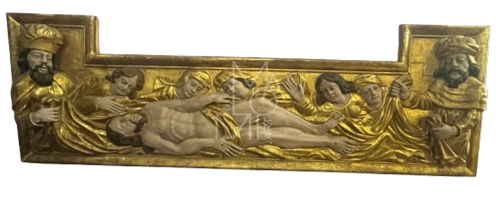
- Title: The Transport of Christ to the Sepulchre (The Lamentation over the Dead Christ)
- Object Type: Architectural high-relief panel / Monumental altar predella
- Chronology: Mid-sixteenth century (circa 1550)
- Cultural Sphere: Renaissance sculpture in Eastern Lombardy / Po Valley Mannerism
- School / Workshop: Brescian woodcarvers of the Val Sabbia school (Camunian master-carvers / Circle of the Sanmicheli)
- Geographical Provenance: Val Sabbia, Province of Brescia, Lombardy (Italy)
- Dimensions: 195 cm (width) x 64 cm (height)
- Support Material: Carved solid timber (indigenous alpine wood, presumably Swiss pine or walnut)
- Executive Technique: Deep high-relief woodcarving with extensive undercutting
- Surface Finish: Water gilding with genuine gold leaf over a red-bole preparation; residual polychromy on the flesh tones (incarnati)
A historico-artistic study of a sixteenth-century Brescian wooden high relief
- Introduction and chronological framework of the work
The artifact under analysis is a high-relief wooden panel, carved, polychromed, and gilded, measuring exactly 195 cm in length by 64 cm in height. Originating from the Brescian territory, and specifically attributable to the Val Sabbia area, the work can be dated to the mid-sixteenth century (circa 1550). From a structural standpoint, its pronounced horizontal development and the geometric shaping of its upper margins indicate a precise original architectural function. The relief highly likely constituted the predella of a monumental wooden polyptych or the lower register of an altar ancona, both of which were standard elements of liturgical production in eastern Lombardy during the Renaissance era.
- Iconographic analysis: the transport to the sepulchre
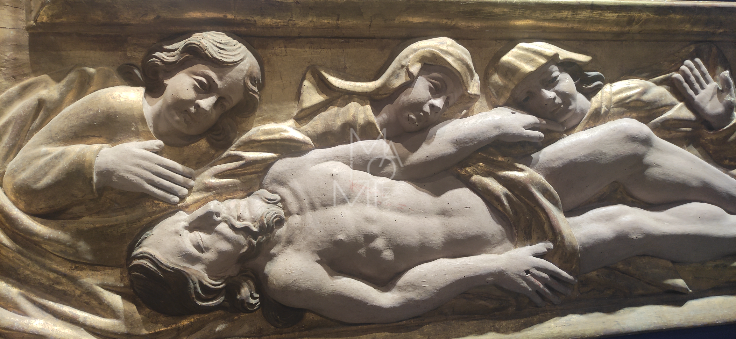
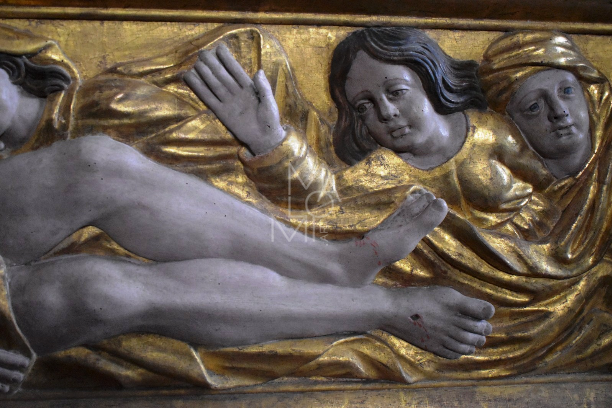
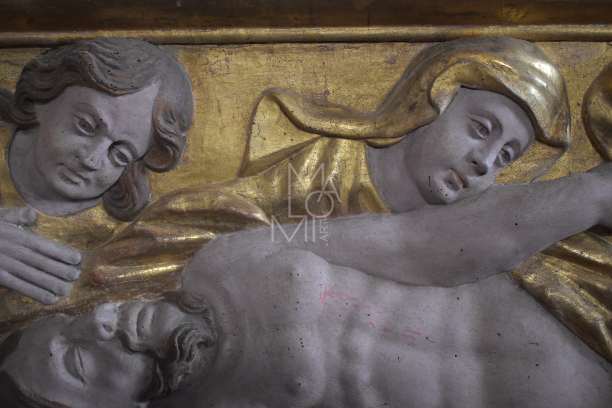
The depicted scene belongs to the codified iconography of the Passion of Christ, focusing on the moment of the Transport to the Sepulchre (or Lamentation). At the center of the composition lies the lifeless body of Jesus, supported by a white shroud that serves as both the visual and structural fulcrum of the entire narrative.
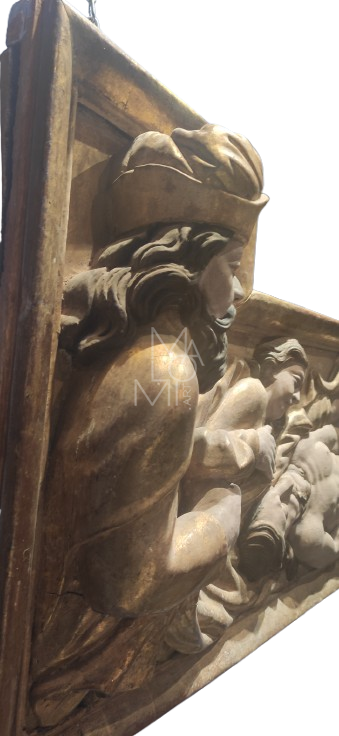
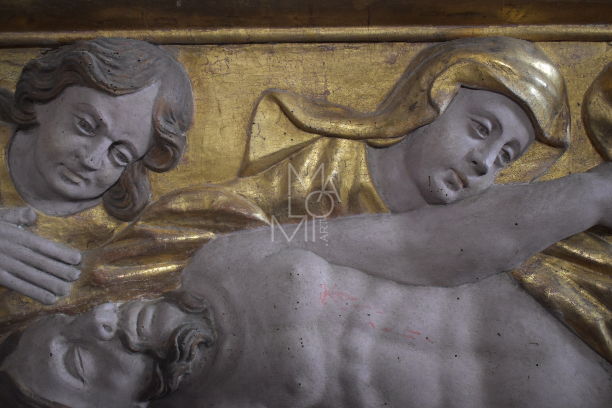
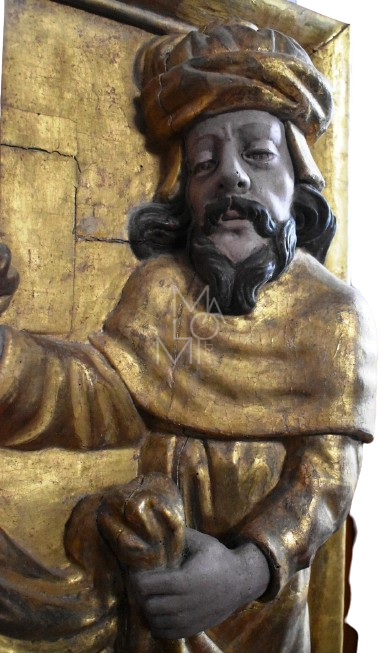
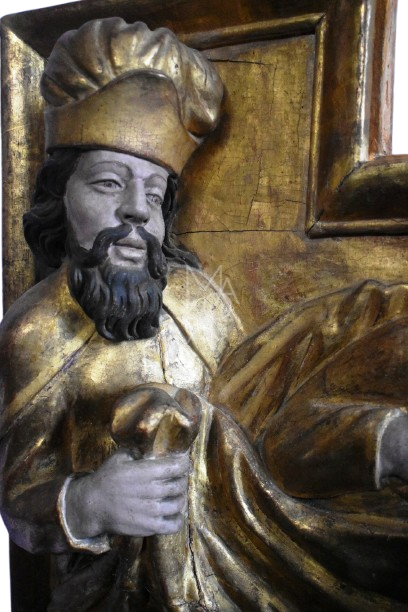
At the outermost flanks, functioning almost as monumental theatrical wings, emerge two standing male figures, sumptuously attired in exotic headdresses and draped garments: these are Joseph of Arimathea and Nicodemus. They hold the edges of the funeral shroud, assuming the role of guardians of the sacred body. In the central space behind the figure of Christ, the chorus of mourners unfolds. Among them, the Holy Women and Saint John the Evangelist can be distinguished, captured in attitudes of profound consternation. Their gazes converge dramatically upon the Savior, while their hands move between the act of supporting the body and the outward expression of an intimate, solemn grief.
- Geographical and manufacturing context: the val sabbia and brescian sculpture
The geographical provenance from the Val Sabbia region places the work within one of the most active centers of Lombard wooden sculpture during the Cinquecento. In this territory, woodworking was not merely a craft activity, but a true artistic excellence linked to dynasties of carvers, notably the masters of the Camunian school and local workshops influenced by the great Brescian ancona builders, who were closely tied to the structural models of the Sanmicheli.
The mid-sixteenth century represents a phase of complex stylistic transition for the Brescian province. On one hand, a solid fidelity to the plastic volumes of the fifteenth-century tradition persists; on the other, it assimilates the major pictorial lessons of the local High Renaissance — dominated by the figures of Alessandro Bonvicino known as Moretto, Girolamo Romanino, and Giovanni Girolamo Savoldo. The high relief under examination reflects this felicitous synthesis, wherein the rigidity of the wooden medium softens into a quest for dynamism and pathos typical of the Po Valley region.
- Philological comparison and the persistence of renaissance models
To define the philological identity of the work, it is fundamental to establish a comparison with the monumental Brescian statuary of the early sixteenth century, particularly with the famous Pietà with Five Figures by Gasparo Cairano (preserved in the Museo di Santa Giulia in Brescia). The high relief in question configures itself as a coherent evolution and reworking of that plastic prototype:
- Postural Syntax: The posture of Christ, laid diagonally on the edge of the sepulchre with his torso tilted backward and legs slightly bent, derives directly from the formal models established by Cairano in Brescia.
- The Emotional Balance: The figure of the Virgin Mary, positioned at the exact center of the scene while holding her Son's arm, reproduces the dramatic and structural core typical of Lombard workshops of the period.
- Mannerist Variations and Enrichments: Compared to the austere marble monumentality of the first decades of the century, this mid-Cinquecento panel welcomes a greater decorative exuberance. The space becomes populated with complementary elements, such as angels with outstretched wings and cherubins, testifying to a shift toward the ornate and virtuosic taste of valley Mannerism.
- Stylistic, formal, and technical analysis
The work is distinguished by a remarkable executive skill and by formal choices that reveal its high qualitative value:
- Composition and Spatiality: The carver resolves the horizontal progression of the predella through a measured rhythm. The lines of force generated by Christ's body and the shroud guide the viewer's eye from left to right, while the faces of the mourners create a second, undulating register of strong emotional impact.
- Plastic and Anatomical Rendering: The figure of Christ displays a careful, if calligraphic, anatomical study, with a pronounced definition of the rib cage and abdominal muscles. The drapery of the robes of Nicodemus and Joseph of Arimathea presents deep, geometric folds capable of catching the light in a sharp manner.
- The Technique of Carving and Gilding: The high relief utilizes a considerable depth of gouging to accentuate chiaroscuro effects. The extensive use of leaf gilding, applied over a bole preparation, does not serve a purely decorative purpose. The golden finish was intended to reflect the dim candlelight within the ecclesiastical space, imparting a transcendent aura to the predella and an illusion of greater three-dimensionality.
- Conclusions
The Brescian panel from Val Sabbia constitutes a significant testament to the sacred Renaissance sculpture of Northern Italy. The work demonstrates how the Brescian valleys were territories of artistic avant-garde, capable of reworking the sophisticated models of the city into a vigorous, expressive language of immediate devotional efficacy. The preservation of its original structure and the quality of the surviving gold render this high relief a fundamental piece for understanding the production mechanisms of Lombard wooden workshops prior to the rigid counter-reformational codifications decreed by the Council of Trent.