Sienese wooden sculpture: 16th-century torch-Bearing Angels
Sienese wooden sculpture, torch-bearing angels, angeli cerofori, late 16th-century art, Counter-Reformation Siena, estofado gilding, carved linden wood, Francesco Vanni, Renaissance sacred furnishings, polychrome sculpture restoration.
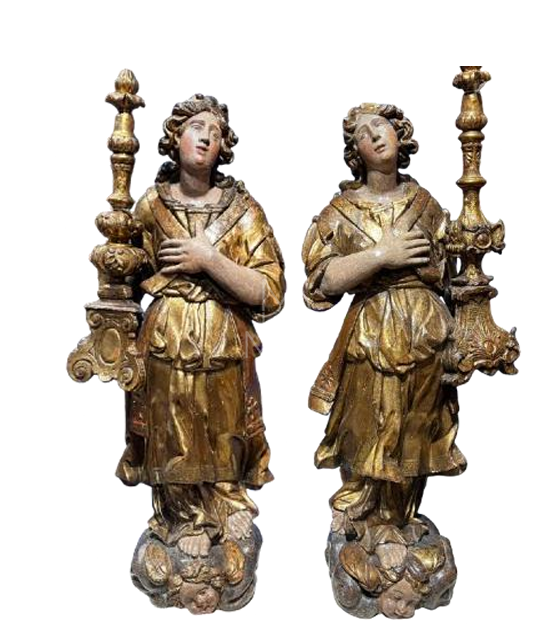
- Object: Pair of specular Torch-Bearing Angels (Angeli Cerofori)
- Cultural Sphere: Sienese School / Tuscan Mannerism
- Date: Late Sixteenth Century (ca. 1575–1600)
- Medium and Technique: Carved linden (or poplar) wood; gesso ground (ammanitura); water-gilding (a guazzo) on Armenian red bole; estofado (sgraffito) textile decoration; oil-painted flesh tones (incarnati)
- Dimensions: Height: 105 cm; Width: 45 cm (altar metrological standard)
- Condition Report: Excellent historical condition; preserved original patina with widespread craquelure on the flesh tones; coherent deposits of historical dust and liturgical wax residues within the carved recesses; minor abrasions to the gilding on raised areas exposing the underlying red clay bole
- Stylistic Affiliations: Strongly indebted to the mystical, devotional painting of Francesco Vanni and Alessandro Casolani; ornamental lexicon aligns with the contemporary designs of Flaminio del Turco and Domenico Cafaggi (il Caprino)
- Critical Description: These sculptures are exemplary models of post-Tridentine liturgical production in Siena. Engineered as theatrical agents to reflect candle flames—symbolizing Divine Light—the figures feature a rigorous axial specularity and an ecstatic, pathetic facial expression. The bare feet rest on mixtilinear bases from which winged cherub heads emerge, functioning as architectural buttresses that stabilize the 105 cm structural load. The millimetric precision of the cabinetmaking on the baluster candelabra and the sophisticated decoration confirm the execution by a premier Counter-Reformation workshop in Siena.
- Sienese Renaissance wood sculpture
- Polychrome and gilded wooden angels
- 16th-century Italian torchbearers pair
- Counter-Reformation sacred furnishings
- Late Manierista carved linden wood
- Antique Tuscan altar sculptures 105x45 cm
- Water-gilding estofado sgraffito technique
THE LIGHT AND THE CARVING: A PAIR OF TORCH-BEARING ANGELS IN LATE SIXTEENTH-CENTURY SIENESE WOODEN SCULPTURE
Introduction and Historical-Artistic Context
In the landscape of Tuscan sculpture at the end of the sixteenth century, Siena occupied a position of singular cultural complexity. Having overcome the dramatic fall of the Republic in 1555 and its definitive absorption into the Medici Grand Duchy, the city's artistic workshops did not abdicate their centuries-old visual identity; rather, they re-elaborated it through the rigid and theatrical demands of the Counter-Reformation. The decrees of the Council of Trent imposed a profound revision of sacred spaces, placing a renewed emphasis on the Eucharistic cult and, consequently, on the architectural centrality of the tabernacle. It is within this precise context that the monumental production of sacred furnishings in carved, polychromed, and gilded wood emerged. The demand from confraternities, religious orders, and parishes for pairs of torch-bearing angels standing approximately 105 centimeters tall—the ideal metrological standard for placement on altar steps or flanking monumental ciboria—experienced an exceptional surge (Spargi 1987, p. 122). These figures did not merely fulfill a decorative purpose; they functioned as true scenographic agents, designed to reflect the vibrant light of candles through the pure gold leaf of their vestments, thereby translating the theological concept of Divine Light into tangible plastic forms for the contemplation of the faithful.
Iconographic Analysis and Specular Structure of the Works
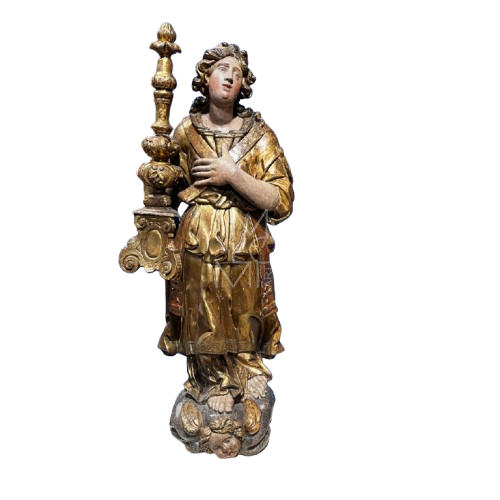
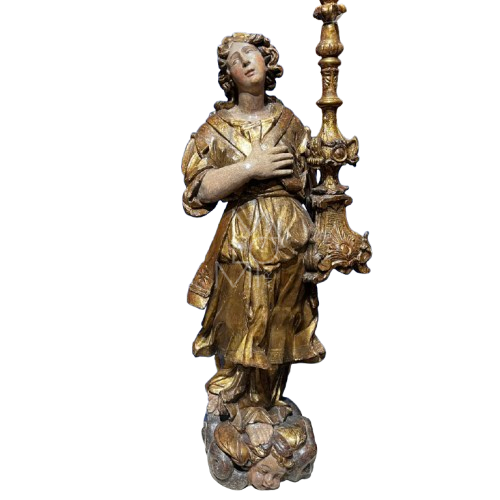
The two torch-bearing angels under examination constitute a coherent example of Counter-Reformation liturgical symmetry. Conceived to visually frame the focal center of the altar, the two bodies are structured according to a principle of rigorous axial specularity, balancing masses while guiding the viewer's gaze toward the center of the sacred apparatus. The first angel displays a marked torsion of the torso, with its left arm bent and the hand softly resting on its chest in a gesture of profound humility and devotional submission, while the right hand clasps the shaft of a large candelabrum. Specularly, the second angel inverts this distribution of weight and motor functions, bringing its right arm to the heart while the left supports the counterpart of the monumental candelabrum. The candelabra themselves merit special attention, as their carving revives a late-Renaissance repertoire of fine cabinetmaking, structured through the superimposition of baluster knots, geometric fluting, classical moldings, and elegant acanthus leaves wrapping the base. The millimetric precision in the correspondence of measurements and ornamental motifs confirms the use of a single executory graphic design (patrone) within the workshop (Bagnoli 1987, p. 210).
Stylistic Focus: The Face and Ecstatic Pathos
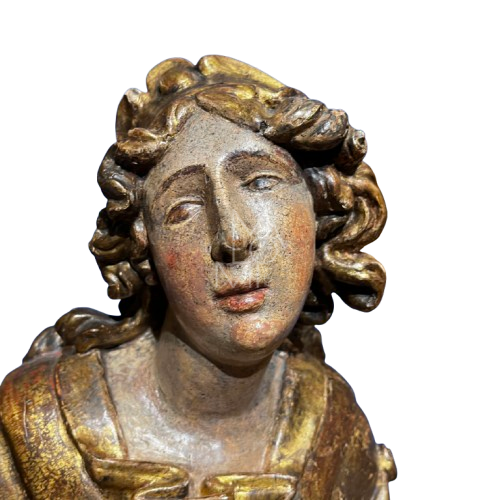
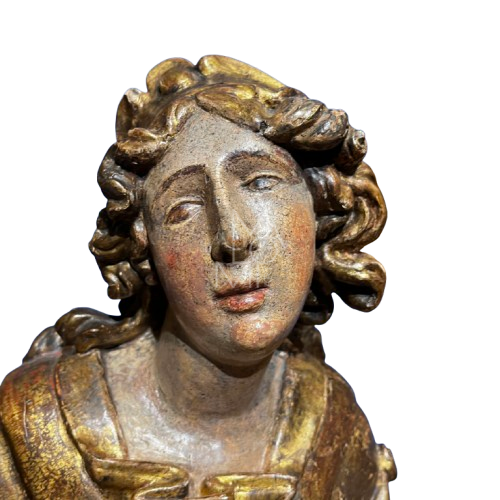
A close examination of the angels' faces reveals the extraordinary expressive quality of the master carver. The neck undergoes a pronounced lateral torsion that connects with the pathetic inclination of the head. The physiognomic features are sharp and elongated, defined by a straight, slender nose, a small mouth with lips imperceptibly parted at the moment of a mystical sigh, and a rounded, prominent chin. The eyes, framed by heavy eyelids, are turned obliquely upward. This rapt, ecstatic gaze constitutes a precise formal choice aimed at striking the emotional chords of the worshipper, guiding them toward the contemplation of the invisible in accordance with Counter-Reformation precepts (Borghini 1584, p. 112). Stylistically, this psychological rendering is heavily indebted to contemporary late-sixteenth-century Sienese painting, which was dominated by the fluid, mystical, and spiritual figures of Francesco Vanni and Alessandro Casolani (Torriti 1980, p. 74). The hair is resolved with a plastic vigor that anticipates Baroque solutions; the gouge deepens into the wooden support to create large, curled locks that lift volumetrically from the nape of the neck. This expedient breaks the monumental rigidity of the figure, generating a powerful, dynamic chiaroscuro where the raised, gilded areas capture the ambient light and the recessed carvings plunge into shadow.
Workshop Context and Iconographic Comparisons in Sienese Production
To fully contextualize the stylistic lineage of this pair, it is essential to place the works within the workshop dynamics characterizing Sienese plastic production between the sixth and seventh decades of the sixteenth century (Bagnoli, Bartalini, Seidel 2010, p. 342). While the paintings of Vanni and Casolani provided the primary ideal substrate for the rendering of ecstatic pathos, the three-dimensional translation of these formal models finds precise parallels in contemporary sculpture, particularly within the circle of figures such as Domenico Cafaggi, known as il Caprino, and in the structural persistence inherited from the historical workshop of Marrina. A primary and compelling formal comparison can be established with the torch-bearing angels executed for the monumental apparatus of the Church of San Raimondo al Refugio in Siena (Riedl, Seidel 1992-2006, II, p. 185). In those works, one finds the same structural composition of an elongated figure, defined by a tunic cinched at the waist that falls in vertical folds, interrupted only by the protrusion of the advanced knee. The physiognomic rendering of the faces—characterized by sharp profiles and upward-cast eyes with deeply incised eyelids—demonstrates a direct derivation from Vanni's graphic prototypes, underscoring how Sienese carvers drew from a shared, highly standardized figurative repertoire to satisfy Counter-Reformation commissions (ASSi, b. XLII, 1582).
From the perspective of fine cabinetmaking and the ornamentation of the candelabra, the decorative lexicon of the pair under examination reveals a close kinship with the decorative modules disseminated by the circle of Flaminio del Turco. The geometric superimposition of the baluster knots and the decorative use of acanthus leaves, which wrap the shafts with millimetric precision, recall the decorative schemes visible in the wooden details of the choir of Siena Cathedral (Gurrieri, Coppi 2014, p. 98) and the furnishings of the Basilica of San Domenico. Furthermore, the peculiar morphology of the cherubim at the base—rendered with full cheeks and a symmetrical arrangement of wings that acts as a structural buttress—finds a direct echo in plastic production of pronounced Tuscan-Medicean taste, identifiable in the decorative details of contemporary furnishings preserved in the Chigi Saracini Collection. This controlled asymmetry in the rotation of the putti's heads confirms an executive practice internal to first-rate workshops, capable of combining the seriality required for specularly paired production with high-value manual variations.
The Base: Iconography and Structural Performance of the Cherub
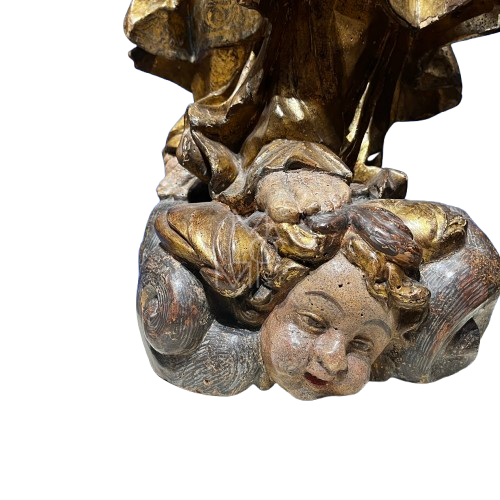
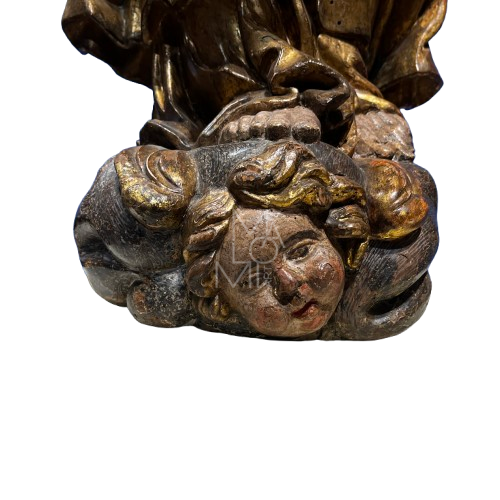
Another passage of exceptional artistic merit is found in the lower portion of the sculptures, where the bare feet of the angels rest upon a mixtilinear base. Here, the carver materialized a portion of heaven, sculpting a cumuliform mass simulating a cloud, from whose folds emerges, in a frontal position, the winged head of a cherub. The inclusion of the winged putto responds to two distinct necessities. Theologically, it establishes the celestial status of the principal figure, detaching it from the earthly dimension and placing it within a paradisiacal atmosphere. Architecturally and structurally, the cherub's face, characterized by full cheeks, fleshy lips, and short golden curls, functions as a true plastic buttress; it physically supports the weight of the angel's foot and discharges the volumes toward the supporting plinth, ensuring static stability for the entire sculpture. Minor executive variants are observable between the two cherubim of the pair: in one exemplar, the putto's face is slightly more inclined, while in the other, it is more frontal. This controlled asymmetry underscores the entirely manual execution of the work and excludes the use of mechanically replicated casts.
Construction Technique, Polychromy, and Estofado
The two sculptures are the result of a complex operative chain involving close collaboration between the carver and the gilder-painter (Ciatti 2002, p. 54). The main torso, head, and base were generally extracted from a single, large trunk of a soft, homogeneous wood, identifiable in this case as linden or poplar. The protruding arms and candelabra were carved separately to align with the natural grain of the wood and avoid structural splitting, before being joined to the central body using wooden dowels and hot animal glue. Upon the finished carving, the ground layer (ammanitura) was applied, consisting of multiple overlaid layers of gesso and animal glue, meticulously sanded. In the zones destined for garments and hair, Armenian bole was applied—a fluid clay of a reddish-brown hue typical of the Tuscan tradition—which served as a cushioning and tonal base for the gold. The pure gold leaf was applied using the water-gilding technique (a guazzo) and subsequently burnished with an agate stone to achieve a specular, metallic brilliance. For the fabrics of the tunics, the refined technique of estofado is evident: the gold was entirely covered with a layer of pictorial pigment and then scratched away with a stylus to reveal the underlying metal in the form of a decorative damask pattern. Conversely, the flesh tones of the face, hands, and feet received a matte or satin oil finish, applied in thin glazes to render a naturalistic epidermal effect.
State of Conservation and Diagnostic Notes
Both angels bear the evident signs of a long history of conservation within sacred spaces, fortunately spared from drastic or incongruous recent restoration interventions. The surface is protected by a precious historical patina. Within the recesses of the carving—particularly around the ocular orbits of both the angel and the cherub, and between the volutes of the hair—one finds consistent deposits of historical dust and bituminous residues linked to the centuries-long combustion of liturgical wax and incense (AASi, Visite Pastorali, 1575). The pictorial film of the flesh tones presents a dense and widespread network of micro-cracking (craquelure), caused by the natural hygroscopic movements of the underlying wooden support across the centuries. At points of maximum relief, such as the nasal bridge of the angel, the cheeks of the putto, and the edges of the drapery, the gilding is partially worn away by human contact during periodic liturgical cleanings, allowing the warm tone of the underlying red bole to emerge.
Conclusions
In conclusion, the pair of Sienese torch-bearing angels analyzed in this study represents an exceptional union between post-Tridentine liturgical functionality and late-Mannerist artistic mastery. Through a precise metrological standard of 105 by 45 centimeters, the workshop structured a highly stable and vertically dynamic composition, perfectly proportioned to the spatial realities of late-sixteenth-century altar architecture. A deep comprehension of their material nature—from the internal joinery of the linden trunks to the complex stratification of the estofado decoration—not only attests to the technical excellence of Sienese artistic craftsmanship but also restores the memory of an era in which carving and light converged to make the mystery of the sacred tangible.
Philological Bibliography and Sources
Archival and Documentary Sources
- Archivio di Stato di Siena (State Archives of Siena - ASSi), Regolamenti e decreti delle confraternite laicali post-tridentine, folder XLII, ad annum 1582.
- Archivio Arcivescovile di Siena (Archiepiscopal Archives of Siena - AASi), Visite Pastorali della Diocesi di Siena (1575-1600), register of Monsignor Francesco Bossio (1575), fols. 45r-72v.
- Borghini, Raffaello, Il Riposo, Florence, Giorgio Marescotti, 1584.
Specialized Critical Literature
- Bagnoli, Alessandro, La scultura in legno a Siena dal Gotico al Rinascimento, Florence, Editrice Grafica, 1987.
- Bagnoli, Alessandro, Roberto Bartalini, and Max Seidel, eds., Il Rinascimento a Siena: il Cinquecento, exhibition catalogue (Siena, 2010), Milan, Silvana Editoriale, 2010.
- Ciatti, Marco, ed., Dall'intaglio alla doratura: tecniche e restauri di sculture lignee policrome, Florence, Edifir, 2002.
- Gurrieri, Francesco, and Juri Coppi, La cattedrale di Siena: il coro ligneo e gli arredi monumentali della Controriforma, Venice, Marsilio, 2014.
- Riedl, Peter Anselm, and Max Seidel, eds., Die Kirchen von Siena, vols. 2-3, Munich, Bruckmann, 1992-2006.
- Spargi, Giovanni, "Arredi sacri e liturgia nella Siena della Controriforma", Bullettino Senese di Storia Patria, XCIV (1987): 120-145.
- Torriti, Piero, La pittura a Siena nel tardo Cinquecento: Francesco Vanni, Alessandro Casolani, Ventura Salimbeni, Milan, Electa, 1980.