Seventeenth-century poplar burl sideboard: a masterpiece of Bolognese cabinetmaking
Exceptional 17th-century Emilian sideboard entirely veneered in poplar burl. A monumental Bolognese piece featuring double-bent sides and hidden compartments.
- Period: 17th century (seicento)
- Origin: Italy, Emilia-Romagna (bolognese area)
- Materials: Poplar burl (external veneer), solid poplar (internal structure), wrought iron (hardware)
- Dimensions: Length 225 cm, depth 79 cm, height 118 cm
Emilian cabinetmaking in the seventeenth century: a historical, artistic, and structural analysis of a poplar burl sideboard
Historical and geographical context: the bolognese area in the seventeenth century
During the seventeenth century, the Emilian region experienced a period of extraordinary artistic fervor. In this scenario, the city of Bologna held a preeminent role. Despite being firmly integrated within the Papal States, it maintained a strong and proud oligarchic identity governed by the ancient families of the local senate. This climate of autonomy was directly reflected in the decorative arts and interior architecture, where the theatrical demands of Roman Baroque were assimilated and translated into a more measured and restrained language, yet no less monumental.
The Bolognese cabinetmaking of the era expressed the opulence of the aristocratic rank not through the ostentation of gilding or complex figurative carvings, as was common in Roman or Venetian workshops, but through the dramatic and chiaroscuro enhancement of the wood species themselves. The wealthy bourgeoisie and senatorial nobility loved to surround themselves with furnishings capable of dialogues with the austere solemnity of their urban palaces.
A frequent anecdote in the workshop chronicles of the time recalls how the choice of a large piece of furniture was not solely related to practical criteria, but represented a true calling card for guests admitted to the state rooms. In such contexts, the sideboard emerged as the centerpiece of the dining room or reception hall.
Material excellence: the integral poplar burl veneering
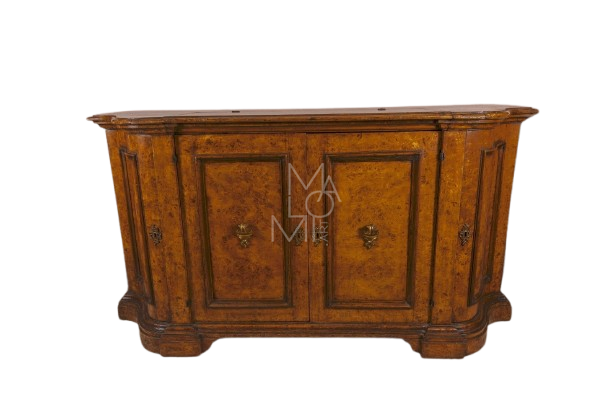
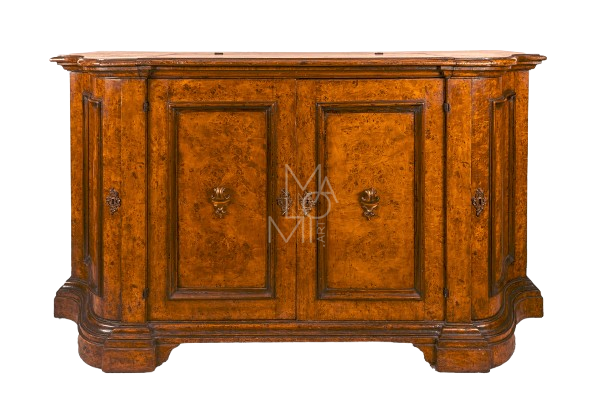
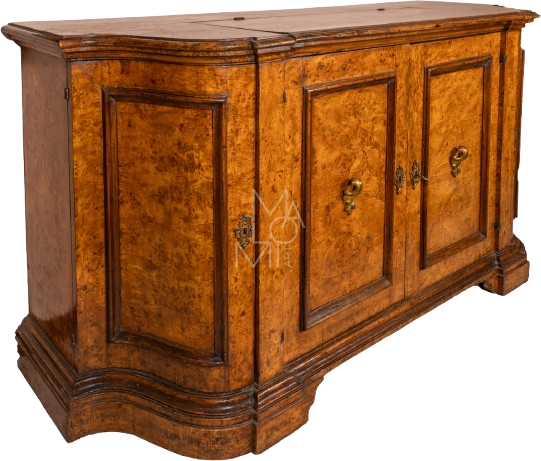
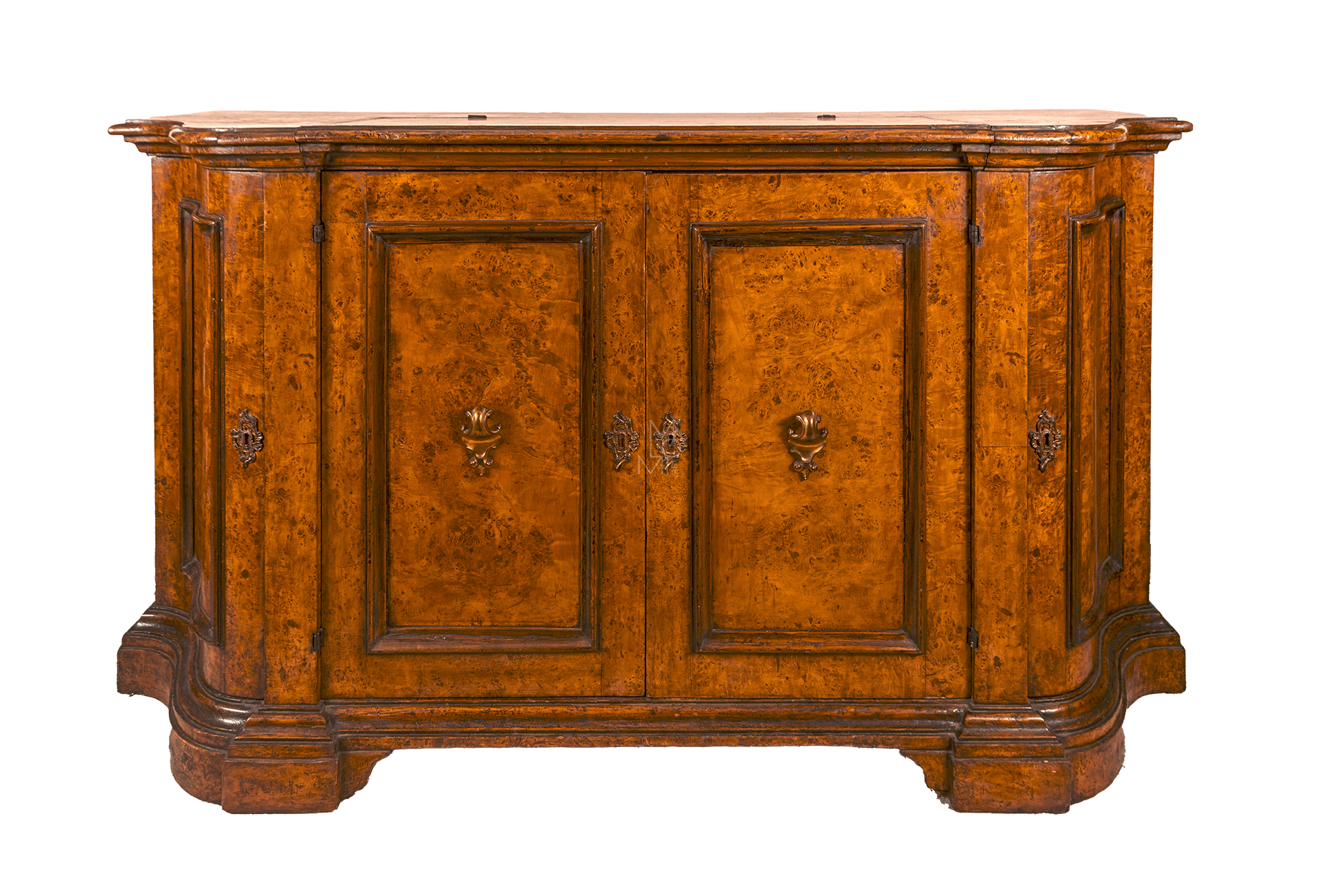
The element of exceptionality that grants this specific piece of furniture the status of a total work of art is the methodical and skillful application of poplar burl veneering across the entire exterior hull, a decorative choice that makes it an extraordinarily rare piece within the panorama of Emilian furniture of the time. Poplar burl, harvested from the knotty and tormented excrescences of the tree trunk, was a highly sought-after material but feared by craftsmen due to its extreme fragility and its tendency to move and split under the effect of environmental hygrometric changes.
A curiosity related to the processing of this wood lies in the registers of the ancient Bolognese carpenters' guilds, where the use of burl on curved surfaces was considered a sort of master examination. Only the most experienced master shipwrights and woodworkers dared to cover large wavy fields, as the manual cutting of high-thickness sheets required extremely sharp blades and organic ox-based glues applied at rigidly controlled temperatures.
Having coated the entire structure, including the concave and convex zones of the sides, transforms the surface of the sideboard into a shimmering and almost pictorial canvas, where the warm grains of amber and burnt brown imitate the complexity of variegated marbles or hard stones so fashionable in Baroque collections.
Architectural and morphological analysis: the play of lines and volumes
The configuration of the sideboard reveals a mature architectural conception, based on an imposing volume but dynamically moved in space. The upper top is crowned by a serpentine movement, a sinuous line that breaks the orthogonal rigidity of the piece and guides the viewer's eye along the sides. The perimeter profile is finished with a refined bevelled molding commonly defined as an owl-beak profile, a high-level technical device that serves to create a distinct shadow line and to impart a sense of lightness to the massive supporting top.
The front of the furniture is dominated by two large central doors protected by substantial molded frames arranged in tiers, which generate a strong perspective depth and accentuate the contrast between areas of light and shadow. The sides of the sideboard adopt a double-bent, bow-shaped configuration that harmoniously connects to the main section.
One of the most fascinating engineering solutions of this artifact lies in the integration of two additional side doors hidden within the continuous pattern of the burl itself. This choice did not solely respond to a search for aesthetic symmetry, but reflected a widespread need for domestic privacy in seventeenth-century residences, allowing servants to store or retrieve everyday objects quickly and discreetly, without necessarily revealing the entire contents of the main compartment.
The internal structure and the upper opening system
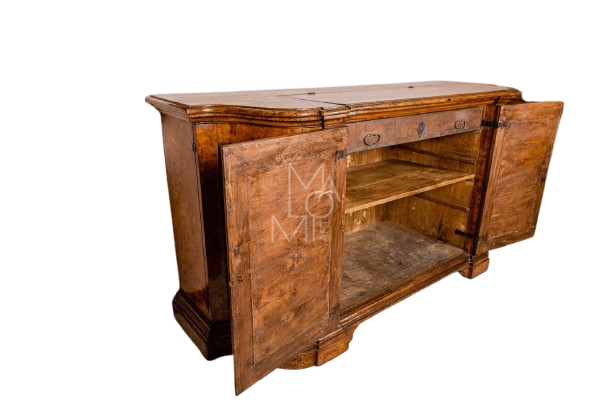
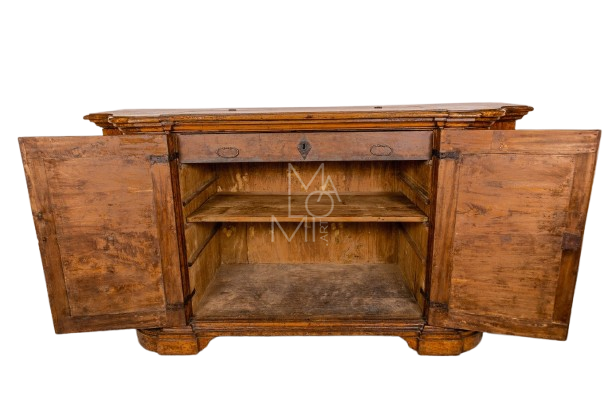
Inspection of the interior space reveals a sophisticated compartmentalization tightly linked to the ceremonial functions of the piece. The upper top partially lifts by means of a central hatch, configuring a well-like or top-flap opening system. This mechanical peculiarity is historically linked to the very origin of the Italian word for sideboard, credenza, derived from the act of the credenziere or butler tasting food and beverages before they were served to nobles to avert the danger of poisoning.
The openable top allowed immediate access to cruets, precious spices, and metal coolers without forcing the attendant to bow down before the lower doors. Encased centrally in the heart of the internal hull beneath the upper opening, lies a large drawer equipped with an independent wrought-iron lock. This protected compartment constituted a true domestic safe, intended for the custody of minor silverware, family seals, or private legal documents.
Below the drawer, the large lower compartment is divided horizontally by a sturdy shelf in solid poplar, designed to accommodate the heavy plate services and the ceremonial linen tablecloths of the house.
The base: fluting and fratinata clog feet
The lower part of the piece concludes with a monumental support system that discharges the considerable structural weight of the furniture onto the ground. The bottom band shows an elaborate bow-shaped fluting, a decorative motif of late-Renaissance ancestry that in the seventeenth century was reinterpreted to follow the curvilinear and flexed profile of the body above.
In the center, the furniture rests on a continuous shaped base known as a ciabatta fratinata. This type of continuous shoe-paddled foot was typical of furniture from conventual areas or large public Emilian halls and was particularly appreciated for its static stability on the terracotta or terrazzo floors of the era.
A workshop anecdote related to this kind of base narrates that the continuous shoe effectively protected the lower part of the furniture from the moisture of floor-washing operations, a common problem in the large and austere Bolognese palaces where cold and damp easily rose from the ground floors.
Metallurgical and diagnostic analysis: hinges and manufacturing marks
The internal hardware constitutes one of the most significant material documents confirming the authenticity and correct chronological placement of the furniture in the mid-seventeenth century. The imposing internal strap hinges are made of hot-forged soft iron, manually hammered on the anvil. Under macroscopic examination, the metal plates reveal slight variations in thickness, irregularities in course, and percussion burrs that attest to the absence of industrial processing and testify to the blacksmith's skill in shaping the metal to fit the asymmetries of the wood. The straps are attached to the frame by means of old pyramidal nails forged one by one, whose outer ends were historically hammered hot against the wood fiber to ensure a permanent hold.
The lock of the central drawer features a solid, hand-filed iron protective box, operated by a typical Bolognese bit key or shaped map key. The deep and symmetrical bitts of these keys were designed to overcome the internal wards of the keyhole, offering a high level of security against lock-picking attempts.
Close analysis of the solid poplar interior surfaces highlights the unmistakable marks left by the jack plane and the jointer plane. Parallel concave undulations and localized grain tears are perceptible to the touch, typical defects generated when the craftsman pushed the manual tool against the natural direction of the grain. Over the centuries, the wood of the internal compartments has developed a deep golden-honey oxidative patina, accumulating historical dust and waxes in areas of least friction and confirming the genuine nature of the artifact.
State of conservation and wear restorations
The sideboard has reached us showing the signs of physiological wear restorations that have affected its structure over the centuries. Since it is a monumental object intended for daily practical use, it is natural to find small conservative stabilization interventions, minimal plugging of the veneer at the junction points, or the replacement of old pins worn by the secular movement of the heavy doors.
Far from diminishing the commercial or historical value of the furnishing, these interventions testify to the care and attention that subsequent generations reserved for the piece to preserve its functionality and superb aesthetic yield, keeping alive the extraordinary natural brilliance of the poplar burl.
Reference bibliography
Alberici, Clelia, Il mobile barocco in Italia, Milan, Görlich, 1969.
Cuoghi Costantini, Marta, I mobili della casa bolognese, Bologna, Grafis, 1992.
González-Palacios, Alvar, Il Tempio del Gusto. Le arti decorative in Italia fra classicismo e barocco, Milan, Longanesi, 1986.
Lodi, Roberto, Bardazzi, Silvestro, Il mobile emiliano, Modena, Artioli Editore, 1984.
Mannoni, Tiziano, Giannichedda, Enrico, Archeologia della produzione, Turin, Einaudi, 1996.
Mazzariol, Giuseppe, Il ferro battuto: tecniche e stili dal Medioevo al Barocco, Venice, Alfieri, 1978.
Spiazzi, Anna Maria, La cultura del mobile: conservazione, restauro, tutela, Venice, Marsilio, 1993.