Seventeenth-Century Gilt-Bronze Sculpture
The Evangelist in Bronze: A Historical-Artistic and Technological Analysis of a Pair of Seventeenth-Century Gilt-Bronze Sculptures
- Introduction and Iconographical Identification within the Devotional Program
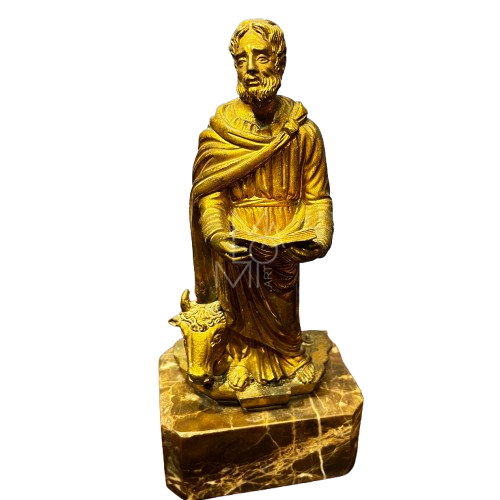
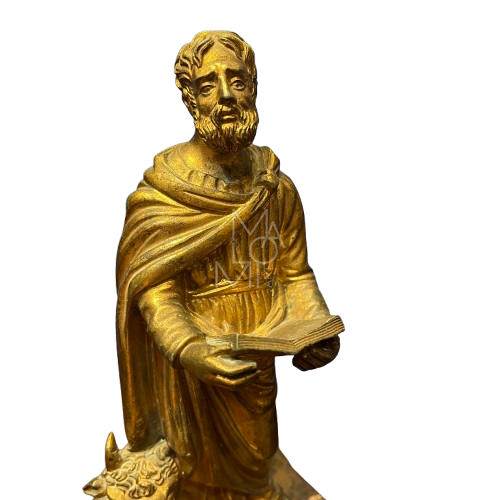
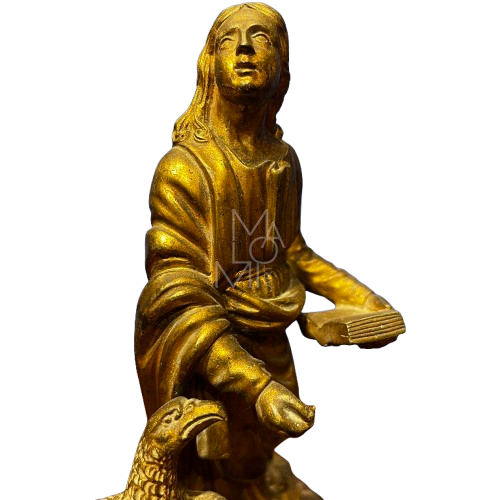
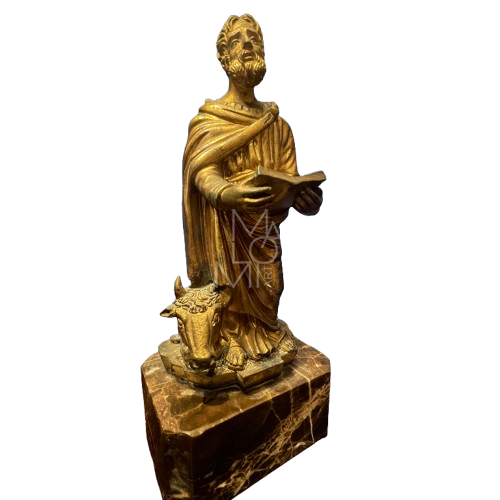
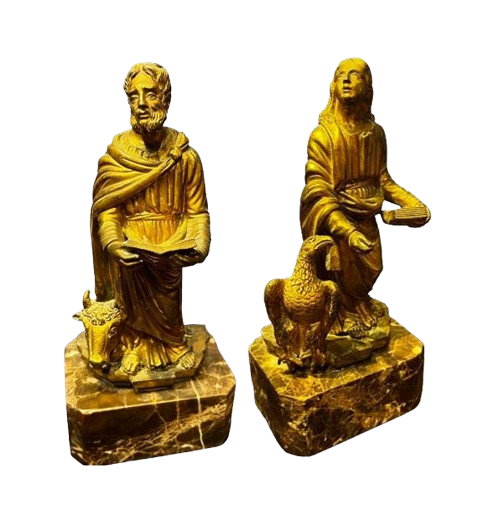
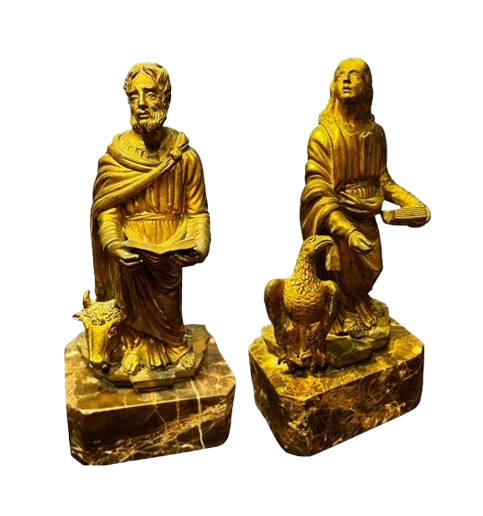
The works under examination comprise a pair of gilt-bronze sculptures of exceptional executive skill and formal refinement, representing Saint Luke and Saint John the Evangelist respectively. Originally conceived as specular and complementary elements of a single cohesive program—a pendant presumably integrated, at its inception, by the now-lost figures of Saint Matthew and Saint Mark—both pieces describe a consistent theological and visual narrative centered upon the celebration of the authors of the Gospel texts and the transmission of the Holy Word. The restrained dimensions of the two artifacts (measuring 18 cm in height, 9 cm in width, and 6 cm in depth for Saint Luke, and 17 cm in height, 8 cm in width, and 5 cm in depth for Saint John), together with the presence of elegant plinths in dark brecciated marble with ochre veins, indicate a destination linked either to high-ranking private devotion or, more likely, to the subsidiary ornamentation of monumental liturgical furnishings, such as temple-shaped tabernacles, ciboria, or reliquaries.
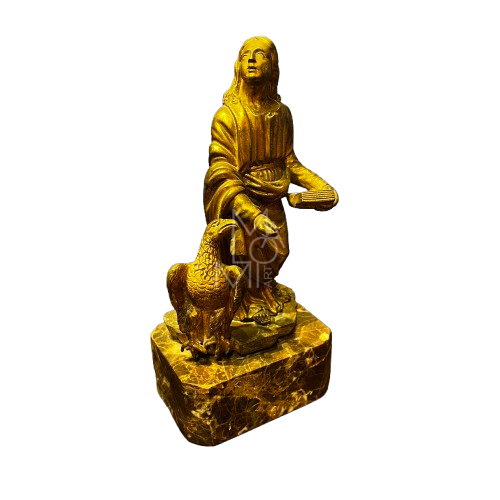
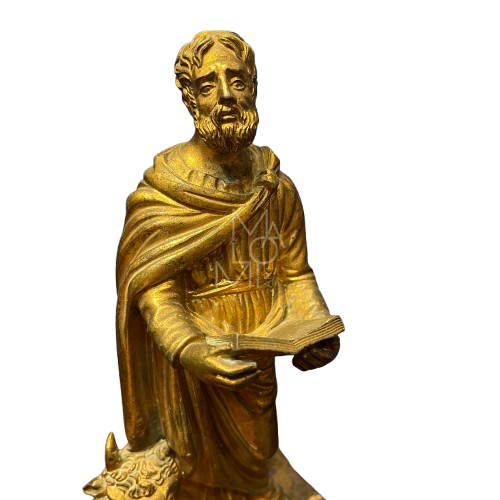
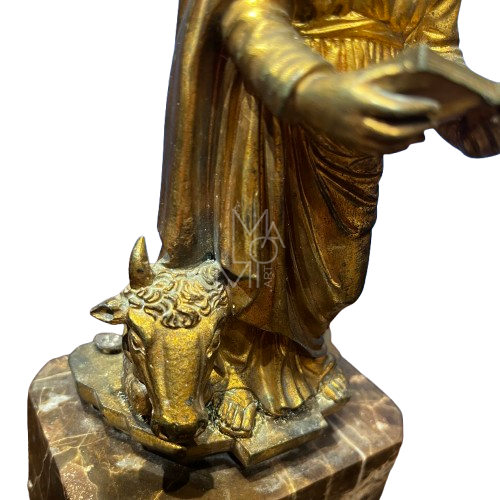
In the first sculpture, Saint Luke the Evangelist is represented with the features of a mature man, characterized by a thick, short beard modeled in small, compact, geometric curls. His identifying iconographical attribute, the winged ox, which according to the tradition of the Tetramorph symbolizes the sacrificial and priestly nature of his text, is here declined solely as a couchant bovine protome. This creature emerges forcefully from the rocky terrain of the base, positioned to the right of the Saint. In perfect typological and physiognomic opposition to Saint Luke, the second sculpture depicts Saint John the Evangelist, traditionally identified as the "beloved disciple." John exhibits the youthful features of an ephebic and beardless face, framed by long, wavy locks of hair falling softly onto his shoulders. At his side, at the lower right, stands the eagle with half-closed wings, the heraldic and spiritual symbol of the theological sublimity of his Gospel, capable of soaring toward the most impervious heights of understanding the divine Word.
The conceptual link between the two works is expressed through a studied, specular gestural grammar and a distinct treatment of the holy book, elements that activate a veritable dialogue across space. In Saint Luke, the codex is held open with both hands in front of his chest, in an attitude of concentrated and reflective reading that symbolizes historical investigation and documentary precision. Conversely, in Saint John, the dynamic becomes purely prophetic and receptive: the Saint supports the volume with his left hand alone, leaving it partially closed, while his right arm flexes forward with an open palm in the typical gesture of declamation or the welcoming of heavenly dictation. A semantic counterweight is thus established, wherein the intellectual and earthly study of Luke acts as a foil to the mystical, airborne ecstasy of John, binding the two physical prototypes to two distinct phases of divine revelation.
- Formal Syntax: The Dialogue Between Structure and Movement
From a stylistic perspective, the two sculptures reveal the hand of the same master craftsman, while expressing two distinct and calibrated variations of seventeenth-century rhetoric. A comparative analysis of the bodies and drapery discloses a refined play of variations on a theme, conceived by the author to avoid any visual monotony within the intended symmetrical arrangement of the pieces inside the sacred space.
The Saint Luke is characterized by a monumental and solid structure, dominated by a predominantly vertical compositional axis. The mantle (the classical himation) envelops the left shoulder and descends along the front, forming broad, rectilinear folds, thick and heavy, which impart stability to the figure. The Saint discharges his weight evenly onto both feet, shod in finely detailed antique-style sandals. This erect, almost architectural posture acts as a visual pillar and an element of formal stability within the pair, placing the work on the boundary between the geometric rigor of the international late Mannerism and the search for plastic dynamism characteristic of the Baroque.
The Saint John, by contrast, breaks the rigid verticality of his companion through a delicate yet evident Baroque torsion, wherein the torso rotates slightly in relation to the pelvis to accommodate the outstretched movement of the right arm. The drapery here becomes tangibly more unstable and vaporous, as the fabric bunching around the hips forms large, curved folds that capture shadow, subsequently descending diagonally toward the left foot and leaving the right uncovered in a hint of pedestrian movement. The most powerful formal bond between the two sculptures, however, is entrusted to the direction of their gazes, which mirrors emotional tension upward. While Luke makes a measured movement, tilting his head with an expression of stern and mature concentration, John exaggerates this attitude, inheriting the lessons of the Roman Baroque derived from the circle of Gian Lorenzo Bernini. His chin is sharply lifted, his mouth left parted in the suspended instant of ecstasy, and his eye sockets are deeply carved to accentuate chiaroscuro effects, translating into bronze the vertigo of inspiration and direct contact with the divine.
- Casting Technology and Central Italian Material Culture
The technical qualification of the two small bronzes offers the most robust data for critical contextualization, owing to the seamless alignment between the external stylistic rendering and the intrinsic nature of the worked material, traceable through the visual examination of the alloy and its aging layers.
The emergence of a characteristic blond-greenish patina in the areas worn by handling represents the key scientific benchmark of this investigation. This specific chromatic reaction allows for the exclusion of bronzes with a high copper content, which are typical of Venetian foundries and characterized by dark brown or reddish shifts. Instead, it indicates the use of an alloy rich in tin with a significant presence of zinc, akin to the family of historical brasses or quaternary bronzes. Within the Central Italian region, and specifically within the Papal States, this composition was extremely frequent due to the constant recycling of metals inside secondary foundries, which worked alternately for artistic patronage and for the utilitarian casting of bells and liturgical artillery (which required alloys with a high tin content to guarantee sonority or structural resistance). The "blond" metallic base, intrinsically light and luminous, constituted the ideal support for the application of gold, as it allowed for a warm, solar final surface without the risk of dark copper oxidations compromising its brilliance. Atop this alloy rests the natural aging patina, where copper carbonates (malachite) have generated over time a soft, powdery greenish tone, stratified particularly within the less exposed recesses, proving a genuine patination rather than one induced chemically.
The two sculptures also share the same meticulous cold-work finishing executed after extraction from the investment mold via the lost-wax casting technique. The artisan intervened with chisels and punches to skillfully differentiate the material textures of the zoomorphic portions. This is demonstrated by the hairy hide of Saint Luke's ox, rendered with short, parallel strokes that recreate the density of the animal's skin, contrasted against the plumage of Saint John's eagle, incised with small blows of a round-tipped chisel to recreate the overlap of feathers with an almost graphic sensitivity. The superficial gilding, executed with a mercury amalgam (fire-gilding), was applied with vigor, following the softness of the wax modeling and smoothing any sharp edges. The present-day losses of the gold align perfectly with the conservation history of the pieces, clustering along the ridges of the drapery and the historical points of manual contact, thus confirming the antiquity and integrity of the coating.
- Structural Analysis of the Reverse: Execution Technique and Fastening Systems
An examination of the posterior portion of the artifacts offers decisive documentary and structural evidence to confirm the original functional use and the executive consistency of the pendant. The morphology of the reverse reveals a rigorous plastic conception, designed primarily for a frontal view yet resolved with synthetic, functional passages devoid of negligence.
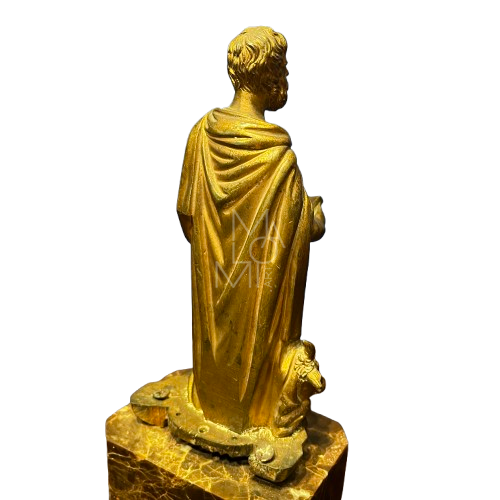
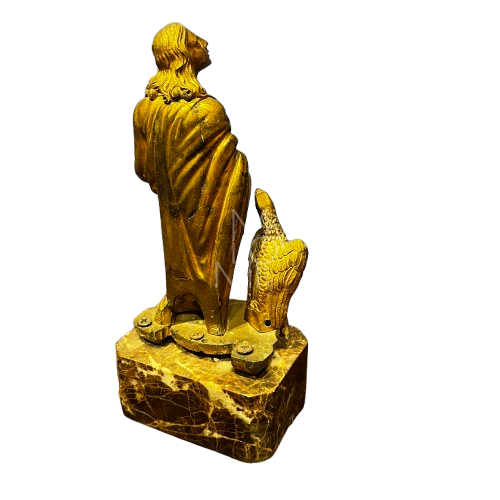
The reverse of Saint Luke shows a solemn drapery with a geometric progression, with the mantle falling across the back in a broad "V-shaped" field characterized by concentric, softly sliding folds. Conversely, the posterior side of Saint John is distinguished by a more animated and fluid plasticity, in which the mantle envelops the left shoulder and slides along the flank in broad diagonal and curvilinear folds that visually accommodate the torsion of the Saint's body. The treatment of the hair, observed from behind, likewise reveals the master's intent for iconographical differentiation: Luke's hairstyle is resolved with a spherical cap of short, individually incised locks, while John's youthful hair divides evenly at the center of the nape and falls over the scapulae in sinuous curls, carved cold with a fine-tipped chisel.
The element of maximum convergence and structural verification resides in the morphology of the mistilineal bronze bases and their anchoring systems. On both sculptures, peripheral through-holes are clearly visible, designed during the cold-finishing stage (or planned directly within the wax model) to accommodate fastening pins. On the Saint Luke, three through-holes are observed retaining the threaded or riveted heads of ancient screws. On the Saint John, corresponding to the reverse of the Saint, the head of an ancient metallic screw with an irregular slot or riveting is clearly visible, firmly clamping the bronze to the underlying marble plinth. A further technical detail of note is the small circular hole located at the base of the tail of Saint John's eagle, acting as a subsidiary anchoring point or a casting vent, useful for stabilizing the figure of the animal (which projects laterally relative to the Saint's axis) during assembly.
This structural evidence permits an exact reconstruction of the functional history of the pair: these bronzes were not born as freestanding statuettes for table or collector display cabinets, but were elements solidly anchored to a supporting architectural framework. The pins served to lock the bronze bases originally onto a wooden socle (perhaps the crest of a tabernacolo or the cornice of an altar made of ebony and semi-precious stones). Only at a later stage, during the late eighteenth or nineteenth century, were they adapted and fixed onto the insulating plinths of brecciated marble visible today. Regarding the state of conservation, the fire-gilding on the reverse of both figures presents itself as exceptionally vibrant and dense. The absence of mechanical wear from manual friction on the posterior side has protected the original gold film over the centuries, maintaining a more intact thickness that fades into the blond-greenish patina only within the most protected recesses of the furrows, confirming an authentic temporal sedimentation and a conservation history perfectly shared by both artifacts.
- Geographical Context, Destination, and Historical Function
Dimensional findings show a minimal millimetric discrepancy between 18 and 17 centimeters in height, a feature entirely physiological in ancient bronze production, resulting from the differential shrinkage of the molten metal during cooling and the intrinsic imperfections of hand-worked wax models. Such measurements securely place the pair within the realm of subsidiary plastic art or decorative furnishings for larger structural complexes.
The joint analysis of stylistic, material, and structural factors allows for the exclusion of both the chilly design-led rigor of the late sixteenth-century Florentine school and the exaggerated pictorialism or elongated proportions of Venetian workshops. The pair sits stably within the productive orbit of Central Italy, along the Umbro-Roman or Marchigiano axis of the Papal States during the second half of the seventeenth century. In this specific cultural territory, the production of small bronzes was strictly subordinate to the requirements of liturgical altar renewal promoted by the Catholic Counter-Reformation. Monumental architectures such as temple tabernacles, complex reliquaries, or grand organ cases required the presence of decorative sacred figures that could be read clearly by an observer positioned below.
The slight forward inclination of the bodies of both evangelists, the vertical thrust of their gazes, and the synthetic execution of the reverse confirm that the two sculptures were intended for an elevated position, originally placed within niches or atop the lateral pillars of an altar ciborium, serving as symbolic guardians of the Eucharistic dogma. The workshops of this area (highly updated on the rhetorical and theatrical models of Berninesque Rome for the ecstasy of Saint John and Algardian models for the composure of Saint Luke) translated the magniloquence of the papal capital into reduced formats suitable for provincial patronage.
The plinths in dark brecciated marble, with their edges cut at forty-five degrees, act as isolating elements and accentuate the solemn tone of the figures. The choice of a marble rich in yellowish and ochre veins is not accidental, but responds to a precise aesthetic will: it chromatically echoes the tones of the gilding and the blond patina of the bronze, binding the sculpture to its support in a visual block of extraordinary Baroque coherence. In conclusion, the pair represents a learned and successful testament to that Marchigiano and Umbrian sculpture capable of assimilating the grand theatrical language of papal Rome, translating it into artifacts of exceptional technical skill, profound devotional efficacy, and intact historical integrity.