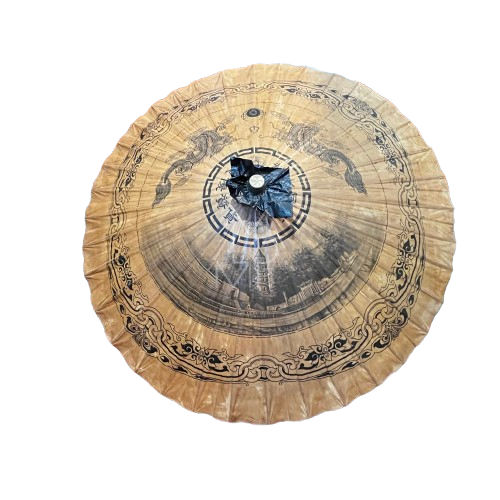
Rare 1946 chinese oil-paper parasol executive headquarters military mediation commission
Chinese material culture, Republic of China history 1946, general Marshall mission, Chinese Civil War artifact, executive headquarters Peiping, Jundiao militaria, oil-paper parasol, Hangzhou West Lake iconography, 20th-century Chinese political history, A
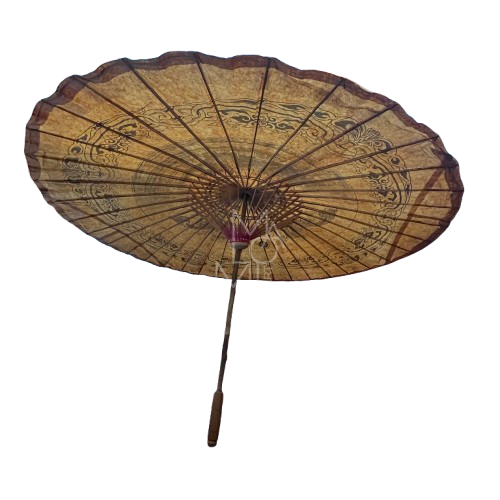
- Artifact Type: Traditional Chinese oil-paper and bamboo parasol (Youshan).
- Chronology / Dating: Republic of China (ROC), circa 1946–1947.
- Historical Significance: A highly scarce and important political artifact commissioned by the Executive Headquarters (軍事調處執行部) in Peiping (Beijing). This tripartite commission—comprising the Chinese Nationalists (KMT), the Chinese Communists (CCP), and US mediators led by General George C. Marshall—attempted to broker peace during the crucial post-war phase of the Chinese Civil War.
- Epigraphy / Inscriptions:
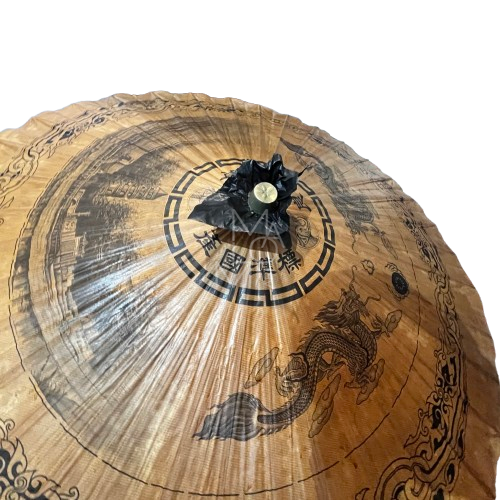
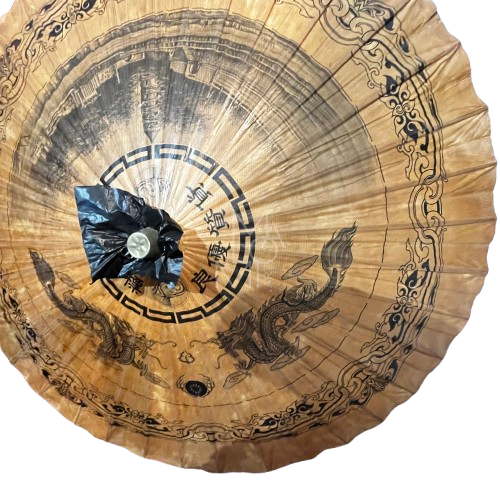
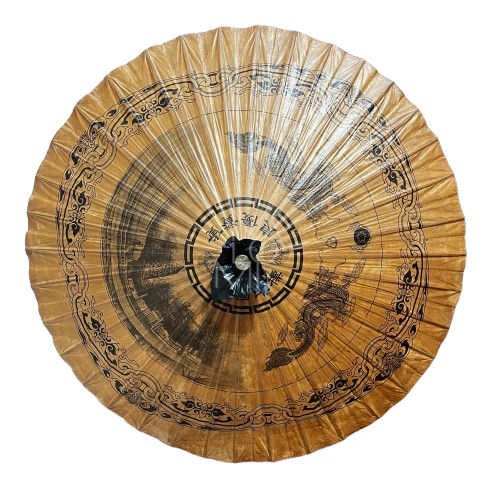
- 「貨質優良」 (Huò zhì yōuliáng) – "Product of Excellent Quality" (National Goods Movement certification).
- 「軍調團製」 (Jūn diào tuán zhì) – "Manufactured by the Military Mediation Group / Executive Headquarters."
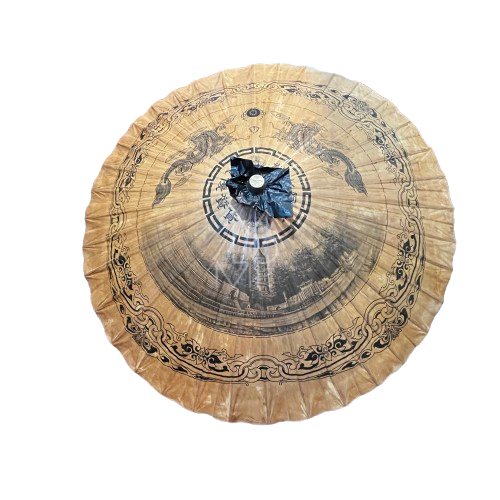
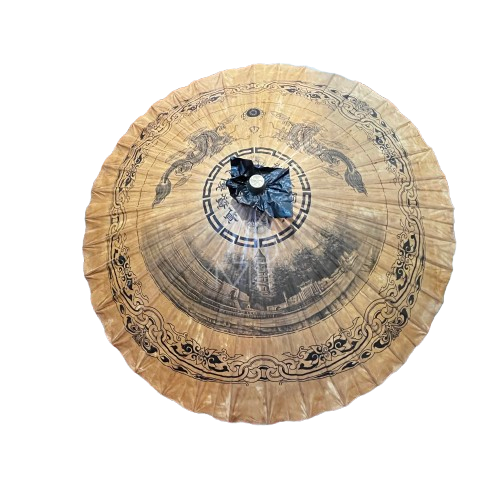
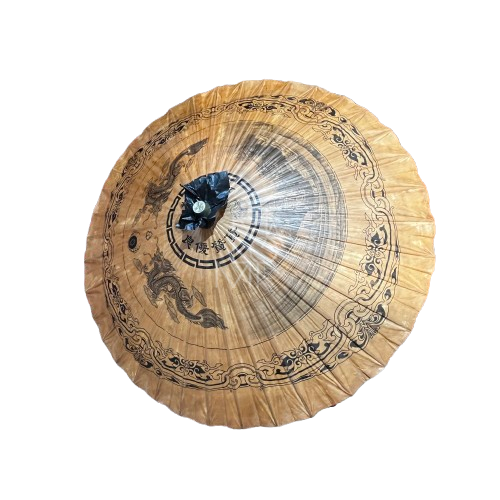
- Iconographic Analysis: Fine ink-printed traditional motifs featuring Imperial-style Chinese dragons in the upper register and a panoramic vista of the West Lake (Xihu) in Hangzhou, punctuated by the Baochu Pagoda, in the lower register. The composition is framed by a continuous geometric key-fret pattern.
- Materiality & Construction: Mulberry/rice paper canopy lacquered with organic tung oil mounted upon a dense radial framework of split Moso bamboo ribs and stretchers. The central hub is reinforced with traditional red structural thread-bindings acting as a tension absorber.
- Condition Report: Exceptional vintage condition. The organic canopy remains stable and intact with no significant perforations, tears, or structural losses. Displays a beautiful, homogenous, warm amber patina consistent with mid-20th-century preservation. Mechanical bamboo framework remains entirely stable and operational.
The parasol of mediation: a historical-artistic and cultural analysis of a rare artifact from the Marshall mission (1946–1947)
- Introduction: the material artifact as a political document
In the vast landscape of Oriental studies, Sinology, and the rigorous examination of twentieth-century Chinese material culture, it is highly uncommon to encounter an ephemeral craft object that transcends its utilitarian purpose to become a primary diplomatic and geopolitical document. The traditional oil-paper parasol under analysis represents one of these extraordinary exceptions. It does not merely stand as a fine and sophisticated example of a youshan—the traditional Asian umbrella crafted from vegetable-oil-treated paper—but functions as a tangible historical archive, preserved in exceptionally legible condition.
Through a multidisciplinary examination encompassing the epigraphic philology of its central seals, the iconographic analysis of its ink-printed motifs, and the structural engineering of its complex bamboo framework, the artifact reveals its direct provenance from one of the most delicate, dramatic, and under-documented phases of modern East Asian history. This corresponds to the convulsive and crucial two-year period immediately following the conclusion of World War II, during which the destiny of China oscillated precariously between the utopia of national democratic reconciliation and the abyss of a fratricidal civil war. This artifact thus stands as a silent and extraordinarily rare witness, shedding new light on the propaganda dynamics and everyday material life of the international delegations that attempted to rewrite the political equilibrium of the region.
- The socio-political framework: the executive headquarters and the Marshall Truce
To fully comprehend the origin, rationale, and intended use of this exceptional artifact, it is indispensable to contextualize the historical and geopolitical landscape between January 1946 and the early months of 1947. Following Japan's formal surrender in August 1945, China found itself liberated from foreign occupation but dramatically suspended on the brink of a catastrophic civil war. Latent tensions between Chiang Kai-shek’s official Nationalist government (Kuomintang, KMT) and Mao Zedong’s burgeoning Communist forces (CCP) threatened to engulf the entire Asian continent. In a desperate bid to stabilize the region and prevent the rise of a hostile bloc, US President Harry S. Truman dispatched General of the Army George C. Marshall to China as a special presidential envoy, leveraging the prestige of the architect of the Allied strategy in Europe.
General Marshall immediately recognized that halting hostilities required a neutral, centralized executive body. Consequently, in January 1946, the Executive Headquarters—historically abbreviated as Jūndiào (軍調) or the Military Mediation Group—was established in Peiping (modern Beijing), with its headquarters located within the grand spaces of the Grand Hotel de Pékin. This structure was designed as a unique, tripartite investigative and enforcement commission. On one side sat high-ranking cadres of the Nationalist government; on the other, delegates of the Chinese Communist Party, among whom the diplomatic figure of Zhou Enlai stood out; and at the center operated officers, interpreters, and mediators from the military and diplomatic apparatus of the United States of America.
The mandate of the Jūndiào was to monitor the ceasefire and coordinate the "truce teams" dispatched to the field to separate the opposing armies. Within this feverish climate of diplomatic and logistical activity, the general affairs and propaganda department of the Executive Headquarters commissioned a limited series of consumer goods, supplies, and high-quality artisanal presentation objects. These items were not intended for commercial trade; instead, they were utilized within the operational bases or offered as prestigious institutional gifts to foreign delegates, particularly American officers, to celebrate the ideal of cooperation and to document the authority of the mediation body. The parasol under analysis originates precisely from this restricted sphere of military and diplomatic patronage, configuring itself as an official object of representation.
- Historiographical genesis and archival verifications: the official journals of the Marshall mission
The precise identification of this institutional provenance has been achieved by cross-referencing the material culture of the artifact with the primary written sources of the era, specifically the official diaries, minutes, and reports of the American diplomatic mission. This immense documentary corpus is collected in the monumental work titled The Marshall Mission to China: December 1945–January 1947, a text whose turbulent historical genesis faithfully mirrors the political tensions of the post-war era. The original documents were compiled daily, in real time, by the secretariats of the officers assigned to the three sections of the Executive Headquarters in Peiping. Every logistical agenda, every subsistence inventory, and every note regarding supplies destined for the members of the tripartite commission was produced within an environment of mutual espionage, resulting in immediate encryption or restriction under military secrecy.
When the truce collapsed in the early months of 1947, General Marshall ordered the immediate and secured repatriation of all archives to protect them from the destruction of the escalating civil war. Upon arrival in Washington, these texts were classified by the US Department of State and the Department of War for over twenty-five years. The fear of American administrations was that publishing the details of the negotiations might fuel bitter domestic debates over McCarthyism and the so-called "Loss of China" to the Soviet bloc. Only in the mid-1970s, following the enactment of the Freedom of Information Act and the historic diplomatic opening toward Beijing initiated by Richard Nixon and Henry Kissinger, were the documents declassified and transferred to the National Archives and the Hoover Institution at Stanford University, enabling historian Lyman P. Van Slyke to edit the first comprehensive critical edition in 1976.
It is precisely within the logistical appendices and expenditure ledgers of these official journals that critical verisons for the authentication of this parasole emerge. In chapters dedicated to public relations and the management of the Grand Hotel de Pékin, the practice of financing and commissioning artifacts from traditional Chinese paper and bamboo guilds is detailed. Marshall and his staff recorded how such commissions were strictly required to incorporate both symbols of local artistic tradition and the official certification stamps of the truce authority. The political objective was two-fold: to sustain the domestic manufacturing economy and to demonstrate to the Chinese counterparts the mission's deep respect for the host nation's sovereignty and aesthetic culture. The written journal of Marshall thus finds its precise physical counterpart in this oil-paper umbrella.
- Epigraphy and exegesis of the seals: standardization and state legitimacy
The element that imparts an inestimable documentary value to this parasol, allowing it to be definitively differentiated from any subsequent commercial or tourist reproduction, lies in the epigraphic inscription printed in traditional Chinese characters within the central geometric circle. The reading of the characters, which unfolds counter-clockwise according to the strict conventions of horizontal writing prevalent during the Republican era, reveals a two-part text of fundamental philological significance. The right portion of the medallion reads Huò zhì yōuliáng (貨質優良), a formula that translates literally as "Product of Excellent Quality." This phrase was not a simple commercial slogan; rather, it connected directly to the decrees of the "National Goods Movement" (Guohuo Yundong). This economic and cultural campaign, promoted since the 1920s and 1930s by the Chinese government, aimed to certify and promote domestic manufacturing excellence, urging citizens and institutions to purchase items made within the territory using local raw materials, thereby countering the long-standing economic monopoly of Western and Japanese imports.
The historiographical turning point, however, focuses on the left half of the central circle, which clearly reads Jūn diào tuán zhì (軍調團製), translatable in academic terms as "Manufactured by the Military Mediation Group" or "Produced under the Supervision of the Mediation Headquarters." The term Jūndiào constitutes the exact historical contraction and official title utilized at the time to designate the Executive Headquarters of the Marshall Mission. The subsequent term, Tuán, defines the unit or logistical action corps responsible for subsistence and supply, while the character Zhì appends the final seal of controlled manufacturing. The combination of these two formulas yields a programmatic text: the military authority certifies that the object meets the highest quality standards of the nation and was produced expressly for the needs and under the direct aegis of the tripartite commission. This represents an attestation of state legitimacy that transforms the object into a fully-fledged archival document.
- Iconography and symbolism: the visual synthesis of landscape and Myth
The decorative program adorning the amber canopy of the umbrella demonstrates an extraordinary aesthetic awareness, skillfully blending millenarian canons of traditional ink landscape painting (shanshui) with the self-representation needs of Republican political and military power. The visual surface is ideally divided into two broad narrative registers that engage in dialogue, offering the observer a message of harmony, legitimacy, and stability.
In the lower register, a detailed and evocative panoramic view unfolds, celebrating one of the most iconic and culturally dense locations in all of China: the West Lake (Xihu) of Hangzhou. The artistic ink composition clearly highlights the unmistakable, slender, and geometric silhouette of the Baochu Pagoda rising on the lake shore. This iconographic choice possesses multiple levels of reading. On one hand, the city of Hangzhou and Zhejiang province were historically considered the global capitals and cradle of high-grade oil-paper and silk umbrella manufacturing, renowned for the quality of their materials and the skill of their decorators. On the other hand, within the Chinese literary tradition, the landscape of the West Lake evokes par excellence the philosophical concepts of serenity, social harmony, equilibrium, and eternal peace. Including this specific vista on an object commissioned by a military mediation body carried a clear propagandistic and auspicious message: the commission was operating so that China could rediscover the peace and stability symbolized by that timeless landscape.
In perfect symmetrical opposition, the upper register hosts the depiction of majestic Chinese dragons floating sinuously amidst stylized clouds and celestial vapors. It is important to emphasize that following the fall of the Qing dynasty and the advent of the Republic, the figure of the dragon was stripped of its exclusive value as an imperial and absolutist emblem. In the twentieth century, the dragon was reinterpreted as the supreme symbol of national sovereignty, the spirit of the Chinese people, and benevolent protection against adversity. Its presence on the parasol serves to legitimize the actions of the Jūndiào, placing them under the visual protection of the tradition's most sacred symbols. The entire decoration is enclosed and harmonized by a refined peripheral meander border, also known as the key-fret pattern. In Sinitic decorative grammar, this continuous, broken geometric line symbolizes uninterrupted longevity, institutional continuity, and imperishable fortune, sealing the work with a potent auspice for the success of the peace negotiations.
- Material and structural analysis: the engineering of bamboo and oil-paper
From the perspective of material culture and industrial archaeology, the parasol offers extraordinary testimony to the sophisticated artisanal engineering of Southern China. This technology, which remained substantially unchanged for centuries, was applied here with rigorous control standards to fulfill an institutional commission. Every component of the object responds to precise physical and structural requirements, demonstrating a perfect synergy between the choice of organic materials and their mechanical performance.
The upper canopy, the element most exposed to atmospheric stress, is constructed through the layering and partial overlapping of high-strength paper sheets, traditionally derived from the bark fibers of the mulberry or rice plant. The fundamental characteristic allowing the paper to resist time and weather is the complex waterproofing process. The surface was repeatedly brushed with pure tung oil, a vegetable oil extracted from the seeds of the fruits of the Vernicia fordii (tung tree) or China wood tree. Tung oil, penetrating the fibers of the paper, undergoes a natural process of polymerization and oxidation upon contact with air, transforming into a protective, water-repellent, flexible, and semi-gloss film. This treatment is directly responsible for the splendid amber patina—warm and translucent—that the object displays when backlit, highlighting the grain of the paper as if it were an antique parchment.
Beneath the canopy unfolds a true masterpiece of artisanal carpentry: a dense, geometric radial framework exceeding forty units, composed of primary ribs and secondary stretcher struts. The entire supporting structure and the central shaft are crafted from Moso bamboo, a variety celebrated for its exceptional mechanical qualities of flexibility, lightness, and extraordinary resistance to both tensile and bending stress. The nerve center of the movement is represented by the runner, the wooden or solid bamboo hub that slides along the main shaft to permit the opening of the parasol. At this crucial nexus, a spectacular and dense geometric binding executed by hand with twisted silk threads is visible, dominated by the traditional red coloration. This network of threads possesses more than just decorative or auspicious value; it performs a vital engineering function. It acts as a tension shock absorber: when the umbrella is opened to its maximum extension, the silk network uniformly distributes the physical forces and mechanical stresses across all secondary bamboo stretchers, preventing the joint points from undergoing critical loads that could cause splitting or structural failure of the thin woody fibers.
- Conclusions: collectible Scarcity in the international antiquities market
The definitive failure of General Marshall's diplomatic mission in the early months of 1947, precipitated by the irreconcilable ideological and military positions of the Nationalists and the Communists, led to the abrupt withdrawal of US mediation forces and the total collapse of the Executive Headquarters. Shortly thereafter, China was engulfed in the bloodiest phase of its civil war, culminating in 1949 with the proclamation of the People's Republic of China by Mao Zedong and the flight of the Kuomintang government to the island of Taiwan. During these epochal upheavals, the Jūndiào headquarters in Peiping were hastily dismantled; paper archives were partially destroyed or classified, and the vast majority of logistical materials, supplies, and celebratory objects tied to the commission were irretrievably dispersed, destroyed by looting, or forgotten in the chaos of conflict.
The very few specimens of this institutional production that managed to survive to the present day arrived in the West almost exclusively as personal souvenirs or historical trophies, brought home by American officers, accredited journalists, or members of international logistical committees at the conclusion of their service in Peiping in 1946. This dramatic and documented scarcity radically transforms the classification and appraisal of the parasol under analysis. It can no longer be considered or valued according to the standard commercial parameters governing the market for oil-paper umbrellas of late-Republican tourist production or even the fine artisanal Taiwanese manufacture of Meinong from the 1960s and 1970s.
This object configures itself in all respects as a highly rare historiographical unicum, a tangible artifact of a moment when world history oscillated between diplomacy and warfare. In international auctions specialized in Republic of China antiquities, twentieth-century Asian militaria, and international political memorabilia, a artifact that combines the absolute integrity of its organic structure with the presence of an epigraphy so clear, sharp, and historically circumscribed to the 1946–1947 biennium ranks at the apex of collectible rarity. The object represents a high-profile acquisition for both elite private collectors and museum foundations dedicated to the study of Sino-American relations and twentieth-century political history.
- Bibliography and references
Political and institutional history (The Marshall Mission and the Jūndiào)
- Beal, John Robinson (1970). Marshall in China. Toronto: Doubleday & Company.
- Lynch, Michael (2018). The Chinese Civil War 1945–49. Oxford: Osprey Publishing.
- Marshall, George Catlett (1976). The Marshall Mission to China: December 1945-January 1947. Arlington: University Publications of America.
- Westad, Odd Arne (2003). Decisive Encounters: The Chinese Civil War, 1946-1950. Stanford: Stanford University Press.
Material culture and craft history (Youshan and Guohuo)
- Dikötter, Frank (2007). Exotic Commodities: Modern Objects and Everyday Life in China. New York: Columbia University Press.
- Hommel, Rudolf P. (1937, Reprint 2013). China at Work: An Illustrated Record of the Primitive Industries of China. Cambridge: MIT Press.
- Needham, Joseph (1965). Science and Civilisation in China: Volume 4, Physics and Physical Technology, Part 2, Mechanical Engineering. Cambridge: Cambridge University Press.
Iconography and conservation of Oriental artifacts
- Clunas, Craig (1997). Pictures and Visuality in Early Modern China. London: Reaktion Books.
- Ecke, Gustav (1993). Chinese Domestic Furniture and Minor Arts of the Republican Period. Hong Kong: Hong Kong University Press.