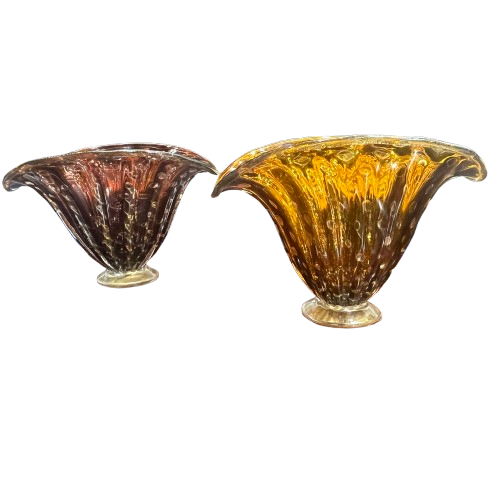
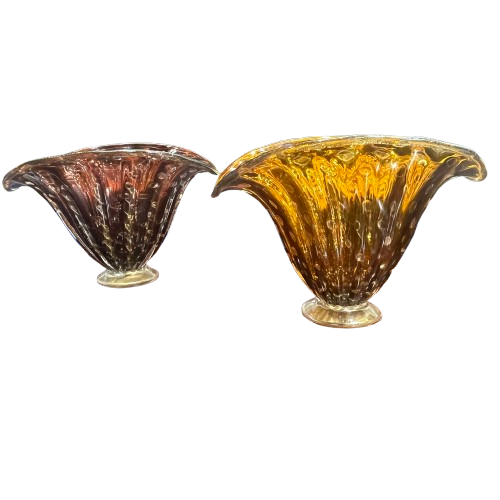
Pair of 1950s Toso Murano sommerso vases in gold cordonato glass
- Manufactory: Toso Murano
- Period: circa 1950–1952
- Technique: sommerso, cordonato, bullicante glass with genuine gold leaf inclusions
- Dimensions: 41 x 27 x 28 cm in height
- Signature: original cold-incised diamond-point signature on the lower resting plane (underside)
The Submerged Space and the Golden Light: A Critical Study on a Pair of Cordonato Vases by Toso (Murano)
Historical Framework and the Toso Dynasty in Twentieth-Century Glassmaking
The Origins of the Manufactory and the Post-War Renaissance
Within the vast and fascinating historical landscape of the Venetian lagoon, the surname Toso evokes one of the most enduring and influential dynasties in the history of glass art. The foundation of the historic Fratelli Toso dates back to the mid-nineteenth century, a period when the island of Murano was strenuously attempting to rise from the long decline that followed the fall of the Venetian Republic and the economic restrictions imposed by the Austro-Hungarian Empire. However, the true artistic and conceptual turning point for the furnace took place in the second post-war period, an era defined by extraordinary economic reconstruction and a profound stylistic transition that steered ancient local techniques toward the shores of international avant-garde design.
In this climate of artistic renaissance, the manufactory distinguished itself through its ability to re-elaborate Baroque sculptural heaviness through the geometric and abstract lens of modernism, giving rise to unique artifacts that rapidly became symbols of the sophisticated taste of the emerging European and American middle classes. The pair of vases under examination, with their imposing dimensions of forty-one centimeters in height, twenty-seven centimeters in width, and twenty-eight centimeters in depth, magnificently embodies this precise historical juncture, presenting themselves not as mere domestic furnishings, but as autonomous and monumental works of art.
The Artistic Direction of Ermanno Toso and Collaborations with Master Artists
The artistic direction of this prosperous post-war period was assumed by Ermanno Toso, a charismatic and far-sighted figure who chose to dismantle the traditional application of ancient Muranese techniques to align with the trends of action painting and geometric abstraction. Under his leadership, the furnace masters began collaborating regularly with external painters and designers, among whom the name of Pollio Perelda stands out, whose partnership with the firm commenced in the immediate post-war years. A well-known anecdote among glass historians relates that the old furnace masters initially viewed Perelda’s designs with skepticism, judging his asymmetrical forms and clashing color combinations as impossible to execute on the factory floor.
It was precisely Ermanno Toso’s obstinacy that compelled the craftsmen to experiment with new formulas for glass fluidity, merging millenary artisanal knowledge with a conceptual audacity that achieved unprecedented plastic dynamism. This openness to contemporary art definitively consecrated the brand within the world's most prestigious exhibition venues, from the Venice Biennale to the Milan Triennale, transforming every single piece into a highly collectible object sought after by major international museums.
Technical Analysis of the Execution: Sommerso and Aureate Inclusions
The Secret of the Sommerso Technique and the Superimposition of Crucibles
From a purely technological and chemical perspective, the pair of vases under examination constitutes a masterly display of the complex sommerso (submerged glass) technique. This procedure, which requires perfect synchronicity of movement and uncommon physical endurance from the master glassmaker and his team, is based on the principle of superimposing glass layers of different colorations or densities. The process begins with the blowing of an initial glass core, known as the parison or bolo, which is subsequently dipped into successive crucibles containing molten glass of varying shades.
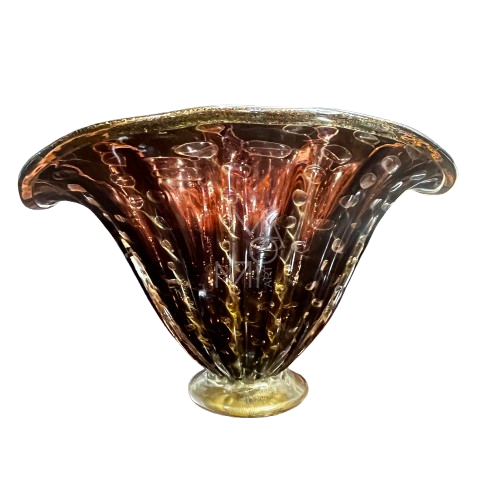
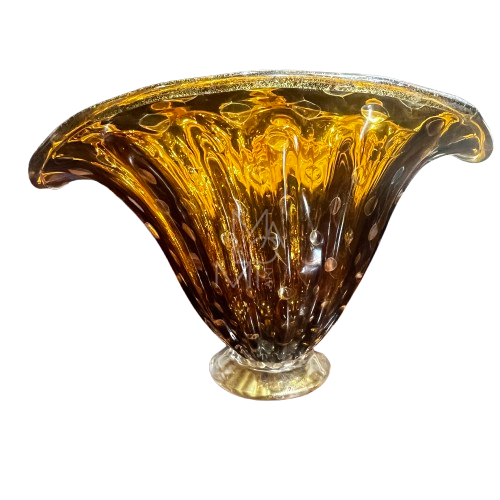
In the specific case of this pair of vases, the deepest chromatic layer, characterized by warm amber tones that deepen toward refined purple and violet reflections, is encased and protected by a thick jacket of perfectly transparent crystal. This superimposition creates a sophisticated optical illusion of three-dimensional suspension, wherein the color appears to float within the vacuum of the glass mass, undergoing continuous variations in intensity depending on the viewing angle and the surrounding light refraction.
The Bullicante Effect and the Dispersion of 24-Karat Gold Leaf
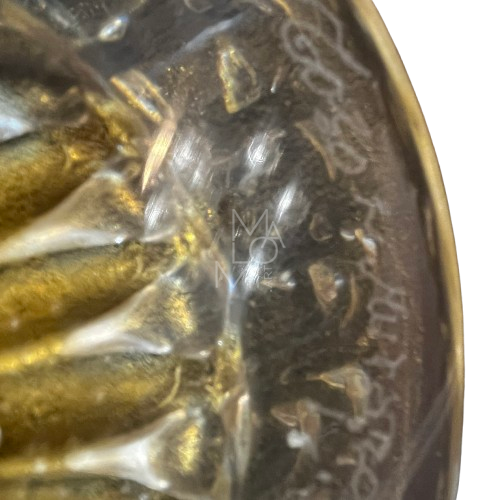
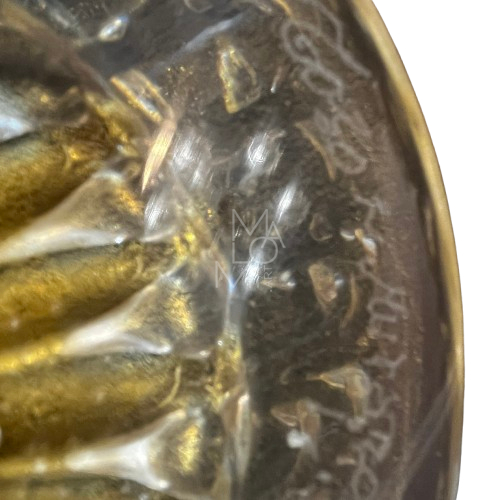
The internal structure of the vases is rendered even more precious by the spectacular combination of the sommerso with the bullicante decoration and the inclusion of precious metals. The bullicante effect, namely the presence of a perfectly regular pattern of microscopic air bubbles trapped within the glass, is not the result of a casual melting error, but the outcome of a rigorous geometric control. Before submerging the colored core, the incandescent glass bolo is introduced into a frustum-conical iron mold, the inner wall of which is lined with a dense grid of sharp spikes. The pressure exerted by the master causes these metallic spikes to leave small indentations on the surface of the molten glass.
A curiosity related to this step lies in the fact that the master must calculate the execution time to the exact second, since if the glass cools by even a few degrees, the mold fails to imprint the required depth, ruining the symmetry of the pattern. Immediately after extraction from the mold, the bolo is wrapped in an ultra-thin sheet of 24-karat gold leaf and dipped once more into the liquid crystal. The extreme heat of the second crucible causes the immediate tearing of the metallic leaf, which disperses into a myriad of suspended golden micro-flakes within the interstitial space, while the viscous glass seals the air inside the indentations, transforming them into luminous spherical lenses that infinitely multiply the reflections of the gold.
Morphology and Plastic Form of the Cordonato Structure
The Evolution from the Foot to the Imposing Flared Rim
The sculptural line defining the silhouette of the two vases manifests a dynamic, sinuous, and strongly organic volumetry. The entire vertical development originates from a massive circular foot, also enriched with dense aureate inclusions, which serves as a solid visual and structural center of gravity to support the substantial weight of the overriding crystal. From the foot unfolds the wide, ribbed body of the work, characterized by deep vertical grooves modeled while hot on the workspace using specialized metallic tongs.
This ribbing successfully accentuates the vertical momentum of the artifact, guiding the observer's gaze upward, where the form opens dramatically into a majestic, asymmetrical flared rim. The upper edges do not follow a rigid geometry; instead, they are folded while hot with wide undulations that recall the wavy motion of the Venetian lagoon or the outspread wings of a marine creature. This calculated asymmetry of the upper rims bestows a plastic dynamism upon the pair that shatters any academic staticity, celebrating the intrinsic fluidity and malleability of the glass medium when in its molten state.
The Symmetry of the Twins and the Technical Prowess of the Toso School
The realization of a pair of vases of these proportions and with such dense decoration constitutes one of the most formidable challenges for a Murano furnace. In the realm of art glass, creating two identical pieces that maintain the same volumetric proportions, the same massive weight, and the identical distribution of air bubbles and gold requires a coordination and a visual memory that only a very few masters possessed. A famous workshop legend narrates that glassmasters often refused to produce symmetrical pairs on commission, as the second piece was either considered a copy devoid of the soul of the first, or because the risk of wasting quintals of raw material due to a minor weight discrepancy was exceedingly high.
The fact that these two vases have survived to the present day while preserving perfect execution specularity and absolute proportional rigor bears witness to the excellence and extraordinary technical skill achieved by the craftsmen of the Toso school, who were capable of dominating fire and gravity to give life to two twin masterpieces destined to dialogue harmoniously within the same architectural space.
Paleographic Analysis of the Signature and the Study of Authenticity
The Incised Signature on the Underside and Workshop Practice
A fundamental element that elevates the historical and collectible value of this pair of vases is the presence of the autograph inscription incised cold, visible on the underside, precisely on the lower resting plane of the crystal foot. Paleographic analysis of this script reveals that it was executed with a diamond point or with a slender metallic tool made of tungsten carbide, instruments that leave an extremely thin, clean, and slightly calligraphic stroke on the glass. The decision to place the signature on the underside of the vase, a surface that was frequently finished on the grinding wheel to ensure the perfect stability of the object once placed on furniture, satisfies both an aesthetic and a functional requirement.
On one hand, the master sought to preserve the absolute formal purity of the vase's body, preventing an artificial graphic mark from interfering with the interplay of light refractions generated by the sommerso and the gold. On the other hand, the signature on the resting plane served as a discrete yet irrefutable seal of guarantee, protected from the wear of time and friction, allowing merchants and collectors to immediately recognize the island authorship of the artifact in contrast to serial or commercial production lacking any marking.
The Evolution of Scripts and Textual Decomposition
The inscription develops by harmoniously following the curvilinear path of the lower edge of the foot, articulating itself in a fluid and continuous cursive script across two distinct words: "Toso Murano". In the first part of the graphic arc, one recognizes the capital cursive letter "T", characterized by a long upper horizontal stroke that serves as a ligature for the subsequent letters, which are traced with a swift and confident ductus. The second word begins with a capital letter "M" with sinuous and slender vertical strokes, a stylistic choice highly common in Muranese workshop signatures of the mid-twentieth century.
Glass art historians pay close attention to the decomposition of these scripts, since the fluidity of the stroke and the pressure exerted by the diamond point allow for the exposure of modern forgeries, which are often hastily executed with electric vibrating pens that leave a wide, whitish, and grainy furrow entirely incompatible with the traditional techniques of Murano's golden age. The perfect coherence between the handwriting of this signature, the wear condition of the base, and the technological characteristics of the bullicante workmanship confirms the absolute authenticity of the works, placing them by right within the historical catalog of the finest twentieth-century Italian decorative production.
Critical Dating of the Work
The Chronological Context between the Late 1940s and the Mid-1950s
Determining the chronological timeframe in which this pair of vases was executed requires a cross-analytical approach linking the formal characteristics, technological peculiarities, and the evolution of the trademarks used by the Toso furnace. The structural combination of thick sommerso glass, associated with cordonato ribbing and a regular bullicante texture with gold dust, places the artifacts with scientific approximation between the late 1940s and the mid-1950s, with a more probable convergence around the years 1950–1952. This specific temporal segment coincides with the peak expression of mid-century monumental taste in Murano, a period when the leading furnaces definitively abandoned the rationalist experimentation of the 1930s to embrace more opulent, sinuous plastic forms capable of interacting with the new spaces of international architecture.
A fundamental point of reference for this dating is provided by the asymmetrical flared morphology of the rims and the typology of the circular foot. This precise model of cordonato vase, engineered to enhance the refractive properties of crystal coupled with the warm tones of amber and purple, finds perfect equivalents in the commercial catalogues and archival drawings of Fratelli Toso and the contemporary Barovier & Toso from the early 1950s. Furthermore, the diamond-point signature incised on the underside displays that loose, non-rigid cursive ductus that predates the standardization of graphic acronyms that occurred in the late 1960s, confirming that the pieces belong to a limited art series created under the direct supervision of the masters of the Muranese old guard.
Reference Bibliography (Chicago Manual of Style)
Monographic Sources and General Catalogues
Barovier Mentasti, Rosa. Il vetro di Murano nel Novecento. Milan: Mondadori Electa, 1992.
Bossaglia, Rossana, ed. I Toso di Murano: Una dinastia del vetro d'arte. Venice: Arsenale Editrice, 1989.
Deboni, Franco. I vetri di Murano: La Fratelli Toso. Turin: Allemandi, 2008.
Dorigato, Attilia. Il museo del vetro di Murano. Milan: Filippo de Pisis Editore, 1986.
Heiremans, Marc. Murano Glass: Themes and Variations (1910-1970). Stuttgart: Arnoldsche Art Publishers, 2002.
Romanelli, Giandomenico, and Rosa Barovier Mentasti. Vetri veneziani del Novecento. Venice: Marsilio, 1996.