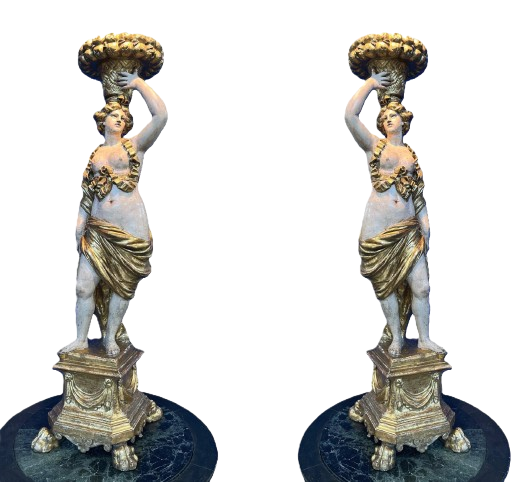
Pair of 17th Century Venetian Baroque Gilded Wooden Caryatid Vase Bearers
- Object: Pair of Sculptural Vase-Bearers / Torchères (Caryatids / Canephorae)
- Period: 17th Century (High Baroque)
- Geographical Attribution: Venetian School / Venice (Italy)
- Medium: Carved softwoods (typically Limewood or Swiss Pine)
- Surface Finish: Original pale-toned polychromy mimicking marble (pelle della scultura for the flesh tones); genuine water-gilding in gold leaf (oro zecchino) for the drapery and ornamental details.
- Dimensions (H x W): 111 cm x 30 cm (approx. 43.7 x 11.8 inches)
- Conservation Status: Excellent overall condition consistent with age and material history; minor, natural wear to the gold leaf and superficial polychromy with localized oxidation of the original patina.
- Pair of 17th Century Venetian Baroque Gilded Wooden Caryatid Vase Bearers
- Discover an exceptional pair of 17th-century Venetian Baroque caryatid vase-bearers. Hand-carved wooden sculptures with gold leaf and polychromy. Measures: 111x30 cm. High-end Italian antiquities.
- Venetian Baroque sculptures, 17th century gilded caryatids, antique wooden torchères, high-epoch Italian furniture, Venetian canephora vase bearers, antique polychrome wood carving.
- Symmetrical pair of 17th-century Venetian Baroque caryatid vase-bearers in carved polychrome and gilded wood, 111 cm height.
The Caryatid as Decorative Sculpture in the Venetian Baroque: A Historical-Critical Essay on a Pair of Polychrome and Gilded Wooden Vase-Bearers from the 17th Century
Abstract
This paper offers a rigorous historical-critical analysis of an exceptional pair of 17th-century Venetian carved wooden vase-bearers (reggivaso). Measuring 111 x 30 cm, these sculptures represent a pinnacle of the "mobile-scultura" (furniture-sculpture) typifying the Baroque palaces of the Serenissima. By examining their iconographic roots, material composition, precise dimensional matrix, and stylistic affinity with the workshop of the Groppelli brothers and the legacy of Josse de Corte (Giusto Le Court), this study contextualizes these artifacts within the wider framework of Venetian ceremonial furniture and international collecting.
1. Introduction and Typological Framework
This pair of late 17th-century sculptures represents an extraordinary manifestation of high-prestige plastic furniture (arredo plastico d'alta rappresentanza) from the Venetian Baroque. Designed for the reception halls (porteghi) of patrician palaces, these objects seamlessly merged practical utility—as supports for vases, hydriae, or floral arrangements—with the highest achievements of ornamental sculpture. In the theatrical domestic architecture of the period, objects of this caliber were not mere functional furnishings; they operated as central visual anchors. Positioned symmetrically alongside monumental mirrors, portals, or console tables, they served as overt signifiers of the patron’s economic power, social status, and cultural erudition.
2. Iconographic Analysis: The Baroque Metamorphosis of the Caryatid
From an iconographic perspective, these sculptures reinterpret the classical motifs of the cariatid and, more specifically, the canephora—the maiden designated in ancient ritual processions to carry baskets of offerings upon her head. However, the Seicento thoroughly dismantled the rigid verticality, tectonic stress, and severe immobility of classical antiquity. The two full-length, counter-posed (speculari) female figures are animated by a sinuous "S-curve" torsion. This dynamic movement is heightened by a classical chiasmus between the weight-bearing and the flexed leg, imparting an elastic, lifelike vitality to the wooden medium.
Each figure raises an external arm to stabilize a large, gadrooned, entirely gilded basket, while the opposite arm glides gracefully along the hip in a gesture of studied composure. The torso is exposed in a partial nude of pagan and classicizing flavor, bounded by drapery bands (zonae) that cinch the figure just below the breast. Over the hips and legs, a heavy gilded drapery unfolds, deeply undercut to generate a powerful chiaroscuro effect that animates the plastic forms.
3. Formal and Technical Analysis: Carving, Polychromy, and Gilding
The executive mastery of these pieces lies in the sophisticated equilibrium of materials and surface finishes. The structures were sculpted from soft, light timbers—typically limewood (tiglio) or Swiss pine (cirmolo)—which were the materials of choice for Venetian carvers due to their exceptional plasticity. This allowed the craftsmen to gouge the drapery folds to dramatic depths and articulate the minute details of the decorative apparatus with extreme precision.
The superficial treatment relies on a striking chromatic dualism designed for theatrical interior lighting:
- The Polychromy of the Flesh Tones: The skin of the maidens is treated with a pale, lacquered finish mimicking marble or ivory—a technique known as pelle della scultura (sculpture skin). This masterfully provided the noble visual weight of stone while preserving the structural lightness of the wooden support.
- The Leaf Gilding: The drapery, gadrooned baskets, and base moldings are entirely clad in genuine gold leaf (oro zecchino), meticulously alternating between burnished and matte surfaces. Under the flickering light of period candles, these gilded surfaces vibrated with reflections, amplifying both the illusion of movement and the perceived opulence of the interior.
4. The Venetian Workshop Context and the Legacy of Josse de Corte
The attribution of this pair to the Venetian school is supported by rigorous stylistic correspondences. In 17th-century Venice, wooden sculpture experienced a golden age catalyzed by the revolution of the Flemish master Josse de Corte (Giusto Le Court, 1627–1679). Le Court infused Venetian plastic arts with the fleshiness, sensuality, and turbulent dynamism of the Northern European Baroque. The figures under analysis bear his unmistakable mark: the soft yet taut anatomy and the billowing drapery folds appear swept by a perennial lagoon breeze—a calculated device to capture the fluid, natural light bouncing off the Grand Canal.
Furthermore, the idealized grace of the countenances and the fluid, unforced gestures link these works directly to the prominent workshops specializing in monumental furniture, most notably that of the Groppelli brothers (Marino, Domenico, and Giuseppe), active between the late 17th and early 18th centuries. The carving conforms to the strict regulations of the Marangoni da Cornise (the elite branch of the Venetian carpenters' guild), who worked in close symbiosis with professional gilders (doratori) to synthesize sculptural mass with the shimmering optical properties of precious metals.
5. Metric and Proportional Analysis: The 111 x 30 cm Matrix
The physical dimensions—111 cm in height with a maximum base width of 30 cm—offer precise insights into the geometric engineering and original spatial layout of the pieces. Standing just over one meter tall, these sculptures occupy a highly specific typological tier: they are medium-to-high parade elements (elementi da medio-alta parata). They were never intended to sit directly on the floor. Instead, they were designed to surmount monumental console tables or wall benches measuring approximately 80–90 cm in height. Elevated in this manner, the ensemble reached an overall height of roughly two meters, placing the figure and its load at the ideal eye level of a standing viewer.
The proportional relationship between the height and the footprint establishes a strict ratio of approximately 1:3.7. This metric calculation satisfies both tectonic and aesthetic requirements:
- Structural Stability: The 30 x 30 cm quadrangular base guarantees a low and solid center of gravity. This was structurally essential to counteract and safely discharge the top-heavy load of a ceramic, porcelain, or marble vase, neutralizing the lateral torque generated by the cariatid's asymmetrical posture.
- Visual Elongation and Spatial Optimization: The swift transition from the stable 30 cm plinth to the slender anatomy of the figure alleviates visual weight, rendering the sculpture airborne and elegant. Concurrently, the narrow 30 cm width allowed these pieces to fit perfectly within the tight wall piers (moli) located between the vast windows of Venetian palazzi, optimizing floor space without sacrificing architectural scale.
6. The Monumental Pedestal and Comparative Critical Appraisal
The figures rest upon imposing plinth bases that echo the solemnity of Baroque ecclesiastical architecture. The faces of these pedestals are adorned with deeply carved, gilded swags and foliate festoons—classical motifs revitalized by 17th-century plastic vigor. The plinth terminates in heavy, zoomorphic lion-paw feet finished in faux-bronze or gold.
When appraised within the wider history of furniture, this pair occupies a rare and highly sought-after collecting niche. While the subsequent 18th-century Venetian tradition shifted heavily toward the famous mori (Blackamoor figures) rendered in full natural height (frequently exceeding 160–180 cm), 17th-century classical caryatids of this specific size are substantially scarcer.
Unlike floor-standing torciere, which dictate cavernous spaces, a pair measuring 111 cm maintains an extraordinary versatility for modern curatorial displays. It can easily dialogue with high-epoch surfaces or minimalist contemporary gallery plinths, preserving its original architectural power and theatrical aura within any sophisticated interior.