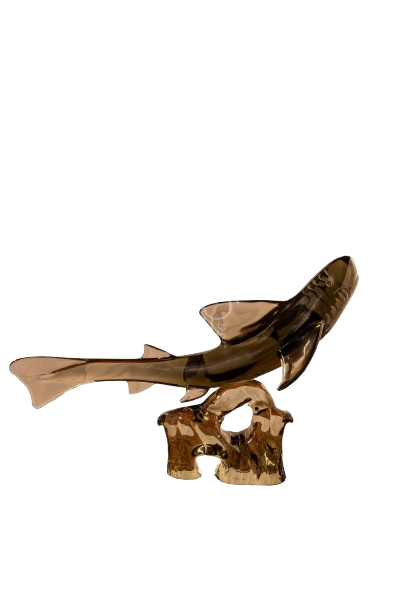
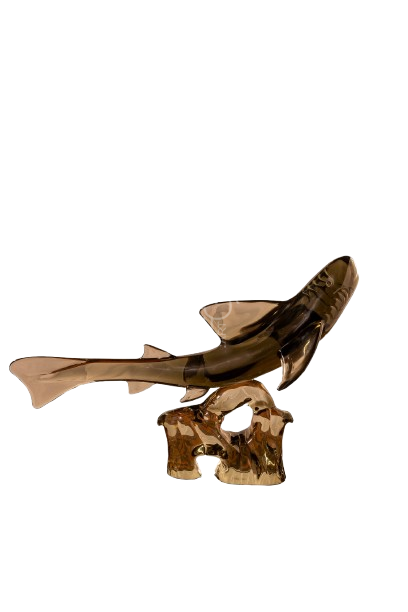
Monumental submerged glass shark in smoky monochrome by Seguso Vetri d'Arte – Murano, 1960s
The aesthetics of weight and the monumental shift of Seguso in the nineteen-sixties
The artistic landscape of the Venetian lagoon, at the dawn of the nineteen-sixties, was shaken by a profound shift in horizon. Until that moment, international taste had rewarded the sinuous, organic lines and bright colors of the post-war period, masterfully interpreted by Flavio Poli. However, as the new decade approached and brutalist and minimalist currents emerged in interior architecture, the glassworks Seguso Vetri d'Arte understood the need to redefine the very concept of glass sculpture. Under the artistic guidance of Mario Pinzoni, the furnace chose to pursue the complex path of monumentality, replacing the gentle forms of the past with severe, geometric, and imposing volumes.
The magnificent zoomorphic sculpture of a shark, with its extraordinary dimensions of eighty centimeters in length by fifty-three centimeters in height, represents the perfect manifesto of this silent revolution. In those years, master glassmakers faced an exceptional physical challenge: detaching themselves from the tradition of the decorative tabletop object to invade space with heavy statuary, capable of holding its own visually against the avant-garde salons of the era. In the cafés of Piazza San Marco, it was often said that other furnaces looked upon Seguso’s monumental pieces with fear and admiration, since handling such colossal vitreous masses required a physical effort that put the entire team to the test. A curiosity of the era reveals that lifting and turning the glass block of the shark during modeling required up to four people simultaneously, coordinated by the rhythmic shouts of the master to prevent the weight from tearing the iron of the pontil rod.
The virtuosity of monochromatic smoky glass and the secrets of the fire
From a strictly technical point of view, the execution of this shark constitutes a true tour de force. The work completely rejects internal blowing and is modeled from a single, immense block of incandescent glass worked as a solid mass (lavorazione a massello). This technique imposed extremely tight execution rhythms, as the master had only a few minutes before the temperature dropped below the point of workability. In that brief lapse of time, the formless mass had to be pulled, flattened, and modeled using wooden paddles, known in jargon as borse, and iron forceps.
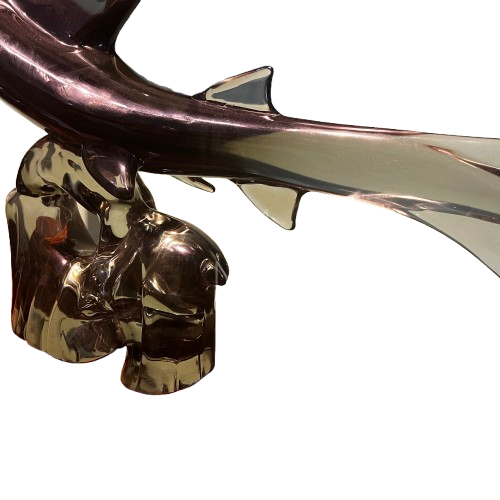
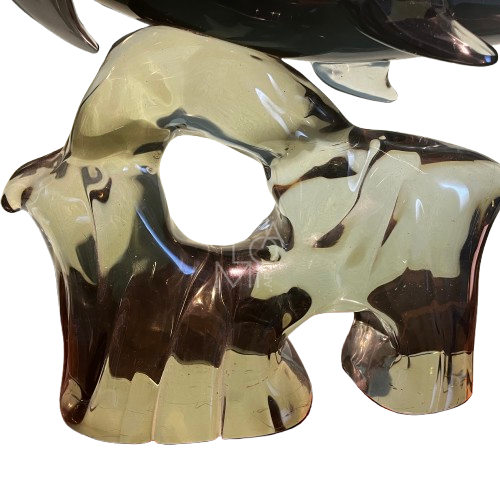
The close-up framing dissipates any doubt regarding the chromatic composition: the entire work, including the wave-like base, is crafted in a rigorous and uniform smoky glass (vetro fumé). This monochromatic choice strips the object of any concession to polychrome decorativism, concentrating the observer's attention exclusively on the purity of the line and the volumes. In the historic furnaces of Seguso, obtaining such a homogeneous smoky tint on a vitreous mass of this thickness was considered a jealously guarded chemical secret. If the mixture of metals in the crucible was not perfect, the glass risked veering toward unpleasant greenish or yellowish tones once cooled. The total grey-anthracite purity of the piece testifies to an absolute mastery in the preparation of the batch.
The presence of the large void within the base is not a mere aesthetic choice, but an ingenious expedient inspired by the sculptures of Henry Moore and contemporary postwar abstract art. Creating a void in the heart of such a heavy base served to discharge the internal thermal stresses of the glass during its long and delicate passage through the annealing ovens, called muffole, where the piece had to rest for several days to prevent the density of the accumulated vitreous mass from causing a spontaneous explosion of the crystal due to thermal shock.
Expressive details and the perfect mirror-like polishing of the base
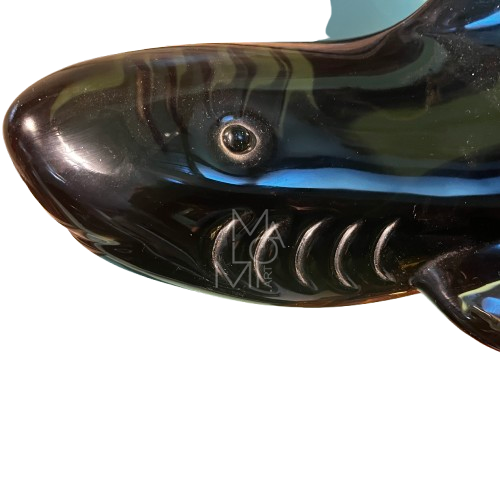
Observing the transition from geometric design to a fierce anatomical mimesis, one appreciates the profiling of the lower fins and the tail, which taper toward an almost ethereal transparency, revealing the refraction of the internal light. The eye is the result of a layered hot-application: a droplet of crystalline glass accommodates a core of dark, opaque paste at its center, creating a lenticular effect that seems to follow the observer depending on the viewing angle. In the tales of Murano elders, the precision in positioning the pupil determined the "spirit" of the animal: a single millimeter of error was enough to give the shark a grotesque expression rather than a fierce and fearsome one.
The branchial slits, reproduced in five distinct lines on the snout, reveal the skillful use of the sharp iron tool. The master incised the fluid glass with sharp, rhythmic gestures; the pressure of the blade displaced the matter, creating small ridges which, once solidified, capture the light and deepen the shadow within the furrows, mimicking the muscular contraction of the animal in motion.
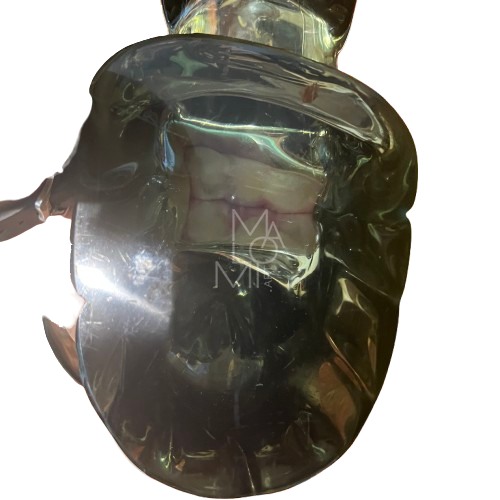
The definitive confirmation of the extraordinary executive quality of this specimen resides in the technical finish of its underside. Turning the sculpture over, one observes a perfectly flat support surface, impeccably cold-worked and transformed by Seguso’s grinding workshops into a true high-furnace optical mirror. This masterful craftsmanship completely erases the raw remnants of the pontil mark and allows for an absolute crystalline refraction that faithfully reflects the hands of the viewer moving the piece. Alongside this perfect flat transparency, the subtle shelf wear accumulated over the decades on the perimeter of the base narrates the life of the object, confirming to art experts that this is an authentic masterpiece from the mid-twentieth century. Seguso's shark thus ceases to be a simple glass artifact to become the spokesperson for an unrepeatable era, in which the fire and toil of man challenged the force of gravity.
Iconographic and stylistic comparisons within Seguso's monumental production
To fully understand the placement of this shark within the historical catalog of Seguso Vetri d'Arte, it is necessary to establish a comparative analysis with the coeval marine fauna born from the archive models of Mario Pinzoni. During the nineteen-sixties, the furnace developed an entire underwater bestiary that shared the very same structural grammar as the shark under examination. An immediate comparison can be drawn with the famous sculptures depicting dolphins in flight and solid-mass whales, where the smoky grey vitreous core was stretched to the physical limits of the material to suggest the idea of hydrodynamic penetration into space. In these works, exactly as in the shark, the chromatic transition constitutes the unmistakable visual signature of the manufacture, designed to exploit the thickness of the crystal as a natural refraction lens.
An highly interesting archive anecdote reveals that the inspiration for this line of marine predators arose during a series of visits that the furnace designers paid to major European aquariums and natural history museums, with the aim of capturing the ruthless geometric essence of oceanic fish, thus distancing themselves from the by-now outdated tradition of Venetian ornamental fish, which were deemed too caricatured. This quasi-scientific approach can be found in a related model of a swordfish, cataloged in the mid-sixties, which features the exact same setting for the pierced rock-like base. In that piece, currently preserved in a well-known private collection in Milan, the central cavity of the rock and the monochromatic nature of the smoky glass were utilized with the same structural and chiaroscuro function, demonstrating the existence of a true artistic program focused on the aesthetics of the void and the severity of the solid color.
A further and precious element of comparison is offered by the large abstract sculptures exhibited by Seguso at the Venice Biennales between nineteen-sixty-two and nineteen-sixty-eight. On those occasions, international critics praised the ability of the craftsmen to eliminate gold leaf and internal bubbles—elements judged too baroque for the rising minimalist taste—in favor of naked surfaces, polished to a mirror finish and animated only by sharp cuts executed while hot. The shark responds exactly to these same exhibition canons: the branchies incised with iron tools on the snout and the lens-applied eye are found identically in the anatomical details of other Seguso creatures of the same period, such as the monumental eagles and owls worked as solid masses, where the furrows of the feathers were traced with the exact same rhythm impressed upon the gills of the predator.
Critical bibliography and reference archive sources
The correct historical contextualization and subsequent scientific validation of Seguso Vetri d'Arte's monumental shark cannot dispense with a rigorous bibliographic survey within the specialized literature dedicated to twentieth-century Venetian glass. Within the publishing landscape, the essential starting point for understanding the stylistic evolution of the furnace is constituted by the monographic volume by Umberto Franzoi, entitled Storia di Seguso Vetri d'Arte, a fundamental text that reconstructs in detail the handovers between artistic directors and the complex technological transition of the manufactory. Within these pages, it emerges clearly how the production of the nineteen-sixties programmatically abandoned light transparencies in favor of an almost brutal physicality of the glass material, a concept also expressed in the historical exhibition catalogs of decorative arts from the Seguso stables.
To specifically analyze the work of Mario Pinzoni and his propensity toward large solid-mass sculptures, critical literature offers a valuable contribution through the studies of Rosa Barovier Mentasti, particularly in her famous essay Il vetro di Murano alle Biennali di Venezia. This text documents how large-scale zoomorphic works, stripped of polychromy and playing entirely on the nuances of smoky grey, were the ideal candidates to represent the Venetian avant-garde on the international stage of the Biennale. The chronicles of the nineteen-sixties exhibitions frequently mention the sensation that these colossi of monochromatic glass aroused among art critics of the time, who were accustomed to a more traditional and purely ornamental Murano production.
Another milestone for bibliographic verification is represented by the international design repertoires edited by Helmut Ricke, among which stands out the catalog Italian Glass - Murano Milan 1930-1970, published on the occasion of the major retrospective exhibitions at the Kunstpalast in Düsseldorf. This volume offers a fundamental identifying and comparative overview, illustrating with a wealth of detail how the hydrodynamic forms and the heavy sommerso glasses of Seguso fit into an international dialogue with Scandinavian design and European abstract sculpture. Ricke's texts help the expert decode the choice of monochromatic smoky glass, highlighting how the renunciation of color was the reflection of a global aesthetic need that united Venetian glass with the plastic research of masters of contemporary sculpture.
Finally, for a technical verification related to hot-working methodologies and the mirror-like polishing of the bases, the manuals on the industrial archaeology of glass by Giovanni Sarpellon offer the definitive key to interpretation. His studies on solid-mass technology and flat wheel-grinding in post-war furnaces allow one to link the physical marks found on the base of the shark to the precise execution practices documented in the historical archives of Murano furnaces. The entirety of these bibliographic sources not only provides the work with a solid theoretical framework but transforms the sculpture from an isolated object of mid-century design into a documented chapter of Italian design history.