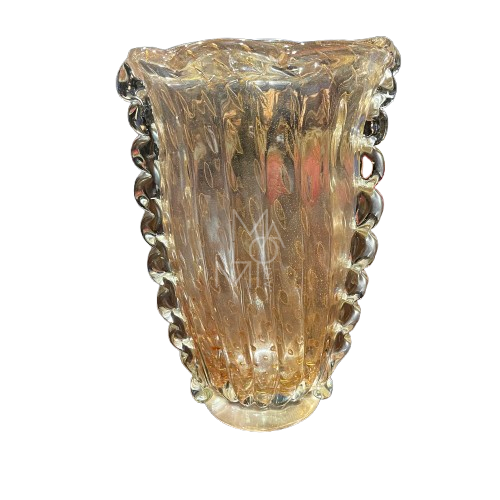
Guide to the Monumental Murano Ribbed Glass Vase by Barovier & Toso
Identification and archival data
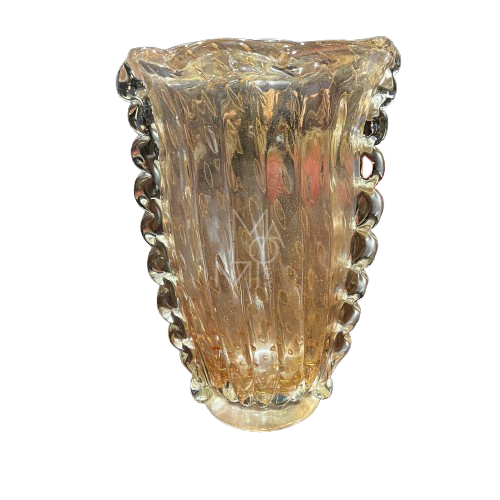
- Author: Ercole Barovier (Murano, 1889 – Murano, 1974), design attribution.
- Manufactory: Barovier & Toso, Murano (Venice).
- Object/Title: Monumental ribbed vase with lateral morise.
- Series: "Bullicante Oro" (a variant of the Bullicanti a Morise series).
- Chronology: c. 1940 – 1953 (based on a model designed between 1935 and 1938).
- Cultural sphere: 20th-century Murano art glass / Italian avant-garde design.
Technical data and materials
- Material and technique: Heavy blown glass in amber/straw tone, shaped with vertical ribs; internal decoration featuring a programmed bullicante effect (controlled air bubbles arranged on a concentric geometric grid); widespread internal inclusion of micro-flakes of 24-karat gold leaf (modern aventurine technique); external incamiciatura (overlay) in transparent crystal.
- Applications: Two large, continuous wavy or "zig-zag" morise in solid, transparent glass, applied hot along the sides and modeled entirely free-hand with furnace jacks.
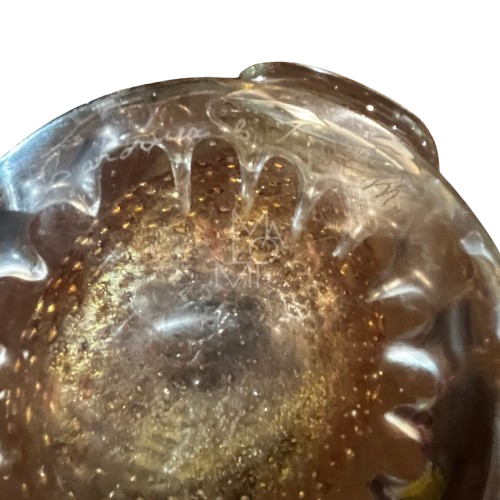
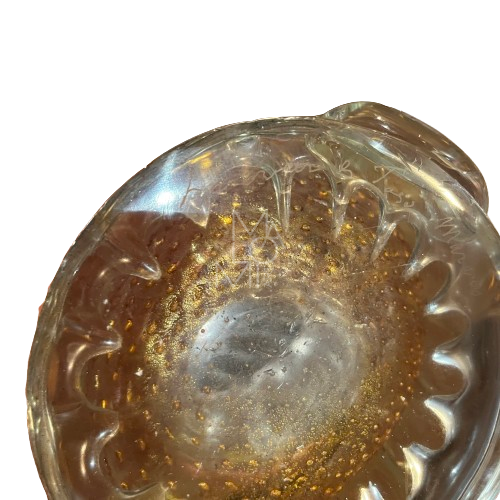
- Inscriptions and marks: Presence on the resting base of the authentic official signature, hand-engraved cold with a diamond point:
"barovier & toso murano"(in lowercase cursive script with a fluid, continuous stroke).
Dimensional data (Maximum clearance)
- Height: 33 cm
- Width: 23 cm
- Format: Oval section with an inverted truncated-conical development, expanding into a fan shape toward the rim.
Historical-critical description
State of conservation
- Diagnostic assessment: Very good / Excellent.
- Condition report notes: The object shows no cracks, passing chips, or conservative restorations. The upper rim and lateral morise are intact. The pontil scar at the bottom is regularly ground and polished to a mirror finish. The resting base exhibits a natural network of microscopic surface scratches and a light dullness due to friction over time, which serve as crucial indicators of period authenticity.
Legal status and provenance
- Collection: Private collection.
- Supporting bibliographical references:
- M. Barovier, Ercole Barovier 1889-1974: Vetri Muranesi, Venice 1993.
- M. Barovier, L'arte dei Barovier: Vetrai di Murano 1866-1972, Venice 1993.
- A. Dorigato (ed.), Ercole Barovier dandy del vetro: Cento anni di storia e arte, Venice 1989.
Historical-Critical Study and Catalogue Raisonné: The Monumental Ribbed and "Bullicante" Vase by Barovier & Toso
This scholarly paper presents a comprehensive philological, technical, and documentary analysis of an art vase made of Murano glass, attributed to the design of Ercole Barovier for the Barovier & Toso manufactory. The artwork is examined in light of its exceptional monumental dimensions, basal epigraphic evidence, and its broader position within the historiography of twentieth-century Italian decorative arts.
Chapter I: Historical-institutional profile of the manufactory and the role of Ercole Barovier
1.1 Historical origins and the corporate merger
The Barovier & Toso glassworks traces its documented roots back to 1295, establishing itself as one of the oldest and most influential glassmaking dynasties in the Venetian lagoon. The modern corporate structure, which gave rise to the official trademark found on the artifact under examination, was permanently consolidated in 1936 through the merger between Vetreria Artistica Barovier C. and Fornace Ferro Toso. This strategic union marked the dawn of a golden age for glass design, combining managerial excellence with unprecedented technical experimentation.
1.2 The artistic direction of Ercole Barovier
The central figure of this era was Ercole Barovier (1889–1974), a chemist, artist, and entrepreneur of extraordinary acumen. Upon assuming artistic direction, Barovier brought about a radical shift in production: he abandoned nineteenth-century historicist revivals and academic figuration to focus on the purity of the glass matter itself. His work centered on the intrinsic manipulation of the incandescent gather, where thickness, color, and gaseous or metallic inclusions became the primary elements of sculptural form. The vase under examination represents the pinnacle of this design philosophy, expressing a flawless synthesis of geometric rigor and plastic expression.
Chapter II: Morphological, structural, and dimensional analysis
2.1 Formal synthesis and proportional canon
From a morphological perspective, the artwork is configured as an oval-section vase with an inverted truncated-conical development, characterized by precise geometric parameters including a maximum height of 33 centimeters and a width at maximum clearance of 23 centimeters. The body expands elegantly upward, terminating in a rim with a sinuous, undulating profile, while the central structure is articulated by deep vertical ribbing. This specific architecture serves a function beyond mere decoration; it acts as a prismatic apparatus. The ribs function as lenses of variable thickness capable of capturing ambient light, channeling it along vertical axes, and amplifying the internal refractions of the glass mass.
2.2 The lateral "morise" and free-hand shaping
The element of greatest plastic and dynamic emphasis consists of the large morise applied hot along the two lateral profiles of the artifact. These solid, transparent glass applications are modeled in a continuous wavy or "zig-zag" pattern. Executed entirely free-hand using furnace tongs and jacks without the aid of constrictive molds, the morise visually stabilize the vertical thrust of the vase, extending the clearance to 23 centimeters and imparting a sculptural volumetry that accentuates the character of the object as a unique piece.
2.3 Critical relevance of the monumental format
The height of 33 centimeters places the artifact far above the standard commercial and utilitarian formats of the period, which were typically limited to heights below 25 centimeters. Within the Murano taxonomic system, a height exceeding 30 centimeters qualifies the work as a "showpiece" or exhibition vase. Managing such a massive glass weight in the furnace implies extraordinary technical mastery: the weight of the gather on the pontil requires significant physical strength and millimetric temperature control to prevent the structural collapse of the inner walls or the deformation of the ribs during blowing and the application of the morise.
Chapter III: Technology of the glass: the "bullicante" and the gold inclusion
3.1 The technique of programmed "bullicante" glass
The technical peculiarity of the vase lies in the bullicante effect, one of the most celebrated inventions conceived by the genius of Ercole Barovier between 1934 and 1935. The process unfolds in rigorous phases, beginning when the master glassmaker gathers an initial quantity of incandescent glass and blows it into a truncated-conical metal mold lined internally with small, sharp points, known as a bronzin. Subsequently, these points impress a regular pattern of small hemispherical depressions onto the surface of the still-plastic glass. The gather is then extracted and immediately dipped back into the crucible to be coated with a second superficial layer of transparent crystal through the incamiciatura (overlay) technique. Finally, this outer layer rests on the crests of the molded glass without penetrating the small indentations, thereby sealing the air inside each cavity and generating a geometric, concentric grid of permanently trapped air bubbles.
3.2 The inclusion of 24-karat gold leaf (modern aventurine)
The amber and straw-colored glass mass is further enriched by a metallic inclusion technique. Prior to the final shaping, the scorching glass gather is rolled over a sheet of ultra-fine 24-karat gold leaf laid upon the marver, which constitutes the iron working table. The extreme heat instantly shatters the gold leaf into a myriad of micro-flakes. During the subsequent blowing and expansion phases of the vase, these gold particles dilate and distribute homogeneously, creating a warm and opulent internal iridescence that heightens the visual vibration of the bullicante pattern.
Chapter IV: Glass epigraphy and methods of cataloging the base
4.1 Cold diamond-point engraving
Microscopic analysis and the evolution of the firm's markings reveal that cold diamond-point cursive script, used between the 1930s and the late 1950s for high-end pieces, was progressively replaced by electric vibro-engraving starting in the 1970s—distinguishable by its more rigid and serrated stroke—while serial production was often left to simple paper or adhesive labels destined to be lost over time. Examination of the base of this specific vase reveals the authentic signature traced in cursive characters, reading "barovier & toso murano". This marking was executed cold, manually, using a stylus tipped with an industrial diamond or tungsten carbide, displaying a fluid, calligraphic, and continuous flow that is entirely free from the rigidity typical of later mechanical engravings.
4.2 State of conservation and authenticity markers
The base presents diagnostic elements crucial for authentication. At the center of the foot, one observes the trace of the pontil scar—the mark left by the iron rod used to support the vase during the finishing of the rim—which has been carefully ground and polished to a mirror finish to ensure the perfect stability of the object. Furthermore, the resting surface displays a dense network of microscopic surface scratches and patinated dullness distributed non-uniformly. These signs are entirely consistent with the sliding of the object across shelves over several decades and confirm the period authenticity of the piece, differentiating it from modern reproductions or fakes artificially aged via acid etching.
Chapter V: Philological comparison and archival chronology
5.1 Chronological positioning within historical ledgers
Although Ercole Barovier’s earliest experiments with bullicante glass and lateral morise designs date back to the years between 1934 and 1936, an integrated philological analysis allows for a narrowing of the temporal window for this specific specimen. The signature bearing the full corporate name spread widely during the post-WWII period; therefore, the work is to be ascribed to the sophisticated and exhibition-standard production executed between 1940 and the first half of the 1950s, a period in which the manufactory reissued its most successful models, gaining immense visibility within high-end catalogues for both the international and exhibition markets.
5.2 Stylistic correlations within the oeuvre of Ercole Barovier
The vase represents a perfect link among the different series created by the designer, highlighting a unique conceptual coherence. The work inherits its technical execution and the zig-zag application of the profiles from the Bullicanti a Morise series produced between 1935 and 1938, foreshadows the Rostrati of 1938 which would push the concept of plastic relief to its extreme by transforming the ribs into protruding three-dimensional spikes, and ultimately connects to the Cordonati d'Oro of the 1950s, which would revisit the fusion of ribs and 24-karat gold leaf within softer, organic, and more enveloping volumes.
Chapter VI: Essential bibliography and official printed references
For the inclusion of the artwork within an official expertise, an auction catalogue, or documentation of authenticity, the following indispensable printed bibliographical references, authored by the world’s leading experts on Murano glass, are provided:
- BAROVIER, Marina. Ercole Barovier 1889-1974: Vetri Muranesi. Venezia: Il Cardo, 1993.
(An essential text for understanding the chronological evolution of all the series conceived by the designer, featuring extensive photographic repertoires dedicated to the bullicante and cordonato glass of the 1930s and 1940s). - BAROVIER, Marina. L'arte dei Barovier: Vetrai di Murano 1866-1972. Venezia: Arsenale Editrice, 1993.
(A catalogue raisonné analyzing corporate transitions, catalogue designs, and the execution techniques of the manufactory, offering direct cross-references to registered models). - DORIGATO, Attilia (ed.). Ercole Barovier dandy del vetro: Cento anni di storia e arte. Venezia: Marsilio, 1989.
(A monograph published on the occasion of the celebratory exhibition at the Murano Glass Museum, rich in archival files concerning transparent gold glasses, bullicanti, and monumental exhibition variants). - MENTASTI ROSA, Astone. Il vetro veneziano del Novecento. Milano: Electa, 1992.
(A volume providing general historical contextualization, placing the bullicanti a morise series by Barovier & Toso at the apex of international decorative arts, with an analysis of their context within the Venice Biennales). - DE BONI, Franco. I Vetri di Murano: Dizionario degli artisti e delle fornaci. Torino: Allemandi, 1994.
(A fundamental repertoire for verifying cold-engraved signatures, trademarks, and basal epigraphic variants of the firm from 1936 onward).
Appendix: Critical note on the cataloging of the work
In conclusion of this historical-artistic analysis, the formal identification of the artifact for art registries is established as follows. The work is cataloged as a monumental ribbed and morise vase belonging to the "Bullicante Oro" series, designed by Ercole Barovier and manufactured by Barovier & Toso in Murano within a timeframe circumscribable between 1940 and 1953. The execution technique involves the use of ribbed blown glass with a programmed bullicante effect, enriched with internal inclusions of 24-karat gold leaf, and completed with lateral morise applied hot and modeled entirely free-hand. The object features dimensions of 33 centimeters in height by 23 centimeters in maximum clearance width, and bears on its base the official authentication consisting of the cold diamond-point engraved cursive signature with the wording "barovier & toso murano".