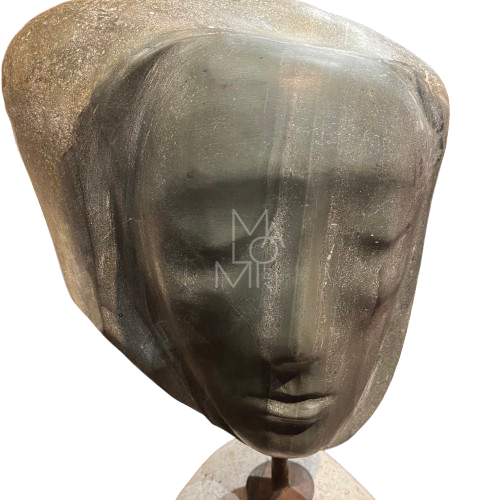
Early river stone sculpture by Guido Moretti: analysis and history
Explore a rare figurative river stone sculpture by Guido Moretti. An authentic 1970s anthropomorphic artwork from the Valtrompia art district in Brescia, Italy.
- Subject: Stylized female face (Mask)
- Artist: Guido Moretti (Gardone Val Trompia, 1947 – 2025)
- Signature: "GUIDO" incised a graffietto on the reverse; complementary studio annotations in pencil
- Dimensions: Height 38 cm, maximum width 20 cm
- Material: Double Mella river stone (compact Triassic limestone) with an internal metallic connecting pin
- Technique: Carved with a burin; facial mask polished and hot-patinated; reverse left in its natural raw mineral state
- Presumed date: 1972–1973 (deduced from the graphite archive trace)
- Provenance: Private Brescian collection (Lombardy, Italy)
A Face Born of Water and Time
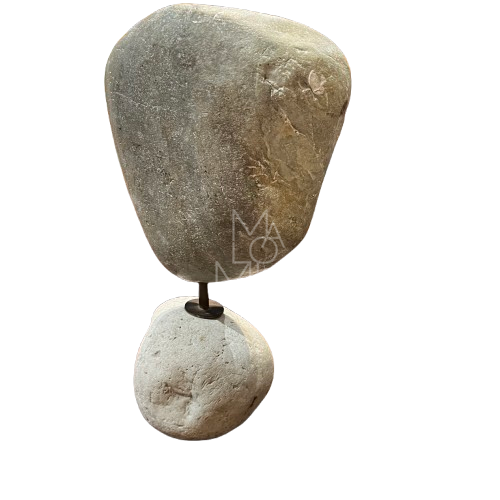
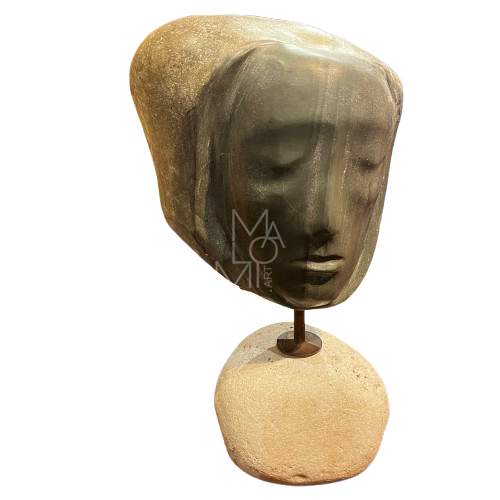
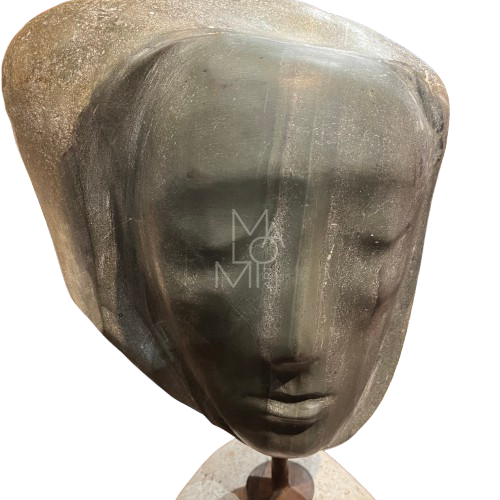
The sculpture revealed through visual analysis presents itself as an elegant and evocative modern work in stone, standing thirty-eight centimeters high and twenty centimeters wide, immediately capturing the viewer's attention with its intrinsic sacredness. The composition is structured in a highly singular manner, formed by two distinct river stones—cobbles smoothed by time—joined together by a solid internal metallic pin. This structural choice supports and elongates the upper section, which depicts an extremely stylized female face withdrawn into itself, enveloped in a sort of veil or coif that softly follows its contours.
The clean, essential, and deeply expressive design belongs to that specific current of portraiture and sacred iconography that characterized the first half of the twentieth century. Observing the delicacy of the features and the hieratic pose, the mind immediately turns to historical representations of the Madonna or the Pietà, echoing the unmistakable style of celebrated twentieth-century Italian sculptors, most notably Libero Andreotti. The work presents itself to the observer through a fascinating material dualism, combining a polished and intentionally darkened surface for the facial mask with a completely raw, angular, and natural finish for the back of the head and the entire base stone, generating a magnetic contrast between human intervention and the millennia-old work of nature.
The Echo of Valtrompia and the Twentieth-Century Masters
To fully comprehend the context in which a work of this nature could come to life, it is necessary to travel ideally toward Valtrompia, a land defined by a centuries-old, indissoluble tradition linked to the working of metal, iron, and stone. Throughout the twentieth century, the entire district encompassing Gardone Val Trompia, Inzino, and Magno saw the flourishing of both historic gunsmithing dynasties and extraordinary art workshops and apprentice schools dedicated to high-precision engraving, a domain where the boundary between craftsmanship and pure sculpture became increasingly blurred.
Great industrial dynasties and historic workshops that set global standards grew within this valley landscape. Alongside the world-renowned Fabbrica d'Armi Pietro Beretta, a historic pillar rooted in Gardone, families of ancient tradition distinguished themselves, such as the Sabatti and Tanfoglio, as well as the elite workshop of Renato Gamba, specialized in fine shotguns and over-and-unders of extraordinary geometric precision. However, it is in the art of engraving that Valtrompia reaches the pinnacle of pure plastic expression, thanks to monumental institutions like the workshop of Cesare Giovanelli in Magno di Inzino, founded in nineteen fifty-five and established as a global benchmark for the teaching of the burin, or the studios led by masters of the caliber of Giulio Timpini, Firmo Fracassi, Galeazzi, and Iora, who were capable of transforming metallic surfaces into genuine micro-paintings.
The Mirage of Marino Marini and the Stylistic Enigma
Initially, the absolute formal purity and hieratic nature of the countenance suggested a compelling parallel with Giacomo Manzù or with Marino Marini, one of the absolute giants of international twentieth-century sculpture. Marini explored the theme of faces and heads throughout his life, alternating the use of bronze, terracotta, plaster, and stone to shape his celebrated series of warriors and Pomone. The sculpture under examination shares with the Pistoian master precisely that rigorous volumetric synthesis and that archaic, almost Etruscan or primitive flavor that Marini constantly sought in his figures.
Yet, the analogies with Marini diverge in the face of a profound technical difference. The Tuscan master tended to leave highly tormented, rough, scratched, or stippled surfaces to make light vibrate across the material, even when working with monumental stone blocks. Conversely, the almost vitreous smoothness of the dark face in this sculpture and the adoption of an intact river cobble as a structural element suggest a different approach, closer to the purified geometries of Adolfo Wildt or the early plastic experimentation of Alberto Giacometti. An authentication by the Marino Marini Foundation in Pistoia would have projected the object into a very high bracket of the international market, but the enigma of the sculpture was destined to be resolved along a different path, no less noble and deeply rooted in the Lombard territory.
The Poetics of the River Stone
The use of river stone is the key element defining the entire nature of the work, offering precious testimony to its creator's artistic philosophy. Choosing to directly carve a cobble gathered from a torrent bed means embracing a precise twentieth-century sensibility that anticipates or aligns with the currents of Land Art and the celebration of natural matter, reminiscent of the famous installations of Giuseppe Penone. River stones, smoothed by the unceasing flow of water over millennia, already possess a finished organic shape—a geometric soul that the artist chose not to destroy.
In this sculpture, the artisan sought to establish an intimate dialogue with the material, intervening exclusively on the frontal portion to bring forth the facial features and darkening the mask, likely through the expert use of historical waxes, patinas, or hot acid treatments. The rest of the cobble and the entirety of the base stone were left exactly as nature molded them, categorically excluding any hypothesis of industrial or serial production. Finding two identical stones in nature to form the head and the support is impossible, and this endows the object with an implicit economic value tied to its absolute uniqueness, rendering it a perfect example of artistic union between human ingenuity and the found object.
Geographies of Stone and the Landscapes of Brescian Sculpture
The stony shores and riverbeds connecting the mouth of Valtrompia to the eastern Brescian area compose the natural scenery in which this sculpture physically took shape. This territory is characterized by hills covered with coppice woods, abruptly interrupted by the white scars of historic marble quarries and pre-Alpine limestone formations. It is in this strip of land, where the plains collide with the first mountain ridges, that the master sculptors and artisans of the region established their historic workshops over the decades, working in close contact with living rock and the waters of Alpine torrents.
A fascinating anecdote linked to Brescian art workshops relates how the old masters considered the search for raw material a genuine sacred ritual. Before the advent of modern transport and sampling systems, artists would walk the banks of the Mella and Chiese rivers immediately after the great spring floods. It is said that they sought black cobbles and compact limestones transported by currents from the Bovegno saddle, as the mountain water, rich in iron minerals, conferred an extraordinary hardness and unpredictable internal coloration upon those rocks. This sculpture stands as tangible proof: the artist did not choose a squared quarry block, but preferred the dynamism of a stone shaped by currents, linking the work to the wild fluvial landscapes that furrow the valleys.
The landscape of Valtrompia is also reflected in the contrasts of the sculpture itself. Moving up the valley toward the north, past the town of Gardone, the rocky walls become steep and vertical, assuming shades that vary from ash gray to volcanic black. The local workshops were immersed in this atmosphere of austere mountain beauty, where the unceasing roar of hydraulic hammers striking iron at the bottom of the valley provided a counterpoint to the silence of the studios perched on the slopes of Inzino. This geographical dualism, divided between heavy metallurgical industry and the elegance of plastic art, is perfectly mirrored in the choice to fuse the river stone with a metallic pin—a technical detail that implicitly references the skills of Valtrumplian master forgemen.
Geological Imprints: The Lithological Secrets of the Mella River
To push the analysis of the work toward even more precise and compelling boundaries, it becomes essential to examine the specific geological properties of the stone materials composing the body and support of the face. The hydrographic basin of the Mella River, which furrows the entire Valtrompia before opening into the Brescian plain, behaves as an immense natural conveyor belt, gathering fragments of diverse pre-Alpine rock formations and incessantly smoothing them through hydraulic friction. Observing the fine grain, the gray-blue coloration with hazelnut tones, and the healed micro-fractures visible in the macroscopic images of the reverse, it is possible to advance a highly accurate petrographic hypothesis regarding the nature and point of origin of these stones.
The cobbles selected by the artist exhibit the typical characteristics of compact limestone and Triassic dolomites, sedimentary rock formations that dominate the geology of middle and upper Valtrompia. In particular, the stone shows a close affinity with Esino limestone or with the calcareous-marly formations that outcrop abundantly near the Bovegno saddle and along the steep slopes overlooking the settlement of Tavernole sul Mella. These rocks, once plunged into the riverbed due to natural mass wasting and weathering, undergo a journey of several kilometers during which the action of the current blunts their sharp edges, transforming raw blocks into oval, compact cobbles structurally devoid of macroscopic bedding planes, perfect for resisting the impact of the chisel.
A careful examination of the geographical positioning suggests that the exact gathering point of these two specific stones can be circumscribed to the river stretch between Marcheno and the bend of Inzino, shortly before the watercourse reaches the town of Gardone Val Trompia. In this specific section of the Mella bed, the river's gradient decreases slightly, favoring the selective deposition of medium and large cobbles, with a diameter ideal for the creation of studio sculptures. The choice to utilize a stone from this area did not merely address criteria of logistical convenience for an artist operating within the valley district, but was linked to a profound technical awareness: the river limestone collected in that stretch, having already passed the severe natural selection of the upper valley rapids, guaranteed a homogeneous consistency and an extraordinary aptitude for receiving patinas and mirror-like polishes, such as the one defining the enigmatic dark mask of the female countenance.
The Signature "Guido" and the Deciphering of Studio Memories
The decisive turning point in understanding the sculpture arrived thanks to the discovery of a signature incised a graffietto directly onto the raw portion of the back of the stone, flanked by several faded pencil inscriptions. An analytical and close-up re-reading of the incision dispelled early uncertainties, revealing vertically the unmistakable characters of the word "Guido". The first letter opens at the bottom with the typical circular loop of a capital G, followed by the linear groove of the U, a single vertical stroke for the I, the straight loop of the D, and the spherical closure of the O. This precious signature formally attributes the work to the artist's proper name, invoking a monumental figure of the Lombard territory.
Within the Brescian artistic panorama, this name immediately evokes the profile of Guido Moretti, born in Gardone Val Trompia in nineteen forty-seven. Although his international renown is tied to abstract geometric sculpture, mathematical intersections, and three-dimensional optical illusions produced in his mature years, his early esords in the early nineteen seventies were characterized by profound experimentation with the materials of his native valley. An archaic work in river stone, played entirely on the duality between natural form and the plastic intervention of the burin, fully reflects that youthful sensibility aimed at investigating the expressive potential of river rock before arriving at the rigor of pure geometric forms and metals.
The exciting microscopic examination of the faded pencil inscriptions positioned above the signature revealed the stratification of a genuine studio archive. The graphite, partially absorbed by the porous grain of the limestone, shows the outline of a highly elongated cursive capital letter, identifiable as an M or a V, followed by a sequence of rapid horizontal oscillations reminiscent of the word "Vito" or a technical abbreviation such as "Mat", commonly used in workshops to indicate the material or matriculation number of the piece. Not far away, one discerns the shadow of a two-digit number, a seven followed by a zero or a three, which temporally places the work in the early nineteen seventies, precisely coinciding with the period in which Moretti was completing his studies in physics and establishing his studio in Brescia, initiating his first historic collaborations with city galleries and actively participating in the cultural fervor of local exhibitions.
From the Organic to Geometry: The Mature Evolution of Guido Moretti
To deeply grasp the profound meaning of this face in river stone, it is necessary to cast one's gaze beyond this early phase and analyze how Guido Moretti's style transformed radically over the course of his artistic maturity. The work under examination represents a rare component—a starting point where the artist still explored figuration, anthropomorphism, and direct dialogue with the form that nature spontaneously provides. However, the Gardonese sculptor already carried within himself the seeds of what would become his unmistakable stylistic signature: an obsession with geometric interlocking, millimetric precision, and the study of space.
The genuine revolution in Moretti's career occurred toward the end of the nineteen seventies and consolidated in the following decades, when his academic background in physics and mathematics took precedence over raw matter. The sculptor permanently abandoned figurative inspiration and the use of the found object to dedicate himself to abstract sculpture based on absolute geometric rigor. His complex modular structures, orthogonal intersections, and spatial rotations executed in wood, bronze, and steel gained international acclaim. An iconic example of this transition is his famous Cubosfera (Cubosphere), a geometric structure where a spherical shape mysteriously emerges from the progressive interlocking of cubic elements.
An illuminating anecdote uniting Moretti's youth and maturity concerns precisely his conception of empty space. While in this river stone the artist worked by subtraction, carving the rock to reveal the facial mask and allowing the stone's own weight to define the work's presence, in his mature sculptures the void becomes the true protagonist. Moretti began cutting and sectioning blocks of wood or metal according to rigid mathematical calculations, creating works that change shape depending on the observer's viewpoint, transforming into genuine three-dimensional optical illusions. This youthful face, with its hieratic stillness, thus represents the calm before the geometric storm—the artist's final homage to classical plastic tradition and pre-Alpine nature before venturing into the pure and infinite territories of visual mathematics.
The Cultural Fervor of the Associazione Artisti Bresciani in the 1970s
The historical context in which this artistic transition occurred is indissolubly linked to the activities of the Associazione Artisti Bresciani, historically known by the acronym A.A.B., which experienced one of its periods of maximum splendor and cultural renewal precisely in the nineteen seventies. Founded in the aftermath of the Second World War to restore a voice and energy to the province's intellectual community, the association had become the axis around which the most heated aesthetic debates of eastern Lombardy revolved—a meeting point where old-guard masters encountered and confronted emerging avant-garde youth.
Chronicles of the period describe the association's headquarters as a permanent laboratory of ideas, assiduously frequented by critics, poets, and sculptors. In those central years of the decade, the A.A.B. did not limit itself to organizing traditional solo exhibitions, but promoted collective exhibitions, debates on the social role of art, and cultural exchanges with other European centers. It was precisely within this stimulating environment that young talents like Guido Moretti found the space and encouragement to exhibit their first daring experiments. Collective exhibitions dedicated to young Brescian artists were highly anticipated events for the public and local collectors, who crowded the rooms to discover new plastic and pictorial trends.
A curiosity linked to the activities of the A.A.B. in that decade concerns the almost scientific attention dedicated to working materials. It was not uncommon for the association to organize roundtables focused on the recovery of local artisanal traditions, such as bronze casting or sculpture on local stone, inviting artists to rediscover the resources of the Bergamo and Brescia valleys. The appearance of a work in river stone signed and inscribed in pencil fits perfectly within this current of material revival promoted by the associative milieu. The annotation on the back of the cobble may have been written precisely on the occasion of one of these historic exhibitions, where the inventory code served to register the piece within the faldoni of the A.A.B. before the work entered the prestigious private Brescian collection where it has been preserved to this day.
The Photographic Mise-en-Scène: Capturing the Tridimensionality of Rock
The visual analysis of a work endowed with such a powerful material imprint raises a question of fundamental critical importance regarding the optimal modalities through which photographic documentation can enhance or compromise the correct perception of plastic volumes. A sculpture that draws its expressive strength from the sharp contrast between the vitreous smoothness of the mask and the rough porosity of the cobble cannot be fully understood if captured with flat or frontal illumination, as the absence of tonal contrasts would flatten the perception of the depth of the carving executed by the artist into the rock.
To restore the complex three-dimensional plasticity of the female face, the study of light must favor schemes with strong raking incidence, coming from lateral light sources positioned at angles between thirty and forty-five degrees relative to the camera lens axis. This approach, technically termed side-lighting or skimming light, allows the natural micro-reliefs of the river stone and the tool marks to generate thin, elongated shadows capable of mapping the geometric progression of forms and rendering legible even the grooves of the "Guido" signature and the residual shadows of the studio graphite. The choice of a neutral, matte background, free from decorative patterns or parasitic chromatic reflections, ensures that the observer's attention remains concentrated on the tactile quality of the stone, transforming the photographic shot from simple documentary registration into a genuine interpretative act of the work.
Variations in the inclination of the raking light also play a crucial role in the correct reading of the faded pencil inscriptions on the raw portion. When the light source is lowered almost to the level of the stone surface, the minuscule mineral crests of the limestone rock that retained the carbon particles cast a series of micro-shadows into the adjacent small hollows, provoking an artificial increase in visual contrast that highlights the outlines of letters and inventory numbers. Capturing the work through a dynamic photographic sequence, in which the light progressively moves around the volumes of the head, simulates the experience of an observer moving through an exhibition space, restoring the sculpture to its original nature as a pulsating plastic volume situated in time and space.
Intersections of Style: The Stone Face and Moretti’s Early Geometric Ink Sketches
The juxtaposition between the plastic volumetry of this head and the early graphic sketches on paper produced by Guido Moretti opens an extraordinary critical perspective, revealing that the transition from figurative expression to geometric abstraction was not a sudden trauma, but a coherent and subterranean conceptual evolution. Examining the Pistoian master's youthful notebooks, dense with drawings executed in black India ink and lines drawn tightly with a ruler, one immediately senses the identical desire to rationalize form that governs the modeling of the river stone. In the sheets from the nineteen seventies, Moretti did not seek pictorial shading or academic chiaroscuro; instead, he used crisp geometric strokes and orthogonal sections to decompose space—a methodological approach that is symmetrically mirrored in the polished planes and almost sharp essentiality of the sculpture's face.
If we ideally place the river stone next to a geometric ink sketch from that period, the visual dialogue intensifies around the concept of the contour line. In drawings on paper, India ink defines rigid boundaries—squares, circles, and perspective projections that force the eye to perceive tridimensionality on a bidimensional surface. In the sculpture, Moretti applies the same mental logic while reversing the medium: he intervenes upon the original, rounded volume of the cobble by tracing incised reference lines (such as the perfectly straight horizontal line identified beneath the pencil inscription) to perimeter the facial mask. The veil enclosing the face thus ceases to be a simple decorative element and transforms into a solid geometric field—an inclined plane that isolates the face from the rest of the raw rock exactly as an ink frame isolates a geometric figure on a white sheet.
This comparative analysis unveils a fascinating curiosity linked to Moretti's creative process as both sculptor and scientist. The ink sketches and preliminary mathematical calculations functioned as a theoretical counterpart for the hand guiding the chisel on the torrent bed. The study of linear intersections on paper allowed the artist to foresee how light would strike the inclined planes of the dark mask, ensuring that the stylization of the countenance would not lose its expressive power once translated into three dimensions. Consequently, the face in river stone and the geometric graphs in India ink should not be considered as two distant or contradictory moments of his production, but as two sides of the same coin: the paper represents the mental design of pure geometric structure, while the cobble constitutes the physical experiment in which that same structure collides, adapts, and ultimately fuses with the unpredictable matter of nature.
Secrets of Cleaning and Preserving Stone
To preserve the integrity of the sculpture and protect the delicate dark patina of the face from alterations over time, it is fundamental to adopt extremely cautious maintenance interventions devoid of aggressive chemical agents. Periodic dusting must be performed strictly dry, utilizing a cloth or a brush with very soft bristles, ideal for inserting itself into the porosities and roughness of the raw river stone without scratching it, while a light pass with a dry microfiber cloth is sufficient for the polished mask. Should a deeper cleaning become necessary to remove soil deposits, commercial degreasers, alcohol, vinegar, or bleach must be absolutely avoided, as acidic or alkaline substances would end up corroding the calcareous component of the stone or dissolving the superficial wax layer. Instead, the use of a cloth barely moistened with a solution of demineralized water and a few drops of pure neutral Marseille soap is recommended, taking care to dry the surface immediately to prevent the formation of halos.
If the dark surface of the face should appear dull or dehydrated, restorers suggest applying a very small quantity of purified microcrystalline wax or white virgin beeswax, spreading it with a cotton cloth only on the polished part of the face and gently buffing it with a wool cloth after a few hours of drying. From an environmental standpoint, the sculpture requires placement in interiors characterized by a constant humidity level, away from direct and prolonged exposure to sunlight, which could overheat the material and compromise the binding substances of the patination. Finally, it is advisable to periodically monitor the junction point of the metallic pin to intercept any phenomena of oxidation or traces of rust early on, as these could expand inside the cavities of the two cobbles, thereby ensuring ideal preservation for this fragment of pre-Alpine history for future generations.
References
Anelli, Carlo. Geologia strutturale e litologia delle Prealpi bresciane [Structural Geology and Lithology of the Brescian Prealps]. Brescia: Edizioni del Mella, 1984.
Associazione Artisti Bresciani. Cronache d'arte del Novecento: l'attività dell'A.A.B. dal dopoguerra agli anni Ottanta [Chronicles of Twentieth-Century Art: The Activity of the A.A.B. from the Post-War Period to the 1980s]. Edited by Giovanni Pasini. Brescia: A.A.B. Edizioni, 1995.
Bossaglia, Rossana. La scultura del Novecento in Lombardia: correnti, maestri e botteghe [Twentieth-Century Sculpture in Lombardia: Currents, Masters, and Workshops]. Milan: Electa, 1980.
Moretti, Guido. Geometrie dello spazio tridimensionale: quarant'anni di scultura e calcolo matematico [Geometries of Three-Dimensional Space: Forty Years of Sculpture and Mathematical Calculation]. Gardone Val Trompia: Quaderni dell'Atelier, 2005.
Ragazzi, Franco. Libero Andreotti e la scultura monumentale del primo Novecento [Libero Andreotti and Monumental Sculpture of the Early Twentieth Century]. Florence: Leo S. Olschki, 1976.
Terraroli, Valerio, ed. Scultura in Lombardia dal Rinascimento alle Avanguardie: il territorio bresciano [Sculpture in Lombardia from the Renaissance to the Avant-Gardes: The Brescian Territory]. Milan: Skira, 2002.
Valtrompia Storica. Le botteghe artigiane e le dinastie dell'incisione nella media valle [The Artisan Workshops and Engraving Dynasties in the Middle Valley]. Inzino: Quaderni di Cultura Locale, 1991.
Technical File of the Work
- Title or Subject: Stylized female face (Mask)
- Artist: Guido Moretti (Gardone Val Trompia, 1947 – 2025)
- Signature: "GUIDO" incised a graffietto on the stone on the reverse; complementary studio annotations in pencil
- Overall Height: 38 cm
- Maximum Width: 20 cm
- Material: Double river stone (compact limestone/Triassic dolomite from the Mella river basin) with an internal metallic connecting pin
- Technique: Carved with a burin and chisel; facial mask polished and darkened via hot patination; reverse and base left in their natural raw mineral state
- Presumed Date: 1972–1973 (deduced from the graphite archive trace present on the stone)
- Territorial Provenance: Art district and workshops of Valtrompia (Brescia)
- Current Location: Private Brescian collection