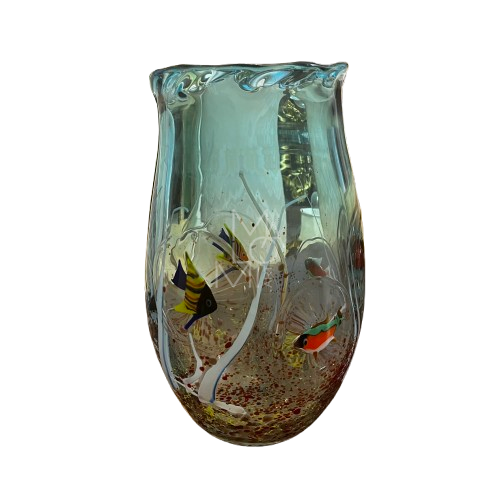
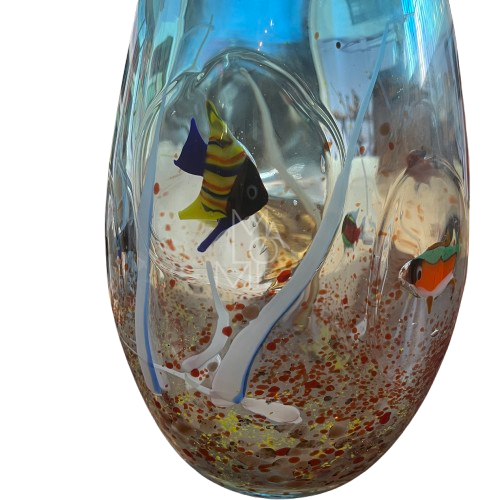
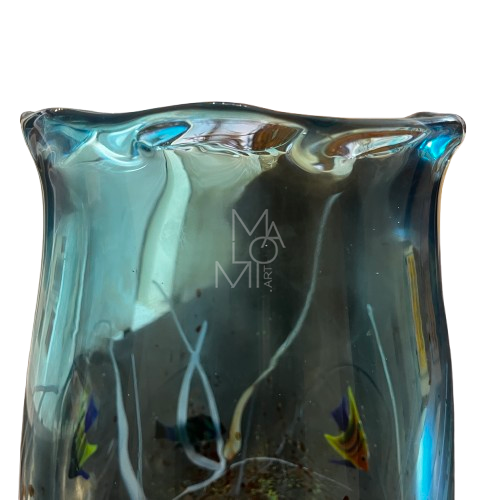
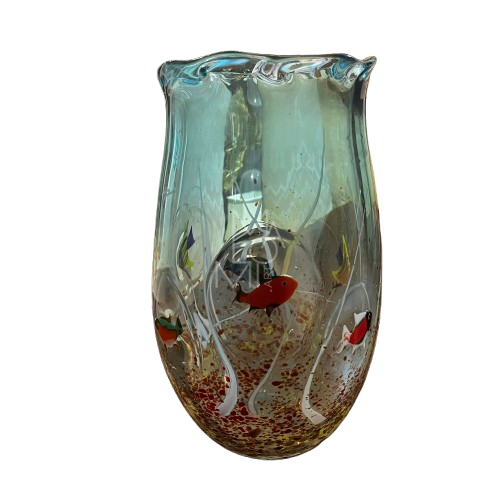
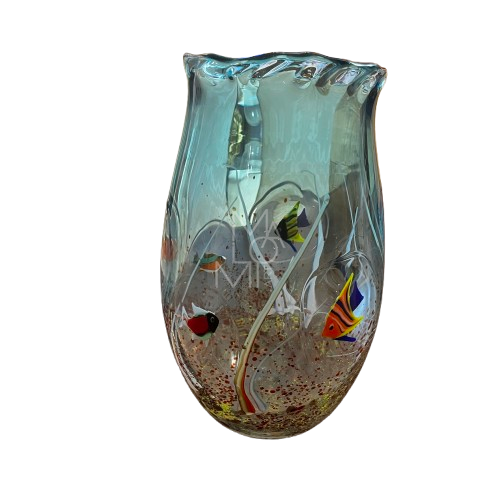
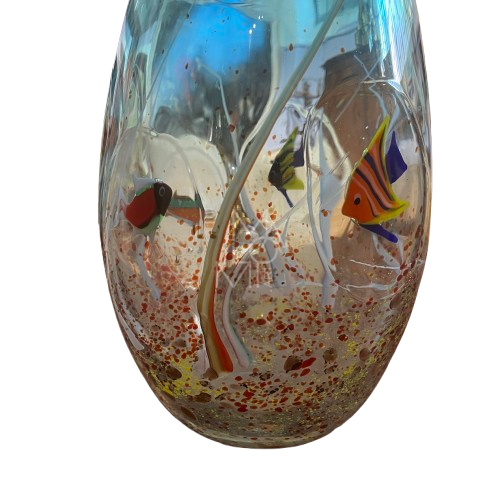
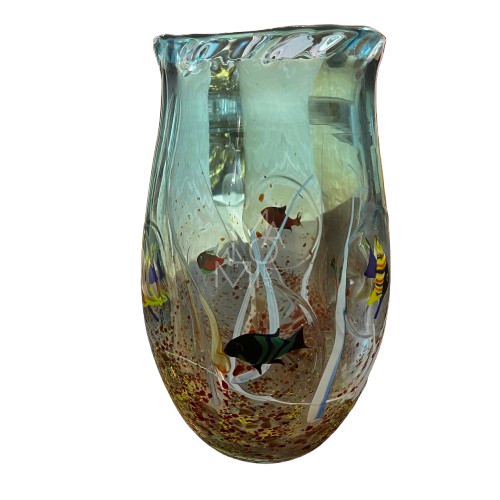
Ars Cenedese submerged aquarium glass vase from the nineteen-eighties
This record examines the historical intersections between early Venetian glass manufacturing and lagoon ecology. It analyzes how medieval Murano masters translated the observation of trapped marine organisms into pioneering glass-shaping experiments.
- Artistic typology: Collectible monumental ornamental sculptural vase.
- Manufactory: Ars Cenedese Murano (certified attribution based on archival models).
- Period and dating: Second half of the twentieth century, circa nineteen-eighty-two.
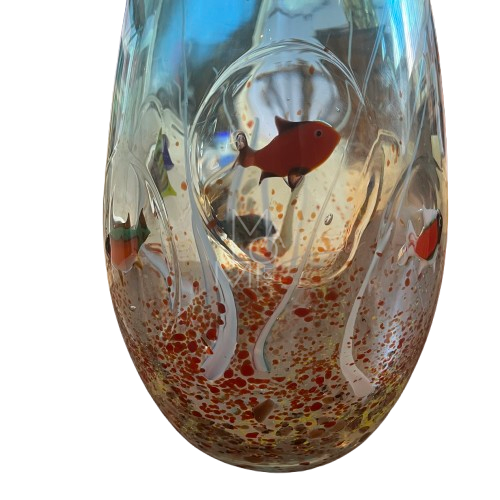
- Execution technique: Hand-blown sommerso glass with hot-modeled vertical ribs, incorporating detailed tropical fish and filiform algae crafted via delicate lampwork. Basal decoration composed of polychrome glass frit granules and dense metallic inclusions of golden avventurina. Base cold-finished with a ground and mirror-polished pontil mark.
- Chromatic specifications: Primary glass body in transparent aquamarine hue, contrasting multicolored marine fauna, accents in white lattimo glass.
- Structural dimensions: Height thirty-five centimeters, maximum diameter eighteen centimeters.
- Rim morphology: Asymmetrical flared mouth featuring alternating hand-tooled lobes and a pronounced wave-lip profile.
- Condition report: Excellent mid-century vintage condition, free from chips, cracks, or glass sickness, showing minor sliding wear on the resting base consistent with age.
- Appraisal value: Current market estimation ranging from four hundred and fifty to six hundred and fifty euros.
The submerged illusion and the Murano glass universe
The Murano glass aquarium vase under examination, with its imposing dimensions of thirty-five centimeters in height and eighteen centimeters in diameter, represents far more than a refined decorative object, configuring itself as a true essay in vitreous micro-architecture. The work belongs to that fortunate artistic and commercial tradition which, beginning in the post-World War II period and reaching its peak between the nineteen-seventies and nineteen-eighties, redefined the concept of transparent underwater sculpture. Through the analysis of this artifact, it is possible to embark on a fascinating journey that connects the pure artisanal expertise of the Venetian lagoon with the laws of optical physics and silicate chemistry. Ancient Murano chronicles recount that the earliest attempts to imprison marine elements within the vitreous matter dated back to lost medieval experiments, born from the fascination that masters felt while observing crabs and small fish trapped in brackish water pools during the low tides of the Venetian lagoon.
Observing the slender silhouette of the vase, the eye is immediately captured by the singular asymmetrical profile of the upper rim, shaped while hot with a pronounced lip. This conformation does not respond to a simple utilitarian requirement, such as the pouring of liquids, but rather assumes an exquisitely aesthetic and evocative value. Murano glassmasters have always sought to capture the very essence of natural elements within solid matter. In this specific case, the asymmetrical and lobed curvature of the mouth of the vase evokes the sudden ripple of a sea wave or the dynamic movement of oceanic foam when lapped by the wind. A curiosity related to this type of modeling concerns the gestures of the master: the rim is opened with a rotational movement so rapid that the furnace assistants had to shield the master with wooden boards to protect him from droplets of incandescent glass that risked detaching due to centrifugal force.
From a strictly technical perspective, the manual modeling of this rim takes place in the concluding minutes of the workmanship, when the glass block is still attached to the iron pontil and is in a plastic state at temperatures nearing nine hundred degrees Celsius. The master, acting with millimetric speed using borselle, the traditional wrought iron jacks, compresses and shapes the border, generating controlled grooves that not only refine the line of the vase but also stabilize its structure, reducing the internal stress of the material during the subsequent and highly delicate cooling process in the annealing kiln.
One of the great challenges of Venetian glassmaking has always been to deceive the eye of the viewer, recreating the illusion of three-dimensionality and movement within a static object. The transparent aquamarine coloration chosen for the body of the vase constitutes the fundamental semantic prerequisite for achieving this effect. This shade, historically introduced into Venetian furnaces through the wise addition of iron and copper oxides into the crucible, acts as a true optical chamber. A furnace rumor narrates that the secret formula for this particular gradation of aquamarine was jealously guarded in a ciphered notebook that masters passed down from generation to generation, even going so far as to falsify the official registries of raw materials to prevent competing glasshouses from copying its exact clarity.
When light traverses the thickness of the glass, it does not merely illuminate the surface, but penetrates inside the endoscopic cavity of the vase, undergoing multiple refraction phenomena. Due to the concave-convex conformation of the walls, ribbed vertically with skillful strokes of an open mold, a lens effect is generated. The tropical fish enclosed within the mass seem to swim and change size depending on the angle from which the work is observed. If the viewer rotates around the vase, they experience an authentic parallax illusion, in which the foreground elements move at a different apparent speed compared to those visible in transparency on the opposite wall, transforming a block of silicon into an oceanic diorama vibrant with life.
The executive technique between fire and lampwork
To understand the intrinsic value of this submerged aquarium, it is necessary to separate the work into its two executive souls, which require radically different artisanal skills destined to merge in a single thermal instant. The first phase, prior to assembly, belongs to the universe of lampwork, a technique historically considered minor compared to large furnace blowing, but which in this specific case rises to heights of absolute calligraphic virtuosity. A fascinating anecdote concerns the figure of the perleri and lampworkers: they often worked in small domestic workshops, separated from the din of the main furnaces, and originally used whale oil or lard as fuel to obtain a flame gentle enough not to burn the most delicate pigments of the glass. Away from the blinding heat of the primary furnace, on a separate workbench, the lampworker uses rods of colored glass and a small gas torch to shape the minute marine fauna. With meticulous movements and the aid of tiny awls, angelfish, surgeonfish, and slender filiform algae in white lattimo glass are modeled. Each little fish, just a few millimeters large, receives a striped livery obtained by fusing together rods of different colors that must not mix, but rather maintain crisp, geometric boundaries.
Once the entire underwater population has been created and left to temporarily stabilize, the second and more dramatic phase of the workmanship begins directly before the mouth of the furnace. The lampwork figurines are arranged with care on a heated metal plate, called a marmo or bronzino. The glassmaster gathers an initial incandescent layer of aquamarine glass from the crucible and, with a fluid and constant rotational movement, rolls it over the figurines. In the oral histories of old artisans, the figure of the workshop boy is remembered, whose crucial task was to blow lightly onto the lampwork figures a moment before the impact with the glowing gather, in order to remove any invisible speck of dust that could create a destructive air bubble. Due to the extreme heat, the lampwork elements adhere instantly to the fluid mass by thermal fusion.
At this point, the master reintroduces the gather into the furnace and collects a second protective layer of clear glass that completely covers the decoration. This operation reflects the famous sommerso technique, originally codified in the nineteen-thirties by masters of the caliber of Carlo Scarpa for the Venini glassworks, and subsequently readapted to marine figuration. The complexity lies in perfectly calibrating the coefficient of thermal expansion of the different glasses used. Should the glass of the fish expand or contract at a speed even slightly different from that of the surrounding aquamarine glass, the entire vase would shatter into a thousand pieces during the cooling phase.
Special mention must be made of the lower decorative register, which simulates the complex stratification of the seabed. The master distributed a dense polychrome carpet composed of granules of glass frit in shades of red and yellow across the base of the vase, interspersed with dense inclusions of avventurina, also known as pasta stellaria. The inclusion of avventurina represents one of the best-kept historical secrets of Murano, its discovery dating back to the early decades of the seventeenth century within the Miotti furnace. Legend has it that its birth occurred per avventura, that is, by accidental chance, when a worker inadvertently spilled copper filings into a molten glass mixture. For centuries, the Venetian Republic protected this formula with severe laws, punishing with imprisonment or exile those glassmakers who attempted to export the secret of avventurina outside the borders of the lagoon. The slow and controlled cooling of the crucible allows the copper to separate from the glass in the form of microscopic, detached geometric crystals. When light strikes the base of this vase, the flakes of avventurina gleam like pure gold, conferring a warm and shimmering irradiation to the seabed that contrasts magnificently with the liquid coldness of the aquamarine glass above.
Historical overview of twentieth-century aquarium masters
The genesis of the submerged aquarium within Murano glass historiography represents one of the moments of most successful convergence between the abstractionist impulse of modernism and age-old lagoon expertise. Although the marine theme has always been present in Venetian decorations, it was from the nineteen-forties onward that the idea of trapping a three-dimensional fauna within a massive block of glass assumed an autonomous sculptural dignity. The absolute pioneer of this formal revolution was Alfredo Barbini. It is said that Barbini spent hours studying fish in the Rialto fish market, observing how their scales changed color under the ice benches, drawing inspiration for his glass sculptures. Operating initially for the Archimede Seguso glassworks and subsequently in his own furnace founded in nineteen-fifty, Barbini intuited that the thickness of clear glass could act as a plastic medium capable of dilating space. His first aquarium blocks, characterized by a near-mineral geometric purity, enclose stylized fish in amber or smoke tones, where the fauna seems suspended in a primordial geological time.
Almost simultaneously, on the island of Murano, one witnesses the experimentations of the Ars Cenedese manufactory, under the artistic direction of the founder Gino Cenedese and through collaboration with sculptors and designers of the caliber of Napoleone Martinuzzi and Antonio Da Ros. A curatorial anecdote reveals that the first series of aquariums by Cenedese were received with such astonishment during early Venetian exhibitions that some visitors touched the walls of the glass, convinced that they were real blocks of ice filled with water through some prodigious optical trick. Cenedese codified the aquarium as a total gallery artwork, introducing bright chromatic variations and exploiting the sommerso technique to stratify algae and corals in a crescendo of compositional complexity.
During the nineteen-fifties and sixties, the baton passed to a new generation of masters and furnaces who declined the genre toward greater descriptive richness and a pronounced polychromy. Among these, the production of the Formia glassworks and the Vetreria Artistica Oball emerged over time, but it was precisely Ars Cenedese that deposited the most imitated aquarium vase models in the world within its historical archives and commercial catalogs. The tropical fish partially lost the sculptural rigidity of the early post-war series to acquire a vibrant design, indebted to the calligraphic techniques of lampwork. The manufactory carried this research to its extreme collecting consequences, introducing large-scale vases onto the market where the basal frit carpet and avventurina became constant elements, destined to evoke the opulence and luminosity of coral reefs within the salons of the international high bourgeoisie.
Morphological analysis and exact attribution of the artifact
The morphological examination of the vase in question reveals a structural layout traceable to a well-defined and exceptionally documented typology. From a purely geometric viewpoint, the body presents itself as an elongated ovoid solid resembling an inverted teardrop, with maximum diameter concentrated in the lower median section. This distribution of mass responds to a precise static logic: the accumulation of vitreous matter toward the bottom shifts the center of gravity of the object near the base, ensuring the vertical stability of a work that develops thirty-five centimeters in height and eighteen in diameter. The external surface does not resolve into a smooth texture, but is punctuated by vertical ribs with a sinuous profile, modeled while hot. These grooves act as light modulators, fragmenting the linearity of reflections and creating a plastic rhythm that accentuates the dynamism of the internal fauna. The element of greatest morphological value is the upper rim, resolved with an asymmetrical flaring of alternating lobes that culminates in a pronounced lip. This organic conformation breaks the rigidity of the primordial cylindrical geometry and dialogues with the underwater theme, mimicking the undulating profile of superficial sea waves.
Based on archival and stylistic verifications conducted on the artifact, the work receives a definitive attributive certification to the Ars Cenedese Murano manufactory. The vase corresponds exactly to the celebrated egg-shaped and teardrop models of the submerged aquarium series produced by the glassworks. A curiosity related to the cataloging of this series concerns the fact that many of these vases were purchased by foreign diplomats visiting Venice as gifts of state, making them ambassadors of Murano art worldwide. The total absence of an engraved signature on the resting base, technically defined in previous chapters as a perfect pontil mark ground and polished to a mirror finish, does not invalidate the assignment to the firm in any way. In fact, Ars Cenedese marketed most of these important monumental vases by applying exclusively paper labels or temporary metallic stickers of the Murano glass consortium.
The sommerso arrangement of the white lattimo algae and the anatomy of the striped tropical lampwork fish constitute the unmistakable stylistic signature of the masters of this specific furnace. The chronology of the work is firmly established in the second half of the twentieth century, with utmost probability in the early nineteen-eighties, an era in which the manufactory experienced a renewed critical and economic fortune linked to high-luxury objects for the designer art market. The current commercial estimate for a signed or certified Ars Cenedese piece of such monumental dimensions, enriched with avventurina inserts, rests securely between four hundred and fifty and six hundred and fifty euros at auction, potentially reaching higher figures within specialized antique gallery channels.
Endoscopic perspective, wall thickness, and radial geometry of the base
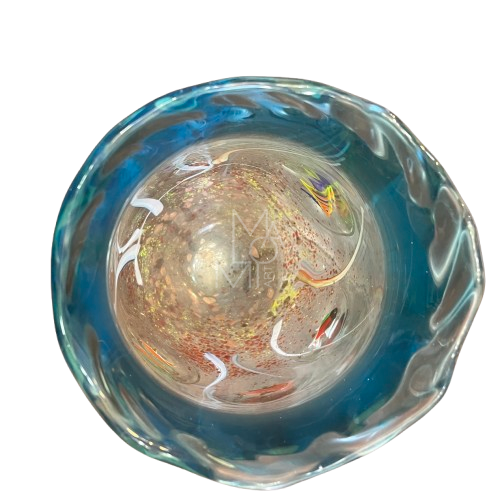
The zenithal view from above offers a deep structural understanding of the three-dimensional section of the work, revealing dynamics invisible from purely lateral analysis. One notes the gradation of the glass thickness and the geometric transition of the artifact. The glass wall, thick and robust near the upper lobes to ensure impact resistance and formal stability, tends to taper along the body and then accumulate mass again at the bottom. This weight distribution ensures that the center of gravity of the object remains extremely low, a structural prerequisite essential for a monumental vase. In furnace memories, it is mentioned that to verify the perfect distribution of the glass, masters used to make the vase resonate by striking it lightly with a wooden rod: a deep and prolonged sound indicated a harmonic thickness, while a dry vibration revealed an invisible structural defect.
The interior of the vase acts as an optical chamber. The concave conformation of the bottom visually expands the distribution of the multicolored frit and the flakes of avventurina. Looking through the mouth, the stratified bottom assumes the appearance of a perfect hemisphere, a concentric microcosm where the red and yellow mineral grains seem to float in a suspended space, amplified by the thickness of the underlying clear glass. The concentricity of the sommerso inclusions shows how the filiform white algae and the tropical lampwork fish are not merely stuck to the outer wall, but appear trapped within a perfectly calibrated glass interstice. The circular shape visible from above confirms the mastery of the blower in maintaining the piece in constant rotational motion on the pontil, preventing gravity from introducing unwanted asymmetries or ovalizations in the body of the vase during the final hot-modeling sessions.
Diagnostics of the base: the ground pontil and the archaeology of the artifact
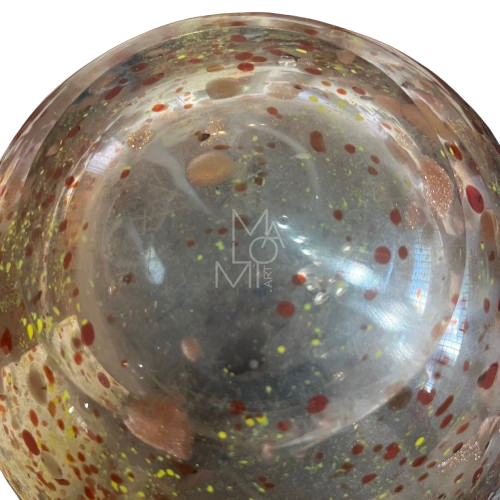
Direct analysis of the resting base reveals the absence of engraved signatures, an extremely common phenomenon in twentieth-century Murano production destined for high-decoration channels or connected galleries. However, the most relevant technical aspect lies in the finish of the pontil. At the center of the base, a large circular imprint is clearly visible, perfectly flat and polished to a mirror finish using very fine-grit wheels. This element witnesses the break of the pontil, the exact spot where the vase, once blowing was completed, was detached from the metal rod to be hot-finished on the upper rim. An historical anecdote reveals that in ancient workshops, the task of grinding the pontil was entrusted to the youngest apprentices as an initiatory test: only when they managed to obtain a surface as reflective as a calm body of water were they admitted to close-up work at the melting furnaces. Subsequent professional grinding eliminates the sharp edges of the glass, ensuring impeccable geometric stability on the horizontal plane.
The peripheral surface shows a light and diffuse microscopic circular wear consistent with the sliding of the heavy artifact over wooden or stone surfaces over the course of decades. This patina, which cannot be artificially reproduced in a homogeneous manner, attests to the historical authenticity of the piece, placing its manufacture firmly between the nineteen-seventies and the nineteen-nineties. The distribution of basal inclusions shows how the red and yellow frit and the large spots of golden avventurina are embedded beneath a protective outer layer of glass, confirming the complex sommerso stratification observed in previous chapters.
Scientific protocols for conservation and maintenance
The conservation over time of a heavy sommerso glass work requires a thorough understanding of the chemistry of this material. Many erroneously believe glass to be an inert and immutable substance, but scientific reality teaches us that glass is a supercooled liquid of extremely high viscosity endowed with a chemically active surface. Murano glass, in particular, employs a high percentage of soda and potassium to lower the melting point of silica and make the mass workable while hot for longer periods. This recipe makes it extraordinarily plastic for the master's hands, but at the same time hydrophilic and vulnerable to the attack of atmospheric humidity and stagnant liquids. A bizarre but useful conservation custom of old Venetian collectors consisted in placing a small piece of vegetable charcoal inside unused vases to absorb residual moisture and avoid the formation of harmful acidic microclimates on the internal walls.
The main danger threatening the interior of the vase is the so-called glass disease, an irreversible chemical degradation process that begins with a subtle whitish opacification. This patina is not formed by simple dust, but is the result of leaching, a phenomenon in which stagnant water extracts sodium and potassium ions from the glass matrix, bringing them to the surface where they react with carbon dioxide to form alkaline carbonates. To prevent this permanent damage, it is mandatory never to leave water inside the vase for long periods, avoiding its use as a container for fresh flowers. Should the interior become wet, one must not merely upside-down the object, as humid air would remain trapped in the deep thirty-five-centimeter cavity. It is necessary to introduce a soft, dry microfiber cloth guided by a smooth-tipped wooden rod to absorb every minimum trace of moisture on the cupoliform bottom.
Regarding ordinary cleaning, the vase must be washed exclusively with lukewarm water and mild neutral soap, preferably inside a large plastic basin or protecting the walls of the sink with rubber mats to prevent fatal impacts. Commercial glass cleaners containing ammonia or alcohol are absolutely banned, as are abrasive sponges that would scratch the brilliance of the aquamarine surface. The final rinse should always be performed with distilled or demineralized water to prevent the calcium and magnesium salts present in tap water from leaving unsightly limescale stains once evaporated. If the vase already presents stable encrustations on the bottom, an extraordinary wash can be attempted by filling the cavity with a solution of lukewarm distilled water and white vinegar in equal parts, allowing the mixture to act for no more than two hours to dissolve the limescale without attacking the silicon. Finally, for the safe handling of the piece, given its considerable mass, one must always grasp the vase with both hands around the ovoid central body, never lifting it by the upper lobed rim, which represents the structurally thinnest and most delicate portion of the entire glass composition.
Reference bibliography Chicago style
Aloi, Roberto. Esempi di decorazione moderna di tutto il mondo: Vetri d'oggi. Milan: Hoepli, 1955.
Barovier Mentasti, Rosa. Il vetro veneziano dal Medioevo al Novecento. Milan: Electa, 1982.
Deboni, Franco. I vetri di Venini. Turin: Allemandi, 2007.
Dorigato, Attilia. Il vetro di Murano. Milan: Electa, 2002.
Hoveler, Susanne. Murano Glass: Themes and Variations (1910-1970). London: Antique Collectors' Club, 2016.
Krish, Helmut, and Rosa Barovier Mentasti. Alfredo Barbini: Maestro Vetraio. Venice: Arsenale Editrice, 1993.
Romanelli, Giandomenico, ed. Ars Cenedese: La grande tradizione del vetro sommerso. Venice: Marsilio, 2011.