A Late Seventeenth-Century Venetian Candlestick
monumental venetian torchère, 17th century baroque candlestick, mecca gilding antiques, venetian wood sculpture, andrea brustolon carving style
Rare late 17th-century monumental Venetian torchère in mecca-gilded wood (325 cm). A museum-quality masterpiece combining Baroque carving and structural joinery.
A Late Seventeenth-Century Venetian Candlestick: A Historical-Artistic, Technical, and Formal Analysis of a Monumental Torchère
- The Historical-Artistic Context: The Late Seventeenth-Century Venetian Baroque
In the final decades of the seventeenth century, Venice experienced a period of intense and profound artistic flourishing, characterized by a sumptuous, theatrical, exuberant, and markedly dynamic taste. Wood sculpture and carving liberated themselves definitively from the subaltern role of minor arts to engage in a direct, paritetic, and continuous dialogue with the grand monumental architecture of absolute masters such as Baldassarre Longhena. Within this specific cultural horizon, furnishings were no longer conceived as mere utilitarian complements or as purely functional objects within a space. Instead, they became an essential element in the structuring of the Baroque scenic apparatus, actively contributing to the celebration of patrician power and the solemn sacralization of the ecclesiastical spaces of the Serenissima.
This extraordinary candlestick belongs with absolute critical pertinence to the typology of parade and high-apparatus torchères. These were monumental furnishings originally intended for the vast salons of aristocratic palaces overlooking the Grand Canal or for the presbyteries of the most important Venetian basilicas. Its extraordinary and majestic monumentality addresses the precise Baroque necessity to astonish, marvel, and capture the observer, modulating the surrounding space through fluctuating and semovent light sources. These lights were amplified, refracted, and fragmented into a thousand glimmers by the complex plastic modeling of the surfaces and the gilded finish.
Furthermore, the formal transition of the structure testifies to the receptive assimilation of Berniniese and Roman artistic currents. These stylistic flows were expertly filtered, re-elaborated, and softened by the Venetian sensitivity, which was historically oriented toward the enhancement of pictorial chiaroscuro, linear fluidity, plastic softness, and the luminous vibration of matter. The work thus stands as an ideal convergence point between the rigor of architectural structure and the expressive freedom of Baroque carving.
- Morphology and Architectural Syntax of the Object
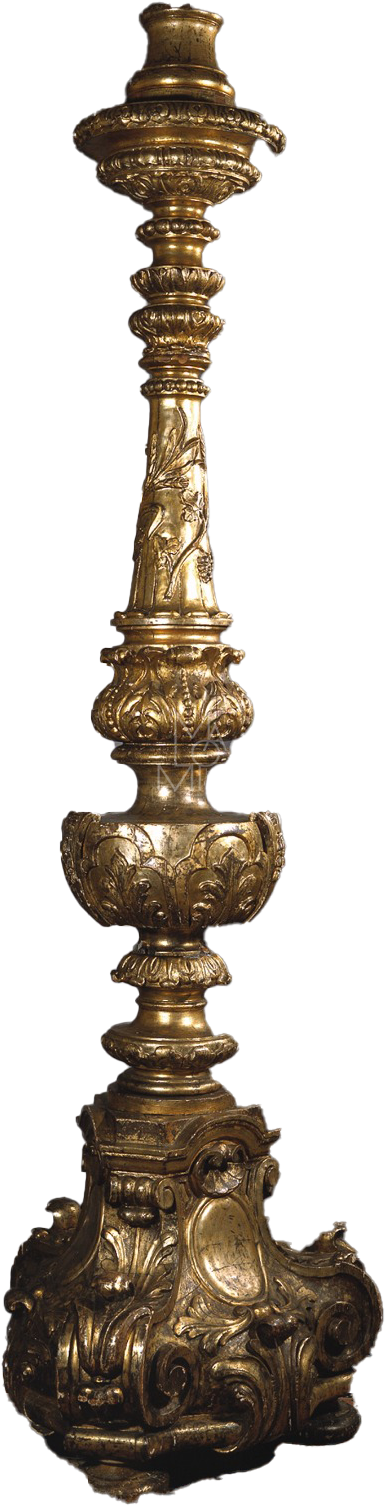
The work under examination represents an exceptional testament, and one of extreme rarity for collectors, to the plastic and decorative production of Venice at the end of the seventeenth century. Standing at an imposing monumental height of 325 centimeters, this architectural torchère is articulated according to a rigorous, studied, and calibrated ascendant logic. This approach transposes classical architectural orders, derived from the sixteenth-century tradition, into a complex and typically Baroque ornamental syntax. To conduct an in-depth methodological analysis, the wooden artifact can be ideally and structurally subdivided into three distinct superimposed macro-sections, each endowed with a specific formal and static function.
The base constitutes the most massive, imposing, and structurally complex portion of the entire candlestick. The tripodal base, characterized by a complex mixtilinear section, has the fundamental task of discharging the visual, geometric, and structural weights of the shaft to the ground. This action occurs through a veritable triumph of large, inverted-scroll volutes with a strong plastic projection. Oval panels and cartouches framed by deep flutings alternate rhythmically with rocky elements, naturalistic carvings, and dynamic ripples. This alternation confers a strong and indispensable sense of rootedness to the foot of the object and, simultaneously, a wave-like, flexuous, and vibrant motion that lightens its bulk.
The shaft, or lower calyx, rises above a progressive series of finely turned and molded nodes. This section features a prominent and pronounced swelling in the form of an inverted cup, which immediately captures the spectator's attention. The surface of this node is entirely clad, without interruption, in tight, deep gadrooning and strongly projecting acanthus leaves. This horizontal element acts as a visual and structural hinge within the composition. It sharply breaks the verticality of the torchère and prepares the observer's eye for the geometric transition toward the slenderness of the upper column.
The upper column and the terminal pan complete the ascendant path of the artifact. The upper section tapers progressively into a slender, elegant shaft that narrows toward the top. In its median portion, the column is densely decorated with plant motifs executed in dense relief, among which festoons, vines, leaves, and tendrils can be distinguished. These elements recall the allegorical symbols of prosperity, abundance, and sacred liturgy. The visual journey finally concludes with a stylized capital and a terminal pan. The latter is finely molded with multiple superimposed orders of gadroons and is centrally designed to accommodate the large candle or parade torch.
- The Decorative Repertoire: Naturalism and Sub-Chapters of Carving
The ornamental apparatus coating this imposing torchère can be considered a true compendium of mature seventeenth-century carving techniques and motifs. Every centimeter of the wooden surface is masterfully exploited by the carver according to the aesthetic principle of horror vacui. However, this decorative density never generates visual confusion, as the author maintains an absolutely impeccable structural and geometric legibility, where each ornament emphasizes the underlying static function.
The cornerstone motifs structuring the decoration include volutes and scrolls. These are elements that fuse structural function with purely decorative purpose. They create continuous lines of force based on opposing curves and counter-curves, which impart a plastic dynamism to the base and break the rigidity of orthogonal planes. One can also distinguish the gadroons, turned nodes, and longitudinal flutings. These geometric-organic motifs are derived directly from the revival of classical antiquity. They are utilized with compositional intelligence to punctuate the horizontal rhythms of the work, creating artificial shadows that accent the roundness and plasticity of the nodes.
Finally, acanthus leaves and long vegetal festoons sinuously envelop the slender shaft. The carving is executed with extraordinary depth, fully exploiting the technique of undercutting. This expedient generates sharp, dark, and deep shadows that starkly detach the leaves from the background. In this manner, the work imitates the exuberant vitality of nature, transforming the wood into an organic, mobile matter that pulses under the effect of light sources.
- The Technique of Mecca Gilding
One of the elements of greatest technical, artistic, and philological relevance in this Venetian candlestick is the superficial decoration. It was executed entirely using the famous and complex technique of mecca. Mecca is a specialized varnish formulated with alcohol or high-proof aqua vitae, in which various natural resins were dissolved, including shellac, sandarac, gamboge, dragon's blood, and saffron. This liquid, golden mixture was applied with extreme precision over silver leaf. The silver leaf, in turn, had been previously laid upon the wood using the traditional preparation of gesso and Armenian bole. The final result of this chemical and artisanal process is a flawless, warm, deep, and extraordinarily brilliant imitation of the more expensive pure gold leaf.
Within the production horizon of Venice, the use of mecca must not be considered an economic alternative or a simple cost-saving measure compared to pure gold leaf. Rather, it was a true aesthetic preference, theorized and sought after by the patrician commissioners themselves. Venetian mecca is historically distinguished from that produced in other Italian centers by a unique luminosity. It retains a silvery, cold undertone under direct light, which fuses with a warm, amber golden transparency on the surface. This chromatic ambivalence allowed the surface to react in an extremely vibrant manner to the shifting, flickering, and warm light of candles. The effect generated shimmering, silvery, golden, and bronze reflections that were far less static, monochrome, and flat than traditional pure gold gilding.
- State of Conservation and Paleographical Considerations on Restoration
The technical and descriptive record of the artifact explicitly mentions the presence of restorations due to use and time. In a wooden artifact of exceptional monumentality, which exceeds three meters in height and boasts a history of more than three centuries, conservative and integrative restorations must not be viewed as a defect. They constitute an intrinsic, documentary, and precious component of the object's material history, testifying to its life and collecting vicissitudes.
Torchères of these precise dimensions were subjected to severe and continuous physical stresses during their operational use. In the upper portion, the intense heat of the flame and the fall of hot wax progressively corroded the paint film, the mecca, and the underlying gesso layers. In the lower portion, conversely, the frequent movements necessary to reorganize salons or presbyteries exposed the protruding scrolls and volutes of the base to impacts, chipping, and fractures.
The restoration interventions that have stratified over the centuries—including structural consolidations of the wood, securing of the gilded film, and localized touch-ups of the mecca—do not diminish the historical value of the work in the slightest. On the contrary, these interventions unequivocally attest to its functional continuity, the respect for its beauty, and the collecting interest that has preserved and protected it to the present day.
- Stylistic Comparisons: The Torchère in the Era of Andrea Brustolon and the Great Venetian Carvers
To fully comprehend the artistic caliber and critical importance of this candlestick, it must be contextualized within the rich landscape of Venetian wood sculpture of the late seventeenth century. This historical period was dominated by the complex stylistic transition from the mature, monumental Baroque toward the first formal solutions of the Rococo. The inevitable point of reference for carving in this era is Andrea Brustolon (1662–1732), an artist from Belluno but of Venetian training, whom Honoré de Balzac magnificently defined as "the Michelangelo of wood."
While Brustolon pushed wooden carving toward an extreme anthropomorphic, allegorical, and figurative dynamism—as can be clearly observed in the famous Ethiopian stand-holders, the warriors, and the armchairs executed for the Venier family and today preserved at Ca' Rezzonico—the master responsible for this torchère chose a different path. He adopted a more architectural, controlled, and structured approach, preferring the severity of classical orders to the exuberance of intertwined human figures.
A detailed stylistic comparison, however, reveals a series of close and undeniable formal affinities, especially in the treatment of the foliage and the volumetric conception of the ornament. The projecting, tormented, and vibrant acanthus of the candlestick's lower calyx displays the same executive fury, the same depth of gouging, and the same sense of movement that Brustolon applied to his secular decorative apparatuses. The use of deep undercutting serves here to capture ambient light, an expedient typical of the Brustolonian workshop to impart movement and expressiveness to purely abstract or non-figurative sections.
Furthermore, the rigid ascendant syntax, the elegance of the column, and the use of gadrooned nodes closely recall the monumental works of Giacomo Piazzetta (father of the celebrated painter Giambattista). The elder Piazzetta was famous in Venice for the grandiose wooden carvings executed for the Basilica of Santi Giovanni e Paolo. The candlestick under examination thus places itself within that precise current of Venetian sculpture which accepted the redundancy and luxury of the Baroque but chose to discipline and organize it within a clear geometric-architectural grid of distinct Longhenian lineage.
- Archeometry and Atelier Secrets: The Ancient Chemical Composition of Mecca Varnish
The splendid mecca finish that characterizes the surface of this monumental torchère must not be considered a simple superficial varnishing. It is the mature result of a sophisticated, complex, and time-tested empirical chemical recipe. This formula was guarded with extreme jealousy by gilder artisans within their Venetian ateliers. Silver leaf, due to its metallic composition, tends to oxidize very rapidly when in contact with air and sulfur fumes. This phenomenon produces silver sulfide, a dark substance that blackens and dulls the surface. The mecca varnish thus fulfilled a fundamental dual function within the artifact: a protective and sealing function, and an optical and aesthetic function.
Period treatises and manuscript recipe books reveal that the varnish was a complex mixture structured around three main components, all carefully dissolved in pure alcohol or high-proof aqua vitae. The body, glassy consistency, and final brilliance were guaranteed by the so-called binding resins. Among these, the most widely used were shellac—a natural resin secreted by the insect Kerria lacca in the regions of Asia—and sandarac, obtained from cypress resin. Once finely pulverized and dissolved in alcohol, these substances created a transparent, hard, impermeable, and insulating film. This barrier perfectly sealed the underlying silver, protecting it from the deleterious action of oxygen and moisture.
The chromatic transformation and the illusion of gold were instead entrusted to transparent yellow pigments. To convert the cold metallic reflection of the silver into the warm and regal glow of gold, artisans utilized gamboge. This is a gum resin extracted from trees of the genus Garcinia, which was expertly combined with warm infusions of saffron. These botanical elements maintained a crystalline transparency within the varnish. In this manner, ambient light could pass through the colored layer, reflect off the underlying silver mirror, and return to the observer's eye with a brilliance and optical depth superior to those of pure gold leaf, which remained intrinsically more opaque and dense.
Finally, to balance the overall chromatic tone and prevent the yellow reflection from appearing too acidic, cold, or unnatural, heat modulators were added. Among these, the most precious and fascinating was dragon's blood, a dark-red resin obtained from the plant Dracaena cinnabari, to which small percentages of succotrine aloe were frequently added. This skillful combination bestowed upon Venetian-school mecca that characteristic, unmistakable warm, amber, and almost bronze nuance in the recesses of the carving. This feature remains visible today in areas of the torchère that have been less exposed to aggressive restorations or destructive cleanings of the past.
- Function of Space: Liturgical Destination and Profane Splendor in Baroque Venice
A torchère that reaches the monumental height of 325 centimeters possesses a dimensional scale and a visual impact that unequivocally determine its original destination. The object was conceived for vast, public, and monumental spaces, whether tied to the sacred or profane sphere. In late seventeenth-century Venice, the line of demarcation between these two spheres was extremely thin, mobile, and permeable. The luxury and richness of religious furnishings directly reflected the economic stability, political power, and international prestige of the Republic of the Serenissima and its patrician families.
In ecclesiastical and liturgical contexts, a pair or a complete set (muta) of torchères of this magnitude found its natural placement in the presbytery, flanking the high altar, or adjacent to the monumental apsidal chapels of the Venetian Scuole Grandi. Their function was closely tied to the theatricalization and dramatization of the Baroque Mass. By elevating the luminous source to over three meters above the ground, the candlesticks illuminated frescoed ceilings, gilded stuccos, and large teleri (canvas paintings) hung upon the walls. Concurrently, they left the nave of the faithful in a mystical and suggestively dim light, exerting a powerful emotional and devotional impact. Furthermore, the vegetal vines, gadroons, and festoons carved onto the shaft engaged directly with the sacred iconography of regeneration, divine light, and eternal life.
Within patrician palaces arranged along the Grand Canal, these monumental torchères were instead the key and indispensable furnishings of the portego, the grand central reception hall that structured the layout of the Venetian house, or of the sumptuous ballroom. In a historical era devoid of electrical illumination, possessing light machines of such proportions was the highest and most immediate indicator of social status and economic power of the family. The mecca gilding was considered a true technical and scenographic virtuosity. Its capacity to reflect the shifting, flickering, and warm light of candles created a fluctuating, sumptuous, and magical effect during nocturnal receptions and balls. This effect was further amplified and multiplied by the large Murano mirrors hanging upon the walls. The torchère thus ceased to be a simple object of daily use to become an autonomous architectural element, capable of structuring the scenography and rhetoric of Venetian patrician power.
- Archival Focus: The Secrets of the "Meccadori" and the Recipes of the Mariegola
In Baroque Venice, the craft of gilders and meccadori was not free, but was rigidly regulated and overseen by strict corporate and state regulations. Their statutes, rights, duties, and technical secrets were solemnly compiled in the Mariegola of the Guild of Painters, Gilders, and Miniaturists. Atelier recipe books, containing the exact proportions of varnish ingredients, were jealously transmitted from generation to generation, from master to disciple. They were secretly registered at the corporate tribunals to prevent plagiarism or counterfeiting by foreign artisans or those not enrolled in the guild. Archival documents and Venetian treatises of the seventeenth and eighteenth centuries allow for the isolation of specific preparation variants of mecca. These formulas were precisely differentiated based on intended use, the placement of the furnishing, and the quality of light within the space.
Archival documents allow for a primary distinction between light mecca, also known as mecca all'alemanna. This variant was characterized by a high percentage of gamboge and sandarac in alcohol, which produced a highly vibrant, acidic, and brilliant lemon-yellow tone. It was utilized predominantly for mirrors, frames, and consoles intended for secondary rooms, boudoirs, or private environments illuminated by large windows. This stood in contrast to warm mecca, commonly referred to in registers as mecca da portego, which is the precise typology found on the candlestick under examination. For grand reception halls, salons of representation, and churches, the recipe required a significant load of dragon's blood and succotrine aloe. This rich mixture imparted an amber, deep, dense, and almost reddish nuance within the recesses of the carving. This technical expedient served to simulate the appearance of antique gold leaf, which over time tended to acquire a warm, brown tone due to natural copper impurities present in the mint alloy of the Venetian Zecca.
Technical manuscripts of the period further specify that the application of mecca required a controlled environment and a true baking room. The liquid varnish, once applied by brush over silver perfectly burnished with agate stone, had to be exposed to the constant heat of warm braziers or placed in specialized kilns. This heating process favored the controlled fusion of natural resins and their perfect cohesion with the metallic support. It was an extremely delicate operation that required vast empirical experience. If the temperature of the braziers was too high, the aloe would burn instantly, irremediably blackening the piece and forcing the artisan to scrape away all the work. If the temperature was too low, the shellac would not melt completely and remained tacky on the surface. Over time, this defect attracted dust, moisture, and candle soot, causing the furnishing to blacken. Restorations found on our artifact have frequently had to remedy over the centuries precisely the natural or accidental degradation of these highly delicate original glassy layers.
- Bibliographical Integration: The Venetian Scuole Grandi and Liturgical Patronage
To fully comprehend the socio-economic context of production for monumental furnishings of exceptional scope such as this torchère, it is indispensable to analyze the extraordinary institutional system of the Scuole Grandi of Venice. These exceedingly powerful lay confraternities of devotion and charity constantly rivaled the State of the Serenissima, major religious orders, and patrician families themselves in artistic patronage. They invested astronomical sums in the decorative, pictorial, sculptural, and liturgical apparatuses of their architectural complexes. The following titles integrate the bibliography of the essay, focusing specifically on the patronage of wooden carving apparatuses, processional machines, and grand light machines by the Scuole:
- Pullan, Brian, Rich and Poor in Renaissance Venice: The Social Institutions of a Catholic State, 1580-1790, Oxford, Blackwell, 1971.
- Critical note: This is the foundational and unsurpassed text for understanding the economic, social, religious, and political weight of the Scuole Grandi and Scuole Piccole in Counter-Reformation and Baroque Venice. The volume provides the historical framework within which the great demand for monumental liturgical furnishings developed, understood by the confraternities as true instruments of propaganda and social prestige for city coalitions.
- Gramigna, Silvia; Perissa, Annalisa, Scuole di Arti, Mestieri e Devozione a Venezia, Venice, Helvetia, 1981.
- Critical note: A systematic and documentary study mapping with precision the Scuole Piccole and the Guild Schools, including those of carpenters, carvers, gilders, and meccadori. It is fundamental for understanding the organization of labor, contracts of allocation, and commissions of torchères and parade elements executed based on designs by the architects or proti of the School.
- Howard, Deborah, The Architectural History of Venice, New Haven-London, Yale University Press, 2002 (revised ed.).
- Critical note: In this celebrated volume, the author analyzes the interior space, volumes, and light of major Venetian buildings, including churches and the chapter halls of the Scuole Grandi. The text offers valuable elements for understanding the monumental scale of Baroque objects: in halls and navates frequently exceeding eight or ten meters in height, torchères surpassing three meters were dimensionally necessary so as not to disappear or be nullified by the surrounding architectural gigantism.
- Aikema, Bernard; Meijers, Dulcia (eds.), Nel regno dei poveri: Arte e storia dei grandi ospedali veneziani in età moderna (1474-1797), Venice, Arsenale, 1989.
- Critical note: A valuable collection of specialized essays exploring the artistic patronage of the four Grand Hospitals and the Schools connected to them. The text contains transcriptions of period inventories describing in detail the grand sets of torchères in carved and mecca-gilded wood ordered for the most solemn liturgical celebrations of the year, confirming the rarity and collecting value of the very few specimens that have reached us intact.
- The Formal Evolution of the Vegetal Festoon and the Acanthus from the Renaissance to the Venetian Mature Baroque
The exceptional and virtuosic plastic skill of the torchère under examination, evident in the compositional density of the shaft and the vigorous projection of all its moldings, is the mature result of a centuries-old and complex stylistic evolution. This transformation affected two of the longest-lived, most widespread, and important ornamental motifs of the Western classical tradition: the vegetal festoon and the acanthus leaf. In the particular historical and geographical Venetian context, this evolution did not translate into a simple chronological shift in style. It represents a progressive, radical, and conceptual metamorphosis of the wood-architectural matter itself. The transition from the Venetian Renaissance of masters like Pietro Lombardo or Jacopo Sansovino to the mature Baroque of Baldassarre Longhena and Andrea Brustolon marks a clear and profound shift. One moves from linear, symmetrical structures with geometric low-relief toward dynamic, expanded compositions characterized by deep undercuts and an organic hypertrophy wherein decoration assumes a space-generating function.
In the fifteenth and early sixteenth centuries, the rediscovery of Roman classicism by humanists and artists active in the Lagoon imposed a return to the structural, philological, and geometric purity of the acanthus and the festoon. Derived from the Corinthian capitals of classical monuments, the Venetian Renaissance acanthus appears flat, bidimensional, geometrically controlled, and closely adherent to the architectural surface of the furnishing. It possesses a predominantly tectonic function, serving to emphasize points of transition, junction, or support of the object without altering or disturbing its original geometric profile. The Renaissance festoon likewise maintains an impeccable philological rigidity. Stretched between two precise points of the structure, it describes a geometric curve or a perfect catenary. Within the festoon, fruits, flowers, and ribbons are carved individually with an almost scientific, analytical, and naturalistic approach, typical of the influence of Paduan philosophical culture on the sculpture of the Lombardi workshop.
Toward the second half of the sixteenth century, with the emergence of international Mannerism and the charismatic influence of Alessandro Vittoria’s sculpture, the decorative repertoire underwent a primary and important dramatic acceleration. The acanthus began to curl with greater linear nervousness, the tips of the leaves became sharper, more cutting, and the leaf lost its ancient bidimensionality. It welcomed the first strong chiaroscuro contrasts and detached slightly from the background. Vegetal festoons no longer hung in a static and geometric manner but began to intertwine in a complex fashion with scrollwork, volutes, broken ribbons, and grotesque masks, displaying a fluid, dynamic, and almost fleshy plasticity that anticipated the solutions of the following century.
The end of the seventeenth century finally marked the absolute triumph of the Baroque aesthetic, where ornament emancipated itself definitively from the architectural structure to become its primary visual engine. Under the influence of Longhena’s architecture and the grand sculpture of Giusto Le Court and Andrea Brustolon, the acanthus and the festoon underwent a definitive conceptual and technical metamorphosis. Through the skillful use of curved gouges and sharp chisels, the carver hollowed out the cirmolo wood deeply. He isolated the leaves almost completely from the original wooden ground, achieving an extreme and total undercutting. The acanthus leaf lost at this point all classical symmetry and all tectonic rigidity. It swelled, crumpled, folded upon itself, and projected with violence into the external space, assuming dynamic forms reminiscent of ripples of marine waves in the lagoon or darting flames of a fire.
Parallelly, the festoon lost its rigid linearity and geometric tension to transform into a vital, exuberant, and indomito vegetal vine sinuously wrapping around the shaft of the column. No longer simply hung or applied to the architecture like a static frieze, the phytomorphic motif appeared to spring and gush from the architecture itself of the torchère. It created a continuous rhythmic sequence of protrusions, recesses, voids, and solids that captured light from any angle the observer viewed the work, nullifying the static quality of the wood.
- Engineering of Baroque Wood: Structural Analysis and Joinery Systems in Monumental Torchères
A wooden artifact exceeding three meters in height presents static, constructive, and material resistance problems entirely analogous to those of a micro-architecture or a building. The vertical thrust of the structure's own weight, combined with a center of gravity shifted heavily upward due to the presence of the monumental candle in beeswax, imposed an extremely rigorous engineering and geometric design upon Venetian master marangoni and carvers. The work under examination was not riched from a single immense tree trunk. This option was unfeasible due to timber availability constraints in the Lagoon and the inevitable destructive cracking of wood caused by natural hygroscopic shrinkage movements. The torchère is instead the result of an intelligent and studied modular assembly of multiple cylindrical and polygonal blocks. These pieces are rendered solid by sophisticated internal joinery systems connecting in sequence the upper pan, the upper shaft, the gadrooned central node, the lower shaft, and finally the tripodal base.
The macrostructural stability and longevity over centuries of the torchère rely primarily on the careful selection of timber essences. For shafts of these exceptional dimensions, the wood of choice in the Venetian Republic was cirmolo wood, also known as stone pine, or alternatively linden wood. These are softwoods characterized by an extremely compact, homogeneous fiber and are almost totally devoid of major knots or resin pockets. These features rendered them ideal for deep gouge carving, yet endowed simultaneously with excellent dimensional stability and resistance to deformation. To counteract natural movements of the wood, the various cylindrical modules composing the shaft were assembled while taking care to alternate the direction of the grain and growth rings of the trunk. This ancient principle of internal force compensation prevented continuous variations in relative humidity, typical of the brackish and lagoon environment of Venice, from warping, bending, or bowing the vertical axis of the candlestick, thereby safeguarding its stability.
The primary joint utilized by carpenters to unite the various nodes of the shaft is the traditional mortise and tenon joint, adapted into a specific cylindrical form known as a blind pin or internal core. The tenon, or male pin, was obtained through turning directly from the upper extremity of one of the modules, or was inserted as an autonomous and separate cylindrical element. In this second case, it was crafted from beech or oak—extremely hard woods capable of resisting extraordinary shear, bending, and torsional stresses. The mortise, or female housing, consisted of a perfectly calibrated and polished blind hole, executed at the center of the contiguous module using large metal augers operated by hand. In late seventeenth-century Venetian torchères, the critical junction between the large tripodal base and the first node of the lower shaft frequently utilized a wooden threaded pin. This screw system allowed the shaft to be literally screwed and tightened into the base, facilitating transport operations of the colossus within palaces and ensuring an ideal mechanical tightness adjustable over time.
The chemical and permanent adhesion of the joints was entrusted to the use of bone glue or bovine glue, known in historical workshops as hot glue or strong glue. This natural proteinaceous substance, obtained from the prolonged boiling in water of animal connective tissues and bones, was applied fluidly at a constant temperature of approximately 60 degrees Celsius. Penetrating deeply by capillarity into the porosities of the cirmolo wood, the glue created a chemical-mechanical bond that, once solidified and crystallized, was structurally more resistant than the fibers of the wood themselves. To definitively lock the internal pins and prevent any axial slippage or involuntary rotation, wooden draw-bores or transverse pegs were inserted laterally. These small cylindrical wedges of hardwood traversed from side to side both the outer decorated wall of the module and the hidden internal pin. This expedient sealed the joint permanently and securely without requiring metal nails or pins. The use of metal was avoided because it would have risked rusting due to Venetian humidity, expanding and splitting the slender, delicate external gadrooning of the carving.
Finally, the lower portion of the candlestick represents the true engineering and static fulcrum of the entire structure. To support an majestic height of 325 centimeters and discharge forces, the three large inverted-scroll volutes of the base must not be interpreted as simple ornamental elements. They function as true architectural buttresses, similar to those of cathedrals. Concealed within the base is a radial structural framework. This structure diverts the vertical loads coming from the shaft along the curved lines of the external volutes, significantly widening the geometric support base and drastically lowering the torchère's center of gravity, thereby ensuring its equilibrium.
- The Thermal and Vibrational Factor: Degradation of Protein Glues and Instability of Joints
The structural and conservative analysis of this monumental torchère cannot disregard a careful and scientific evaluation of the severe physical-environmental stresses to which the artifact was constantly subjected during its centuries of operational use. A wooden artifact 325 centimeters high, expressly intended to support a large beeswax candle or parade torch at its summit, behaved during operation as a veritable vertical thermal chimney. The intense and constant heat generated by the combustion of the flame at the summit of the pan induced a continuous and severe thermal escursion in the upper portion of the shaft, triggering over time a dual and combined degradative phenomenon within the wooden structure and its points of union.
On one hand, a continuous and damaging hygroscopic shock of the wood occurred. The radiant heat of the apical flame rapidly and violently dried the wooden fibers contiguous to the terminal pin of the pan, causing localized micro-shrinkage of the material, fissurations, and small linear cracks. Conversely, the lower portions of the shaft and the massive tripodal base constantly felt the effects of rising relative damp, typical of ground floors and Venetian palaces in direct contact with canal water. This marked hygrometric disparity between the top and base of the object created differentiated and opposing internal tensions along the axis of the candlestick. These forces discharged and concentrated directly onto the joinery points and pin connections.
On the other hand, one witnessed the progressive crystallization and chemical hydrolysis of the animal bone glue. This natural adhesive substance, being entirely based on collagen, proves over time highly sensitive to environmental thermo-hydrometric variations. The continuous heat transmitted from the pan, combined with seasonal fluctuations in humidity, accelerated the natural process of aging and degradation of the glue. Losing its original gelatinous and plastic elasticity, the internal adhesive film progressively became glassy, rigid, and brittle. The protein molecules underwent historical phenomena of hydrolysis, fragmenting and totally losing their original cohesive power. This process led to the complete serialization and pulverization of the glue, nullifying the chemical adhesion between the walls of the male tenon and the female mortise.
Added to this already precarious framework of thermal and chemical vulnerability were continuous mechanical and vibrational stresses from the surrounding environment. Due to the monumental height of over three meters, any slight movement of the furnishing within rooms, as well as low-frequency ambient vibrations—caused by footsteps on deformable Venetian-style wooden floors (alla veneziana) or continuous external wave motion of canals crashing against the building's foundation piles—generated a strongly amplified leverage effect at the summit of the torchère.
In the absence of the chemical hold of the now pulverized and degraded bone glue, the internal pins began to function exclusively via mechanical tolerance and friction. The continuous micro-friction between wooden components caused by vibrations progressively widened the mortise seats, instigating microscopic but dangerous structural play and losses of axis. This systematic and progressive loosening of internal joints is the primary and fundamental cause of the restorations due to wear mentioned in the descriptive record of the work. These were historical interventions that involved inserting new tightening wedges, known as biette, re-injecting hot protein adhesives, or applying metal reinforcing brackets and hoops. These expedients were necessary to restore the indispensable, perfect static verticality to the wooden colossus.
- Conclusion
In conclusion, this Venetian candlestick from the late seventeenth century configures itself as a masterpiece of exceptional rarity, importance, and value within the overall landscape of European Baroque furniture. Its complex structure demonstrates how lagoon wood sculpture was capable of fusing with absolute mastery the demands of architectural statics with the maximum expressive freedom of naturalistic carving.
The superb warm mecca da portego finish, miraculously preserved in its chiaroscuro passages and amber transparencies, and the monumental proportions of 325 centimeters render it a piece of museum-grade dignity. Through its material and its conservative history, the work is capable of narrating the splendor, theatricality, technical refinement, and celebratory rhetoric of late seventeenth-century Venice.