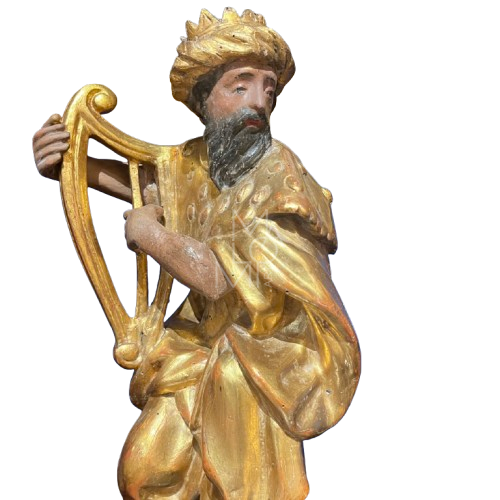
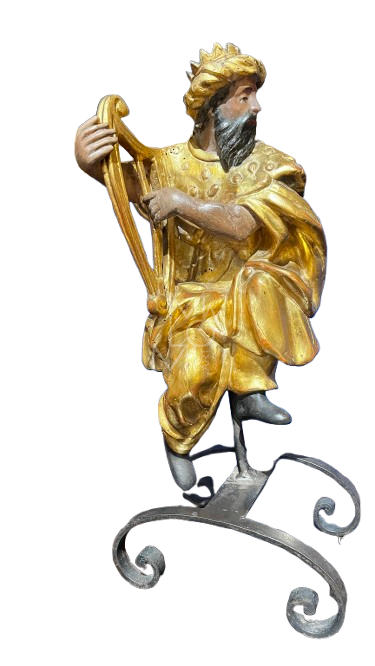
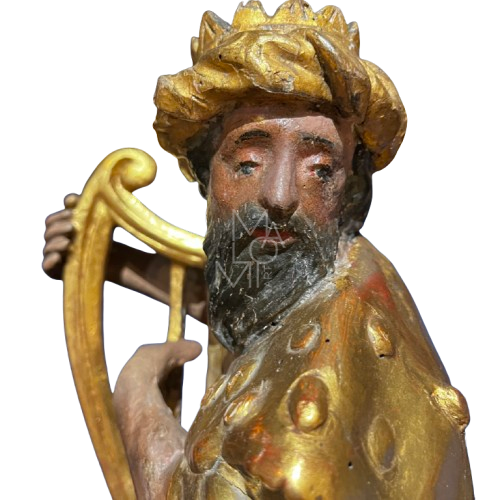
6th-century gilded wooden King David statuette | antique Venetian sculpture)
antique wooden sculpture, gilded wood King David, 16th-century Venetian art, Renaissance gold leaf statuette, Italian Mannerist sculpture, polychrome religious art, antique gallery collectibles.
- Classification: Antique wooden sculpture, Renaissance statuette, sacred cabinetmaking fragment.
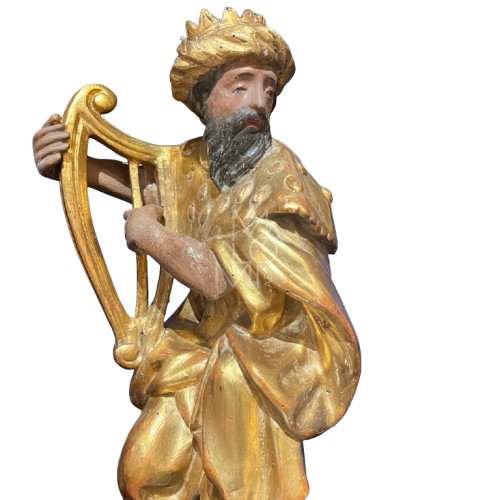
- Subject Matter: King David the Prophet playing the harp / Biblical iconography.
- Period / Style: Late Cinquecento, 16th Century, Venetian Mannerism.
- Dimensions: Height 37 cm | Width 20 cm (Slender proportional ratio).
- Medium & Materials: Carved wood (linden/stone pine), genuine gold leaf, Armenian bole, oil/tempera polychromy.
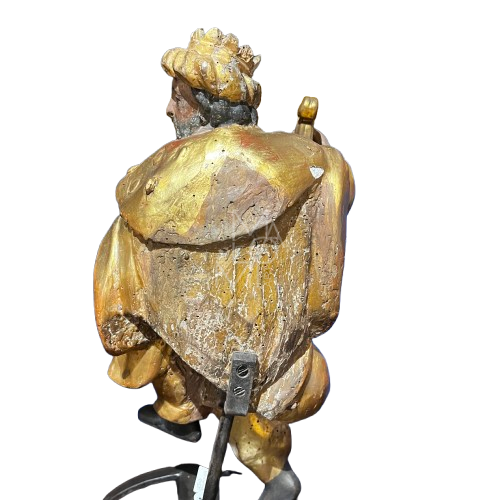
- Condition Report: Rich historical patina; stable age-related wear to the gilding; inactive, historic woodworm flight holes on the reverse.
- Mounting: Custom contemporary wrought-iron display base.
Historical-critical essay: formal, iconographic, and material analysis of a gilded wooden statuette of King David from the sixteenth-century venetian school
Introduction and aesthetic overview
The object of this study is a full-round sculpture in carved, gilded, and polychromed wood, datable to the second half of the sixteenth century, spanning the Late Renaissance and Mannerism, and firmly attributable to the Venetian school. The artifact depicts the biblical figure of King David captured in the act of playing the harp, which serves as his primary iconographic and theological attribute. The sculpture is defined by precise dimensions of 37 cm in height and 20 cm in width. Currently, the artwork is presented on an exhibition display base made of iron of recent manufacture. Although philologically extraneous to the historical materials of the artifact, this modern intervention is structurally necessary to guarantee the static stability of the figure and to allow for its appropriate aesthetic appreciation, effectively transforming a decorative cabinet fragment into an autonomous work of art suitable for a chamber or display case setting.
Formal and proportional analysis: the mannerist canon (37x20 cm)
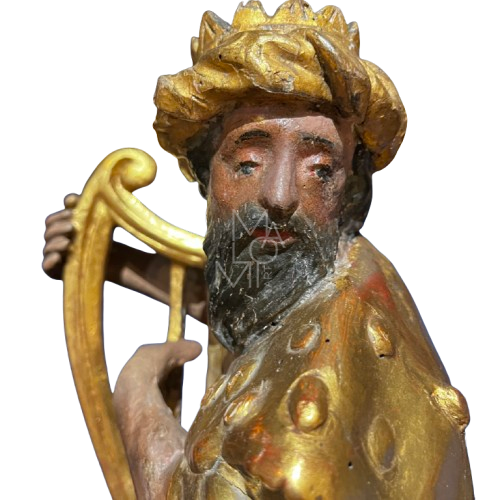
The definitive dimensional metrics provide a crucial interpretive key for understanding the sculptor’s formal choices and stylistic language. The 37x20 cm metric ratio outlines a distinctly slender and longilineal profile, yielding a proportional module close to a 2:1 ratio. This pronounced verticality perfectly aligns with the aesthetic canons of Venetian Mannerism, which was heavily influenced by the monumental sculptural models of masters such as Alessandro Vittoria and Jacopo Sansovino. The sovereign’s body is structured along a flexed and asymmetrical axis. The torsion of the torso, configured according to the quintessential Mannerist movement of the figura serpentinata, and the outward projection of the harp do not breach the boundaries of an ideal cylindrical perimeter. This calculated containment within the 20 cm width suggests that the work was originally conceived to occupy a restricted space, such as a narrow niche or a structural architectural pilaster. Carving such a dynamic figure, rich in hollows and projections within a height of only 37 centimeters, required the expertise of a miniaturist. The carver successfully instilled a sense of monumentality into this small-scale format, precisely defining the minutest details: the elaborate crown superimposed over an exotic, Orientalizing turban, the deeply gouged furrows of the prophetic beard, and the delicate structure of the musical instrument itself.
Iconography and theological significance
Within the artistic and spiritual milieu of the late Cinquecento, the depiction of King David with his harp carries a profound, dual symbolic weight. On one hand, it embodies cosmic and spiritual harmony: David’s music-making is not merely a performance, but an allegory of divine order capable of placating spiritual turmoil and driving away evil spirits, evoking the biblical episode of King Saul. The tuning of the strings symbolizes the perfect alignment and concord between the human soul and the Creator. On the other hand, David represents the prefiguration of Christ: as a monarch, shepherd, and inspired author of the Psalms, he was traditionally interpreted by Counter-Reformation Catholic theology as the direct ancestor and prefiguration of Jesus Christ. The artwork portrays him in his full regal and prophetic maturity, emphasizing the solemnity of his spiritual leadership.
Original context: venetian sacred micro-architecture and furniture
A height of 37 cm excludes the possibility of the work being placed on large, isolated monumental structures, situating the artifact instead within the prestigious category of sacred cabinetmaking and micro-furniture of the Republic of Venice and its mainland territories, the Terraferma. The vertical elongation of the sculpture points toward three highly plausible original destinations. The first is the niche of a monumental Eucharistic tabernacle: following the Council of Trent, altar tabernacles evolved into grand architectural micro-temples made of gilded wood. Statuettes of prophets and kings measuring approximately 35–40 cm were frequently housed within narrow lateral niches to act as symbolic guardians of the Mystery of the Eucharist. The second hypothesis concerns the pilaster of a wooden choir stall or reliquary: the sculpture may have functioned as a projecting decorative element mounted onto the faux-pilasters separating the seats of a choir, or flanking the sides of a majestic temple-shaped reliquary chest. Finally, the piece could have been a component of a small private altar display: the statuette could have adorned a portable house-altar or a devotional cabinet destined for the private chapel of a Venetian patrician palace, where the figure of David celebrated a sophisticated, humanistic synthesis of faith, music, and sacred poetry.
Influences of the venetian school: color, light, and motion
The artifact dialogues closely with the grand pictorial and plastic traditions of Venice during the late sixteenth century. Luministic sensitivity and chiaroscuro manifest in the drapery of the vestments, which appears deeply hollowed out by the burin. The rigid, crumpled folds are designed to multiply the reflections of the gold leaf, echoing the vibrant, broken rendering of light typical of Jacopo Tintoretto’s grand canvases. The flesh tones painted a mistura reflect the standard practices of Venetian workshops, active also in Padua, Treviso, and Verona, where the exposed anatomical parts were finished by applying thin layers of oil pigments or tempera grassa. This created a soft, naturalistic contrast, the living flesh tone, against the transcendent, shimmering abstraction of the surrounding gold. The water gilding itself, executed with pure gold leaf over a ground layer of predominantly red-orange Armenian bole, yields that warm, deep, and enveloping tone specifically engineered to gleam and vibrate within the dim, candle-lit interiors of Venetian churches. Finally, David's face conveys a fierce, aristocratic gravity that directly recalls the patriarchs, prophets, and dignitaries painted by Paolo Veronese.
Autoptic analysis of the reverse and technical-diagnostic remarks
A direct examination of the reverse of the artifact provides fundamental insights into its structural genesis and conservation history. It reveals unifacial craftsmanship and a non-finito execution: in stark contrast to the highly refined treatment of the front, the reverse of the sculpture exhibits a rudimentary, nearly flat surface execution. The rough gouge strokes left by the carver remain completely visible, and the application of gilding is entirely absent or coarsely executed. This technical trait unequivocally confirms that the work was never intended for a 360-degree, free-standing display. Instead, it was systematically designed to be flush-mounted against a structural wall, a niche backdrop, or embedded within a larger monumental framework. Furthermore, the reverse highlights the state of conservation and historical xylophagous infestation, displaying the structural vulnerabilities typical of ancient wood left unprotected by the sealing barrier of a noble finish. A dense and widespread network of flight holes from a historical infestation of woodworms is present, though currently inactive. Finally, minor structural losses are observable within the chalk-and-glue ground layer, the amannitura, along the edges and the shoulder blade. These gaps expose the underlying soft and compact wood support, presumably linden or stone pine, which displays the natural contraction and seasoning cracks indicative of aged timber over centuries.
Historical-critical assessment of the recent base
The integrated iron base represents a contemporary addition of significant museological and collecting interest. It effectively resolves the loss of the original architectural context: having been decoupled from its original furniture or frame context, the sculpture lost its ancient rear or lower anchoring points. Due to the dynamic stance of the legs and the 37 cm vertical height, the figure would be inherently unstable if placed directly onto a flat surface. The recent mount addresses this static limitation through a rectangular metallic clamp bracket fixed to the lower-middle section of the reverse via two tightening screws. This engineering choice securely counterbalances the forward lean of the Mannerist figure without modifying, drilling into, or altering the original lower wooden base. From a critical perspective, this presentation technique successfully isolates the fragment of excellence. By elevating an old decorative component into an autonomous sculpture, the mount allows the carving to be fully appreciated in its three-dimensional plasticity, while transparently declaring the modern nature of the support relative to the antiquity of the wood.
Academic Bibliography
- Primary Sources and Early Art-Historical Literature
- STRINGHI, Giovanni, Venetia città nobilissima et singolare, Descritta già in XIIII. Libri da M. Francesco Sansovino [Venice, a Most Noble and Singular City, Already Described in XIV Books by M. Francesco Sansovino], Venice, Iacomo Sansovino, 1581 (with particular reference to the descriptions of sixteenth-century altarpieces and wooden choir stalls).
- RIDOLFI, Carlo, Le Maraviglie dell'arte, overo le Vite de gl'illustri Pittori Veneti, e dello Stato [The Marvels of Art, or the Lives of the Illustrious Painters of Venice and its State], Venice, Giovanni Battista Sgava, 1648.
- TEMANZA, Tommaso, Vite dei più celebri Architetti e Scultori Veneziani che fiorirono nel Secolo Decimosesto [Lives of the Most Celebrated Venetian Architects and Sculptors Who Flourished in the Sixteenth Century], Venice, Stamperia di C. Palese, 1778.
- Venetian Woodcarving and the Upper Adriatic Tradition
- MARIACHER, Giovanni, Scultura lignea veneziana [Venetian Wooden Sculpture], Florence, Electa Editrice, 1965 (A fundamental foundational text for the study of Lagoon workshops).
- RAMA, Elena, La scultura lignea del Rinascimento a Venezia e nel territorio della Serenissima [Renaissance Wooden Sculpture in Venice and the Territory of the Serenissima], in "Storia di Venezia. L'Istituzione, la Società, la Cultura", Vol. V, Rome, Istituto della Enciclopedia Italiana, 1996.
- DE GRASSI, Massimo (ed.), Scultura lignea del Rinascimento nell'Alto Adriatico: studi, restauri, riflessioni [Renaissance Wooden Sculpture in the Upper Adriatic: Studies, Restorations, Reflections], Trieste, Editreg, 2014.
- CONTI, Roberto, L'intaglio ligneo a Venezia tra Rinascimento e Manierismo: le grandi macchine d'altare e la scultura minore [Woodcarving in Venice Between the Renaissance and Mannerism: Great Altarpieces and Minor Sculpture], Padua, Il Poligrafo, 2008.
- Monographs and Studies on Alessandro Vittoria, Girolamo Campagna, and Their Circle
- BOUCHER, Bruce, The Sculpture of Jacopo Sansovino and his School, New Haven-London, Yale University Press, 1991 (Essential for understanding the roots of Alessandro Vittoria's workshop).
- MARTIN, Thomas, Alessandro Vittoria and the Portrait Bust in Renaissance Venice: Remodeling Antiquity, Oxford, Clarendon Press, 1998 (In-depth analysis of physiognomic rendering of beards and furrowed brows, mirroring the works under examination).
- BACCHI, Andrea; LORENZONI, Marta (eds.), Alessandro Vittoria (1525-1608). Scultore del Rinascimento veneziano [Alessandro Vittoria (1525-1608): Sculptor of the Venetian Renaissance], Exhibition Catalogue (Trento, Castello del Buonconsiglio), Trento, Provincia Autonoma di Trento, 1999.
- DE VINCENTI, Monica, Girolamo Campagna (1549-1625) e la scultura a Venezia tra tardo Rinascimento e Barocco [Girolamo Campagna (1549-1625) and Sculpture in Venice Between the Late Renaissance and the Baroque], Venice, Istituto Veneto di Scienze, Lettere ed Arti, 2012.
- ROSSI, Massimiliano, I seguaci di Alessandro Vittoria: Francesco Cavrioli, Agostino Rubini e la diffusione del Manierismo nell'entroterra veneto [The Followers of Alessandro Vittoria: Francesco Cavrioli, Agostino Rubini, and the Spread of Mannerism in the Venetian Mainland], in "Arte Veneta", LII, 1998, pp. 45–63.
- Technique, Diagnostics, and Conservation of Gilded Wooden Artifacts
- MENDEL, Chiara; SPAGNOLO, Sandra, La doratura a foglia: storia, techniques e restauro delle superfici dorate [Leaf Gilding: History, Techniques, and Restoration of Gilded Surfaces], Florence, Nardini Editore, 2002 (Specific to the analysis of red bole and gesso preparation).
- CASTELNUOVO, Enrico (ed.), Artifex bonus: il mondo dell'artista medievale e rinascimentale [Artifex Bonus: The World of the Medieval and Renaissance Artist], Rome-Bari, Laterza, 2004 (Valuable for exploring the concept of "workshop economy" and the rough-hewing of the versos of sculptures).
- CIATTI, Marco (ed.), La scultura lignea policroma: storia, tecniche, restauro [Polychrome Wooden Sculpture: History, Techniques, Restoration], Florence, Edifir, 2009.
- Iconography and Religious Context (The Counter-Reformation in Venice)
- PROSPERI, Adriano, Il Concilio di Trento: una introduzione storica [The Council of Trent: A Historical Introduction], Turin, Einaudi, 2001.
- RELETHFORD, John, The Decrees of the Council of Trent on Sacred Images and their impact on Venetian Liturgical Furnishings, in "Journal of Ecclesiastical History", LXIV, 2011, pp. 112–134.
- PANOFSKY, Erwin, Meaning in the Visual Arts, Garden City, N.Y., Doubleday, 1955 (For the iconological framing of Old Testament prophets and kings as Christological prefigurations).
The king and the prophet: a critical, structural, and comparative study of a 16th-century venetian wooden pendant
Within the landscape of sixteenth-century sacred sculpture, small- and medium-scale wooden works occupy a position of primary importance for understanding private devotion and the complex apparatus of liturgical furnishings. Traditionally penalized by an outdated historiographical prejudice that relegated it to a minor or purely artisanal craft, woodcarving in the second half of the sixteenth century in Venice demonstrated, in fact, an extraordinary vitality. The great workshops of the Lagoon did not restrict themselves to monumental undertakings in marble, bronze, and stucco; they also directed a dense network of carvers, painters, and goldbeaters to supply intricate ecclesiastical structures.
The subject of this study is a pendant consisting of two sculptures in carved, gilded, and polychrome wood of identical dimensions, measuring forty centimeters in height by eighteen centimeters in width. The objects depict respectively King David with the Lyre and the prophet Moses with the Tablets of the Law, and have been mounted in recent times on modern iron bases with mechanical retention brackets. The parallel analysis of these two artifacts underscores their seamless formal and technical correspondence, confirming that they were originally conceived to interact within the same monumental framework, such as a polyptych, an organ case, or the panels of a patriarchal cathedra. In the exegetical tradition of the Counter-Reformation, the pairing of David, the Psalmist King, ancestor of Christ, and symbol of sacred kingship, with Moses, the lawgiver, guide of the chosen people, and prefiguration of Christ the Judge, constitutes one of the most frequent iconographic devices used to visually summarize the theological continuity between the Old and the New Testaments.
Comparative plastic analysis: the linea serpentinata and lagoon influence
Despite their diminutive proportions, both sculptures achieve an extraordinary sense of monumentality, breaking free from the static, hieratic conventions of the fifteenth century to fully embrace the fluid dynamics of Mannerism. Their visual power resides in a sophisticated interplay of counterpoises and mirror symmetries, specifically calculated for synoptic viewing within their workshop of origin. King David is captured in a moment of intense plastic lyricism, showing his body undergoing a torsion toward his right, which is balanced by the geometric mass of the lyre resting at his flank and an elevated left knee, while his gaze lifts upward in search of divine inspiration for his Psalms. Mirror-like, Moses responds by rotating his torso toward his left with a more peremptory and martial impetus, keeping his right knee receded and allowing his right arm to cut diagonally across his chest to thrust his index finger toward the Tablets of the Law, where small incised markings simulate the Hebrew characters of the Ten Commandments.
In both works, the physiognomy of the faces betrays a shared cultural lineage. The Michelangelesque terribilità, declined in the deep wrinkles of the furrowed brows and the thick, fluid beards carved in swirling, organic locks that flow like waves, points directly to the prototypes of Alessandro Vittoria. The latter had successfully translated Michelangelo’s physical power into the decorative and elegant rhythms of Venetian Mannerism, heavily impacting small-scale carving across the region through his accentuated Mannerist torsion and characteristic fluidly wavy locks of hair. Concurrently, the robustness of the underlying anatomical structure, evident both in the robust anatomical volumetry and in the way Moses shifts his weight onto his left knee, along with the eloquent, didactic nature of the gestures, recalls the mature production of Vittoria’s rival, Girolamo Campagna. These twin sculptures fit perfectly within the circle of these two giants, translating into softwood the grandiloquent language that the masters typically expressed in marble or bronze for major Palladian temples such as San Giorgio Maggiore or Il Redentore.
The rectos: venetian colore and the aesthetic of light
The surface treatment of the frontal views aligns with a precise aesthetic and theological intent, intimately linked to the primacy of color and light characteristic of contemporary Venetian painting by Titian, Tintoretto, and Veronese. The mantles of both figures are entirely enveloped in a precious water-gilding using pure gold leaf, laid over a bed of red bole and gesso preparation. The carver chose not to let the draperies flow smoothly, preferring to model them into deep, sharp, and almost crumpled folds around the waist. This pronounced volumetric variation allows the crests of the fabric to catch the ambient light, shattering it into a shifting shimmer of light. This was not merely an ornamental device, but a theological and structural one: the gold leaf symbolizes the splendor of sacred wisdom while simultaneously ensuring the plastic vibration and visual legibility of the figures even within the dim recesses of sixteenth-century chapels or wooden choir stalls.
Serving as a counterpoint to this luminous abstraction is the pronounced naturalism of the flesh tones, applied using cold polychromy with warm, nuanced gradations. On the veined arms, the blocked-out feet, and the faces, the painted application assumes distinct nuances to accommodate the psychology of the subjects: in the David, it softens the features of the musical king absorbed in prayer, whereas in the Moses, it heightens the severity of the lawgiver, exasperating the contrast between living human flesh and the immutability of the golden law.
Structural analysis of the versos: high-relief technique and workshop economy
While the front views celebrate stylistic unity and captivate the eye, the structural analysis of the reverse sides reveals their true structural nature, offering an exceptional testament to the archaeology of the artifact and the workshop practices of sixteenth-century Venice. Both sculptures are clearly revealed to be half-round structures, meaning highly projecting high-reliefs rather than freestanding statues designed for three-hundred-and-sixty-degree open space. The backs of the figures and the rear portion of the mantles appear nearly flat, swiftly blocked out with broad, clean strokes of the gouge and chisel, which the artisan intentionally left rough.
The distribution of the finish follows a strict logic of workshop economy. The gold leaf on red bole meticulously wraps only around the outermost profiles of the shoulders and mantles that remained visible from an angle, halting abruptly toward the center of the raw wooden back that was concealed inside the niche. This expedient saved precious metal without compromising the final aesthetic result; even if a viewer observed the furnishing from a sharp angle, they would still perceive a continuous, fully gilded surface. Similarly, the hair undergoes a drastic plastic simplification on the reverse, reduced in both cases to a dark, compact skullcap devoid of the detailed, vibrant curls that adorn the faces on the front.
The matching reverses also document the complex conservation history of the artifacts across their four centuries of existence. The two blocks share the exact same material traumas: deep longitudinal fissures caused by the natural hygrometric movement of the wood fibers due to fluctuating humidity levels within the churches, and a widespread constellation of small exit holes from wood-boring beetles. The pests colonized the reverses of the two artifacts almost exclusively, as the raw wood offered easy access, unlike the frontal surfaces protected by the sealing barriers of gesso, bole, and gold leaf.
Proposed critical attribution
In the absence of archival documentation or an autograph signature, which is impossible to find on works born as secondary components of a larger structure where the signature belonged at best to the master builder or architect, the identification of the author must be pursued stylistically. The exceptional quality of the carving excludes the hands of a simple provincial carver, placing the pendant firmly within the orbit of the direct collaborators of the two great Venetian masters. Within this circle, three targeted attributive hypotheses can be formulated. The first involves Francesco Cavrioli, a prominent figure in Venetian woodcarving, celebrated for his ability to translate the plastic models and fluid rhythms of Alessandro Vittoria into wood. Specializing in niche figures and monumental furnishings such as organ cases, he exhibits a sharp treatment of drapery and a structural synthesis of the reverse that perfectly match the characteristics of our pendant.
The second hypothesis leads to Agostino Rubini, a pupil, close collaborator, and relative by marriage of Alessandro Vittoria, who worked extensively between Venice, Vicenza, and Padua. His stylistic hallmark combines the Mannerist grace of his master with a pronounced bodily volumetry that almost seems to anticipate the classicism of Campagna, while the proportions and marked expressiveness of the faces closely reflect the canons of Rubini's minor figures. Finally, the third path belongs to the Segala workshop, represented by Orazio or Francesco Segala. Active during the final decades of the century, they embody that transitional taste in which Vittoria's lessons were reduced to smaller formats with a heightened focus on the painterly rendering of the surface and a generous use of gold leaf to illuminate the drapery. In light of these elements, the work should be scientifically cataloged as a product of the Venetian milieu, within the circle of Alessandro Vittoria or Girolamo Campagna, and specifically attributable to a master within the entourage of Francesco Cavrioli or Agostino Rubini in the last quarter of the sixteenth century.
Modern display and conclusion
The critical journey of the two artifacts concludes with their recent recovery for private collection and exhibition display. Both figures have been stabilized using an identical museum-grade mounting intervention: a robust, flat metal bracket made of darkened iron has been secured beneath the blocked-out base of each original trunk using two modern slotted screws. This system fulfills a dual function: on one hand, it protects the sculpture by supporting the center of gravity without placing stress on or perforating the lower portions of the feet and mantles, which are historically more fragile and prone to losses; on the other hand, it respects philological rigor by isolating the pieces within the display space and restoring their original suspended posture. The figures, originally positioned at a high elevation to be viewed from below, thus regain the ascending impetus and the correct visual inclination intended by the master woodcarver.
In conclusion, the critical reunification of King David and Moses allows for a comprehensive appreciation of the complex sacred scenography to which they were destined. The exceptional quality of the carving, the masterly orchestration of reflected light over the gold surfaces, and the rigorous adherence to the expressive canons of Venetian Mannerism bestow upon this pendant the value of an invaluable historical-artistic document—a faithful mirror of the aesthetic, plastic, and dogmatic demands of the Counter-Reformation in the Venetian territories.
The king and the prophet: a critical, structural, and comparative study of a 16th-century venetian wooden pendant
Within the landscape of sixteenth-century sacred sculpture, small- and medium-scale wooden works occupy a position of primary importance for understanding private devotion and the complex apparatus of liturgical furnishings. Traditionally penalized by an outdated historiographical prejudice that relegated it to a minor or purely artisanal craft, woodcarving in the second half of the sixteenth century in Venice demonstrated, in fact, an extraordinary vitality. The great workshops of the Lagoon did not restrict themselves to monumental undertakings in marble, bronze, and stucco; they also directed a dense network of carvers, painters, and goldbeaters to supply intricate ecclesiastical structures.
The subject of this study is a pendant consisting of two sculptures in carved, gilded, and polychrome wood of identical dimensions, measuring forty centimeters in height by eighteen centimeters in width. The objects depict respectively King David with the Lyre and the prophet Moses with the Tablets of the Law, and have been mounted in recent times on modern iron bases with mechanical retention brackets. The parallel analysis of these two artifacts underscores their seamless formal and technical correspondence, confirming that they were originally conceived to interact within the same monumental framework, such as a polyptych, an organ case, or the panels of a patriarchal cathedra. In the exegetical tradition of the Counter-Reformation, the pairing of David, the Psalmist King, ancestor of Christ, and symbol of sacred kingship, with Moses, the lawgiver, guide of the chosen people, and prefiguration of Christ the Judge, constitutes one of the most frequent iconographic devices used to visually summarize the theological continuity between the Old and the New Testaments.
Comparative plastic analysis: the linea serpentinata and lagoon influence
Despite their diminutive proportions, both sculptures achieve an extraordinary sense of monumentality, breaking free from the static, hieratic conventions of the fifteenth century to fully embrace the fluid dynamics of Mannerism. Their visual power resides in a sophisticated interplay of counterpoises and mirror symmetries, specifically calculated for synoptic viewing within their workshop of origin. King David is captured in a moment of intense plastic lyricism, showing his body undergoing a torsion toward his right, which is balanced by the geometric mass of the lyre resting at his flank and an elevated left knee, while his gaze lifts upward in search of divine inspiration for his Psalms. Mirror-like, Moses responds by rotating his torso toward his left with a more peremptory and martial impetus, keeping his right knee receded and allowing his right arm to cut diagonally across his chest to thrust his index finger toward the Tablets of the Law, where small incised markings simulate the Hebrew characters of the Ten Commandments.
In both works, the physiognomy of the faces betrays a shared cultural lineage. The Michelangelesque terribilità, declined in the deep wrinkles of the furrowed brows and the thick, fluid beards carved in swirling, organic locks that flow like waves, points directly to the prototypes of Alessandro Vittoria. The latter had successfully translated Michelangelo’s physical power into the decorative and elegant rhythms of Venetian Mannerism, heavily impacting small-scale carving across the region through his accentuated Mannerist torsion and characteristic fluidly wavy locks of hair. Concurrently, the robustness of the underlying anatomical structure, evident both in the robust anatomical volumetry and in the way Moses shifts his weight onto his left knee, along with the eloquent, didactic nature of the gestures, recalls the mature production of Vittoria’s rival, Girolamo Campagna. These twin sculptures fit perfectly within the circle of these two giants, translating into softwood the grandiloquent language that the masters typically expressed in marble or bronze for major Palladian temples such as San Giorgio Maggiore or Il Redentore.
The rectos: venetian colore and the aesthetic of light
The surface treatment of the frontal views aligns with a precise aesthetic and theological intent, intimately linked to the primacy of color and light characteristic of contemporary Venetian painting by Titian, Tintoretto, and Veronese. The mantles of both figures are entirely enveloped in a precious water-gilding using pure gold leaf, laid over a bed of red bole and gesso preparation. The carver chose not to let the draperies flow smoothly, preferring to model them into deep, sharp, and almost crumpled folds around the waist. This pronounced volumetric variation allows the crests of the fabric to catch the ambient light, shattering it into a shifting shimmer of light. This was not merely an ornamental device, but a theological and structural one: the gold leaf symbolizes the splendor of sacred wisdom while simultaneously ensuring the plastic vibration and visual legibility of the figures even within the dim recesses of sixteenth-century chapels or wooden choir stalls.
Serving as a counterpoint to this luminous abstraction is the pronounced naturalism of the flesh tones, applied using cold polychromy with warm, nuanced gradations. On the veined arms, the blocked-out feet, and the faces, the painted application assumes distinct nuances to accommodate the psychology of the subjects: in the David, it softens the features of the musical king absorbed in prayer, whereas in the Moses, it heightens the severity of the lawgiver, exasperating the contrast between living human flesh and the immutability of the golden law.
Structural analysis of the versos: high-relief technique and workshop economy
While the front views celebrate stylistic unity and captivate the eye, the structural analysis of the reverse sides reveals their true structural nature, offering an exceptional testament to the archaeology of the artifact and the workshop practices of sixteenth-century Venice. Both sculptures are clearly revealed to be half-round structures, meaning highly projecting high-reliefs rather than freestanding statues designed for three-hundred-and-sixty-degree open space. The backs of the figures and the rear portion of the mantles appear nearly flat, swiftly blocked out with broad, clean strokes of the gouge and chisel, which the artisan intentionally left rough.
The distribution of the finish follows a strict logic of workshop economy. The gold leaf on red bole meticulously wraps only around the outermost profiles of the shoulders and mantles that remained visible from an angle, halting abruptly toward the center of the raw wooden back that was concealed inside the niche. This expedient saved precious metal without compromising the final aesthetic result; even if a viewer observed the furnishing from a sharp angle, they would still perceive a continuous, fully gilded surface. Similarly, the hair undergoes a drastic plastic simplification on the reverse, reduced in both cases to a dark, compact skullcap devoid of the detailed, vibrant curls that adorn the faces on the front.
The matching reverses also document the complex conservation history of the artifacts across their four centuries of existence. The two blocks share the exact same material traumas: deep longitudinal fissures caused by the natural hygrometric movement of the wood fibers due to fluctuating humidity levels within the churches, and a widespread constellation of small exit holes from wood-boring beetles. The pests colonized the reverses of the two artifacts almost exclusively, as the raw wood offered easy access, unlike the frontal surfaces protected by the sealing barriers of gesso, bole, and gold leaf.
Proposed critical attribution
In the absence of archival documentation or an autograph signature, which is impossible to find on works born as secondary components of a larger structure where the signature belonged at best to the master builder or architect, the identification of the author must be pursued stylistically. The exceptional quality of the carving excludes the hands of a simple provincial carver, placing the pendant firmly within the orbit of the direct collaborators of the two great Venetian masters. Within this circle, three targeted attributive hypotheses can be formulated. The first involves Francesco Cavrioli, a prominent figure in Venetian woodcarving, celebrated for his ability to translate the plastic models and fluid rhythms of Alessandro Vittoria into wood. Specializing in niche figures and monumental furnishings such as organ cases, he exhibits a sharp treatment of drapery and a structural synthesis of the reverse that perfectly match the characteristics of our pendant.
The second hypothesis leads to Agostino Rubini, a pupil, close collaborator, and relative by marriage of Alessandro Vittoria, who worked extensively between Venice, Vicenza, and Padua. His stylistic hallmark combines the Mannerist grace of his master with a pronounced bodily volumetry that almost seems to anticipate the classicism of Campagna, while the proportions and marked expressiveness of the faces closely reflect the canons of Rubini's minor figures. Finally, the third path belongs to the Segala workshop, represented by Orazio or Francesco Segala. Active during the final decades of the century, they embody that transitional taste in which Vittoria's lessons were reduced to smaller formats with a heightened focus on the painterly rendering of the surface and a generous use of gold leaf to illuminate the drapery. In light of these elements, the work should be scientifically cataloged as a product of the Venetian milieu, within the circle of Alessandro Vittoria or Girolamo Campagna, and specifically attributable to a master within the entourage of Francesco Cavrioli or Agostino Rubini in the last quarter of the sixteenth century.
Modern display and conclusion
The critical journey of the two artifacts concludes with their recent recovery for private collection and exhibition display. Both figures have been stabilized using an identical museum-grade mounting intervention: a robust, flat metal bracket made of darkened iron has been secured beneath the blocked-out base of each original trunk using two modern slotted screws. This system fulfills a dual function: on one hand, it protects the sculpture by supporting the center of gravity without placing stress on or perforating the lower portions of the feet and mantles, which are historically more fragile and prone to losses; on the other hand, it respects philological rigor by isolating the pieces within the display space and restoring their original suspended posture. The figures, originally positioned at a high elevation to be viewed from below, thus regain the ascending impetus and the correct visual inclination intended by the master woodcarver.
In conclusion, the critical reunification of King David and Moses allows for a comprehensive appreciation of the complex sacred scenography to which they were destined. The exceptional quality of the carving, the masterly orchestration of reflected light over the gold surfaces, and the rigorous adherence to the expressive canons of Venetian Mannerism bestow upon this pendant the value of an invaluable historical-artistic document—a faithful mirror of the aesthetic, plastic, and dogmatic demands of the Counter-Reformation in the Venetian territories.
Academic bibliography
- Stringhi, Giovanni, Venetia città nobilissima et singolare, descritta già in XIIII. libri da M. Francesco Sansovino, Venice, Iacomo Sansovino, 1581.
- Ridolfi, Carlo, Le meraviglie dell'arte, overo le vite de gl'illustri pittori veneti, e dello Stato, Venice, Giovanni Battista Sgava, 1648.
- Temanza, Tommaso, Vite dei più celebri architetti e scultori veneziani che fiorirono nel secolo decimosesto, Venice, Stamperia di C. Palese, 1778.
- Mariacher, Giovanni, Scultura lignea veneziana, Florence, Electa Editrice, 1965.
- Rama, Elena, La scultura lignea del Rinascimento a Venezia e nel territorio della Serenissima, in "Storia di Venezia. L'istituzione, la società, la cultura", Vol. V, Rome, Istituto della Enciclopedia Italiana, 1996.
- De Grassi, Massimo (ed.), Scultura lignea del Rinascimento nell'Alto Adriatico: studi, restauri, riflessioni, Trieste, Editreg, 2014.
- Conti, Roberto, L'intaglio ligneo a Venezia tra Rinascimento e Manierismo: le grandi macchine d'altare e la scultura minore, Padua, Il Poligrafo, 2008.
- Boucher, Bruce, The sculpture of Jacopo Sansovino and his school, New Haven-London, Yale University Press, 1991.
- Martin, Thomas, Alessandro Vittoria and the portrait bust in Renaissance Venice: remodeling antiquity, Oxford, Clarendon Press, 1998.
- Bacchi, Andrea; Lorenzoni, Marta (eds.), Alessandro Vittoria (1525-1608). Scultore del Rinascimento veneziano, exhibition catalogue, Trento, Provincia Autonoma di Trento, 1999.
- De Vincenti, Monica, Girolamo Campagna (1549-1625) e la scultura a Venezia tra tardo Rinascimento e Barocco, Venice, Istituto Veneto di Scienze, Lettere ed Arti, 2012.
- Rossi, Massimiliano, I seguaci di Alessandro Vittoria: Francesco Cavrioli, Agostino Rubini e la diffusione del Manierismo nell'entroterra veneto, in "Arte Veneta", LII, 1998, pp. 45–63.
- Mendel, Chiara; Spagnolo, Sandra, La doratura a foglia: storia, tecniche e restauro delle superfici dorate, Florence, Nardini Editore, 2002.
- Castelnuovo, Enrico (ed.), Artifex bonus: il mondo dell'artista medievale e rinascimentale, Rome-Bari, Laterza, 2004.
- Ciatti, Marco (ed.), La scultura lignea policroma: storia, techniques, restauro, Florence, Edifir, 2009.
- Prosperi, Adriano, Il Concilio di Trento: una introduzione storica, Turin, Einaudi, 2001.
- Relethford, John, The decrees of the Council of Trent on sacred images and their impact on Venetian liturgical furnishings, in "Journal of Ecclesiastical History", LXIV, 2011, pp. 112–134.
- Panofsky, Erwin, Meaning in the visual arts, Garden City, N.Y., Doubleday, 1955.