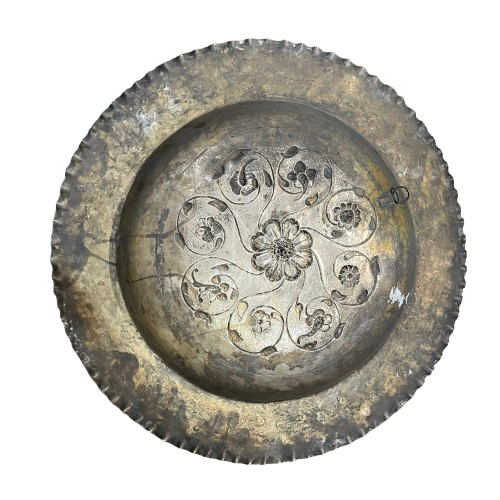
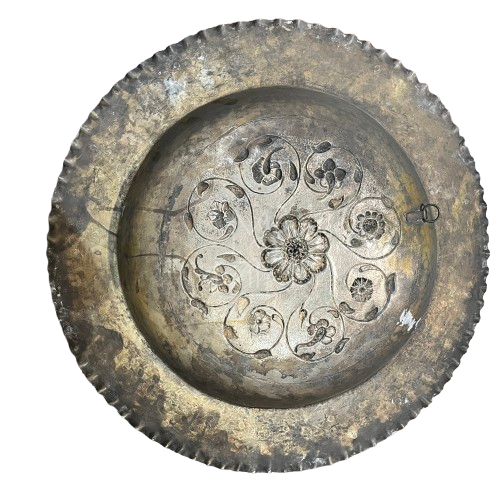
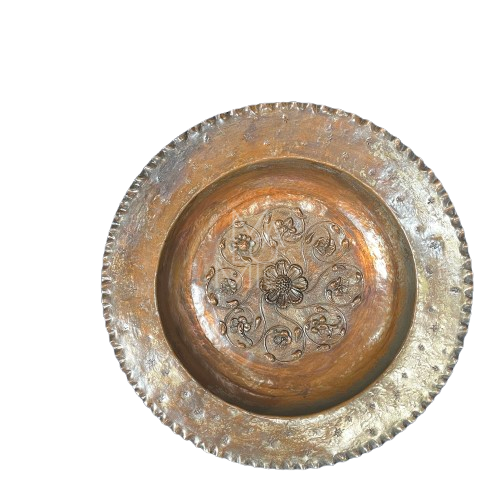
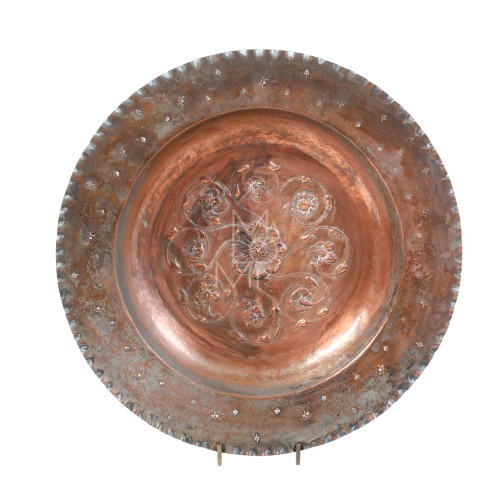
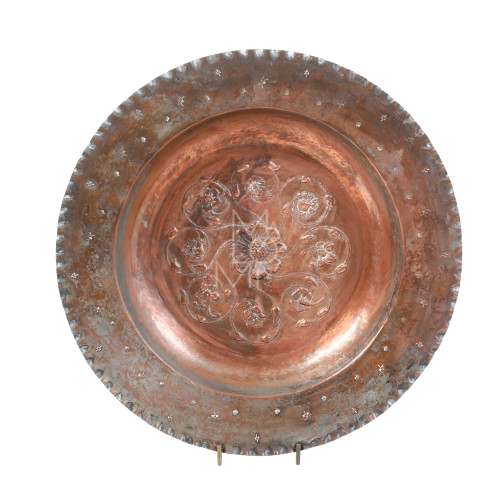
18th-century monumental silvered copper lavabo basin with heraldic punches – 51 cm
- Artifact Classification: Monumental ceremonial lavabo basin / Secular and liturgical parade dish
- Chronology and Dating: 18th century / First half of the Settecento (circa 1720–1750)
- Substrate Alloy: Pure, hand-hammered sheets of red copper
- Surface Finishes: Authentic mercury fire-silvering (amalgamation technique)
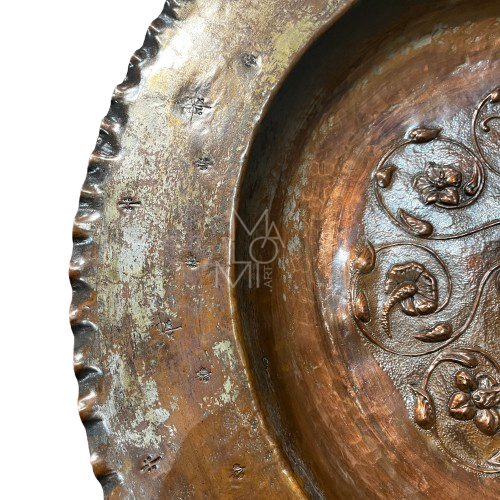
- State of Preservation: Excellent, untouched conditions; historical bimetallic patine plaisir showing selective copper bleeding on outer crests and gray-lead silver oxide inside the grooves
- Dimensions and Diameter: 51 cm / 20 inches (rare, extra-large monumental scale)
- Manufacturing Technique: Hand-forging, hammer-pleated and crimped undulating rim (tesa), pitch-repoussé medallion, final chasing (cesello), and background stippling via multi-point graining punches
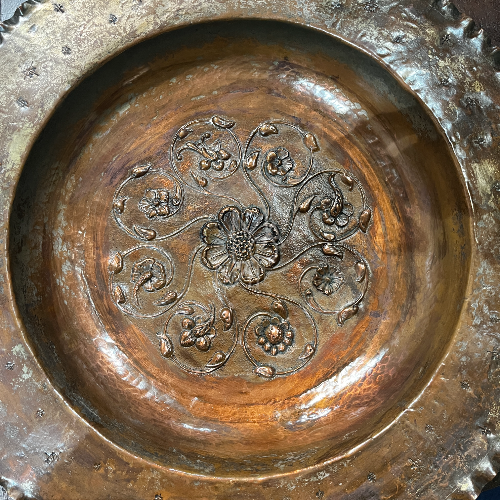
- Central Decorative Apparatus: High-Rococo phytomorphic medallion; twelve-petalled central gadrooned rosette radiating into eight curvilinear vegetable scrolls, stylized tulips, and scrolling acanthus leaves
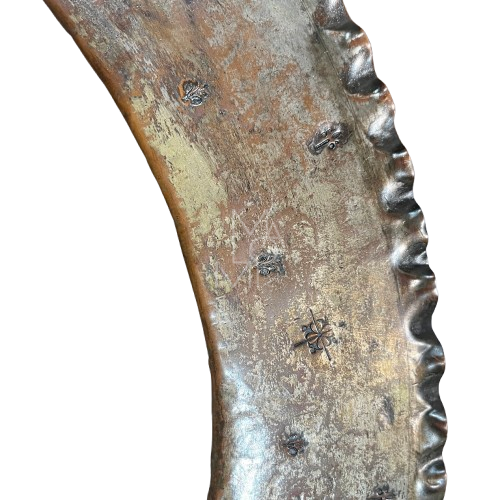
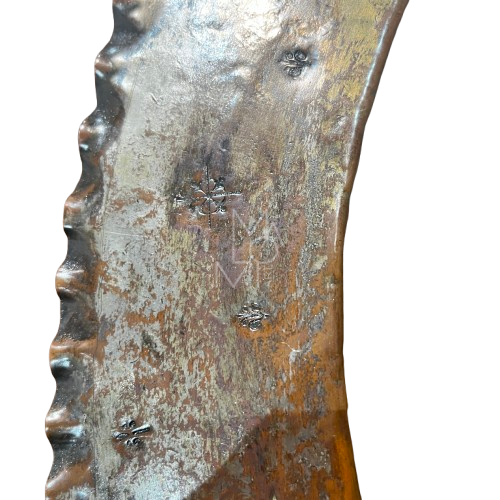
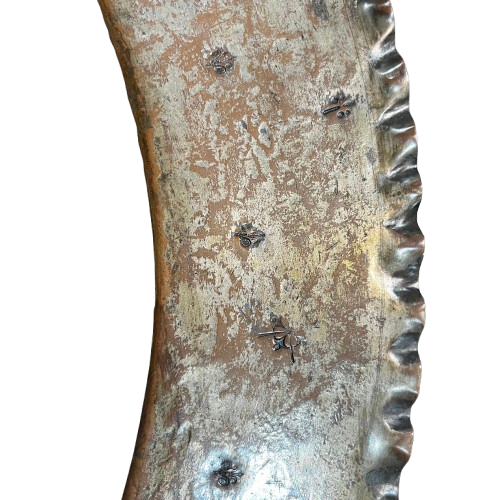
- Rim Punching Syntax: Alternating ornamental and fiscal cold-stamped marks on the obverse, featuring the heraldic lily (fleur-de-lis) and the geometric compass rose / multi-pointed star
- Accessory Functional Elements: Original wrought-iron suspension ring for vertical wall display, secured by a copper loop fixed via hard brass brazing
- Geographical Provenance: Transalpine Bavarian-Venetian trade axis; sheet metal pre-formed and control-marked in Nuremberg, subsequently embossed and fire-silvered by the Coppersmiths' Guild (Fraglia) in Venice
- Socio-Cultural Context: High-apparatus liturgical washings (the lavabo rite and Holy Thursday Mandatum ceremony) or theatrical hand-washing protocols during patrician banquets in Venetian Grand Canal palaces
- Antiquarian Market Classification: Premium collector's item due to the scarcity of diameters exceeding 50 cm and the pristine condition of the obverse multi-punching layout
The monumental silvered copper lavabo basin in the righteenth century: alloy economics, transalpine decorative syntax, and the anthropology of ritual between the Venetian patriciate and sacred commissions
- Introduction and historico-artistic research methodology
The monumental eighteenth-century silvered copper lavabo basin (or hand-washing basin), bearing traces of mercury fire-gilding, constitutes an exceptional artifact for the integrated study of decorative arts history, production archaeology, and the material culture of the Ancien Régime. Within the hierarchy of eighteenth-century sumptuary arts, this specific class of objects occupies a liminal and highly polysemic position. They do not belong to the sphere of solid silverware—the exclusive preserve of the institutional pinnacles of the Church and the high aristocracy of blood—but represent a sophisticated and luxurious production in "base metal" ennobled on its surface.
The adoption of silvered copper for large lavabo basins with diameters exceeding 50 centimeters responded to precise economic, aesthetic, and social self-representation demands. On the one hand, the artifact had to fulfill heavy hydraulic and ritual functions related to the containment and flow of liquids; on the other, it had to simulate the visual splendor of solid silver, deceiving the observer through refined technological expedients.
The research methodology applied in this essay aims to overcome the rigid dichotomy between major and minor arts, analyzing the object according to a holistic approach that considers its transalpine metallurgical genesis, its manufacturing integration in rococo Venice, the stylistic-iconographic analysis of the ornamental apparatus, and the anthropological-functional dynamics that regulated its use in both sacred and profane spaces.
- The geopolitics of red gold: the transalpine transit between Bavaria and Venice
During the eighteenth century, the Serene Republic of Venice, though approaching the final chapter of its political trajectory, maintained a central role as a commercial and customs emporium in the Adriatic and Mediterranean basins. However, the lagoon territory and its hinterland were structurally devoid of extractive deposits of copper and tin capable of satisfying the immense demand of local industries, ranging from the shipbuilding of the Arsenal to the numerous artisan workshops dedicated to the applied arts.
The raw material of excellence came almost entirely from the rich mines of Central Europe, whose distribution channels were firmly controlled by the great merchant and financial consortia of southern Germany. The imperial centers of Nuremberg and Augsburg served as the logistical and distributive hubs of this traffic. Across the Brenner and Tarvisio passes, long caravans of merchants transported pure copper ingots and pre-laminated metal sheets toward the Po Valley and the Adriatic coast.
The customs terminal for this commercial flow was the Fondaco dei Tedeschi in Venice, located near the Rialto Bridge. In this monumental complex, Bavarian and Franconian merchants enjoyed special statutes, dedicated warehouses, and lodgings. Here, raw copper was weighed, registered by the Venetian magistracies, and sold to members of local guilds. This transalpine axis was not limited to a mere exchange of raw materials, but determined a fertile circulation of graphic models, morphological solutions, and technological skills that ideally united the metallurgical workshops of southern Germany with the lagoon botteghe.
- The transalpine guilds and the legal system of control marks
The Bavarian coppersmith guilds (Kupferschmiede), particularly those operating in Nuremberg, were regulated by extraordinarily rigorous statutes that imposed ironclad controls on the quality and workability of the metal sheets destined for export. A metal sheet intended to be transformed into a monumental basin had to possess absolute ductility and molecular homogeneity to avoid cracks or fractures during the long and grueling phases of cold manual hammering.
To guarantee the conformity of the alloy and settle transit customs taxes, guild experts and imperial city officials cold-stamped onto the metal, directly on the obverse of the sheet, appropriate guarantee punches. This stamp punch followed well-codified rules that involved the use of different types of marks with specific functions. The heraldic or figurative mark, often enclosed in a shaped shield, attested to the city of origin or the workshop of the authorized master coppersmith, frequently manifesting under the guise of the Nuremberg lion or the imperial eagle. This was flanked by accessory geometric symbols, such as punches in the shape of a multi-pointed star or compass rose, impressed as fiscal verification marks to certify that the sheet had passed weight and customs duty controls before crossing the alpine borders.
Finally, repeated ornamental punches were used, among which the heraldic lily (fleur-de-lis) stood out, utilized both as a refined decorative finishing element and as a corporate quality mark. The presence of this complex syntax of marks stamped on the front of the piece became a veritable certificate of metallurgical excellence, a seal of guarantee that made German semi-finished basins extremely coveted and sought after on the Venetian and Italian markets.
- The art of Venetian coppersmiths and the manufacturing integration of the sheet
Once the pre-formed and punched sheet was purchased at the Fondaco dei Tedeschi, the object entered its "Italianization" phase within the workshops of the Fraglia dei Calderai e Ottonai (Guild of Coppersmiths and Brassworkers) of Venice. This trade association, regulated by the decrees of the Giustizia Vecchia magistracy, was structured to defend the category's technical secrets and guarantee the aesthetic excellence of lagoon production.
In the Venetian workshops, the object underwent a profound formal metamorphosis that softened its rigid German geometric rigors to align it with the flowing taste of the late Italian Baroque and Rococo. The operational chain was articulated through highly specialized interventions, beginning with the hardening and flattening of the rim (tesa). Using flat steel hammers on specific shaped anvils (tassi), the Venetian artisan refined the rim of the basin. The characteristic wavy and pleated crimping of the perimeter edge served both to increase the structural rigidity of the 51-centimeter sheet—preventing elastic warping—and to generate a lively, undulating profile that harmonized with the broken lines of the period's aesthetics.
Subsequently, the craftsman proceeded to pitch-repoussé, fixing the basin upside down on a bed of chaser's pitch composed of a mixture of blonde pitch, linseed oil, and plaster; the artisan hammered from the reverse with mallets and ball-head punches to push forward the macroscopic volumes of the large central medallion. The final phase involved chasing and background graining from the obverse, where sharp chisels defined the details of the petals and leaves, while the entire background space was finely stippled with a graining punch to generate a matte, textured surface, designed to highlight by plastic contrast the polished relief of the phytomorphic scrolls.
- The chemistry of splendor: fire-silvering and the plated effect
The crucial step that transformed the copper basin into an object of high apparatus was the process of fire-silvering, also known as mercury amalgam silvering. This procedure, extremely refined but highly toxic due to lethal mercurial exhalations, was managed with great rigor by expert craftsmen.
The technique required preparing an amalgam composed of pure silver reduced to thin foils and liquid mercury, blended under heat until a dense, homogeneous paste was obtained. The surface of the copper basin was previously pickled with acid solutions to eliminate any trace of oxide and promote metal adhesion. The amalgam was precisely applied to the sheet using brass-wire brushes. Subsequently, the artifact was placed inside specific temperature-controlled furnaces.
Under the action of heat, the mercury evaporated completely, leaving the silver deposited on the copper surface, to which it bound at a molecular level through a thermal diffusion process. The result was a silver layer of exceptional compactness, luster, and resistance to hydraulic abrasion. In the recesses of the punched lilies and in the valleys of the grained background of the central repoussé, the thickness of the deposited silver was greater, ensuring its preservation over the centuries. Conversely, on the crests of the floral reliefs and on the flat parts of the rim, the continuous friction of cleaning cloths removed this layer over time, exposing the warm chromatic hue of the underlying copper and generating the typical bimetallic patina that constitutes the chronological signature of eighteenth-century authenticity.
- The botanical Rococo: stylistic and iconographic analysis of the central medallion
The decorative apparatus of the basin's central medallion completely abandons the narrative and exegetical cycles of biblical or mythological matrix that had characterized fifteenth- and sixteenth-century production, fully embracing the syntax of European Rococo phytomorphic ornament. The composition is rigorously centered but governed by an asymmetric dynamism in individual details that imparts vitality and movement to the entire work.
At the heart of the basin stands a large central gadrooned rosette, a radial inflorescence with twelve petals embossed in high relief, culminating in a central button finely incised with a honeycomb pattern that imitates the natural receptacle of a flower. From this visual fulcrum radiate, with a supple and curvilinear movement, eight vegetable scrolls or racemes. Each stem develops within the circular space, winding upon itself in elegant volutes, and terminates in a different variety of stylized bloom: one recognizes tulips with twisted leaves, descending bellflowers, minor rosettes, and delicate, scrolling acanthus leaves.
The association between the alternating geometric arrangement of the lilies on the rim and the naturalistic freedom of the central roundel fully reflects the stylistic dialogue of the eighteenth century, wherein the formal order of the external frames encloses and disciplines the exuberant, asymmetrical fantasy of the internal decorations, amplified by the luminous reflections permitted by the residual silver layer.
- Scenographic splendor and gastronomic theatrics: the culture of Venetian Patrician banquets
During the eighteenth century, the banquets offered by the Venetian patriciate configured themselves as authentic total performances—events in which ephemeral architecture, haute gastronomie, and the exhibition of precious tableware cooperated to astonish foreign diplomatic delegations and guests of high regard. The great patrician families, despite facing the early signs of a systemic economic crisis, chose to respond by channeling their resources into polite ostentation and the ceremonial refinement of refreshments. Banquets celebrated in palaces along the Grand Canal or in the imposing villas of the Riviera del Brenta abandoned the heavy, chaotic symmetries of the Baroque era to welcome the airy, playful, and asymmetrical forms of the Rococo taste.
The Venetian table was transformed into a stage for the famous trionfi (triumphs), monumental ephemeral sculptures modeled in sugar or wax that reproduced mythological scenes, geometric gardens, classical architectures, or political allegories designed to celebrate the good governance of the Serene Republic. The complexity of the menus required a rigid succession of courses divided into cold buffets (credenze) and hot dishes, where waterfowl from the lagoon marshes alternated with rare river sturgeon and confectionery enriched with Oriental spices.
Every meal was punctuated by the combined intervention of the maestri di casa (house masters) and credenzieri (steward-credenza keepers), professional figures responsible for the choreographic coordination of the hall. They supervised the arrangement of porcelain table services from Cozzi or Meissen and the rotation of different silver and plated metals, managing the banquet as a true theatrical drama where material luxury offered itself to the gaze of the invitees as an indissoluble pledge of dynastic stability and political primacy.
- The theatrical banquet: anthropology and status of the lavabo in the Patrician palace
To comprehend the historical significance of a hand-washing basin measuring an exceptional 51 centimeters in diameter, it is necessary to analyze its performative dimension within the palaces of the Venetian patriciate. In the eighteenth century, the lagoon nobility, though affected by a progressive contraction of its commercial capital in favor of landed income, did not renounce the cult of splendor, transforming daily life inside the residences on the Grand Canal into a perennial theatrical representation of their social status.
In this context, the washing of hands during sumptuous patrician banquets constituted a solemn social ritual, regulated by courtesy manuals and domestic ceremonial protocols. Before the universal introduction of the fork for every single dish and in the absence of internal water networks, the act of ablution between courses was a hygienic necessity that the aristocracy sublimated into an act of pure ostentation.
The monumental silvered copper basin, coordinated with a large pouring ewer, was prominently displayed on the credenza di parata (parade sideboard), a monumental stepped piece of furniture situated in the ballroom, intended solely to showcase the home's most spectacular and shiny pieces to impress guests and foreign diplomats. At the moment established by the ceremonial, servants brought the basin into the hall. Warm water, aromatized with precious essences of orange blossom, jasmine, or rose water, was poured over the diners' fingers directly above the basin. The adoption of fire-silvered copper responded to a precise sociological strategy: it allowed patrician families to maintain the decorum and visual luxury of solid silver—whose surfaces magnificently reflected the vibrant light of Murano glass chandeliers and torchères—while drastically reducing financial expenditure compared to the pure metal, in an era of sumptuary reforms and constantly strained family budgets.
- Symbology and theological values of the Lily in ecclesiastical heraldry
The repeated presence of the lily stamped cold on the basin's rim invites a careful theological-heraldic exegesis of the symbol, a primary element in the visual code of ecclesiastical and devotional commissions of the early modern period. In sacred heraldry and Roman Catholic liturgical tradition, the lily transcends its botanical nature to assume the guise of an iconographic attribute associated with concepts of absolute purity, chastity, and divine grace, deeply rooting itself in Marian devotion through the definition of the Virgin Mary as a "lily among thorns." The flower manifests as a recurring emblem in representations of the Annunciation, held in the hands of the Archangel Gabriel or Saint Joseph, visually designating the divine election and ethical incorruptibility of the associated figure.
From a specifically heraldic standpoint, the insertion of the lily into coats of arms and protected insignia of ecclesiastical institutions responded to a dual semiotic track. On the one hand, it expressed a feudal or spiritual submission to the Virgin, patroness of countless dioceses and monastic orders, such as the Dominicans or Carmelites; on the other, it recalled the spiritual sovereignty and doctrinal preeminence of high prelates, frequently integrating itself into the blazons of bishops, cardinals, and commendatory abats belonging to great European princely houses or the Venetian patriciate.
The reproduction of the lily on an artifact intended for washing or alms gathering thus possessed a strong didascalic value. The faithful or the prelate who placed their fingers on the basin's rim visually intercepted the symbol of the lily, receiving a moral reminder of the need to approach the sacred species or perform the act of charity with a purified soul, cleansed of earthly passions and inspired by the white perfection of the saints.
- The sacred space: The rite of the Lavabo and the liturgy of the Mandatum
Parallel to profane pomp, the sacred space of parish churches, Venetian patriarchal basilicas, and the wealthy venues of the Scuole Grandi (the powerful lay devotional confraternities of the city) represented the other great theater of use for these 51-centimeter artifacts. Within the complex eighteenth-century Catholic liturgy, deeply influenced by post-Tridentine codifications and Counter-Reformation splendor, the act of the celebrant's physical purification assumed an absolute theological and dogmatic value, configuring itself as a visible mirror of the ethical purity required by the priestly ministry.
The basin found its daily placement in the sacristy or at the high altar for the performance of the lavabo rite, structured around the words of Psalm 25 (Lavabo inter innocentes manus meas, et circumdabo altare tuum, Domine). Before the Eucharistic prayer and immediately after the offertory, the priest washed the tips of his fingers over the basin to symbolically cleanse himself of earthly faults before coming into contact with the sacred species of the Host and Chalice. The silver layer fulfilled a precise hygienic and dogmatic function in this case: it prevented water from reacting chemically with the copper, averting the formation of greenish oxidations (verdigris) that would profane the sacredness and purity of the rite.
However, an specimen of exceptional dimensions like this was intended primarily for the solemn functions of Holy Week, specifically for the liturgy of the Washing of the Feet (Mandatum) celebrated on Maundy Thursday. During this solemn rite, the bishop, prior, or chief guardian of the Scuola reproduced Christ's evangelical gesture of humility toward the apostles, washing the feet of twelve poor men or elderly members of the community. The monumental diameter of the dish responded to the practical necessity of containing large volumes of water and accommodating the extremities of limbs, but it also possessed a precise acoustic value: the strong metallic reverberation of offering coins or heavy drops of water striking the bottom of the repoussé copper served as an audible cue for the entire congregation, amplifying the anthropological solemnity of the liturgical drama.
- Transalpine comparative analysis: museological evidences between Venice and Nuremberg
The critical inquadramento of a monumental punched and repoussé lavabo basin finds solid scientific confirmation in the catalogs of the main European museums dedicated to the decorative arts. The physiognomy of this object fits into a precise and codified line of production, whose closest comparative terms are preserved within the collections of the Museo Correr in Venice and the Germanisches Nationalmuseum in Nuremberg—two ideal conservative poles for understanding the development of the transalpine bimetallic axis.
The applied arts collections of the Museo Correr house a rich selection of ceremonial basins and parade dishes in copper alloys, many of which come from the bequests of ancient Venetian patrician families or the furnishings of suppressed lay confraternities. The cataloged Venetian specimens, dating to the first half of the eighteenth century, display the same morphological structuring: wide shaped or gadrooned rims, conceived to frame large central clipei where the floral rococo repertoire unfolds with a wealth of detail and chasing. In many of these pieces, the presence of minute cold-punched marks along the outer edges—including geometric rosettes and stars analogous to those observed on the artifact under examination—demonstrates the widespread nature of this ornamental code in lagoon workshops, where cold stamping assumed an integrated decorative and protocollar value.
On the transalpine front, the Germanisches Nationalmuseum in Nuremberg preserves the world's largest and most authoritative collection of hammered copper and brass basins produced by local guilds between the sixteenth and eighteenth centuries. The study of these museological repertoires allows for the verification of the technological genesis of the marks stamped on monumental sheets exceeding fifty centimeters. In the catalogs of the German museum, eighteenth-century lavabo and alms dishes present a constant and rigorous application of lily and star punches directly on the obverse of the rim. These marks, documented in Nuremberg corporate registers as custom verification and purity seals for export sheets, were hammered before the object left the Franconian workshops. Direct comparison with these museum specimens confirms that the artifacts traveled as high-level semi-finished pieces and, once they arrived in the workshops of northern Italy or Venice, received the finishing of the botanical repoussé and the luxurious ennoblement of fire-silvering, combining in a single piece German metallurgical solidity with Italian decorative mastery.
- The object as permanent furnishing: the iron suspension ring
A detail of immense documentary value for reconstructing the object's cultural biography is the presence of a small wrought-iron suspension ring, secured by a metal loop directly onto the rim or the reverse of the wall. This structural feature reveals that the basin did not exhaust its function at the moment of the ritual or domestic wash, but was designed to assume the status of a permanent stanziale furnishing.
When not in use for hydraulic purposes, the dish was hung vertically on the wooden walls of ecclesiastical sacristies, above monumental cabinetry, or between mirrors and textile hangings in the dining rooms of patrician palaces. In this elevated position, the lavabo basin shifted its functional nature, transforming into a "parade dish." Thanks to its wide concave surface and the persistence of the silver layer, it functioned as a true parabolic light reflector. In the penumbras of Baroque churches or in halls facing the Grand Canal, the sheet captured the faint natural light from windows or the glow of candles, amplifying the brightness of the surrounding space and transforming a hygienic utensil into a perennial symbol of visual pomp and institutional decorum.
- diagnostic protocols and antiquarian authenticity criteria
The correct evaluation and scientific cataloging of an eighteenth-century silvered copper lavabo basin require the application of a rigorous autoptic diagnostic protocol. This examination is aimed at differentiating the coeval specimen from the highly widespread historicist style reproductions produced between the late nineteenth and early twentieth centuries, as well as from modern commercial counterfeits.
The investigation focuses on several structural parameters analyzed in an integrated manner to formulate an objective diagnosis.
The examination of the reverse morphology represents the first fundamental analytical element, seeking the asymmetrical marks of manual hammering of the period and a slight non-uniformity in the thickness of the sheet, which tends to be thinner on the outer edges due to the plastic stretching of the metal. Conversely, the presence of perfectly concentric and regular lines is a clear indicator of mechanical turning or industrial press stamping.
A second crucial parameter is the study of the silver layer's wear gradient, which must follow an impeccable historical and functional logic. The original silver must be present and display a stable, stratified gray-lead oxidation exclusively in the protected grooves of the decorative punches and in the deep recesses of the grained background of the central repoussé, while on the crests of the petals and on the flat surfaces of the rim, the silver must show soft, faded transitions toward the exposed bare copper.
A third level of inquiry concerns the nature of the oxide patinas, where ancient silver oxides show a tenacious purple or black micro-crystallization, non-removable with surface washing, easily distinguishable from artificial patines based on ammonium sulfides or acids which appear flat, powdery, and easily removable with a light solvent.
Finally, attention is directed to the structure of the secondary components' welds, such as the metal loop of the iron ring; eighteenth-century joints were executed via hard brass brazing, which leaves a characteristic high-melting yellowish flow line, clearly distinct from soft bright tin soldering or electric arc welding introduced in the contemporary era.
- Conclusion: the historico-artistic value of the bimetallic artifact
In conclusion, the monumental eighteenth-century silvered copper lavabo basin, by virtue of its exceptional diameter of 51 centimeters and its punched and embossed decorative apparatus, configures itself as a material document of extraordinary historical density. It does not represent a minor alternative or a compromise of sumptuary art compared to solid silverware, but bears witness to a complex cultural biography made of technological ingenuity, international merchant routes, and codified rituals.
In its silver losses, in the partial emergence of the underlying copper's warm hue, in the geometric precision of its heraldic lilies, and in the rococo fluidity of its central floral roundel, the object crystallizes the founding values of an era. It simultaneously narrates the metallurgical excellence of Bavarian guilds, the execution mastery of Venetian coppersmiths, the quest for exhibited splendor of the lagoon patriciate, and the profound solemnity of the Catholic liturgy of the Ancien Régime. To scientifically preserve and study such an artifact, safeguarding the integrity of its historical patina without succumbing to the allure of invasive restorations or destructive polishing, means protecting a precious and vibrant witness to the history of applied arts and the material culture of eighteenth-century Europe.