The Triumph of Galatea by Giacomo del Po: A Neapolitan Late Baroque Masterpiece
Explore "The Triumph of Galatea," an oil on canvas attributed to Giacomo del Po. A masterwork of Neapolitan Late Baroque art featuring its coeval gold frame.
- Artist: Giacomo del Po (Palermo, 1654 – Naples, 1726), attributed.
- Subject: The Triumph of Galatea (after Ovid’s Metamorphoses and Poliziano’s Stanze).
- Date: Late 17th Century – First quarter of the 18th Century (Late Baroque / Proto-Rococo).
- School: Neapolitan School.
- Medium: Oil on canvas.
- Dimensions: 82.5 x 67.5 cm (including coeval carved and gilded wooden frame).
- Provenance: Italy, Neapolitan area (private collection).
- Condition Report: Excellent; original canvas with historical patina; coeval frame structurally sound with minor rub-wear to the gold leaf gilding over red bole.
The Triumph of Galatea in Late Baroque Aesthetics: A Critical Analysis of an Oil on Canvas Attributed to Giacomo del Po
Historical-Critical Framework and Attribuzione
The painting under examination—an oil on canvas measuring 82,5 by 67,5 centimeters including its coeval, richly gilded wooden frame—constitutes a testimony of extraordinary interest for the understanding of Neapolitan painting during the first half of the eighteenth century. The canvas is critically attributed to Giacomo del Po, one of the most singular, restless, and fascinating figures of the Italian Late Baroque, who was born in Palermo in 1654 and passed away in Naples on November 15, 1726.
The biographical trajectory of this artist is itself a narrative punctuated by anecdotes that illuminate his fierce and occasionally extravagant character. An artist by inheritance, the young Giacomo received his initial training from his father Pietro, a painter and engraver of the Roman school, before refining his style within the orbit of the classicism of Nicolas Poussin and Domenichino. However, it was his definitive relocation to Naples that marked the radical and irreversible turning point in his figurative language.
In the viceregal capital, the artist was deeply struck by the overwhelming legacy of Luca Giordano and by the chromatic nuances of Genoese painting. He thus developed a highly anti-classical style, sometimes defined by his contemporaries as "pittoresco" or even "bizarre." Biographers of the era, notably the celebrated Bernardo De Dominici, do not fail to underscore Del Po’s reclusive and proud temperament. It is recorded that he worked almost in isolation, frequently refusing major official honors in order to dedicate himself to the decoration of small private chambers and cabinet paintings (quadri da stanza), where he felt liberated to experiment with acrobatic compositions outside the boundaries of programmatic canons.
His nonconformism also manifested itself in a famous professional rivalry with Francesco Solimena, the undisputed monarch of the Neapolitan Academy at the time. While Solimena championed a monumental, severe, orderly, and rigidly drawn Baroque style, Giacomo del Po dismantled all symmetry, offering a painting of pure movement, light, and theatrical suggestion. This canvas faithfully reflects that expressive urgency, positioning itself as a learned and vibrant alternative to academic classicism.
Literary Sources and Iconography of the Myth
The subject depicted is the famous triumph of Galatea, the marine apotheosis of the beautiful nymph, one of the fifty Nereids born of Nereus and Doris, who were traditionally venerated as protectors of seafarers. The original narrative nucleus is rooted in ancient Latin literature and finds its most famous and dramatic codification in the thirteenth book of Ovid’s Metamorphoses. The Latin poet narrates the pure, idyllic, and all-consuming love that bound Galatea to the young and beautiful shepherd Acis. This idyll, however, was tragically shattered by the blind jealousy of the Cyclops Polyphemus, a monstrous giant who, unrequited in his love for the nymph, crushed his rival Acis beneath an enormous volcanic boulder torn from Mount Etna. Galatea, driven by despair, transformed the blood of her beloved into a river of crystalline water, thereby preserving his memory for eternity.
Beginning with Humanism and the Renaissance, the myth underwent a profound iconographic mutation, partially shedding its tragic overtones to focus instead on the glorious and festive moment of the marine apotheosis. The modern literary source that inspired generations of artists resides primarily in the Stanze per la giostra by Angelo Poliziano, written in Medicean Florence at the close of the fifteenth century. Poliziano, with verses of extraordinary musicality, describes the nymph as she skims across the tempestuous Aegean Sea upon a great nicchio—a sea shell—drawn by two dolphins and surrounded by a jubilant corteo of tritons, nymphs, and ocean deities.
While the quintessential Renaissance archetype, painted by Raphael Sanzio at the Villa Farnesina in Rome, isolates Galatea in a statuary, geometric, and balanced pose at the center of the scene, the Late Baroque declination visible in this canvas operates a total dismantling of that spatial rationality. Here, the mythological event loses any cold, didactic quality and is transformed into a vibrant, dynamic, and sweeping Baroque mise-en-scène, where the triumph merges with the natural element in turmoil.
Formal Analysis, Compositional Structure, and Style
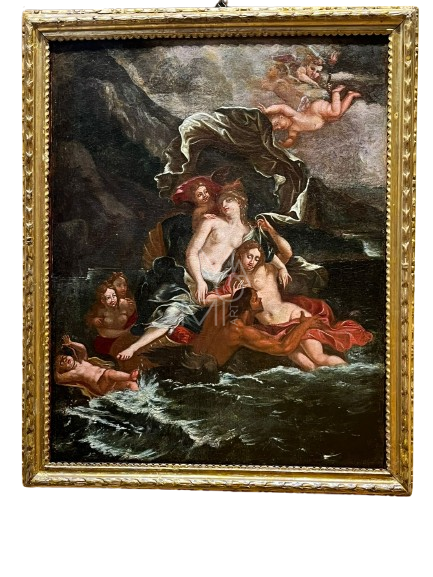
The work distinguishes itself through an asymmetrical and dramatic articulation of the pictorial space, which programmatically renounces traditional central vanishing points. The compositional structure flows through a dense network of diagonal and elliptical lines that guide the viewer’s gaze in a continuous wavy motion. The sky, dominated by leaden and menacing clouds, opens on the upper right side to make room for two winged cupids in flight—highly ethereal figures that introduce a note of celestial grace amidst the marine tumult. Against this dark meteorological background, the foreground cliff detaches itself, its brown rocks serving as a counterpoint to the central scene.
At the exact center of the action stands the figure of Galatea, softly reclining upon her shell. Her nude body, characterized by a milk-white, mother-of-pearl complexion, captures the primary light of the painting and creates a sharp chiaroscuro contrast with the deeply bronzed skin of the muscular triton who supports her structure from below, engulfed in the waves of the agitated water. The dynamism of the work is heightened by the presence of other nereids and tritons caught in complex positions of torsion, their limbs seemingly blending with the sea foam.
A leading role belongs to the large drapery that floats above the nymph. This fabric serves not only a narrative function, useful for evoking the breath of the sea breeze, but constitutes a veritable scenographic device. Billowing like a sail, it creates a deep niche of shadow that projects the principal figures forward and organizes the planes of light. One senses here the influence of Giacomo del Po’s fertile activity as a scenographer and designer of temporary decorations and theatrical machinery for the viceroys of Naples. The artist transfers onto the canvas the same capacity to create artificial visual wings to enhance the dramatic action.
The luminism of the composition reveals a rapid, almost summary handling, where forms tend to dematerialize under the effect of sudden silvery flashes. Compared to the clear, sunny hues of Roman classicism, Del Po’s palette prefers dark and contrasted harmonies. The intense reds of the drapery in the foreground dialogue with the brown earth tones and the deep green of the sea water, offering a nocturnal and mysterious vision that accentuates the dreamlike component of the mythological tale.
Direct Stylistic Comparison with Fresco Cycles in Neapolitan Noble Palaces
The canvas under examination finds precise and compelling formal correspondences within the vast decorative production in fresco that Giacomo del Po executed for the residences of the Neapolitan aristocracy between the end of the seventeenth century and the first two decades of the eighteenth century. A direct stylistic thread links this easel composition to the grand mural decorations of Palazzo Caracciolo di Avellino, executed around 1696, as well as to the mythological scenes painted for Palazzo Casamassima and Palazzo Cellamare.
In his large-scale ceiling cycles, Del Po consistently demonstrated a marked predilection for figures with elongated anatomies, almost devoid of gravitational weight, characterized by facial features with sharp profiles, pointed noses, and intensely pathetic gazes. If one examines closely the faces of the Nereids emerging from the waves in this painting, one finds precisely the same pictorial handwriting. The large, wide-open eyes, the mouths parted in an expression of theatrical awe, and the blonde hair gathered in wet, twisting locks constitute unmistakable signature traits of the Palermitan artist.
An interesting historical detail regarding Del Po’s working practice, handed down by period sources, reveals that the artist was accustomed to reusing the same cartoons and preparatory studies both for grand frescoed vaults and for cabinet paintings intended for private collectors. The wide drapery billowing in a semicircle above Galatea’s head reproduces on a reduced scale the exact same expedient that the painter adopted on the ceilings of noble palaces to visually break through the architectural space and simulate the presence of the open sky. Consequently, the canvas should not be considered a minor work, but rather a precious model or chamber piece in which all the complex, airborne spatiality of Late Baroque Neapolitan interior decoration is concentrated.
Analysis of the Coeval Frame: Carving Typology and State of Conservation
An element of exceptional historical and antiquarian relevance is the presence of the coeval frame, whose external dimensions determine the total size of 82,5 by 67,5 centimeters. In modern art-historical methodology, the preservation of the original setting is considered a factor of crucial philological importance. During the Baroque period, the frame was not conceived as a mere protective accessory or a simple element of aesthetic transition; rather, it represented a true design extension of the painted space, studied to dialogue with the carvings of the furniture and with the architecture of the room hosting the work.
The frame presents a solid cassette structure with a markedly projecting profile, a decorative typology extremely widespread in the workshops of Neapolitan cabinetmakers and woodcarvers at the turn of the seventeenth and eighteenth centuries. The wooden carving shows a continuous motif of stylized foliage along the inner cove, followed by an outer perimeter profile worked in a twisted rope or ribbon pattern. This craftsmanship, despite being sober in its overall geometry, possesses a notable plastic force, designed specifically to tighten the visually highly agitated composition of the painting and channel the viewer’s gaze toward the center of the marine drama.
Conservation analysis reveals that the surface was treated with gold leaf gilding applied over a preparatory layer of red bole. At the points of greatest protrusion, the natural wear of centuries and past cleaning operations have partially rubbed away the thickness of the gold, allowing the warm, reddish hue of the underlying bole to surface in transparency. This phenomenon, far from being a defect, confers upon the whole an antique patina of extraordinary visual softness, impossible to replicate in modern gilding. The wooden support appears structurally sound and compact, free from significant wood-boring insect attacks or losses in the carving, thereby preserving intact the aesthetic value and original visual impact intended by the artist and his first patron.
Examination of the Derivation of this Specific Pose of Galatea from the Models of Luca Giordano Kept in Naples
The postural articulation of Galatea and the undulating movement of the marine cortege are decisively influenced by the immense magisterium of Luca Giordano, nicknamed "Luca fa presto" (Luca hurries) due to his legendary execution speed. Giordano was the absolute monarch of Baroque painting in Naples, and his influence inevitably extended over the entire subsequent generation, profoundly conditioning the work of Giacomo del Po as well.
Specifically, the pose of the nymph—reclining on her side upon the sea shell with one leg softly extended and the torso caught in a subtle and sensual backward torsion—explicitly evokes the celebrated Giordanesque models of the Triumph of Galatea, of which extraordinary examples are preserved in the Museo Nazionale di Capodimonte and in various private Neapolitan collections. Del Po absorbs from Giordano the formal scheme of the figura serpentinata and the effective visual counterpoint between the white, almost lunar complexion of the female figures and the massive musculature, darkened by the sun and salt, of the tritons surrounding them.
A critical anecdote concerns the manner in which Del Po viewed the great master's works. He did not servilely copy Giordano’s models, but instead operated upon them a subtle, systematic, and highly personal stylistic corruption. While Giordano's Galateas move within a sunny, monumental, and festive atmosphere, imbued with a luminosity of Neo-Venetian matrix, Giacomo del Po translates the same compositional scheme into a nocturnal, restless, and almost febrile dimension. Giordano’s sunny sea is transformed into a dark, bituminus liquid mass, and the bodies lose their classical volume to acquire a more nervous, unstable, and acrobatic sensuality. This metamorphosis of the pose from a living statue to a figure floating in the shadow is the clearest proof of how Del Po knew how to ferry the grandiose Baroque rhetoric of Luca Giordano toward the shores of a visionary, bizarre, and intimately tormented Rococo.
The Socio-Political and Cultural Context of Late Baroque Naples
The genesis of this painting is situated at a moment of profound, convulsive, and dramatic transition for the city of Naples, spanning the final years of the seventeenth century and the first quarter of the eighteenth century. This historical period was marked by the traumatic transition from the centuries-old Spanish viceroyalty to the Austrian viceroyalty, which occurred in 1707. This dynastic shift did not represent merely a change in political administration; it shook the social structure of the largest metropolis in the southern Mediterranean to its foundations, paradoxically stimulating a season of extraordinary and fertile cultural flowering.
While the state machinery faced grave financial crises, famines, and continuous tensions between the feudal nobility and the new Habsburg government, the Neapolitan aristocracy took refuge in a lavish and defensive private patronage. Great houses such as the Caracciolo, the Cellamare, the Monteleone, and the Cassano chose to transform their palaces into true theaters of family power, compensating for the loss of real political autonomy through the splendor of the visual arts.
Within this specific sociological climate, a phenomenon of major importance can be observed: traditional patronage of large devotional altarpieces and sacred subjects partially gave way to the demand for cabinet paintings of mythological, allegorical, and profane subjects. The salons and private galleries of noble palaces had to be decorated with ancient fables capable of celebrating the learned taste of their owners. The myth of Galatea, with its strong erotic charge, its link with the marine element, and its Arcadian atmosphere, responded perfectly to this need for evasion and self-representation of a cultured but politically disempowered ruling class.
An extraordinary historical curiosity lies in the fact that Naples, during those very years, was becoming one of the great capitals of the European Enlightenment ante-litteram. It was the Naples in which the philosopher Giambattista Vico operated, who published the first edition of his Scienza nuova precisely in 1725, and it was the city in which the historian Pietro Giannone wrote his jurisdictionalist theses in open contrast with ecclesiastical power. The intellectual circles that gathered around the figure of the scholar Giuseppe Valletta debated Cartesian rationalism, modern science, and secular philosophy.
This profound cultural cross-fertilization favored the diffusion of a critical thinking which, in the artistic field, translated into the definitive rejection of the dark, dramatic, and severe Counter-Reformation iconographies that had dominated seventeenth-century Naples. The free, anti-academic, imaginative, and avowedly profane painting of Giacomo del Po became the ideal visual mirror of this intellectual aristocracy. Patrons sought within Ovidian fables a new, sensual, modern, and disenchanted key to interpreting human passions and the complexity of modern times.
Comparative Analysis of Pigments and the Eighteenth-Century Neapolitan Palette
From the standpoint of material culture, execution techniques, and workshop secrets, the analyzed canvas adheres with absolute rigor to the operational protocols in use in Naples at the beginning of the eighteenth century. The stylistic transition from the mature Baroque toward the first chromatic delicacies of the Rococo did not involve a radical replacement of the materials employed, but profoundly altered the way in which painters mixed and applied pigments to the canvas.
The fundamental starting element is the preparation of the canvas, carried out according to a typically Neapolitan formula derived from the workshops of Mattia Preti and Luca Giordano. Del Po utilizes a dark ground, formulated by mixing earth shadows, iron-rich clays such as burnt Siena earth, carbon black, and a percentage of bitumen, all bound with boiled linseed oil. This brown and deep base did not serve as a simple inert background, but was actively exploited by the artist as a mid-tone. Using a technique termed a risparmio (by saving), Del Po allowed the dark preparation to surface to define the shadows of the cliff and the depths of the tempestuous ocean, applying light colors only for the illuminated portions.
The vibrant red drapery wrapping the marine deities in the foreground constitutes a masterly display of the painter's technical wisdom. To obtain that effect of heavy, luminous fabric, Del Po initially applied a thick and opaque base of cinnabar (mercury sulfide), useful for structuring the volumes of the folds. Subsequently, to create the deep shadows and impart an almost vitreous transparency to the fabric, the artist applied several glazes of organic red lake over the cinnabar, historically identifiable as madder lake or cochineal lake. This skillful stratified contrast allows the drapery to glow with an internal light, detaching itself with visual violence from the darkness of the surrounding liquid mass.
The white, almost lunar, and mother-of-pearl complexion of Galatea and the nymphs is obtained through a dense and textured impasto of flake white (basic lead carbonate), which at the time was the white par excellence for oil painting. This pigment was corrected with minute touches of yellow ochre and green earth to render the delicate mid-tones of the female bodies.
The cool tones of the cloudy sky and the frothy reflections of the sea water rely instead on the use of smalt, a pigment obtained from grinding cobalt glass, or, in more prestigious commissions, precious natural ultramarine blue extracted from lapis lazuli. The phenomenon of aging and partial chemical alteration undergone by these pigments over the course of centuries has accentuated that dramatic and silvery chromatic contrast between the celestial figures and the surrounding darkness, a characteristic that unequivocally defines the visionary aesthetics of Giacomo del Po.
Bibliographical Apparatus and Philological Notes
Notes
- For biographical and aesthetic details, see Bernardo De Dominici, Vite de' pittori, scultori ed architetti napoletani, Naples 1742-1745, volume three, pages 495-512. The eighteenth-century biography written by De Dominici, though with the typical hyperboles of the time, precisely highlights the eccentric nature of the artist and the great fortune of his cabinet paintings among the viceregal nobility.
- Cf. Nicola Spinosa, Pittura napoletana del Settecento dal Barocco al Rococò, Naples 1986, pages 24-28. In this fundamental text, the scholar analyzes the shift in Neapolitan collecting taste toward Arcadian and mythological themes, in close concomitance with the political crisis of Spanish rule.
- Cf. Vittorio Comparato, Giuseppe Valletta un intellettuale napoletano della fine del Seicento, Naples 1970, pages 89-112. The study delves into the avant-garde philosophical climate in the Naples of the era and the openness of large private collections to the secular themes of classical literature.
- On the patronage of the nobility, see Giovanni Civale, Il mecenatismo privato a Napoli tra Sei e Settecento: il caso dei Caracciolo di Avellino, in Rivista Storica Italiana, number one hundred and twelve, year 2000, pages 450-482.
- For purely technical aspects and the use of dark grounds, see Stefano Rinaldi, Storia tecnica della pittura: materiali e metodi dal Medioevo al Novecento, Rome 2011, pages 165-178.
- Cf. Corrado Maltese, Le tecniche pittoriche, Milan 1992, pages 234-241. The text examines the combined use of cinnabar and organic lakes in the Late Baroque to obtain effects of deep chromatic saturation in fabrics.
- See finally Nicola Spinosa (ed.), Giacomo del Po: un artista bizzarro tra Roma e Napoli, exhibition catalogue, Naples 1999, page 43.
Essential Bibliography
- Angelo Poliziano, Stanze per la giostra, critical edition edited by S. Orlando, Milan, 1988.
- Bernardo De Dominici, Vite de' pittori, scultori ed architetti napoletani, 3 volumes, Naples, 1742-1745 (anastatic reprint Bologna, 1979).
- Ferdinando Bologna, Francesco Solimena e la pittura della sua epoca, Naples, 1958.
- Giambattista Vico, Principj di una scienza nuova, Naples, 1725.
- Grete Lesky, Giacomo del Po, 1654-1726, Graz, 1973.
- Nicola Spinosa, Pittura napoletana del Settecento. Dal Barocco al Rococò, Naples, Electa, 1986.
- Nicola Spinosa (ed.), Settecento Napoletano. Sulle ali dell'aquila imperiale 1707-1734, exhibition catalogue (Naples-Vienna), Naples, Electa, 1994.
- Publio Ovidio Nasone, Metamorfosi, Italian translation by G. Chiarini, Milan, Mondadori, 2005.