THE THEATER OF THE AFFECTIONS AND NEGOTIATIONS
THE THEATER OF THE AFFECTIONS AND NEGOTIATIONS
Stefano Magnasco and the Canvas of Laban, Rachel, and Leah Welcoming Jacob: A Historico-Critical and Connoisseurial Investigation into Golden Age Genoa
Within the historiographical landscape of seventeenth-century Genovese painting, the figure of Stefano Magnasco (Genoa, 1635 – 1674) has long suffered from a singular eclipsing shadow, cast paradoxically by the gargantuan stature of his own lineage: his son, Alessandro Magnasco, known as "Il Lissandrino," whose "pitture di tocco" (touch-paintings), skeletal friars, and spectral landscapes would captivate the eighteenth-century European courts. Yet, upon closer inspection, the extraordinary executive freedom of the Lissandrino roots itself deeply within his paternal workshop.
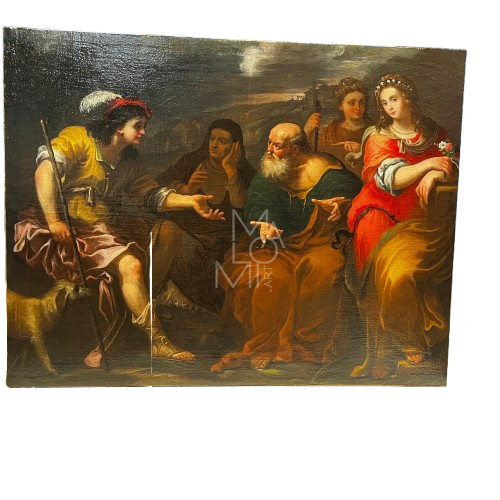
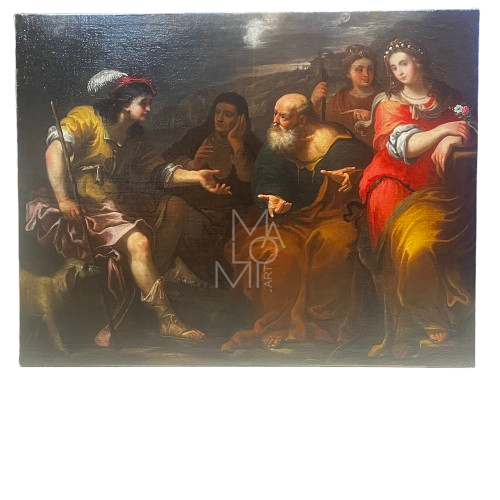
The recent re-emergence from a historic and illustrious Genovese patrician family of a monumental canvas measuring an imposing 158.5 x 122.5 cm, depicting Laban, Rachel, and Leah Welcoming Jacob, represents more than the mere recovery of a masterpiece from Stefano's maturity. It opens a vivid window into the patronage patterns, workshop practices, and cultural milieu of the palatial salons of the Superba.
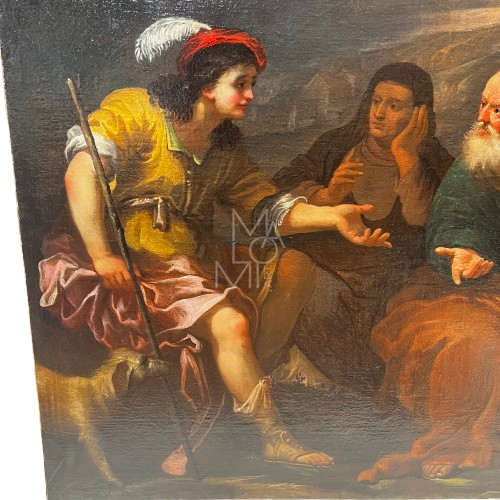
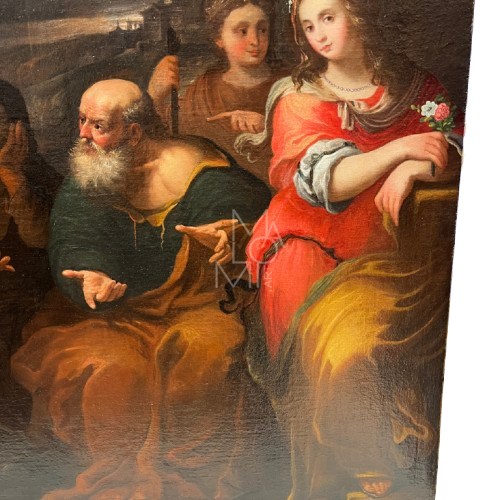
The staging of the characters upon the canvas follows a calculated theatrical score that spans the entire composition. On the left, the scene is dominated by the dynamic figure of Jacob, whose bodily movement dialogues with the rolling hills and rural hamlet in the background. At his feet, serving as the visual anchor of his emotional momentum, rests the faithful shepherd dog. Moving toward the center, the narrative encounters its static and intellectual foil in the shadowed melancholic servant, who bridges the gap between the young traveler's eloquence and the stern authority of the elderly Laban. The latter, serving as the visual axis of the work, introduces the right register of the painting, where the patriarch's plastic monumentality softens into the grace of his two daughters, Leah and Rachel, closing the composition in a climax of chromatic splendor dominated by the saturated red of Rachel's gown.
The Patriarch's Dog and Animalier Painting in Genoa
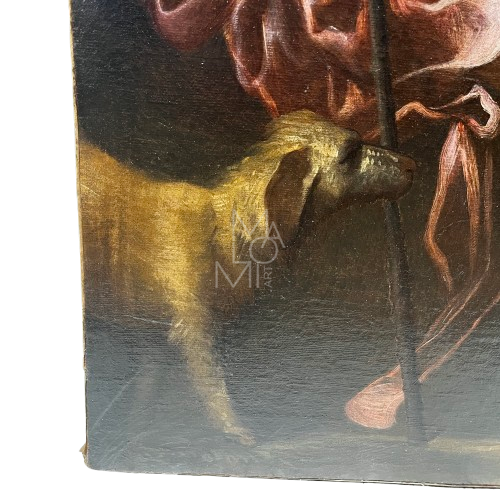
The composition opens in the lower-left register with a passage of absolute naturalistic virtuosity: shadowed by the roseate drapery and Jacob's pastoral staff, emerges the head of a shepherd dog with a fulvous, golden coat. This inclusion reflects a well-documented taste governing the Genovese art market of the period. By the mid-seventeenth century, Genoa was thoroughly enthralled by the fashion for animalier and genre painting, introduced by Netherlandish masters and brought to its zenith by local artists such as Il Grechetto and Anton Maria Vassallo. Connoisseurs clamored for the integration of highly realistic domestic animals into scriptural scenes.
Magnasco executes the hound with a brilliant di tocco technique: over a dark underpainting, he applies rapid, sweeping, thread-like brushstrokes with a semi-dry brush. These marks do not blend; instead, they remain distinct to mimic the coarse, bristling texture of a coat catching the light. Iconographically, the dog transcends mere virtuosity; in the narrative of Genesis, it embodies Vigilantia and Fidelitas. It is the silent, loyal companion that protected Jacob throughout his long and perilous journey from Canaan to Haran, and which now stands watch over this delicate matrimonial negotiation.
The Social and Contractual Role of Women in the Ligurian Baroque
Beyond the literal scriptural narrative, the focus on the figures of Rachel and Leah offers a valuable sociological key, providing a faithful mirror to the matrimonial and economic dynamics of the Genovese patriciate during the seventeenth century. In the biblical text, the two sisters represent the merchandise of an economic exchange masquerading as a kinship pact: Laban surrenders them in return for Jacob's labor, subordinating the feelings of the younger sister and the rights of the elder to a cynical patrimonial calculation. This dialectic between familial affection and financial interest resonated with extraordinary vigor in Genoa, where marriages between the great princely houses were true business partnerships, strictly regulated by detailed dowry chapters drawn up by the Republic's most celebrated notaries.
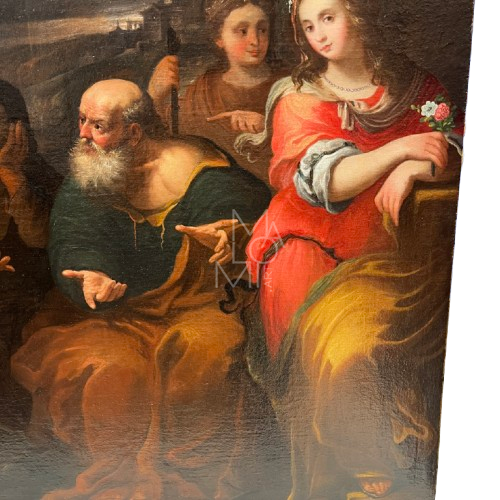
In the canvas, Magnasco translates this complex socio-economic reality into a precise psychological and visual differentiation. Leah, positioned in the middle ground and partially cast in shadow, embodies the silent compliance and resignation of the firstborn whose value is determined solely by birth order and dynastic duty. Rachel, conversely, despite being the formal object of the transaction, is invested with an assertive, proud monumentality. Her sumptuous attire and direct, conscious gaze toward the viewer do not project the passivity of a victim, but rather the fierce agency of a Genovese patrician woman. In the Genoa of that era, though living within a strictly patriarchal framework, women of the nobility enjoyed singular economic prerogatives: they frequently managed substantial dowries, inherited vast estates in the absence of male heirs, and administered the family's urban palaces and global business affairs while their husbands were occupied in overseas commercial outposts or on the bourses of Antwerp and Madrid. Rachel thus serves as a vehicle for this aristocratic dignity: she is no inert piece of capital, but the future custodian of patrimony and the biological and financial continuity of the lineage, incarnating that inseparable fusion of chromatic opulence and dynastic discipline that cemented Ligurian society during its Golden Age.
The Baroque Mise-en-Scène: Stylistic Focus on the Protagonists
By isolating the structural figurative clusters of the canvas, one understands how Stefano Magnasco organizes the pictorial space as a theatrical stage, wherein every gesture operates as an utterance and every drapery fold acts as a dramatic accentuation.
The Young Jacob and the Melancholic Servant
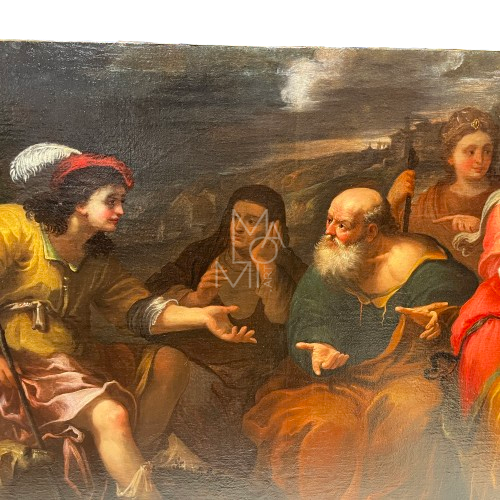
On the left, the young Jacob commands the viewer’s attention through his vibrant dynamism. His profile is the idealized archetype of youth: cheeks flushed with vigorous health, fleshy lips, and a dense, compact cascade of dark curls. This physiognomy stands as a clear homage to the lesson of Valerio Castello, Stefano's brilliant master, who had imported to Genoa the elegant fluidity of Parmigianino and the chromatic audacity of Rubens. Jacob's headdress—a crimson turban surmounted by a pliant white feather—is resolved with phenomenal painterly speed: the plume appears almost to flutter in the crepuscular air of the background.
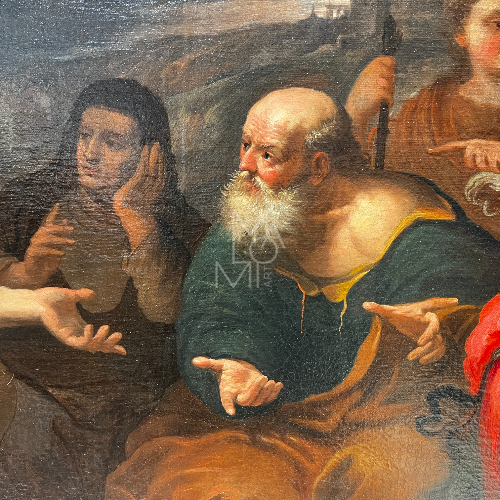
Behind him, nearly swallowed by the terrestrial shadows and earth browns of the middle ground, sits a pensive figure, captured in the classic posture of melancholy (his face propped against the palm of his hand). This figure serves as a brilliant static foil to Jacob’s eloquence, whose forward-stretched arm and open palm present a tour de force of anatomical foreshortening.
The Elderly Laban and Sculptural Tension
At the compositional center, the frame tightens around the aged Laban. Here, Magnasco abandons Castellian sweetness to embrace the solid plastic rigor of Domenico Piola and the contemporary Roman Baroque. Laban's countenance is a triumph of geriatric realism: a forehead furrowed by the wrinkles of shrewd calculation, stern and guarded eyes, and above all, a snowy beard rendered with filiform highlights of lead white that seem to glint with an internal light source.
Laban's hands are knotty, sinewy, and sculptural; his left index finger points authoritatively downward, sealing the terms of the covenant: seven years of labor to win the desired daughter. The ochre-golden mantle enveloping his legs cascades in broad, geometric, almost metallic folds, where the chiaroscuro becomes sharp, dramatic, and tactile.
The Sisters Contrasted: Leah and Rachel
The silent drama of Laban's two daughters unfolds on the right. In the middle distance, visually receded and cloaked in somber tones, appears Leah, the firstborn—she whom the biblical text describes as having "weak eyes," and who would become the instrument of the marital deception orchestrated by her father.
In the immediate foreground, reigning undisputed over the right register of the painting, sits Rachel. Magnasco accords her a sumptuous chromatic treatment: a saturated vermilion gown, embellished with a garland of fresh blossoms in her hair and a string of pearls encircling her ivory neck. Her face, a perfect oval with soft, dreamy eyes, provides an exact physiognomical match to the celebrated Sacred Family Served by Angels preserved in Palazzo Bianco, Genoa. Rachel looks neither at her father nor her suitor; her gaze is directed outward, seeking the complicity of the viewer, fully aware of her destiny as the matriarch of the lineage of Israel.
The Meteorological Sky and Atmospheric Depth
Above the historical actors, the background reveals Stefano Magnasco’s extraordinary modernity. We do not find ourselves before a limpid, idealized sky of Renaissance extraction, but rather within a genuine meteorological landscape.
A dense canopy of menacing, deep-brown clouds dominates the upper half of the canvas, mirroring the psychological complexity of the negotiation below. Yet, with a stroke of scenographic genius, Magnasco breaches the storm in two distinct zones: a silvery light radiates precisely above the head of the young Jacob, signifying divine sanction of his journey, while a golden glow kisses the horizon line behind a small rural hamlet characterized by rustic, gabled architecture.
This method of painterly dissolution—handling air and light through a fluid, abbreviated, and febrile paint application—anticipates eighteenth-century landscape painting by several decades. It is here, within these clouds heavy with rain and light, that the genetic code of his son Alessandro's future compositions lies hidden; the father’s broken brushwork paves the way for the Lissandrino's celebrated "pitture di tocco."
The artist’s stylistic evolution crystalizes precisely through this synthesis of distinct currents. While his adherence to the Castile matrix remains evident in the cantic, fluid draperies and the idealization of Jacob's profile, Stefano's maturity manifests in his assimilation of Piolesque monumentality. A structural rigor of Roman origin and a dramatic deployment of chiaroscuro endow his geriatric figures with an unprecedented plastic force, harmonizing with the executive freedom of the meteorological background.
The Gran Teatro of Genovese Connoisseurship
To fully contextualize a canvas of this magnitude, one must immerse oneself in seventeenth-century Genoa—a city Fernand Braudel defined as the financial heart of Europe. Genovese bankers, enriched by their systemic loans to the Spanish Crown, erected monumental palaces along Via Nuova (now Via Garibaldi) and Via Balbi, requiring artworks that could legitimize their newly minted social and economic hegemony.
Old Testament subjects centered on the Patriarchs were highly coveted for large private galleries. Connoisseurs drew a subtle, astute parallel between the trials of Jacob and the mercantile existence of the Genovese nobility: the contract is negotiated with the same precision and legalistic firmness with which Genoese merchants signed their commercial pacts, and the birth of the future dynasty mirrored the patrician obsession with lineage continuity and the preservation of massive family fortunes through calculated marital alliances. The uninterrupted preservation of this canvas across centuries within the heirs of a prominent local lineage attests not only to the intrinsic artistic value of the work, but also to the deep-seated nature of such dynastic and devotional messages in the aristocratic culture of the Superba.
Annotated Period Bibliography: Primary Historiographical Sources
To scientifically chart Stefano Magnasco’s profile and evaluate the critical reception of his mature corpus within Ligurian collections, one must reference the twin pillars of Genovese art historiography: Raffaele Soprani (1612–1672) and Carlo Giuseppe Ratti (1737–1795).
- R. SOPRANI, Le Vite de' Pittori, Scoltori et Architetti Genovesi, Genova, 1674.
- Critical Context: Published in the very year of Stefano Magnasco's demise, Soprani's text offers a direct, contemporary regional testimony. In the chapter dedicated to the disciples of Valerio Castello, the author praises Stefano for his ability to assimilate the master's "maniera tendera e mossa" (tender and dynamic manner), noting that he was already highly sought after by the "principal picture galleries of the City" for his skill in composing "sacred histories and inventions of a felicitous coloration."
- C. G. RATTI, Delle Vite de' Pittori, Scultori ed Architetti Genovesi in continuazione al Soprani, Vol. II, Genova, Stamperia Casamara, 1769.
- Critical Context: Writing nearly a century later, Ratti expands the biography, establishing a sharp distinction between his youth and the "paintings of his maturity." The biographer notes precisely that Stefano, following a Roman sojourn, tended toward a synthesis of Genovese fluidity and a "fiercer application of chiaroscuro," explicitly praising his "cabinet paintings featuring histories from the Old Testament" and lauding his geriatric facial characterizations.
- C. G. RATTI, Instruzione di quanto può vedersi di più bello in Genova in pittura, scultura ed architettura, Genova, Ivone Gravier, 1780 (2nd Edition).
- Critical Context: This invaluable historical guidebook documents the physical location of Magnasco's works prior to the Napoleonic dispersals. Ratti mentions several "canvases of the histories of Jacob" by the hand of Stefano Magnasco hanging in the state rooms of the Spinola and Durazzo families, confirming the absolute alignment of this canvas with the domestic decorative choices of the Ligurian nobility.
Catalog Entry
- Artist: Stefano Magnasco (Genoa, 1635 - 1674)
- Subject: Laban, Rachel, and Leah Welcoming Jacob
- Date: c. 1665–1672
- Medium: Oil on canvas
- Dimensions: 158.5 x 122.5 cm
- Condition Report: Good. Pictorial surface stable with a uniform period patina.
- Provenance: Historic Genovese patrician family.