The Portrait of Representation in the Mature Period of Jacobus Josephus Eeckhout (1850)
The Portrait of Representation in the Mature Period of Jacobus Josephus Eeckhout (1850)
1. Historical-Artistic Context and Artist Profile
Within the landscape of mid-nineteenth-century Central European painting, Jacobus Josephus Eeckhout (1793–1861) occupied a prominent institutional and stylistic position. Having trained at the Royal Academy of Fine Arts in Antwerp, his birthplace, Eeckhout demonstrated rare versatility from a young age, distinguishing himself as a sculptor, lithographer, and painter. His authority within contemporary artistic debate culminated in his appointment as Director of the Royal Academy of Art in The Hague, a position he held between 1839 and 1844.
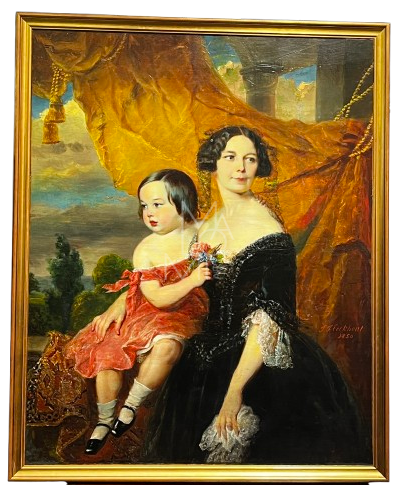
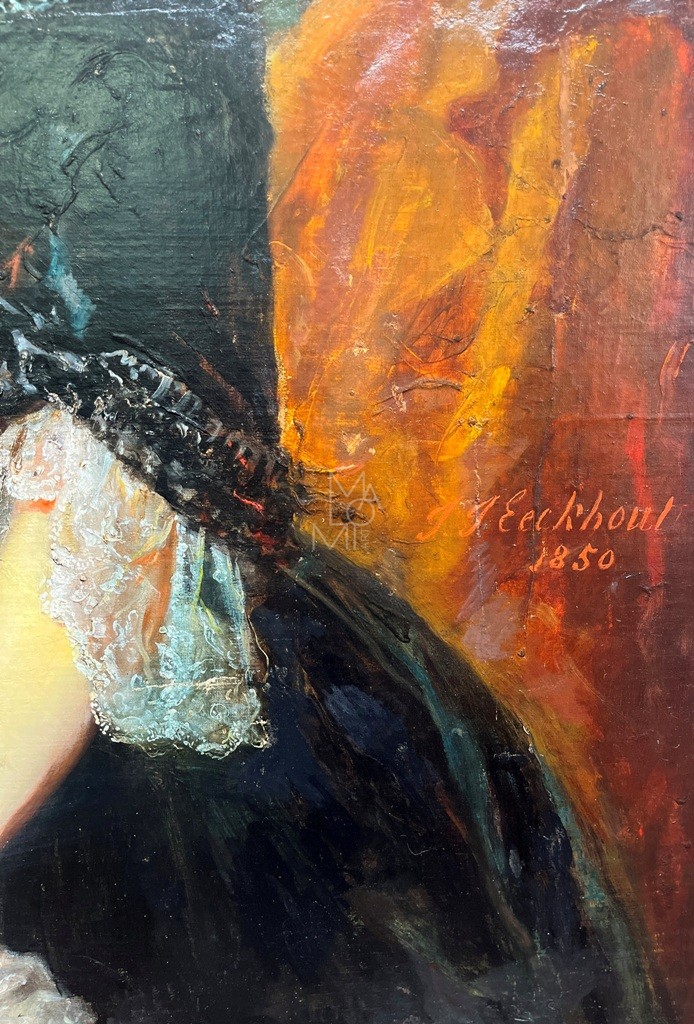
The painting in question, explicitly signed and dated by the author in 1850, belongs to a crucial phase of his biographical trajectory, preceding his definitive relocation to Paris. The work falls within the fertile genre of commissioned portraiture—a market in which Eeckhout was exceptionally sought after by the high bourgeoisie and aristocracy of the Netherlands, Belgium, and Germany. During this period, the artist masterfully interpreted a fundamental aesthetic transition: the departure from the graphic rigidities of Neoclassical derivation in favor of a bourgeois Romanticism sensitive to emotional dimensions and naturalism.
2. Dimensions, Commission, and Social Function of the Artwork
The monumental ambition of the work is supported by its very metrics. Measuring 110x136 cm, the painting commands the exhibition space, asserting its nature as a portrait of representation. In the social system of 1850, a canvas of such proportions was not intended for a private or small room, but rather for the reception room (salon d'apparat) or above the mantelpiece of the main hall in a patrician residence.
The choice of a monumental scale responded to the specific desire of the patrons to eternalize their socio-economic status. Indeed, the height of 136 cm allowed Eeckhout to reproduce the subjects almost at life-size (grandeur naturelle), a technical device that eliminates the psychological distance between the observer and the characters, lending them a striking impression of real presence. At the same time, the width of 110 cm ensures the proper spatial breathing room for the composition, standardizing according to those monumental formats (analogous to the Figure formats of the French tradition) required for integration into the rich wood panelling of the period.
3. Iconographic and Compositional Analysis
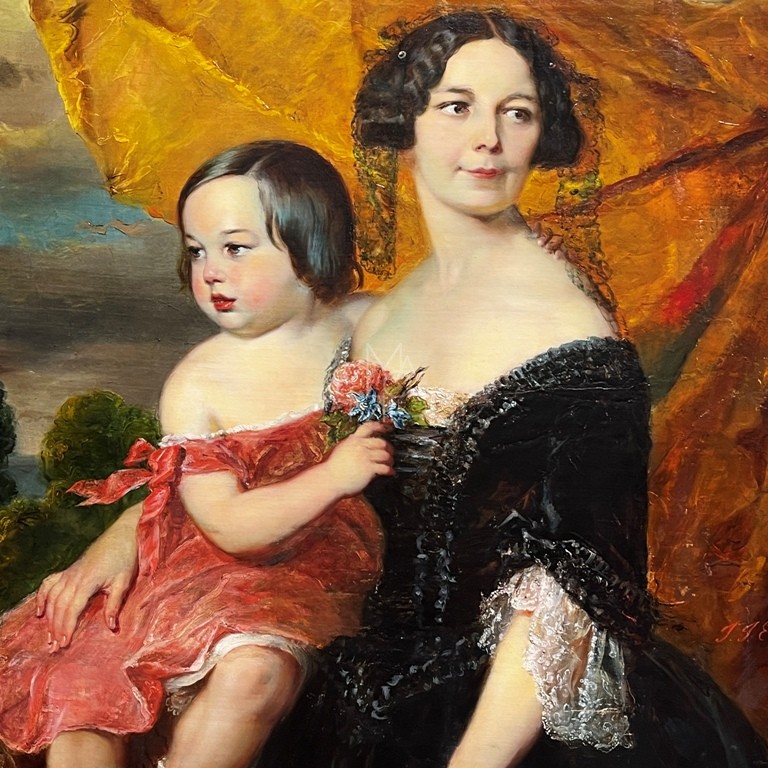
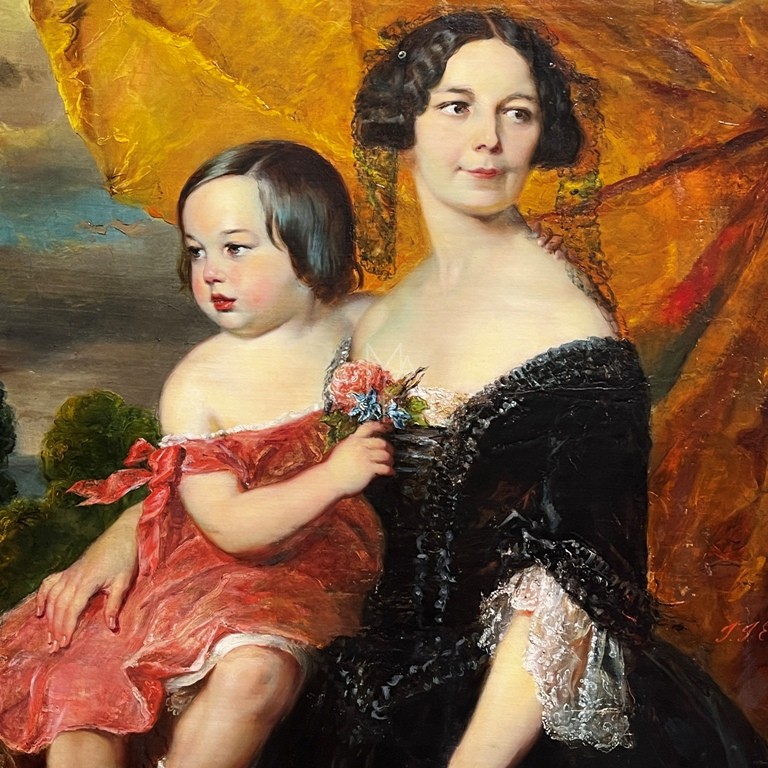
From an iconographic perspective, the canvas articulates the pivotal theme of bourgeois motherhood, celebrating domestic values and the purity of family affection. The geometric structure reveals the painter's deep academic background, capable of masking structural rigor beneath an apparent emotional spontaneity. The figures of the mother and child are formally inscribed within a classical pyramid, the apex of which is formed by the woman’s face, while her wide, dark skirt and the infant's anatomy establish its solid base.
This pyramidal staticism is counterbalanced by a dynamic interplay of linear forces and intersecting gazes. The child's body develops along an ascending diagonal from left to right, intercepted and balanced by the descending line of the maternal arms cradling him. Finally, the space is orchestrated asymmetrically according to a well-tested theatrical staging: on the right, the majestic cascade of a golden, damasked curtain aristocratically isolates the subjects; on the left, a glimpse of the landscape introduces atmospheric depth, relieving the opulence of the interior scene.
4. Visual Language: Light, Color, and Material Rendering
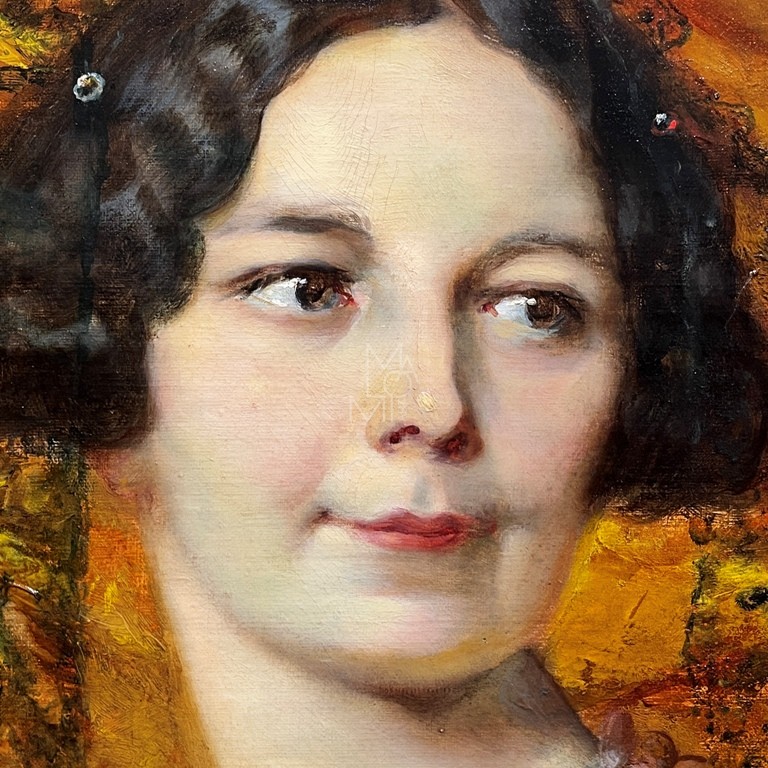
Eeckhout’s virtuosity manifests fully in the tactile rendering of materials—a clear inheritance from the great seventeenth-century Flemish tradition. The painter differentiates the weight and consistency of surfaces with extraordinary skill: the dark fabric of the mother's dress absorbs light, creating deep, soft folds, while the damask of the background reflects its metallic glints. A true display of technical prowess can be seen in the white lace cuffs and collar, described with lenticular minutia through rapid touches of lead white that allow the underlying skin tone to transpire.
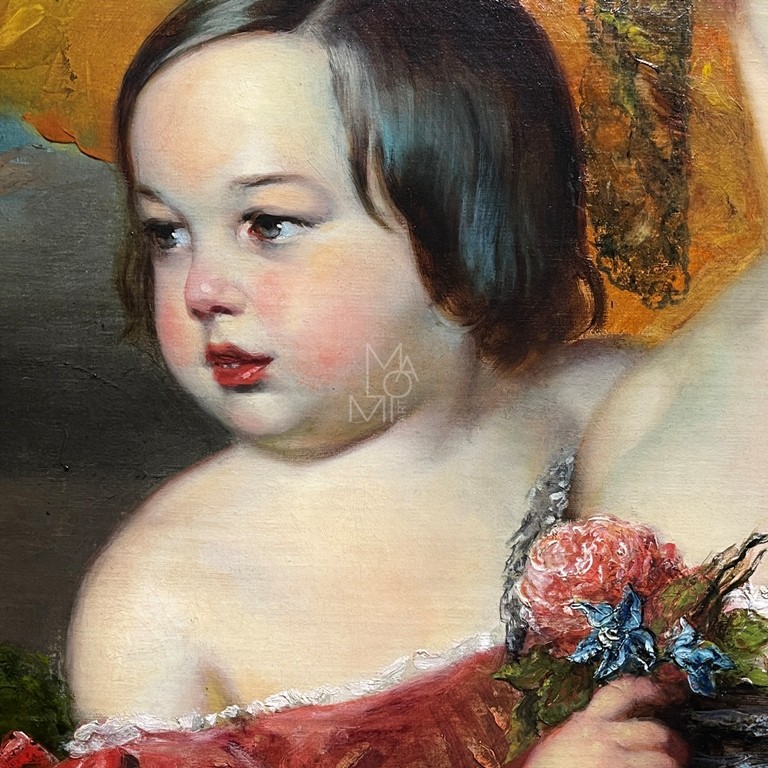
The lighting direction is typical of an exhibition setting, oriented from the left. This choice projects a crisp light onto the child's face and cuts transversely across the mother's décolleté, leaving a large part of her torso in a calculated shadow that emphasizes the focal points of the work. The palette is strictly calibrated to a precise chromatic triad: the austere darkness of the dress, the warm gold of the background, and the pink/red chromatic accent of the child's attire—the latter element carefully designed to catalyze the viewer's attention onto the vitality and innocence of childhood.
5. Conservational History and Materiality of the Support
Regarding its conservational history, the painting benefited from a crucial relining intervention carried out during the twentieth century. This structural operation had become necessary to remedy the physiological loosening and loss of elasticity of the original nineteenth-century canvas, caused by thermo-hygrometric variations within its storage environments.
The twentieth-century intervention, conducted according to the methodological criteria of the era, permanently stabilized the textile support and consolidated the paint film. The effects of this restoration remain legible on the painting’s surface: controlled pressure and heat flattened the natural craquelure, ensuring pigment adhesion and preventing dangerous phenomena of lifting or paint loss. This historical restoration, while likely involving the original stretcher with a more functional modern one, ensures today the excellent legibility of the subtle flesh tone glazes and the minute graphic details impressed by Eeckhout in 1850.