The Nocturnal Veduta Between Tradition and Historical Document: The Case of Carlo Grubacs at Ca' Foscari
The Nocturnal Veduta Between Tradition and Historical Document: The Case of Carlo Grubacs at Ca' Foscari
- Methodological introduction and state of the research
Nineteenth-century Venetian art has long suffered from an unfair interpretative marginalization within art-historical historiography, frequently overshadowed by the monumental vedutismo of eighteenth-century masters like Canaletto and the subsequent twentieth-century avant-garde movements fostered by the Biennale. However, during the nineteenth century, veduta painting underwent a crucial metamorphosis, transitioning from a lucid tool of perspective and Enlightenment documentation into a stage for romantic, nostalgic, and documentary expressions.
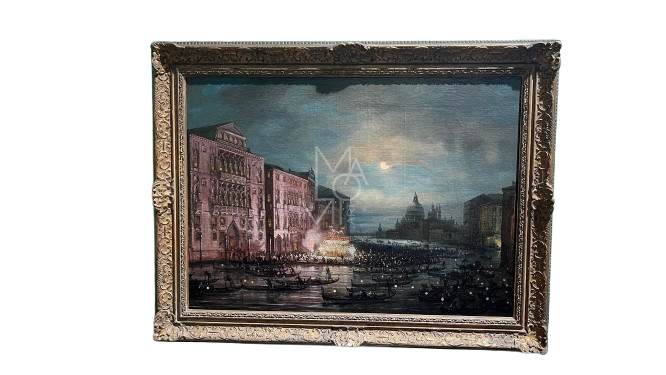
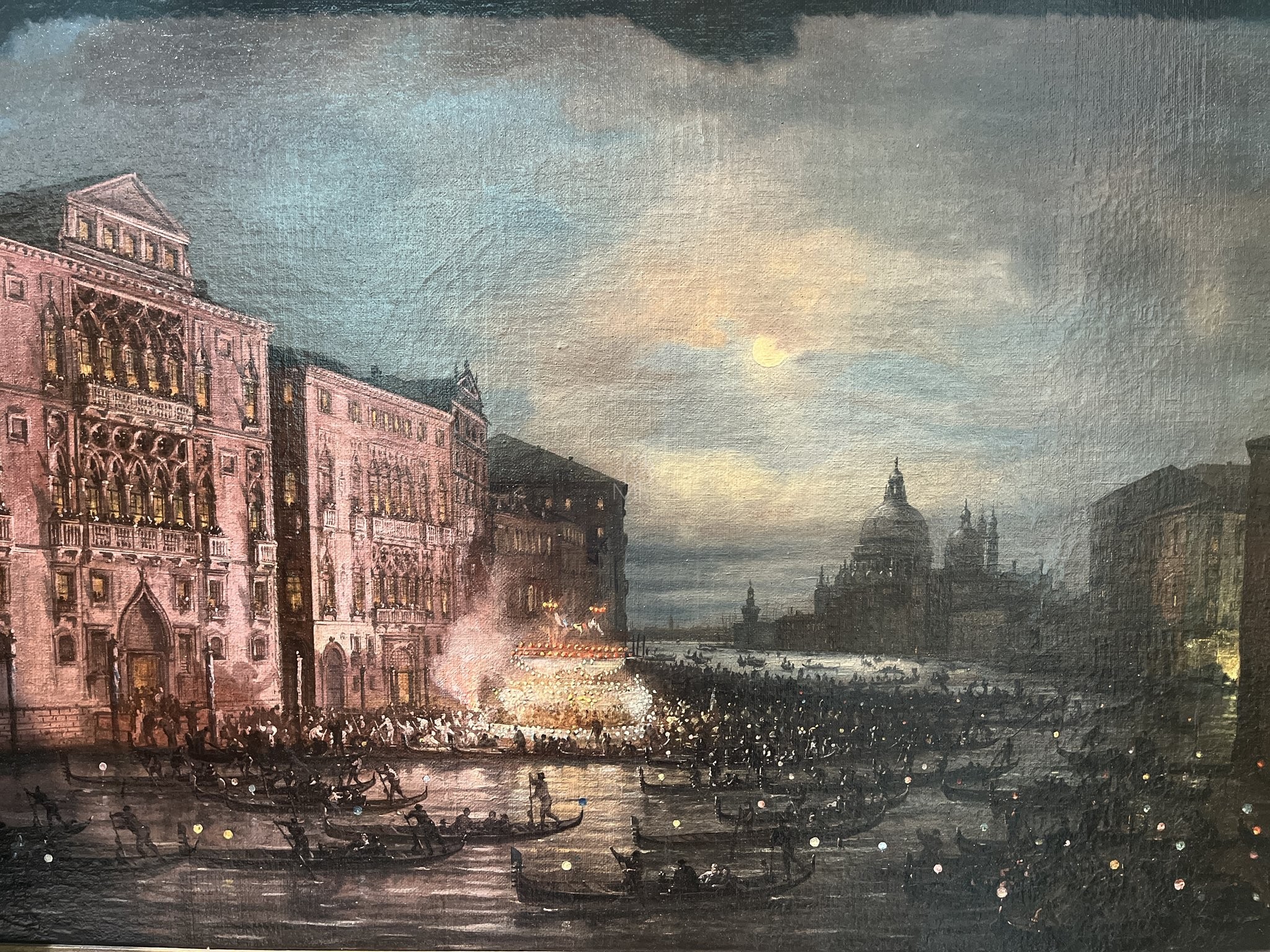
The central subject of this research is an oil-on-canvas painting (measuring 74x52 cm) by Carlo Grubacs (1802–1878) depicting a Nocturnal Festival on the Grand Canal at Ca' Foscari, preserved within its precious coeval frame. The artwork serves as an ideal case study to dismantle the dichotomy between tradition and modernity. While the artist inherits the lenticular precision and graphic rigor of the eighteenth-century workshop tradition, he simultaneously embraces the poetics of the "nocturne"—a genre that found its expressive peak in the work of Ippolito Caffi—redefining it through a unique theatrical and analytical lens.
This thesis pursues a twofold objective. First, it aims to conduct a philological and art-historical analysis of the painting, decoding its exact topography—the famous volta de canal between Ca' Foscari and Palazzo Balbi— and placing it in close critical comparison with the coeval production of Caffi, thereby highlighting the persistence of structural drawing in Grubacs against Caffi’s atmospheric dissolution. Second, through an autoptic examination of macro-details, this study intends to correctly recontextualize the painting within its precise historical setting. Disproving the presence of Risorgimento symbols and identifying a monochrome blue rione regatta flag on the bow of a gondola shifts the chronology of the artwork to the first half of the nineteenth century, under full Habsburg rule. Consequently, the nocturnal festival and the ephemeral floating machina cease to be interpreted as post-unification symbols, revealing themselves instead as extraordinary visual documents of official festivals from the Austrian era, while simultaneously opening a broader academic debate on the persistence of the myth of the Bucentaur and ancient ducal ceremonies in the collective memory of the century.
Finally, a dedicated section focuses on the coeval pastiglia and gold-leaf frame. Treated not merely as an ornamental boundary but as an integral component of the artistic artifact, the frame is analyzed as a document of nineteenth-century collecting taste, capable of actively influencing the spatial and aesthetic perception of the veduta itself.
- The vedutismo of Carlo Grubacs between tradition and romantic sensibility
Carlo Grubacs occupies a pivotal transitional position in art history. Rather than a passive copyist of the past, he stands as a sophisticated interpreter of the paradigm shift from optical Enlightenment to atmospheric Romanticism. His training was deeply indebted to the structural lessons of Canaletto and Bernardo Bellotto, from whom he inherited the conception of the painting as a geometric architecture. Although the use of the traditional camera obscura had been superseded in the nineteenth century by the academic practice of life drawing, Grubacs' works maintain an impeccable perspective rigor. The contour line is never entirely lost; the facades of the palazzi are not mere patches of color, but structures described with orthogonal and geometric precision. This approach satisfied the robust market demand of foreign travelers and the newly emerging bourgeoisie, who required an instantly recognizable Venice rendered in its monumental details.
Yet, the true departure from the Canalettian model occurs through the introduction of a "sense of time" and an emotional approach to the veduta. Where the eighteenth century sought a clear, scientific, and zenithal light to map space rationally, Grubacs transforms light into a dramatic element. His nocturnes and twilight scenes reflect the influence of Northern European Romanticism, where light functions primarily to evoke an emotional atmosphere.
Furthermore, Grubacs specialized in the phenomenon of micro-vedutismo: medium or small-scale formats that, while maintaining expansive overview compositions, focus heavily on microscopic figures, infinitesimal brushstrokes, and minute details such as individual gothic bifora windows or the metal prows (ferri) of gondolas. This reduced scale transforms the grand, solemn eighteenth-century veduta into an intimate, precious object tailored for the nineteenth-century bourgeois gallery.
- Critical comparison: Grubacs versus Caffi
The nineteenth-century Venetian nocturne thrives on a fascinating dualism between the formal persistence of tradition and the impulse toward modernity—a contrast perfectly embodied by the comparison between Carlo Grubacs and Ippolito Caffi. While Grubacs staunchly defends the inheritance of the line and an optical framework derived directly from the eighteenth century, Caffi acts as the champion of a literal revolution of light, veering toward a pre-impressionistic sensibility. This divergence is clearly reflected in how the two artists approach urban description and the rendering of darkness.
Grubacs approaches the night without ever sacrificing the structural clarity of the veduta. Even within the obscurity of the Grand Canal, the architecture preserves its full legibility and a lenticular detail. The gothic windows of Ca' Foscari, the moldings of the palazzi, and the profiles of the gondolas remain defined by a rigorous underdrawing. Light in Grubacs’ work fulfills an almost theatrical purpose: the sharp chiaroscuro contrast between the warm glow of the fireworks and the cold light of the moon isolates individual elements of the scene, creating a highly scenographic, telescope-like effect. His approach remains essentially documentary, descriptive, and analytical.
Caffi, by contrast, revolutionizes the genre by transforming the nocturne into a purely lyrical, atmospheric experience focused on the vibration of the air. In his celebrated night scenes, architectures lose their linear definition and dissolve into fog, air, or the darkness of the night. Caffi employs a chromatic synthesis where forms are merely hinted at; he captures the very reverberation of the water through rapid touches of color-light. Instead of illuminating objects from the outside as seen in Grubacs, Caffi’s light seems to emanate from the atmosphere itself, anticipating the Macchiaioli’s research into painting from life. Where Caffi pursues the lyrical emotion of the dissolution of form, Grubacs reaffirms the three-dimensional stability of Venetian space.
- Descriptive and formal analysis of the canvas (74x52 cm)
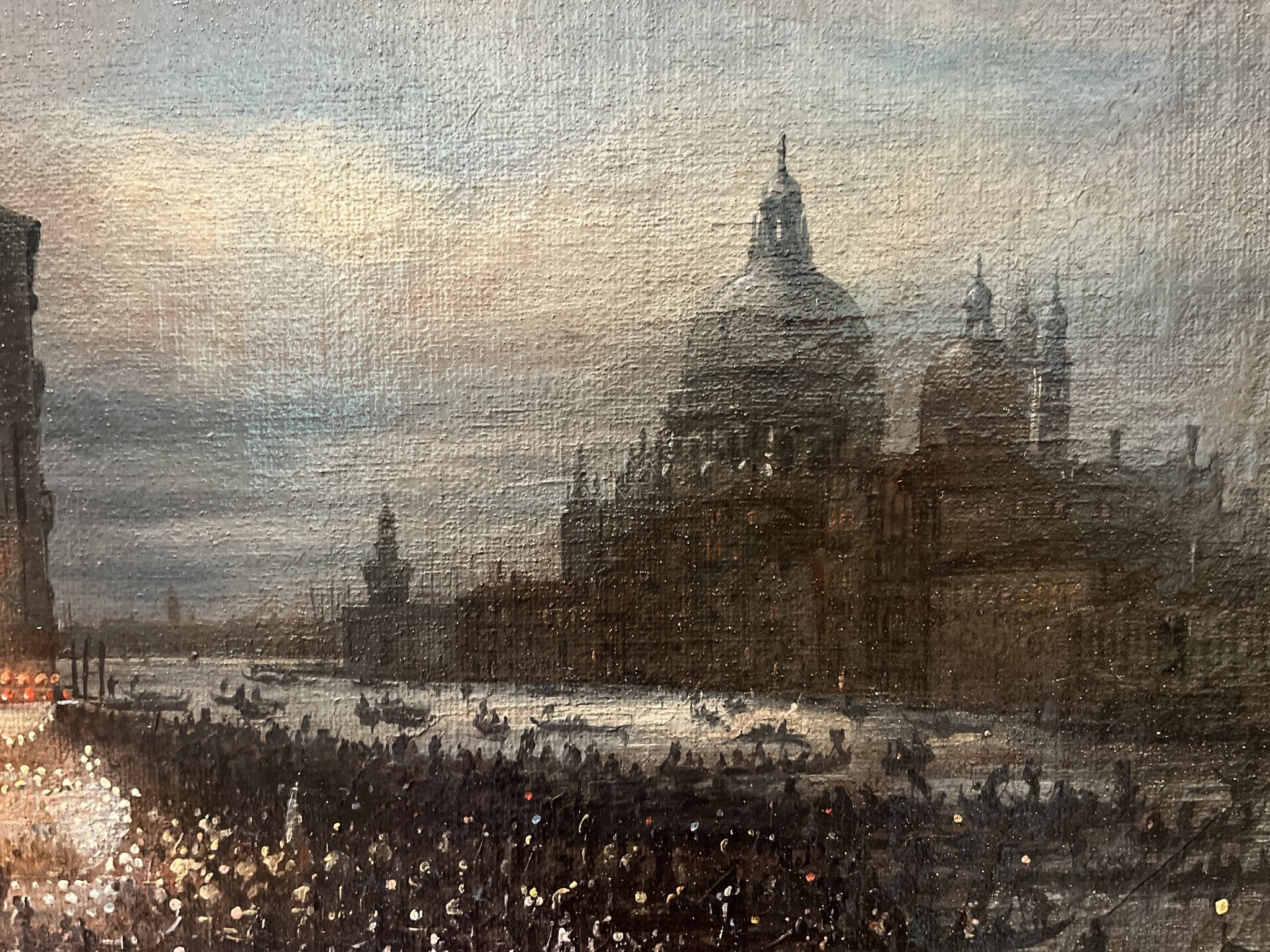
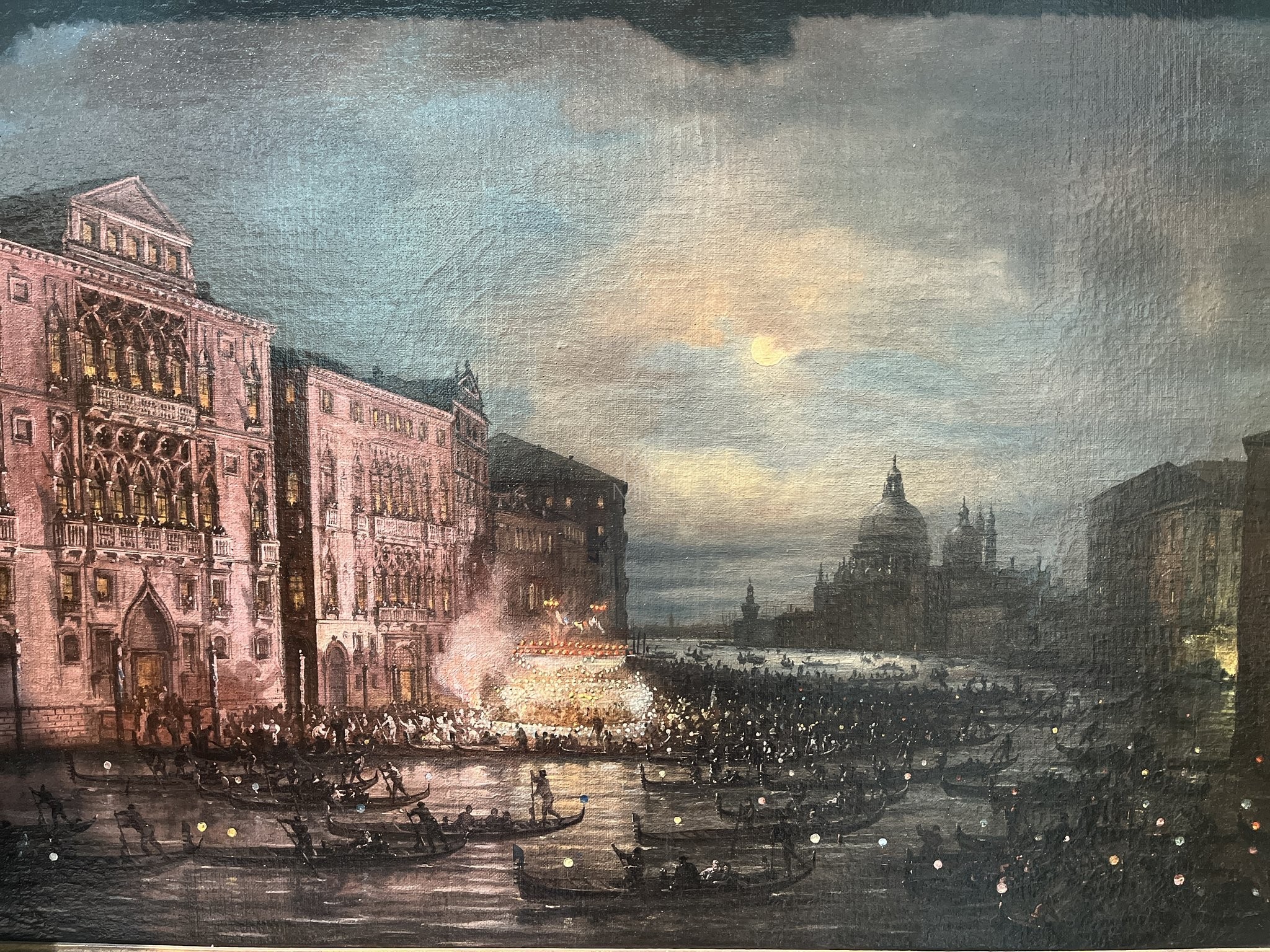
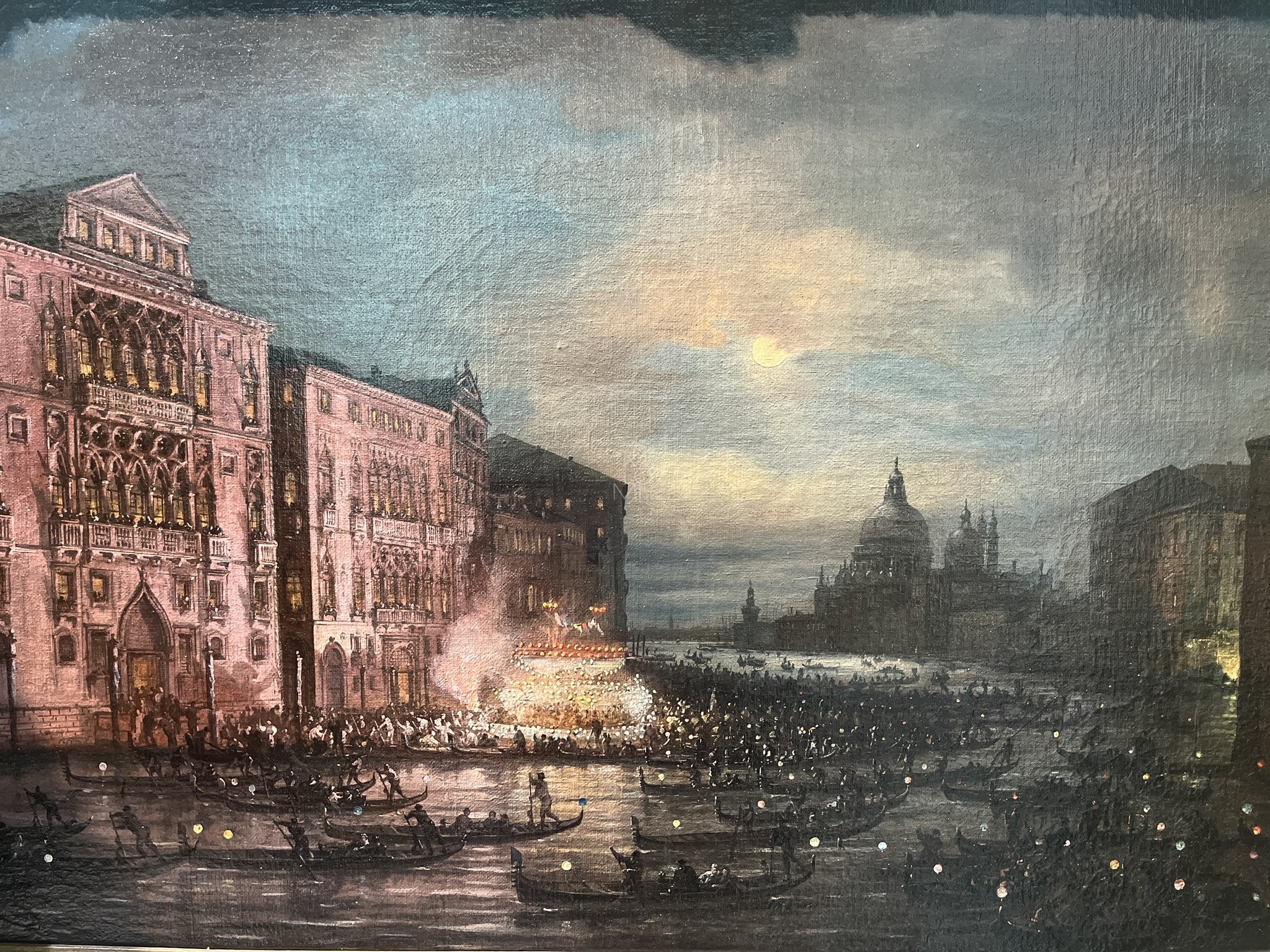
The artwork deploys a complex scenographic apparatus that exploits the curvature of the Grand Canal to amplify deep space, articulating the visual narrative across clearly defined perspective planes, all beneath a nocturnal sky dominated by a full moon amid frayed clouds that diffuses a cold ambient light.
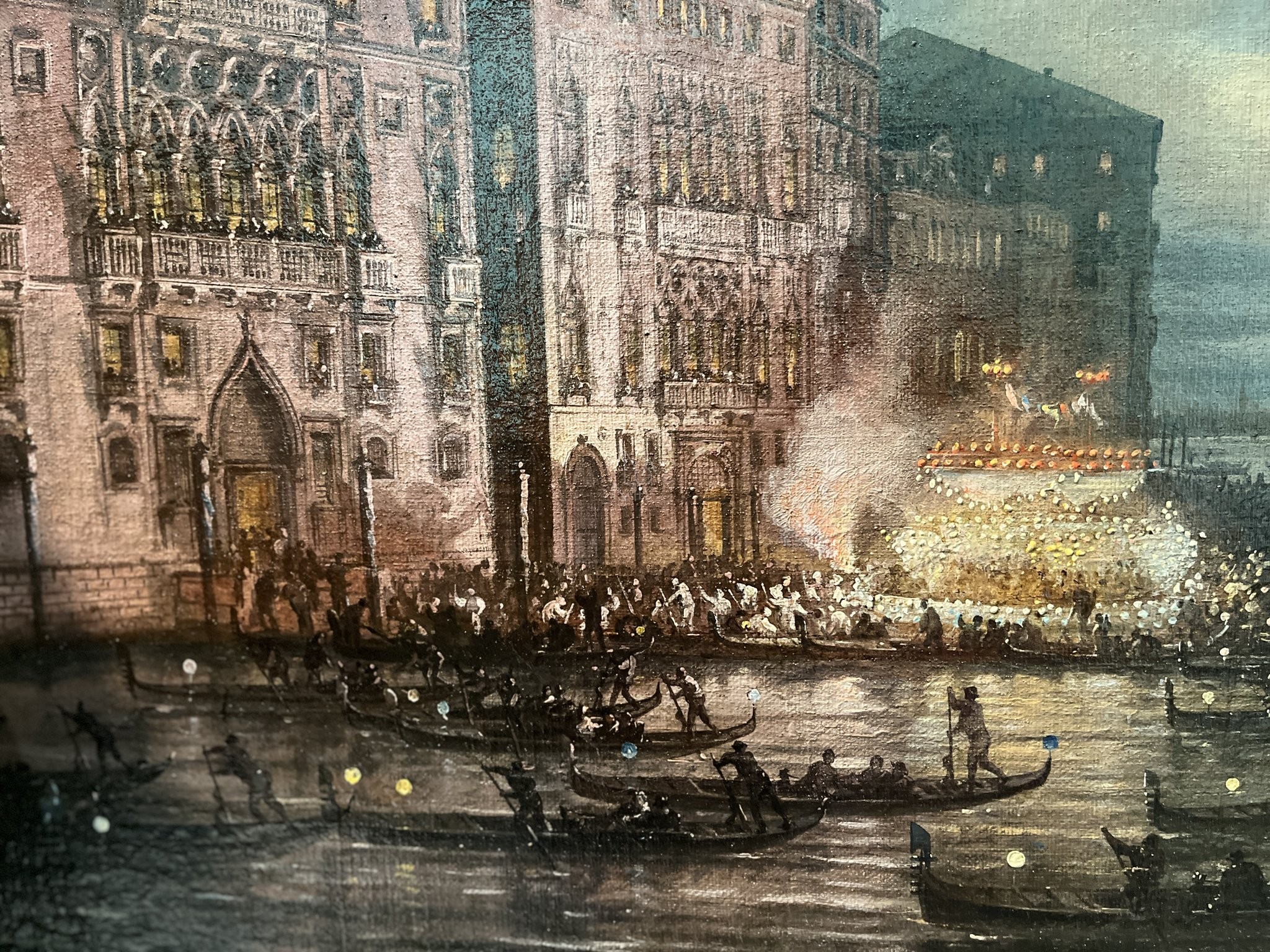
The foreground is entirely occupied by the dark waters of the canal, traversed by a dense fleet of gondolas arranged along precise diagonal vectors that guide the viewer’s eye toward the center of the action. The artist precisely renders the black contours of the felzi and the silhouettes of the gondoliers in motion, captured in dynamic poses. Reflecting off the water’s surface via short, rapid, flickering brushstrokes are the white and yellow highlights of the onboard lanterns, which break up the dense chromatic weight of the browns and blacks. A detail of extraordinary historical significance emerges on the prow of the gondola in the lower right corner, where a small shaped flag flutters: macro examination confirms that this is an entirely blue or azure banner, devoid of tricolor divisions, and attributable to the traditional insignia of Venetian regattas or local rioni.
On the left side of the composition, which forms the architectural heart of the middle ground, rises the imposing block of Ca' Foscari and its adjacent palazzi. The gothic facade is executed with draftsmannish virtuosity: the raking light emanating from the heart of the festival illuminates the pointed arch windows, loggias, and marble tracery, establishing a stark alternation of solids and voids. The Istrian stone takes on warm, pinkish, and amber hues, ignited by the fireworks below, while the water portals at the ground level remain steeped in deep shadow. Along the banks and before the palace entrances, a dense crowd of microscopic figures—rendered at the tip of the brush and dressed in nineteenth-century attire—assembles to watch the event.
Exactly at the center of the canvas, at the turning point of the volta de canal that forms the luminous fulcrum of the entire scene, the painting concentrates its maximum chromatic and luminous intensity. A monumental, ephemeral floating structure, arranged on multiple pyramidal tiers and richly decorated with garlands, lights, and banners, unleashes a burst of warm, golden light. The dense smoke from the pyrotechnics and torches rises upward, creating an area of heavy atmospheric sfumato that envelops the surrounding crowd, effectively separating the sharpness of the Ca' Foscari block from the receding line of palazzi in the background.
In the background, along the right bank as it curves toward the San Marco Basin, the architectures become progressively more synthesized and dark, guiding the eye toward the soft profile of the dome of Santa Maria della Salute, which closes the perspective horizon. The rift in the cloud cover allows for the diffusion of a silvery light that chromatically counters the explosion of artificial light from the festival below, creating a perfect chiaroscuro balance rooted in Romantic aesthetics.
Visual inspection of the state of conservation reveals a generally good level of legibility across the paint film. A light, natural age-related cretto (craquelure) is visible, which is entirely physiological for late nineteenth-century oil binders. The canvas exhibits no evident sagging, indicating that the tension on the stretcher has been well preserved. The superficial protective varnish appears slightly yellowed by time—a factor that accentuates the warm tone of the festival smoke at the center, but may partially veil the original cool crispness of the blues in the sky.
- Historical revision: the nineteenth-century context and Habsburg rule
The correct identification of the iconographic elements obtained through macro photography mandates a fundamental revision of the painting's historical context, soundly refuting frequent and superficial commercial attributions that tend to associate every nineteenth-century Venetian night festival with the post-unification celebrations of 1866. The total absence of the Italian tricolor and the presence of the blue rione flag retrodate the artwork to the first half of the century, placing it squarely within the period of the Kingdom of Lombardy-Venetia under full Habsburg rule (circa 1840–1860).
Under the Austrian administration, the staging of regattas and night festivals featuring grandiose, ephemeral floating structures on the Grand Canal was by no means halted; rather, it was frequently utilized by the government in Vienna as a powerful tool of pageantry, mass distraction, and celebration of imperial authority. Events of this magnitude were organized to coincide with official visits by members of the House of Habsburg, such as the famous and lavish state visit of Emperor Franz Joseph and Empress Elisabeth (Sissi) to Venice in 1856.
The choice to set the scene in front of Palazzo Balbi aligns with a centuries-old logistical convention: situated precisely on the bend of the canal, the palazzo offered the best visibility of the volta, historically serving as the grandstand and finish line for aquatic competitions. Grubacs documents this ceremonial continuity. The painting does not celebrate a national political liberation; instead, it bears witness to a Venice that, although stripped of its political independence, preserved its ceremonial and spectacular fabric intact, adapting it for the patronage of the Grand Tour and the Northern European aristocracy tied to the Viennese court.
- Analysis of the coeval frame
The frame visible in the image expands the overall dimensions of the artifact (from 74x52 cm to approximately 90x68 cm), profoundly altering its spatial perception and offering an excellent example of mid-nineteenth-century cabinetmaking and gilding. The structure is richly ornamented in a gola or vassoio (tray) profile, featuring pastiglia (gesso and glue) decorations applied over a wooden core. It exhibits a beaded or passamaneria profile on the inner sight edge, followed by a wide flat slip and imposing floral volutes, acanthus leaves, and shell motifs executed in a historicist or Neo-Baroque style along the outer borders and pronounced corners.
The deep inner bevel of the frame functions as a literal optical telescope, artificially channeling the viewer's gaze toward the center of the canvas and heightening the illusion of depth within the nocturnal veduta. Furthermore, the gilding of the frame establishes a perfect chromatic dialogue with the artwork, as it picks up and amplifies the warm light of the fireworks painted by Grubacs, building a visual bridge between the physical space of the room and the virtual space of the painting.
The water gilding shows a beautiful aged patina with typical oxidations and rubbing on the highlights, which exposes the underlying red bolo (the clay-based preparation ground). This exposure confirms the authenticity and coeval nature of the frame, preserving the historical integrity of the art object and enhancing its value within the connoisseurship market.
- The myth of the bucentaur between historical reality and nineteenth-century revival
Within this revised historical horizon, Grubacs' work connects intimately with the lingering myth of the Bucentaur (the lavish, gilded state galley of the Doges) and the aquatic ceremonies of the Sposalizio del Mare (the Marriage of the Sea during the Festa della Sensa). For a correct academic exegesis, a fundamental historical knot must be untied: the actual Bucentaur had not sailed Venetian waters since 1798, the year Napoleon’s French troops plundered and burned it on the island of San Giorgio Maggiore to strip it of its pure gold decorations and formally signify the end of the Republic.
However, during the nineteenth century, the physical destruction of the vessel only served to fuel its literary and visual mythologization. In Habsburg-governed Venice, the memory of the Bucentaur ceased to be an active symbol of political sovereignty, morphing instead into a potent nostalgic and commercial topos. This persistence manifests first on a formal level within the parade machine themselves. Although the 74x52 cm canvas does not depict the original Bucentaur in the San Marco Basin, the large floating structure positioned by Grubacs at the center of the Grand Canal bend directly inherits its aesthetic codes. These ephemeral architectures were deliberately designed by nineteenth-century shipwrights to imitate the Baroque decorations, gilding, and monumentality of the ancient ducal ship, functioning as literal scenographic surrogates to evoke the lost splendor of the Republic.
This dynamic reveals the extensive historicist revival operated by the Grubacs workshop. Both Carlo and his son Giovanni responded to a vast market demand by replicating compositions where the Bucentaur appeared either in neo-eighteenth-century day scenes or evoked within the lyrical atmosphere of nocturnes. This phenomenon unveils the dual nature of nineteenth-century vedutismo: on one hand, a documentary fidelity to the physical city; on the other, the necessity of inserting staging elements that celebrated the myth of an eternal, timeless Venice. In the canvas under examination, the golden reflection of the aquatic festival on the Grand Canal embodies precisely this ritual continuity, offering the nineteenth-century viewer the illusion that the glories of the Republic had never truly set.
- Technical analysis: construction phases and decorative proportions of the pastiglia tray frame
From the perspective of nineteenth-century material culture, the tray frame enclosing Grubacs' canvas constitutes an artifact of the highest order, the fabrication of which follows a strict technical protocol typical of mid-nineteenth-century cabinetmaking and gilding workshops. The creation of the frame is articulated across four consecutive, deeply interconnected stages, beginning with the joinery of the wooden support, which consists of four straight strainers of stable soft wood like swiss pine or fir, mitered at forty-five degrees and assembled at the corners using mortise-and-tenon joints reinforced with period nailing. The profile is pre-shaped on the face using molding planes to establish the steep downward gola slope that slopes toward the canvas. Subsequently, the ground preparation is laid down by coating the bare wood with warm ammannitura, a mixture of animal glue and gesso di Bologna that is finely sanded until a stone-like surface is achieved.
The central moment of the artisan craftsmanship resides in the application of the pastiglia. Unlike direct carving onto wood, the nineteenth century optimized production through the use of this malleable paste composed of fine gesso, glue, linseed oil, and marble dust, which is pressed while still warm into negative matrices that replicate the chosen ornamental patterns. Once unmolded and while still flexible, the reliefs are applied using strong glue onto the structural bands of the frame; in the artifact under review, pastiglia shapes both the fine inner beaded border and the massive corner volutes. The process concludes with bolo gilding, applying an extremely fine clay mixed with size of a red hue, characteristic of Venetian manufacturing, which imparts warmth to the gold. The gold leaf is applied via water gilding and, once dry, is burnished with an agate stone on the raised portions, leaving the recessed backgrounds matte to generate a deep three-dimensional chiaroscuro contrast.
The ornamental scheme of the frame answers to a precise geometric and aesthetic hierarchy, structured across three well-proportioned concentric bands that enclose and enhance the canvas. The inner sight edge forms the first molding in direct contact with the painting and features a minute beaded or passamaneria profile finely pressed in pastiglia, the function of which is to sharply break the real space of the room and introduce the darkness of the canvas. Immediately following this is the central smooth gola, which constitutes the widest section of the frame; this large concave scoop is left completely devoid of geometric reliefs to allow the gold to be mirror-burnished. In this way, the polished surface catches the ambient light of the room and projects it perpendicularly onto the dark edges of the canvas, significantly enhancing the luminism of Grubacs’ nocturne. Finally, the outer perimeter rim houses the pronounced centers and corners, where the densest and most volumetric pastiglia decoration is concentrated. The ornamental motifs draw from the repertoire of nineteenth-century historicism and Neo-Baroque style, exhibiting massive foliate floral volutes, curled acanthus leaves, and protruding shell motifs that cast localized shadows onto the smooth gola below, dynamically altering the three-dimensional perception of the frame as the room's light shifts.
- Conclusions
The systematic study of this Nocturnal Festival on the Grand Canal at Ca' Foscari by Carlo Grubacs yields significant conclusions of both an art-historical and a strictly methodological nature. The close-up investigation of the painting has demonstrated the absolute primacy of philological analysis and autoptive examination of macro-details within historiographical practice. In this specific case, the correct decoding of the monochrome blue flag on the prow of the gondola dismantled an erroneous and widespread commercial assimilation that tended to trace every mid-century Venetian nocturne back to the unification celebrations of 1866. This critical rectification has restored the artwork to its authentic chronological and cultural horizon—the period of Habsburg governance within the Kingdom of Lombardy-Venetia—thereby configuring the canvas as an invaluable visual document of official public celebrations orchestrated by Vienna.
Secondly, this research has underscored the high artistic value of the Grubacs workshop within the landscape of nineteenth-century vedutismo. Carlo Grubacs does not emerge as a passive epigone of the glorious eighteenth-century Canalettian model, but rather as a conscious conduit translating that tradition into the romantic and historicist sensibilities of his era. Through a peculiar technical synthesis—uniting the rigorous architectural drawing with a highly theatrical and chiaroscuro-driven luminous rendering—the artist successfully codified a vedutismo of emotion executed at an exceedingly high resolution. The critical comparison with Ippolito Caffi demonstrated how Grubacs charted an alternative path to pre-impressionistic atmospheric dissolution, choosing instead to preserve the formal truth of monumental detail even within the night genre.
Finally, the physical integrity of the artifact, preserved within its magnificent coeval pastiglia tray frame, offers vital evidence regarding the history of collecting and bourgeois taste in the mid-nineteenth century. The frame itself ceases to be a mere ornamental boundary, revealing itself instead as a calculated optical device—a visual telescope designed to amplify the spatial illusion of the veduta and reflect, via its red-bolo water gilding, the chromatic highlights of the canvas. Ultimately, Grubacs’ painting stands as a crucial nexus where the nostalgic memory of the glories of the Serenissima and the imperishable myth of the Bucentaur merge seamlessly with the complex political dynamics and refined market demands of nineteenth-century Europe.
- Annotated bibliography
- Isnenghi, Mario, and Woolf, Stuart. Storia di Venezia. L'Ottocento e il Novecento. Rome: Istituto della Enciclopedia Italiana Treccani, 2002.
- Annotation: A fundamental reference text for the general historical context, indispensable for understanding the social dynamics and the complex administration of public festivals under the Austrian government.
- Lodi, Roberto, and Montanari, Amedeo. La cornice italiana dal Rinascimento all'Ottocento. Modena: Galleria d'Arte Lodi, 1993.
- Annotation: An indispensable manual for the typological classification of historical frames and for the technical analysis of decorative pastiglia and bolo gilding from the historicist period.
- Magani, Fabrizio. I Grubacs: Carlo e Giovanni vedutisti veneziani dell'Ottocento. Venice: Edizioni della Laguna, 1995.
- Annotation: The definitive and singular scientific monograph dedicated to the Grubacs workshop, essential for reconstructing the artist's catalog and analyzing his production of nocturnes.
- Mazzocca, Fernando. La pittura d'interiorità e di notturno nel Romanticismo italiano. Milan: Skira, 2002.
- Annotation: A crucial critical essay for comprehending the evolution of the "nocturne" genre in Italy and the transition from rational Enlightenment vedute to the emotional expressions of the nineteenth century.
- Pavanello, Giuseppe, and Romanelli, Giandomenico (eds.). Venezia nell’Ottocento: Immagini e mito. Milan: Electa, 1983.
- Annotation: A seminal catalog for understanding how the nineteenth-century myth of Venice—and the nostalgic revival of the Bucentaur—was channeled through the visual arts and the international collecting market.
- Scarpa, Annalisa. Ippolito Caffi: Luci del Mediterraneo. Venice: Marsilio, 2005.
- Annotation: The most comprehensive volume on Caffi’s oeuvre, irreplaceable for structuring the comparative chapter of the thesis concerning the formal rendering of light and atmosphere in night scenes.