THE BAROQUE TRIUMPH OF ACIS AND GALATEA of Luca Giordano and Giuseppe Simonelli
The Baroque Triumph of Acis and Galatea
A monographic, philological, and connoisseurial study of a rediscovered masterpiece of seventeenth-century Neapolitan painting
Technical and critical catalogue entry
- Author: Giuseppe Simonelli (Naples, 1650 – 1710) and Luca Giordano (Naples, 1634 – 1705), workshop of / collaboration
- Subject: Acis and Galatea (The marine triumph of Galatea)
- Date: Last quarter of the seventeenth century (circa 1690–1700)
- Medium: Oil on canvas
- Dimensions: 325 x 225 h cm (monumental dimensions, inclusive of its original coeval frame)
- Critical literature: Documented and published in Vincenzo Pacelli, Pittura del Seicento nelle collezioni napoletane, Naples, 2001, p. 93, fig. 144 [p. 93, fig. 144].
- Condition: Excellent; the canvas is housed in its structurally pristine, original period ebonized and gilded setting.
- Introduction and historical context
This extraordinary monumental canvas depicting the Ovidian myth of Acis and Galatea represents a major rediscovery for the study of Southern Italian Baroque painting. Characterized by its imposing scale, the work stands as a paramount example of the grand secular commissions executed to adorn the staterooms (porteghi) of patrician palaces in viceregal Naples toward the close of the seventeenth century [p. 93, fig. 144].
Structurally conceived as a majestic masterpiece of high antiquity, the canvas is supported by a magnificent framing apparatus, hand-carved and gilded with genuine gold leaf. This masterwork is intimately linked to Luca Giordano, the undisputed leader of late Baroque European painting, and his most trusted pupil and collaborator, Giuseppe Simonelli (frequently referred to in early archival sources and antiquarian catalogues as Simoncelli).
The definitive scientific historicization of the canvas was established by the eminent art historian Vincenzo Pacelli. In his seminal volume Pittura del Seicento nelle collezioni napoletane (2001), Pacelli rescued the work from the obscurity of private ownership, recognizing its exceptional philological significance, its compositional originality, and the remarkable survival of its original, coeval framing apparatus [p. 93, fig. 144].
- The literary source: Ovid and the Neapolitan "Neomarinismo"
The iconographic program of the composition draws directly from classical Latin literature, finding its definitive codification in Book XIII of Ovid’s Metamorphoses. The myth recounts the pure, pastoral, and thwarted love between the beautiful sea nymph Galatea (a Nereid) and the young Sicilian shepherd Acis, son of Faunus. Their idyllic romance is brutally shattered by the tragic, violent jealousy of the cyclops Polyphemus, who is also madly infatuated with the nymph. Upon discovering the two lovers, the giant hurls a colossal boulder torn from Mount Etna at the shepherd, crushing him. Heartbroken, Galatea transmutes her lover’s gushing blood into a crystalline subterranean river, thus immortalizing his spirit.
In seventeenth-century Naples, the revival of Ovidian myths enjoyed an immense critical fortune, becoming inextricably intertwined with Neomarinismo—the literary movement inspired by the poetic aesthetics of wonder championed by Giovan Battista Marino (author of Adone). Neapolitan Baroque culture, deeply attuned to themes of sensuality, fluid motion, and the indissoluble link between love and metamorphosis, found an ideal vehicle in the myth of Galatea.
Crucially, while many contemporary artists elected to depict the tragic climax of the narrative (Polyphemus hurling the boulder), the present composition focuses entirely on the Triumph, translating the text into a lyrical and celebratory marine idyll. For the erudite Neapolitan patrons of the era, this setting—though ostensibly Sicilian—served as a sophisticated metaphor for their own coastal landscape, perpetually balanced between the breathtaking beauty of the gulf and the latent, destructive threat of Mount Vesuvius.
- Iconographic analysis and compositional dynamics
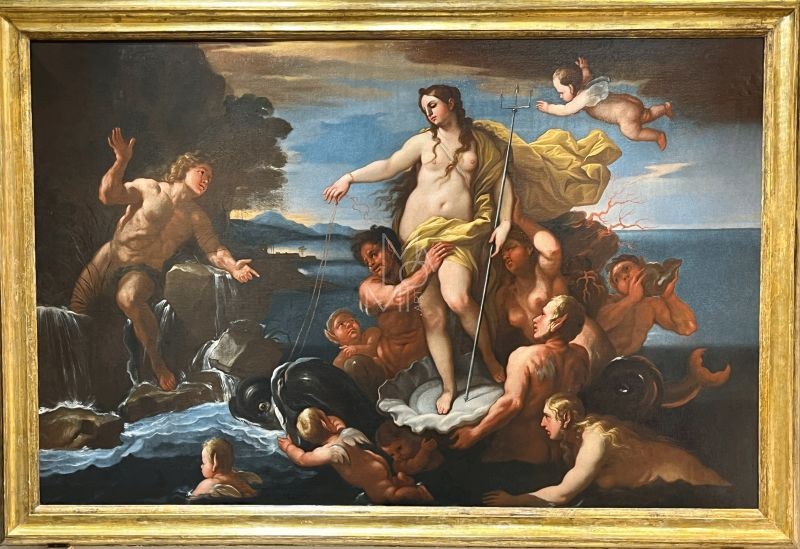
The narrative unfolds against a background characterized by a dark gulf and an overcast sky, while the foreground welcomes putti and sea creatures amidst the deep, rolling waves. The canvas is orchestrated around a complex, undulating, and ascending rhythm that mimics the swell of marine currents, imbuing the scene with a distinctly musical cadence.
At the exact center of the composition, on the right register, stands the radiant figure of Galatea, cast as the sovereign divinity of the seas. Her pearlescent flesh gleams in stark contrast against the dark tones of the surrounding waters as she reclines sinuously atop a monumental silver scallop shell, explicitly evoking the classical iconography of the Birth of Venus. With her right hand, she guides a slender, flexible rein to govern the unseen marine creatures pulling her chariot. Behind her, a sumptuous, golden-yellow drapery billows in the wind like a sacred sail, heightening the theatrical and monumental dynamism of her posture.
On the left register, the young Acis is depicted semi-nude, resting on dark rocks lapped by cascading streams of freshwater. His right arm is raised in a theatrical gesture of adoration toward the Nereid, establishing a powerful visual and emotional diagonal that spans the entire canvas, acting as the sentimental anchor of the composition.
Surrounding the lovers, both in the background and foreground, is a magnificent marine thiasus teeming with muscular tritons, sensuous nymphs, and winged putti darting through the frothing waves. Of particular plastic vigor is the triton on the right, captured in the act of blowing into a large, twisted conch shell (used as a buccina), sounding the ideal triumphant soundtrack for this pagan apotheosis.
- The workshop of Luca Giordano and the painterly agency of Giuseppe Simonelli
The shared attribution proposed by Pacelli requires an examination of the sophisticated production mechanisms of Luca Giordano's (1634–1705) workshop—a veritable global artistic enterprise capable of supplying the primary courts of Europe through high-caliber collaboration [p. 93, fig. 144]. Celebrated across the continent as "Luca Fa Presto" due to his astonishing executive speed, Giordano trained a select group of talents who mastered his compositional style.
Within this versatile artistic ecosystem, different stylistic expressions flourished: Paolo De Matteis championed the more classicist and academic line; Francesco De Mura was destined to transition the style toward the proto-Arcadian elegance of the eighteenth century; and Giuseppe Simonelli operated as the master's chief executive and trusted continuator of the Giordanesque idiom.
The role of Giuseppe Simonelli
Giuseppe Simonelli was undoubtedly the most faithful and technically aligned of Luca Giordano’s pupils. Entering the master’s circle at a young age, he specialized in scaling up Giordano’s bozzetti (oil sketches) and executing large-scale public and private teleri.
The definitive turning point in his career arrived in 1692, when Luca Giordano departed Naples for Madrid to serve as court painter to Charles II. Giordano entrusted the management of the Neapolitan workshop and the completion of its most prestigious unfinished commissions to Simonelli. Inheriting the master’s preparatory cartoons, drawings, and studio secrets, Simonelli successfully sustained this grand Baroque idiom well into the first decade of the eighteenth century.
Comparative stylistic analysis
Connoisseurial analysis of this Acis and Galatea reveals a seamless synthesis between Giordano’s invention and Simonelli’s robust execution:
- Compositional prototypes: When compared to Giordano’s fully autograph Triumph of Galatea in the Gallerie degli Uffizi, or the variant in the Devonshire Collection at Chatsworth, the erect, fluid posture of Galatea and the positioning of Acis upon the rocks demonstrate absolute fidelity to the master’s templates.
- Simonelli's distinctive handwriting: In contrast to the airy, fluid, and almost transparent di tocco (painterly touch) characteristic of Giordano’s late period, Simonelli introduces a denser, more material paint application and a considerably firmer graphic draftsmanship. The powerful musculature of the tritons and the deep chiaroscuro enveloping the background betray the enduring impact of Jusepe de Ribera's naturalism. This tenebrist undercurrent remained a core component of Simonelli’s technique, even as he modernized his palette to accommodate the luminous and festive tones of his master.
- Reconstruction of historical provenance and collecting history
The exceptional, monumental scale of the canvas rules out the possibility of it being produced for the open art market or for a generic devotional setting. Instead, it points directly to an important allogazione (direct commission) designed for the staterooms (porteghi) of the highest ranks of the viceregal aristocracy, such as the Carafa di Maddaloni, the Caracciolo, or the Borromeo families.
The historical trajectory of the painting began with this prestigious noble commission for a patrician Neapolitan palazzo between 1690 and 1700. Subsequently, throughout the eighteenth and nineteenth centuries, the work remained preserved through the strict hereditary entails of the fidecommesso within the family's private gallery. This exceptional stability ultimately led to its rediscovery and scientific publication by Vincenzo Pacelli in 2001, prior to its current re-emergence onto the high-level international antiquarian market.
As Pacelli expertly observed, many of these grand secular compositions executed by Simonelli for private galleries went unrecorded in eighteenth-century historical guidebooks (such as Bernardo De Dominici’s Vite), because early biographers focused almost exclusively on public art housed in churches [p. 93, fig. 144].
The work remained jealously preserved within a single Neapolitan private collection for centuries, protected from the market by strict hereditary entails. This long-term domestic stability shielded the painting from the Napoleonic requisitions and nineteenth-century wartime dispersals that shattered most contemporary collections. This historical preservation is the sole reason for the miraculous survival of the canvas within its original structural woodwork.
- Connoisseurial and technical analysis of the coeval frame
The Baroque frame in carved and gilded wood is both an autonomous work of sculpture and a technical document of paramount antiquarian importance.
Structural characteristics
The frame conforms structurally to the canonical Neapolitan cassetta type of the late seventeenth century. Its profile presents a rigorous architectural articulation defined by alternating convex bands (tori) and concave moldings (gole / ogees). This specific inward-sloping splay served a precise spatial and illusionistic function: it acted as a visual telescope, thrusting the viewer’s eye deep into the marine perspective and enhancing the trompe-l'œil dissolution of the gallery wall.
Carving and water gilding
The plastic decoration features continuous hand-carved stylized acanthus leaves and expansive scrollwork motifs (cartocci) along the intermediate profiles. The crisp, nervous energy of this wood carving runs parallel to the fluid, rolling waves painted by Simonelli on the canvas.
The surface finish utilizes the sophisticated technique of water gilding (doratura a guazzo):
- The bole ground: Beneath the precious metal leaf lies a layer of natural clay known as red Armenian bole. Where centuries of gentle, natural wear have softened the surface, this warm, reddish undertone peeks through, imbuing the gilding with a rich chromatic depth.
- The gold leaf: The genuine gold leaf was meticulously finished by alternating areas burnished with agate stone (rendering them mirror-bright) with passages left entirely matte. In seventeenth-century staterooms, lit solely by the flickering flames of candles, this varied treatment caused the light to shatter irregularly across the surface. This play of light mirrored the painted surfaces of Acis and Galatea, creating a dynamic, shimmering scenography that made the painted sea appear alive.
- Critical conclusion
In conclusion, this Acis and Galatea stands as a work of absolute museum-grade importance. The flawless convergence of Luca Giordano’s compositional genius, Giuseppe Simonelli’s robust executive execution, the impeccable philological pedigree established by Vincenzo Pacelli, and the magnificent, untouched integrity of its coeval frame elevates this lot to a position of primary significance within the visual culture of the Neapolitan High Baroque [p. 93, fig. 144].