Rape of Europa by Giacomo del Po | Neapolitan Baroque Painting
Explore the Rape of Europa oil painting attributed to Giacomo del Po. A masterwork of late Neapolitan Baroque transitioning into Rococo style.
Between classicism and rococo visionariness: the rape of europa by Giacomo del Po
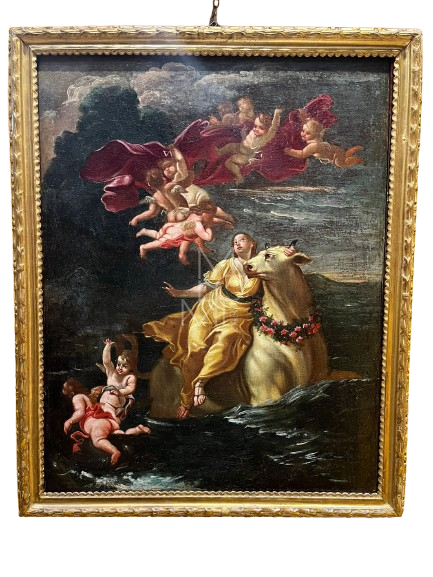
The work under analysis, an elegant oil on canvas measuring 68 by 82.5 centimeters enclosed within a splendid coeval frame, depicts the famous mythological episode of the Rape of Europa. From a historico-critical perspective, the canvas fully belongs to the production of the late Neapolitan Baroque, positioned at that crucial moment of formal transition where the grandiose Baroque rhetoric, dominated by the epic legacy of Luca Giordano, began to dissolve into the earliest, refined, and iridescent sensibilities of the Rococo. The prestigious attribution to Giacomo del Po, a painter and engraver born in Palermo in 1654 and active in Naples until his death in 1726, places this painting at the center of a fascinating stylistic crossroads. Del Po was an artist of a singular and complex personality, raised in Rome under the aegis of strong classicist matrices transmitted to him by his father Pietro, who was himself a close collaborator of Domenichino and a major popularizer of Nicolas Poussin's intellectual poetics. Curiously, contemporary historiography records that Giacomo maintained a formal connection with the Roman art scene for a long time, to the extent that he was elected a member of the Accademia di San Luca in 1674, where he even held the unusual and rigorous post of professor of anatomy.
Upon his arrival in Naples, however, the impact of the vibrant local school prompted him to radically overhaul his palette. He abandoned the severe capitoline composure to embrace an incredibly free, at times oneiric and visionary pictorial handling. Distancing himself from the plastic and sculptural naturalism that characterized the work of Francesco Solimena—his great rival on the Neapolitan art scene—during those same years, Del Po favored a highly cultured and exquisitely theatrical decorativism. A subtle yet fierce competition for the patronage of the great patrician families always existed between the two masters. While Solimena embodied the institutional solidity and chiaroscuro grandiosity of the High Baroque, Del Po was sought after by the most up-to-date nobility specifically for his ability to transform palace walls into aerial, dreamlike visions, earning himself a reputation as an eccentric and sophisticated intellectual.
Literary sources and iconography of the myth
The subject matter of the painting roots itself deeply in secular classical literature, finding its primary source in the second book of Ovid's Metamorphoses. The Latin poet narrates the astute deception devised by Jupiter who, having fallen madly in love with the Phoenician princess Europa, daughter of King Agenore, decided to transform himself into a docile white bull. Mingling with the royal herds grazing upon the shore, the god succeeded in winning the maiden's trust; unaware of the danger, she allowed herself to be seduced by the animal’s extraordinary gentleness. The composition captures with great intensity the dramatic climax of the narrative: the exact moment when Europa, trusting and almost playful, climbs onto the back of the bovine, which suddenly plunges into the sea waves to abduct her and carry her away toward the island of Crete.
Alongside Ovidian philology, art criticism recognizes in this canvas a clear iconographic contamination derived from Agnolo Poliziano's Stanze per la giostra. This celebrated Renaissance text had strongly codified the lyrical delicacy and formal idyll of this specific ancient fable, transforming it into one of the most beloved subjects among European courts. A minor historical anecdote regarding the fortune of this myth concerns how Baroque painters projected the customs of their own time onto it: in early eighteenth-century Naples, noblewomen frequently enjoyed being portrayed as or identifying with the guise of Europa, viewing her not so much as the victim of an abduction, but rather as a triumphant figure chosen by the king of gods to give her name to the entire Western continent.
Formal analysis, compositional structure, and pictorial style
The visual and expressive barycenter of the painting is entirely occupied by the monumental yet sinuous figure of Europa, enveloped in a sumptuous robe of warm golden-yellow and ochre tones. The maiden is caught in a dynamic pose governed by a calibrated rhetorical grace: while her left arm firmly clasps the bull’s horn, her right hand is raised in a gesture of controlled surprise, devoid of genuine terror and closer to an aristocratic astonishment. The bovine, whose cream-colored fur reflects the light, appears tame and adorned with a thick garland of roses—a crucial iconographic detail. The rose, preeminently the sacred flower of Venus, visually expresses the concept that love can strip even the most savage creature of its ferocity, although the latent presence of thorns alludes to the ambivalent nature of pleasure, which carries within itself the seed of separation and nostalgia.
The composition of space is distinguished by an accentuated verticality and a skillful articulation of planes that guides the viewer's gaze through an ascending narrative. The upper register is dominated by a dense crown of putti and winged cupids hovering in the tempestuous sky. They support a wide and scenic purple silk drapery, a theatrical device that functions as a true Baroque wing. This floating fabric does not serve a merely ornamental purpose, but rather symbolizes the intervention of fate or divine wind guiding human affairs. The chromatic warmth of the purple ignites in sharp contrast with the dark background of the woods behind. In the lower register, conversely, the churning of the marine waters unfolds, populated on the lower left by small infant tritons riding the waves, emphasizing the agitation of the maritime journey and demonstrating how even the chaotic element of the ocean docilely bends to the divine will.
The executivant technique refers unmistakably to Giacomo del Po's maturity, characterized by that vibrant, at times frayed luminism that was widely praised by the biographer Bernardo De Dominici in his famous Vite de' pittori, scultori ed architetti napoletani of 1742. The application proceeds via rapid, nervous, and sketchy touches; the bodies of the putti and the consistency of the clouds reveal an ethereal, almost transparent quality where light does not plastically define volumes but rather dissolves them into sudden flashes and iridescent luminescences, effectively anticipating the aesthetic solutions of contemporary French painting.
Stylistic comparison with neapolitan mythological frescoes
To corroborate the assignment of this work to the master's catalogue, it is extremely fruitful to institute a tight and direct comparison with the large decorative fresco cycles executed by Del Po for the Parthenopean aristocracy, particularly those within Palazzo Caracciolo di Avellino, Palazzo Cellamare, and Palazzo Casamassima. Within the halls of Palazzo Caracciolo di Avellino, the artist found himself tasked with decorating environments that were originally low and gloomy; he resolved this structural constraint with an ingenious eccentricity, illusionistically shattering the vaults by projecting aerial and swirling compositions entirely akin to the crown of putti visible in this canvas.
An engaging anecdote tied to these noble building sites concerns Del Po’s legendary speed of execution, a characteristic the artist shared with the great Luca Giordano, who was not coincidentally nicknamed "Luca fa presto" (Luca finishes fast). Modern restorations conducted upon his mural surfaces have confirmed that the painter worked upon the fresh plaster with astonishing speed, applying color directly without almost ever resorting to detailed preparatory drawings on the wall. This sketchy shorthand, synthetically defined as painting "di tocco" (by touch), is faithfully reflected in our Rape of Europa through the compendious treatment of the waves and clouds. The physiognomies of the faces, with large eyes raised upward and mouths slightly parted in an idealized expression, are perfectly matchable with the divinites inhabiting the ceilings of Neapolitan patrician residences, stamping the work as a typical and highly sought-after cabinet painting destined for the private gallery of a cultured member of the viceregal nobility.
State of conservation and analysis of the pictorial film
From a close visual inspection of the surface, the painting presents itself in a generally good state of conservation, displaying the natural and fascinating signs of the passage of time. The canvas exhibits stable planarity and tension, attributable to an old lining intervention presumably carried out between twentieth centuries—an operation that allowed the original support to be preserved. Across the pictorial film, a widespread and homogeneous age craquelure is visible, a dense mesh of micro-fractures particularly traceable in the areas of lighter impasto, such as the bull's coat or the princess's complexion. This pattern of the craquelure is an excellent indicator of authenticity, as it testifies to the natural drying process of the oil binders over the centuries.
Furthermore, a widespread yellowing of the superficial protective varnishes is observable—a completely physiological phenomenon due to the oxidation of natural resins applied during past restorations. This oxidized layer acts as a light, warm filter which, while softening the original coldness of the blues in the sky and sea, simultaneously enhances the golden tones of the dress and the foliage. Certain shadow areas, especially in the landscape passages on the left, appear partially closed or affected by ancient protective patinas built up over time.
Study of the frame typology and artisanal provenance
The frame enclosing the painting constitutes an element of remarkable documentary significance, as it can be considered coeval with the canvas and pertinent to the same area of production. Carving analysis reveals features typical of early eighteenth-century central-southern Italian craftsmanship, heavily influenced by the heights of the Neapolitan Barocchetto. The structure presents a slender box-like profile, punctuated by a succession of moldings sloping inward. The outer perimeter edge is enriched by a motif of stylized leaves and small gadroons carved into the wood, creating a vibrant play of chiaroscuro. The inner rabbet, in direct contact with the canvas, displays instead a refined smooth cove molding interrupted by a profile of dense grooves—a workmanship known as godronatura, widely diffused among the workshops of master gilders active in Naples between the era of Luca Giordano and the early eighteenth century.
The gilding, executed in pure gold leaf using the traditional water-gilding technique, rests upon a preparation of Armenian bole, whose typical reddish tone evocatively surfaces at points of greater wear along the sharp edges. The very slight losses of the gesso preparation and minor gaps in the gold do not disturb the aesthetic appreciation of the whole; rather, they represent a precious certification of historicity, ruling out modern alterations or invasive regilding interventions. In the ceremonial furnishings of the period, the frame was not a mere accessory, but was commissioned alongside the painting to function as a plastic extension of the work's expressive space.
The theater of private power: the flourish of viceregal and patrician patronage for Giacomo del Po
To fully comprehend the critical and commercial fortune of a work such as the Rape of Europa, one must immerse oneself within the dense social fabric of viceregal Naples between the late seventeenth century and the first three decades of the eighteenth century. In this specific historical juncture, the city experienced the traumatic transition from centuries of Spanish Habsburg rule to that of the Austrian Habsburgs in 1707. This political shift was not a mere rotation of viceroys, but sparked a true cultural and stylistic revolution within the local aristocracy. The ancient families of the Neapolitan patriciate and the rising noblesse de robe—enriched by bureaucratic offices—engaged in a tight competition for social prestige, which was fought through architectural renovations and colossal decorative campaigns within their palaces. In this theater of ostentation, Giacomo del Po rapidly became one of the most contested and beloved artists by a specific wing of patronage: the most cultured, intellectual one, desirous of breaking away from the monumental and severe Iberian taste to embrace the aerial, uninhibited novelty arriving from France and the rest of Europe.
Among the noble houses that manifested a genuine predilection for Del Po’s visionary style, the Caracciolo di Avellino family undoubtedly stands out. Marino Francesco Caracciolo, Prince of Avellino and a grand aristocrat embedded within international diplomatic circuits, entrusted the painter with the decoration of the rooms of his monumental palace. The Caracciolo family desired an art that would celebrate their lineage through sophisticated cosmological allegories, yet simultaneously demanded a style of painting that would lighten the imposing environments of the residence. Del Po, with his sketch-like handling and caging palette, answered this need perfectly, creating ceilings where gods soared within infinite skies. Another crucial connection was with the family of the Dukes of Maddaloni, the Carafa, famous for their lavish and updated mecenatismo. Within their picture galleries and salons, Giacomo del Po’s mythological cabinet pieces—precisely like the Rape of Europa under examination—found an ideal placement alongside masterpieces of the High Baroque, serving as a disruptive element thanks to their extraordinary chromatic modernity.
An illuminating anecdote, recorded in the chronicles of the time, recounts how even the Austrian viceroys themselves, arriving in Naples with tastes heavily influenced by the imperial Baroque of Vienna, were captivated by Del Po’s inventions. Figures like the Count of Daun or the famous Prince Emanuele di Savoia, a highly refined collector, appreciated within the painter's cabinet formats that freedom of invention and lyrical classicism which recalled the works of Poussin, but reinterpreted with the verve and light of the Gulf of Naples. Patrician families competed to obtain small secular mythological paintings from him, often commissioned on the occasion of marriages or major dynastic alliances. In such contexts, the myth of the abduction of a princess to found a divine lineage, decorated with nuptial garlands and escorted by triumphs of putti, was not merely a piece of high decoration, but an explicit manifesto of goodwill, legitimation, and noble prestige. To own a "Del Po" meant, for a viceregal noble, to declare oneself aesthetically avant-garde, preferring the whim and lightness of a European-inspired painting to the solid and predictable local tradition.
Explanatory Notes and Bibliographical Orientation
To achieve a comprehensive understanding of Giacomo del Po’s intricate artistic profile and the flourishing of mythological painting in Naples, it is indispensable to consult both period sources and the most authoritative twentieth-century historiographical literature. Beyond the previously cited Vite by Bernardo De Dominici—a foundational text for understanding the eighteenth-century critical reception of painting "di tocco" (by touch)—an essential milestone is represented by Nicola Spinosa’s monumental study, Pittura napoletana del Settecento: dal Barocco al Rococò (published by Electa in 1986). Within this volume, Spinosa thoroughly dissects the formal transition carried out by Del Po and his contemporaries toward a more aerial and decorative aesthetic sensibility.
For direct comparisons with ceremonial grand-manner painting and mythological bozzetti (oil sketches), the catalogue edited by Nicola Spinosa, I dipinti di Capodimonte (published in Naples in 2006), proves invaluable, as it preserves highly significant modelletti by the artist. Further specialized contributions concerning the evolution of the Rococo style and the decoration of patrician residences are due to S. Pinto, with the essay Giacomo del Po e la decorazione tardobarocca a Napoli (published in the journal «Prospettiva» in 1983), and to A. d'Aniello. The latter's study, Giacomo del Po: aperture rococò nella pittura napoletana tra Sei e Settecento (published in 2011), precisely analyzes the dissolution of form enacted by the painter through the manipulation of light, thereby confirming his role as a pivotal conduit of the Neapolitan school toward the most refined elegances of the European eighteenth century.
Bibliographical References / Fonti Bibliografiche
- De Dominici, B., Vite de' pittori, scultori ed architetti napoletani, Tomo III, Napoli, 1743.
- Spinosa, N., Pittura napoletana del Settecento: dal Barocco al Rococò, Vol. I, Electa, Milano, 1986.
- Causa, R., La pittura del Seicento a Napoli. Dal naturalismo al barocco, in Storia di Napoli, Cava de' Tirreni, 1972.
- Pinto, S., Giacomo del Po e la decorazione tardobarocca a Napoli, in «Prospettiva», n. 32, 1983.
- d'Aniello, A., Giacomo del Po: aperture rococò nella pittura napoletana tra Sei e Settecento, in «Ricerche sul Sei-Settecento in Italia», Paparo Editori, Napoli, 2011.
- Spinosa, N. (ed.), I dipinti di Capodimonte. La scuola napoletana, Electa, Napoli, 2006.